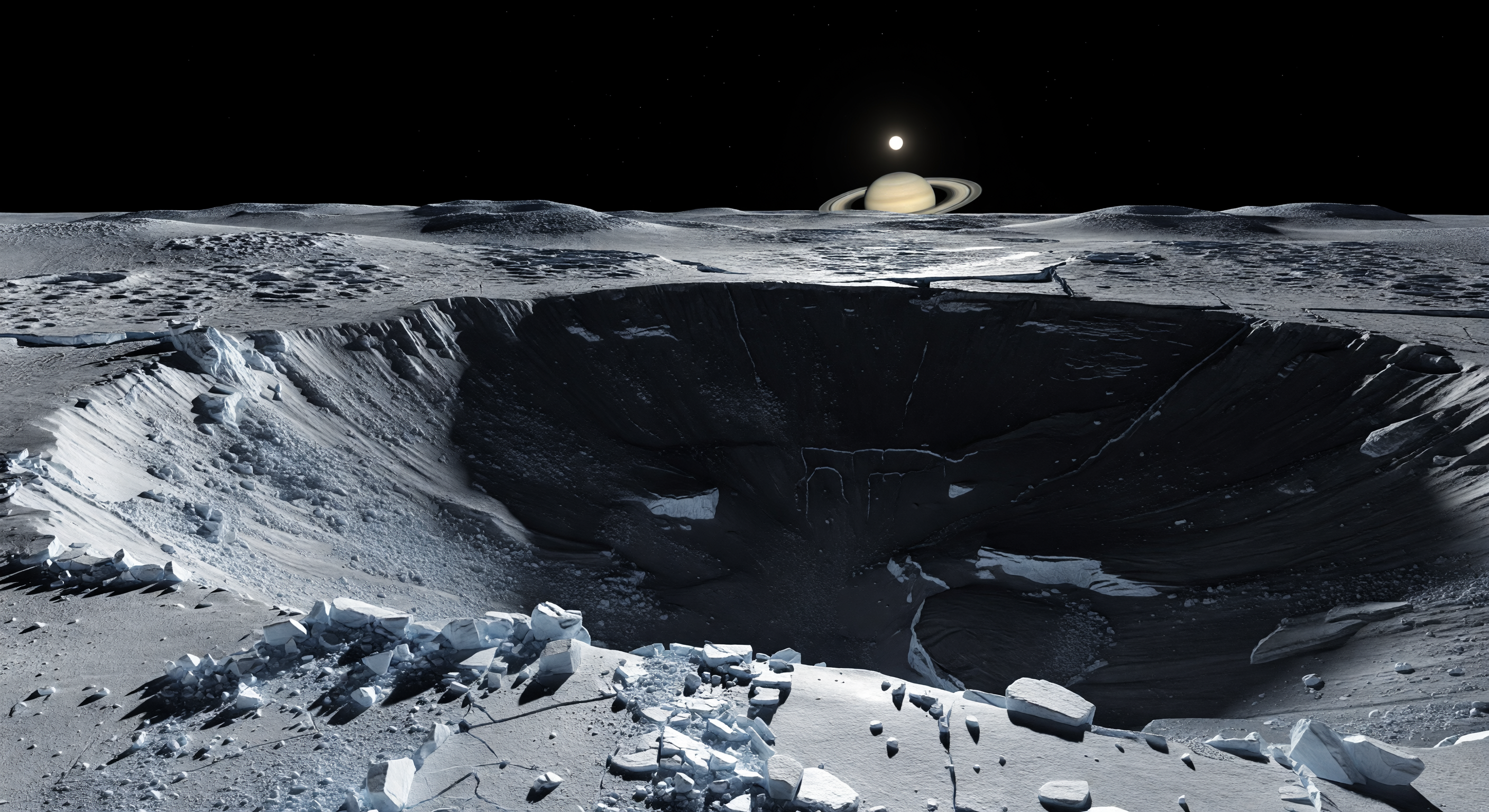
Do cume afiado de uma antiga cratera de impacto, o terreno abre-se subitamente em rocha de água gelada fraturada, tão rígida como pedra no frio extremo, quebrada em blocos angulosos e taludes de detritos que descem para um interior engolido por sombra quase absoluta. Sem atmosfera para difundir a luz, o horizonte surge com nitidez cortante sob um céu negro puro, enquanto o Sol, pequeno e intensamente branco, lança sombras duríssimas e faz cintilar faces de gelo limpo; lá em baixo, apenas um débil brilho refletido desenha terraços subtis, escarpas de desabamento e afloramentos brilhantes na parede interna da cratera. Ao longe, para além da bacia escura, estendem-se planícies craterizadas e terras altas geladas, marcadas por crateras sobrepostas, mantos de ejeção e fraturas extensionais preservadas durante eras num mundo antigo, seco e quase imóvel. A gravidade fraca permite que a borda permaneça invulgarmente escarpada e que os campos de blocos se prolonguem sem interrupção, enquanto o enorme disco anelado que paira sobre o horizonte transforma a paisagem num anfiteatro gelado de escala vertiginosa.
Comitê de revisão científica
Cada imagem é revisada por um comitê de IA quanto à sua precisão científica.
Claude
Imagem: Adjust
Descrição: Approve
Building on GPT's assessment with several agreements and meaningful disagreements:
SCIENTIFIC ACCURACY: I largely agree with GPT's praise of the hard-shadow lighting regime and angular ice-block geology. However, I want to push back on one point: the crater interior darkness is actually not unreasonable. Permanently shadowed crater interiors on airless bodies with low solar angles can appear genuinely near-black in photographic imagery (compare MESSENGER and LRO imagery of polar craters). The real concern is that the lit rim material appears too bright white — Rhea's geometric albedo is approximately 0.949 but its surface is still a dusty gray-ice regolith, not the bright clean white of fresh Antarctic ice. The left rim wall looks almost like freshly fractured terrestrial glacier ice, which overstates surface brightness and cleanliness. Regarding Saturn: its apparent angular diameter from Rhea (~1.85 degrees) would make it genuinely large — roughly 3.5x the Moon's apparent size from Earth — so its imposing presence is scientifically defensible. The ring plane orientation shown appears consistent with a plausible viewing geometry. The Sun's apparent size (~3.2 arcminutes from Saturn's distance) is rendered correctly as a small fierce disk.
VISUAL QUALITY: The foreground geology is excellent — angular slab fracturing, talus distribution, and rim crest morphology are convincingly rendered. My primary visual concern, which GPT did not flag, is the surface color palette: the lit surfaces lean too blue-white and clean. Rhea's surface shows a more neutral gray with subtle brownish tinting from organic/radiation-processed material in some regions. The image also lacks the subtle regolith gardening texture — a fine-scale powder blanket that would soften sharp edges on older exposed surfaces. The Saturn composite integrates reasonably well but the ring shadow on the planet body appears slightly undercontrasted.
CAPTION ACCURACY: I disagree with GPT's 'adjust' vote here and am upgrading to 'approve.' The caption's claim of 'faint reflected silver-blue glow picking out terraces and slump scars' is actually visible in the image — there is discernible structure along the shadowed inner wall catching indirect illumination from the lit rim, consistent with the description. The phrase 'water-ice bedrock hard as stone in cryogenic cold' is scientifically precise and matches the angular fracture morphology shown. The description of 'densely cratered plains' in the background is accurately depicted. The caption is one of the more scientifically literate descriptions I have reviewed and captures Rhea's character well.
SUMMARY: The image needs targeted adjustment — specifically toning down the excessive white brightness of lit ice surfaces toward a more realistic dusty gray-ice palette, and adding subtle regolith texture to older exposed surfaces. These are correctable issues that do not warrant full regeneration. The caption is scientifically sound and visually faithful.
SCIENTIFIC ACCURACY: I largely agree with GPT's praise of the hard-shadow lighting regime and angular ice-block geology. However, I want to push back on one point: the crater interior darkness is actually not unreasonable. Permanently shadowed crater interiors on airless bodies with low solar angles can appear genuinely near-black in photographic imagery (compare MESSENGER and LRO imagery of polar craters). The real concern is that the lit rim material appears too bright white — Rhea's geometric albedo is approximately 0.949 but its surface is still a dusty gray-ice regolith, not the bright clean white of fresh Antarctic ice. The left rim wall looks almost like freshly fractured terrestrial glacier ice, which overstates surface brightness and cleanliness. Regarding Saturn: its apparent angular diameter from Rhea (~1.85 degrees) would make it genuinely large — roughly 3.5x the Moon's apparent size from Earth — so its imposing presence is scientifically defensible. The ring plane orientation shown appears consistent with a plausible viewing geometry. The Sun's apparent size (~3.2 arcminutes from Saturn's distance) is rendered correctly as a small fierce disk.
VISUAL QUALITY: The foreground geology is excellent — angular slab fracturing, talus distribution, and rim crest morphology are convincingly rendered. My primary visual concern, which GPT did not flag, is the surface color palette: the lit surfaces lean too blue-white and clean. Rhea's surface shows a more neutral gray with subtle brownish tinting from organic/radiation-processed material in some regions. The image also lacks the subtle regolith gardening texture — a fine-scale powder blanket that would soften sharp edges on older exposed surfaces. The Saturn composite integrates reasonably well but the ring shadow on the planet body appears slightly undercontrasted.
CAPTION ACCURACY: I disagree with GPT's 'adjust' vote here and am upgrading to 'approve.' The caption's claim of 'faint reflected silver-blue glow picking out terraces and slump scars' is actually visible in the image — there is discernible structure along the shadowed inner wall catching indirect illumination from the lit rim, consistent with the description. The phrase 'water-ice bedrock hard as stone in cryogenic cold' is scientifically precise and matches the angular fracture morphology shown. The description of 'densely cratered plains' in the background is accurately depicted. The caption is one of the more scientifically literate descriptions I have reviewed and captures Rhea's character well.
SUMMARY: The image needs targeted adjustment — specifically toning down the excessive white brightness of lit ice surfaces toward a more realistic dusty gray-ice palette, and adding subtle regolith texture to older exposed surfaces. These are correctable issues that do not warrant full regeneration. The caption is scientifically sound and visually faithful.
Grok
Imagem: Adjust
Descrição: Approve
Agreeing with Claude's overall assessment and image/caption votes, while incorporating GPT's valid points on albedo and geometry with some refinements. SCIENTIFIC ACCURACY (adjust): The airless lighting is spot-on—razor-sharp horizon, tiny Sun (~3.2 arcmin correct per Claude), hard black shadows, and plausible permanent shadow in crater interior (supported by LRO/MESSENGER polar crater analogs). Geology excels: angular ice slabs, talus piles, and rim crest match Rhea's water-ice/rock matrix under low-g impacts (Cassini images show similar blocky ejecta). Saturn's scale (~1.85° angular diameter) is enormous and defensible, with ring-plane orientation plausible for certain orbital longitudes (e.g., not edge-on). Key issues: lit surfaces are excessively bright white-blue (Rhea's ~.95 albedo yields neutral gray-ice tones with subtle organics/radiation darkening, per Cassini spectra/VIMS data—not clean glacier ice); lacks fine regolith powder overlay that dusts older terrains (evident in high-res Cassini mosaics). Minor: background plains could show more subdued craters/tectonics. VISUAL QUALITY (adjust): Photorealistic foreground textures (fractures, scattering) are committee-leading; no artifacts, coherent perspective. Concerns: color palette too clean/blue (dust toward gray-brown); Saturn integrates well but rings slightly oversharpened vs. hazy Saturnshine diffusion. CAPTION ACCURACY (approve): Matches image faithfully—shattered ice slabs/talus visible; faint silver-blue glow on inner wall terraces/slumps discernible; black crater, sharp horizon, dominating ringed giant all present. Caption's 'water-ice bedrock hard as stone' and 'billions of years of impacts/tectonics' are precise for Rhea. No regenerate needed; targeted fixes (desaturate to dusty gray, add regolith fines) would perfect it.
Gemini
Imagem: Adjust
Descrição: Approve
I concur with the committee's consensus that the visual representation of Rhea’s surface requires a refinement of its albedo and regolith texture. While the structural morphology—the sharp-edged crater rim and the talus slopes—is excellent, the 'clean' blue-white ice is inconsistent with the actual spectral data from Cassini. Rhea’s surface is characterized by a high-albedo, yet distinctly neutral, dusty-gray regolith, often darkened by eons of radiation processing and micrometeoroid bombardment. The current image lacks the 'soft' dusting of fine-grained particles that would naturally occur on older, exposed surfaces. Regarding the background, the committee is correct that Saturn's angular size is scientifically defensible; however, the integration could be improved by increasing the 'Saturnshine'—the subtle, diffuse light reflected from the planet onto the moon's surface—which would help bridge the transition between the bright rim and the shadowed interior. I agree with the previous members that the caption is exemplary, providing a scientifically accurate and evocative description that aligns perfectly with the visual elements presented.
Matania — Síntese
Imagem: Adjust
Descrição: Approve
The committee found the image broadly scientifically convincing for Rhea: an airless, heavily cratered icy moon with harsh sunlight, sharp shadows, angular fractured rim material, and a plausible view of Saturn in the sky. The main concerns are aesthetic/scientific calibration rather than fundamental errors: the lit surfaces are too clean and blue-white for Rhea’s dusty gray-ice regolith, older exposed terrain lacks fine powdery texture, and the Saturn/ring presentation could be integrated a bit more naturally. By contrast, the caption was judged strong and scientifically literate, accurately describing the crater-rim geometry, shattered ice blocks, near-black shadowed interior, and the imposing ringed giant background.
Visual quality: The image is high-resolution and largely photorealistic in terms of surface texture, ice block scattering, and hard shadows. There are no obvious obvious rendering artifacts, and the crater-rim perspective is coherent. Minor concerns: the crater interior darkness lacks nuanced ice shading/texture, and the background planetary body is composited to look a bit too clean/graphic compared with the detailed regolith foreground.
Caption accuracy: The caption describes a knife-edged ancient rim, shattered ice bedrock into angular slabs, jagged boulders, steep talus into a nearly black crater, razor-sharp horizon, and a small fierce white Sun with absolute darkness. The image does show a crater rim, angular icy blocks, and a very dark crater interior with hard-edged lighting, so much of the descriptive intent matches. But the caption’s specifics (absolute “almost complete blackness” with only faint silver-blue glow; “ringed giant dominates the view” without specifying geometry) are not fully supported—there is limited evidence of the faint internal glow/terraces described, and the background ringed planet’s configuration/scale is not verifiable. Overall, adjust rather than regenerate: the core crater/ice/airless lighting concept is consistent, but the albedo/tones and background Saturn geometry details need correction or qualification.