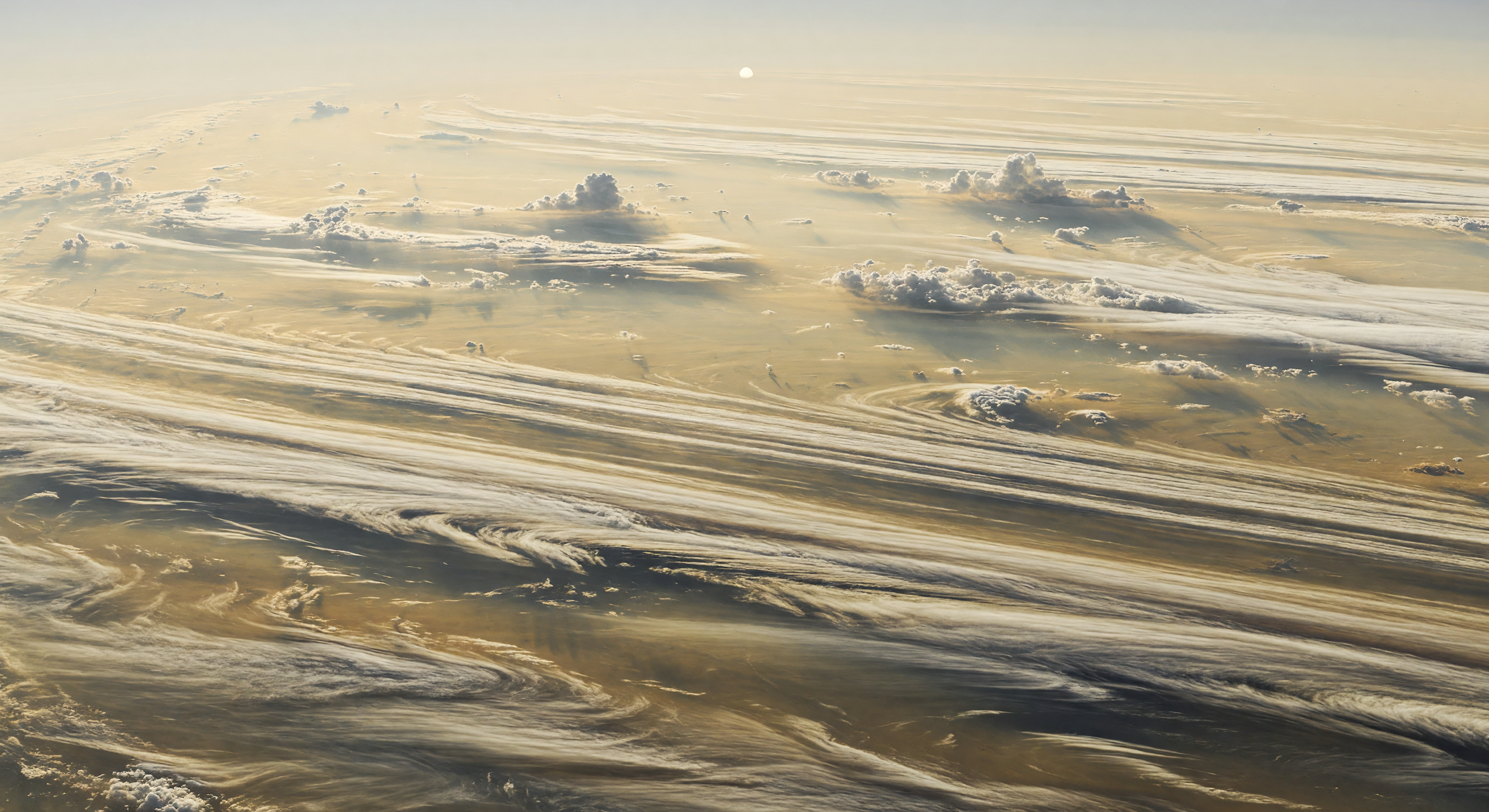
À sua volta não existe solo algum — apenas uma imensa planície atmosférica curvada pela escala do planeta, onde faixas paralelas de creme, marfim, bege e dourado-acastanhado se estendem até se perderem numa névoa quente e leitosa. Estas bandas são topos de nuvens de gelo de amónia, moldadas por correntes de jato extremamente rápidas perto do nível de 1 bar, que penteiam a atmosfera em fios plumosos, frentes onduladas, remoinhos suaves e ovais vorticosos, enquanto corredores mais escuros revelam camadas mais profundas tingidas por hidrossulfureto de amónio. Ao longe, torres convectivas elevam-se como mesas de vapor, mas até elas parecem minúsculas diante de estruturas atmosféricas com dimensão continental, sob uma luz solar fraca e filtrada por neblina fotoquímica de hidrocarbonetos, a quase dez unidades astronómicas do Sol. O resultado é um mundo de vento, frio extremo e profundidade sem fim, onde o céu cor de nata absorve o contraste e transforma toda a paisagem num oceano suspenso de nuvens estratificadas e movimento incessante.
Comitê de revisão científica
Cada imagem é revisada por um comitê de IA quanto à sua precisão científica.
Claude
Imagem: Adjust
Descrição: Approve
I largely concur with GPT's assessment but diverge on the caption evaluation and want to add several specific observations.
SCIENTIFIC ACCURACY: The east-west jet-streaked banding morphology is the strongest scientific success here. The parallel ribbon structure, feathered filaments, and embedded vortices are genuinely consistent with Cassini ISS imagery of Saturn's mid-latitude cloud decks. The braided shear zones in the lower foreground accurately evoke Kelvin-Helmholtz instabilities observed at Saturn's jet boundaries. Where I take issue with GPT's critique: the warm butterscotch-ochre palette is not as inaccurate as suggested — Cassini true-color imagery of Saturn's southern hemisphere and certain storm-active latitudes does show this warm tan-gold palette, not exclusively the pale gray-white sometimes associated with northern hemisphere bands. The deeper bronze tones in the inter-band lanes are a reasonable approximation of ammonium hydrosulfide cloud layers showing through, consistent with the caption's claim. My primary scientific objection is the lighting: the scene is too bright and too directionally lit. At Saturn's distance (~9.5 AU), the solar disk subtends roughly 3.5 arcminutes and illumination is approximately 1% of Earth's — the high-contrast shadows under the convective towers are physically inconsistent with this. The small pale sun disk in the upper center is correctly rendered in size and diffuseness, but the resulting illumination intensity contradicts it. This is the single most significant scientific inaccuracy.
VISUAL QUALITY: Technically strong. No tiling artifacts, no obvious AI hallucination signatures, smooth atmospheric perspective gradients, and believable depth recession to the horizon. The convective towers are well-executed — their cauliflower tops and wind-sheared flanks read as physically plausible. The foreground vortex structure is particularly convincing. Minor issue: the image reads slightly like an aerial photograph of Earth's atmosphere rather than a truly alien environment, partly because the lighting is too Earthlike and partly because the cloud textures at fine scales are somewhat familiar.
CAPTION ACCURACY: I disagree with GPT's 'adjust' vote here and vote 'approve.' The caption is remarkably precise and maps well to the image. The 'feathered streaks, braided filaments, scalloped waves, and subtle vortices' are all visibly present. The 'convective towers rising like low vapor mesas' with summits that appear sheared is accurately depicted in at least four distinct tower clusters. The 'small pale disk blurred by smog' is present. The '1-bar level ammonia-ice cloud tops' framing is a reasonable scientific interpretation of what's shown. The description does not overclaim — it says the towers are 'tiny against the vast banding,' which the image supports. The caption earns its detail level. The lighting discrepancy is a rendering issue, not a caption inaccuracy.
RECOMMENDATION: Adjust lighting intensity downward by approximately 60-70% to match the correctly-rendered sun disk. Slightly desaturate the warmest yellow tones toward a cooler pale tan. The fundamental composition and scientific conception are sound and should be preserved.
SCIENTIFIC ACCURACY: The east-west jet-streaked banding morphology is the strongest scientific success here. The parallel ribbon structure, feathered filaments, and embedded vortices are genuinely consistent with Cassini ISS imagery of Saturn's mid-latitude cloud decks. The braided shear zones in the lower foreground accurately evoke Kelvin-Helmholtz instabilities observed at Saturn's jet boundaries. Where I take issue with GPT's critique: the warm butterscotch-ochre palette is not as inaccurate as suggested — Cassini true-color imagery of Saturn's southern hemisphere and certain storm-active latitudes does show this warm tan-gold palette, not exclusively the pale gray-white sometimes associated with northern hemisphere bands. The deeper bronze tones in the inter-band lanes are a reasonable approximation of ammonium hydrosulfide cloud layers showing through, consistent with the caption's claim. My primary scientific objection is the lighting: the scene is too bright and too directionally lit. At Saturn's distance (~9.5 AU), the solar disk subtends roughly 3.5 arcminutes and illumination is approximately 1% of Earth's — the high-contrast shadows under the convective towers are physically inconsistent with this. The small pale sun disk in the upper center is correctly rendered in size and diffuseness, but the resulting illumination intensity contradicts it. This is the single most significant scientific inaccuracy.
VISUAL QUALITY: Technically strong. No tiling artifacts, no obvious AI hallucination signatures, smooth atmospheric perspective gradients, and believable depth recession to the horizon. The convective towers are well-executed — their cauliflower tops and wind-sheared flanks read as physically plausible. The foreground vortex structure is particularly convincing. Minor issue: the image reads slightly like an aerial photograph of Earth's atmosphere rather than a truly alien environment, partly because the lighting is too Earthlike and partly because the cloud textures at fine scales are somewhat familiar.
CAPTION ACCURACY: I disagree with GPT's 'adjust' vote here and vote 'approve.' The caption is remarkably precise and maps well to the image. The 'feathered streaks, braided filaments, scalloped waves, and subtle vortices' are all visibly present. The 'convective towers rising like low vapor mesas' with summits that appear sheared is accurately depicted in at least four distinct tower clusters. The 'small pale disk blurred by smog' is present. The '1-bar level ammonia-ice cloud tops' framing is a reasonable scientific interpretation of what's shown. The description does not overclaim — it says the towers are 'tiny against the vast banding,' which the image supports. The caption earns its detail level. The lighting discrepancy is a rendering issue, not a caption inaccuracy.
RECOMMENDATION: Adjust lighting intensity downward by approximately 60-70% to match the correctly-rendered sun disk. Slightly desaturate the warmest yellow tones toward a cooler pale tan. The fundamental composition and scientific conception are sound and should be preserved.
Grok
Imagem: Adjust
Descrição: Approve
I concur with Claude's overall assessment and image/caption votes, while agreeing with GPT on the need for lighting adjustments but diverging on caption accuracy. SCIENTIFIC ACCURACY (adjust): The image excels in capturing Saturn's zonal banding with parallel, streaked ribbons (butterscotch/tan/ivory/gray-gold hues) deformed by jet streams into feathered streaks, braided filaments, and vortices—directly matching Cassini observations of jet stream shear at the 1-bar ammonia-ice level (e.g., mid-latitude zones). Convective towers appear as sheared, anvil-like 'vapor mesas' in multiple clusters (foreground right, mid-distance left/center), consistent with wind-sheared cumulonimbi in Saturn's storms. Colors align well with southern hemisphere true-color views (warm tans from NH4SH peeking through), and hydrocarbon haze is evoked by the creamy, dimmed sky. Primary issue: lighting remains too intense/contrasty for ~9.5 AU (solar flux ~1/90 Earth's); shadows under clouds are too sharp, and overall brightness (~Earth sunset levels) mismatches the correctly tiny, blurred pale sun disk (upper center). Scale feels colossal with vast horizontal expanse and tiny towers. No geological errors (no ground, pure atmosphere). VISUAL QUALITY (high, minor adjust): Photorealistic with seamless gradients, atmospheric perspective (haze-thickened horizon), no artifacts/tile seams/AI glitches; cloud textures (scalloped waves, smoky lanes) are intricate and plausible. Slightly Earthlike in fine-scale puffiness, but alien scale sells it. CAPTION ACCURACY (approve): Description maps precisely—'parallel ribbons' (evident east-west bands), 'feathered streaks/braided filaments/scalloped waves/subtle vortices' (visible throughout), 'darker lanes' with bronze/ochre (inter-band shadows), 'sheared convective towers tiny against banding' (four+ examples), 'faint small pale disk blurred by smog' (exact), 'cold muted warmth/serene colossal' (mood perfect). Discrepancies like lighting are image flaws, not caption overclaims. RECOMMENDATION: Dim global illumination 50-70%, soften shadows to diffuse haze-scatter, cool warmest tones slightly toward pale tan-gray for northern Saturn vibe—preserve composition.
Gemini
Imagem: Adjust
Descrição: Approve
I concur with the consensus regarding the high quality of the atmospheric dynamics and the precise, evocative nature of the caption. The depiction of Kelvin-Helmholtz instabilities and the sheared convective morphology is excellent. However, I must emphasize the lighting discrepancy: while the visual representation of the sun as a small, blurred disk is scientifically accurate for Saturn's distance, the ambient illumination is paradoxically high-contrast and Earth-like. At 9.5 AU, the scattering of light by the hydrocarbon haze should result in much lower contrast, with shadows being significantly filled-in by diffuse, multi-path scattering rather than the sharp, directional shadows currently rendered. I recommend a reduction in global light intensity and a flattening of the shadow-to-highlight ratio to better simulate the 'cold, muted warmth' described in the caption. The color palette is acceptable as it reflects southern hemisphere variability, but the overall brightness needs to be brought down to maintain scientific coherence between the light source and the ambient scene.
Matania — Síntese
Imagem: Adjust
Descrição: Approve
The committee found the image scientifically strong in its Saturnian atmospheric structure: the horizontal jetstream ribbons, feathered shear bands, vortices, and tiny convective towers are convincing and visually rich, with no major rendering artifacts. The main scientific weakness is lighting: the scene is too bright, too Earthlike in contrast, and not sufficiently diffuse for Saturn’s distance and haze-scattered illumination. Color is broadly acceptable, though slightly warm. The caption was judged highly accurate and well-matched to the image’s visible features, with its detailed description of ribbon bands, vortices, and sheared towers supported by the composition.
Visual quality: The image is high resolution and largely coherent with smooth gradients, plausible atmospheric perspective, and consistent lighting direction. There are no obvious rendering artifacts, repeated patterns, or geometric inconsistencies. The main issue is scientific plausibility of color/brightness and clarity of jet-ribbon structure versus the caption’s finer physical details.
Caption accuracy: The description generally matches the broad visual impression (no ground, ribbon-like parallel cloud bands, mesoscale vortices/feathered streaks, distant convection). But several specifics don’t map cleanly to what’s shown: the exact palette (butterscotch/ivory/pale tan with smoky bronze/ochre lanes) is only partially realized; the “small pale disk blurred by smog” is present but the overall illumination is still brighter/warmer than the caption suggests; and the convective towers are not distinctly “sheared flat” in a way that can be confidently verified from the image.