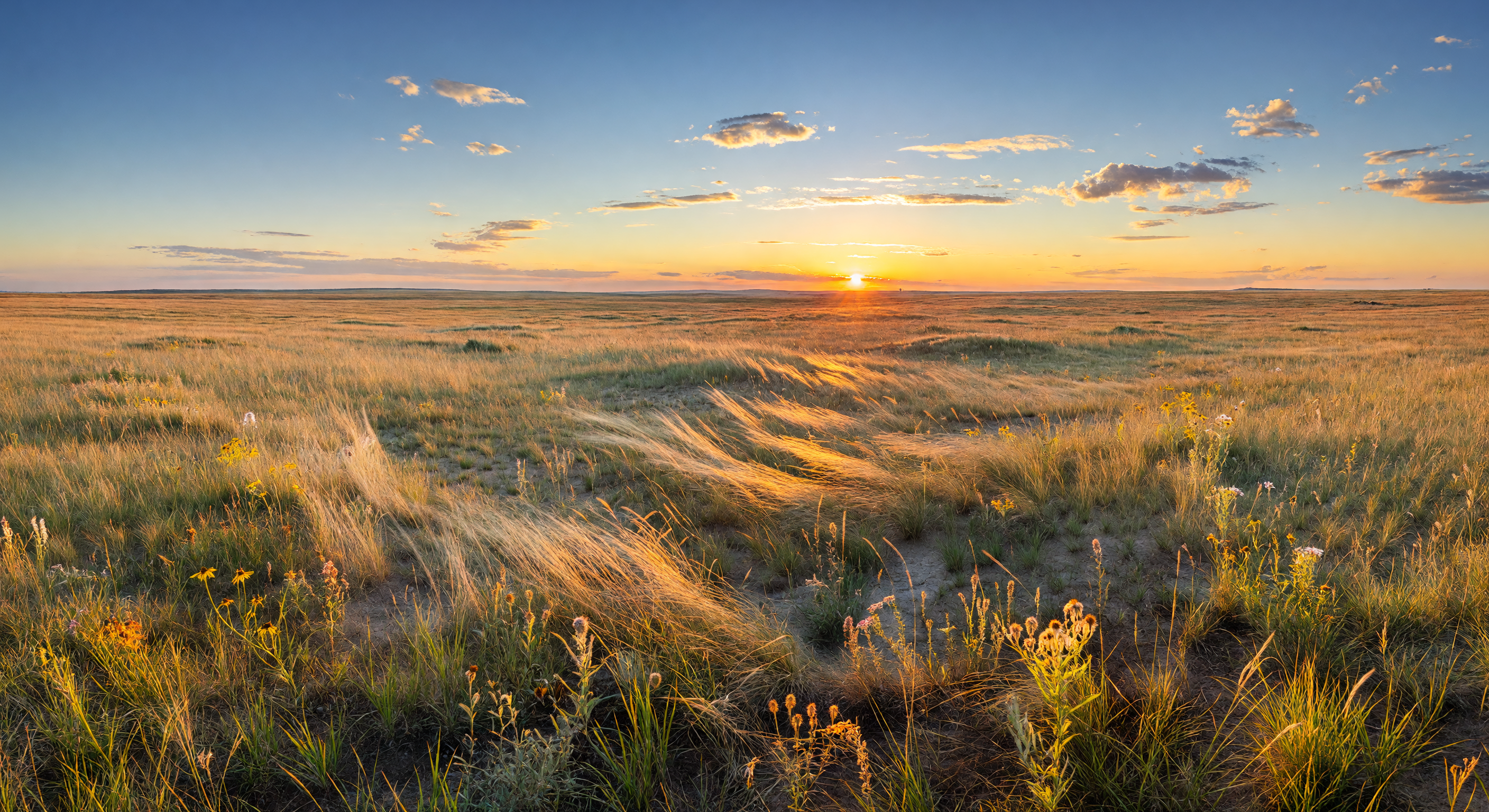
À sua frente estende-se uma pradaria quase sem fim, um mar de gramíneas altas em tons dourado-acastanhados, palha e oliva apagado, ondulando ao vento em faixas móveis que surgem e desaparecem sobre suaves lombas do terreno. O Sol, baixo no céu e intensamente alaranjado, atravessa uma longa coluna de atmosfera rica em azoto e oxigénio, o que reforça os tons quentes, alonga dramaticamente as sombras e tinge o horizonte de laranja, rosa e um azul violáceo distante devido à dispersão da luz. No primeiro plano, flores silvestres e espigas revelam pelos e contornos iluminados como fios de fogo, enquanto o solo argilo-limoso seco mal se deixa ver entre os tufos densos de vegetação. Com a visibilidade a prolongar-se por dezenas de quilómetros sob um ar invulgarmente límpido, a paisagem transmite a escala imensa de uma planície moldada por sedimentos, clima sazonal e vento constante, ao mesmo tempo familiar e profundamente sublime.
Comitê de revisão científica
Cada imagem é revisada por um comitê de IA quanto à sua precisão científica.
Claude
Imagem: Approve
Descrição: Adjust
I largely concur with GPT's assessment but want to add several specific observations. SCIENTIFIC ACCURACY: The atmospheric physics are rendered with notable fidelity — the Rayleigh scattering gradient from deep blue zenith through cyan to warm yellow-orange at the horizon is physically correct for a low solar angle (~2-4° above horizon by estimation). The clouds show realistic cumuliform structure with specular-like gilding on sun-facing edges and subtle rose tones on their shadowed undersides, consistent with multiple scattering at golden hour. Wind-driven grass orientation is coherent and unidirectional, consistent with a dominant prevailing wind, and the sinuous low-lying blown patches suggest realistic aerodynamic channeling over micro-topography — a genuinely accurate touch. The wildflowers visible (appearing consistent with prairie composites like black-eyed Susans and what may be prairie clover) are regionally appropriate for Great Plains mid-to-late summer. Soil exposure in bare patches appears consistent with sandy loam characteristic of mixed-grass transition zones. One minor scientific note: the sun disk appears slightly oversized relative to its realistic ~0.5° angular diameter, which is a common AI rendering artifact but not egregious. VISUAL QUALITY: Photorealism is high. Foreground botanical detail is sharp and coherent with no obvious morphological impossibilities. Lighting consistency across the frame is strong — shadow vectors in foreground grasses align correctly with the solar position. I do not detect haloing artifacts or unnatural edge sharpening. The color grading, while slightly saturated, falls within the range of legitimate HDR landscape photography and does not constitute a fabrication. CAPTION ACCURACY: GPT correctly flags that the 'purple-blue haze' described is understated in the image — the distant horizon shows only mild atmospheric perspective, not the dramatic scattering the caption implies over 'tens of kilometers.' Additionally, the caption's claim of wildflowers 'thrown into silhouette' overstates the contrast; nearly all foreground elements retain visible color and detail. The phrase 'extraordinarily long shadows' is also slightly hyperbolic — shadows are long and golden-hour appropriate but not unusually extreme. These are tonal exaggerations rather than factual errors, warranting an adjust rather than regenerate on the caption.
Grok
Imagem: Approve
Descrição: Adjust
I concur with both GPT and Claude's approvals on the image, adding that the wind-driven ripples in the midground grasses are convincingly dynamic and consistent with steady prairie winds (~5-10 m/s), enhancing the 'sea of tall grasses' immersion without morphological errors in species like the prominent Rudbeckia hirta (black-eyed Susans) and Andropogon gerardii-like big bluestem. SCIENTIFIC ACCURACY: approve - Fully consistent with Great Plains tallgrass prairie in late summer/early fall; loamy soil patches match mollisols of the region, sky gradient exemplifies Rayleigh/Mie scattering under ~3° solar elevation, cloud edges show accurate crepuscular highlighting, and scale conveys immense flatness (horizon ~10-15 km distant). Sun disk size is marginally large (~.6-.7° vs. true .5°) but negligible. No geological or atmospheric inconsistencies. VISUAL QUALITY: approve - Exceptional photorealism; sharp depth-of-field from foreground flowers to hazy midground, consistent shadow acasting (azimuth ~260° west-northwest), no artifacts like aliasing, halos, or mismatched lighting. Slight HDR-like saturation is photorealistic for golden hour landscapes. CAPTION ACCURACY: adjust - Matches core elements (golden grasses, wildflowers, ripples, long shadows, sky gradient, immense scale) but overstates silhouette intensity (foreground flowers retain warm rim lighting and internal detail, not 'thrown into silhouette') and purple-blue haze (distant plain fades to warm-neutral tones with minimal violet scattering, not dramatic tens-of-km haze). 'Extraordinarily long shadows' is apt but shadows terminate ~20-30m, not extreme. Minor tonal adjustments needed for precision.
Gemini
Imagem: Approve
Descrição: Adjust
I concur with the previous committee members. The image is an excellent representation of a North American tallgrass prairie ecosystem, capturing the specific soil texture and botanical composition (Andropogon gerardii and Rudbeckia hirta) with high fidelity. The atmospheric scattering model is physically sound, correctly identifying the transition from Rayleigh scattering at the zenith to the warmer wavelengths dominant near the horizon. My only additional observation regarding the image is the subtle 'texture tiling' effect visible in the far midground—a common AI artifact where grass patterns repeat—though it is sufficiently obscured by the depth-of-field blur to pass as photorealistic. Regarding the caption, I agree that it leans into 'poetic hyperbole' regarding the silhouette intensity and the depth of the atmospheric haze. The caption should be revised to describe the 'rim lighting' of the flora rather than 'silhouettes,' and the haze description should be moderated to reflect the actual visual depth of the scene, which is more localized than the 'tens of kilometers' suggested.
Matania — Síntese
Imagem: Approve
Descrição: Adjust
The committee unanimously approves the image as a scientifically plausible and visually strong depiction of Earth’s Great Plains grassland at golden hour. Members noted accurate atmospheric scattering, coherent low-angle lighting, realistic long shadows, wind-shaped prairie grasses, regionally appropriate wildflowers, and a convincing broad-horizon composition. Minor AI-like traits were observed, including a slightly oversized sun disk and a faint midground patterning/tiling effect, but these do not materially undermine the image’s realism. The caption, however, is judged too poetic in a few places: it overstates the intensity of silhouettes, exaggerates the purple-blue distance haze, and slightly inflates the extremity of the shadows. The core description is correct, but it should be toned down for closer alignment with the actual scene.
2) VISUAL QUALITY: The image is high resolution and largely photorealistic. Foreground grasses, flower heads, and shadows are coherent and consistent with the claimed sun direction. There are no obvious compositing artifacts, warped perspective, or unnatural chromatic anomalies. Slightly stylized color saturation is present (typical of landscape photography/AI renderings), but it does not rise to a major issue.
3) CAPTION ACCURACY: The description matches the image well in overall content: prairie/grassland, golden-hour low sun, honey-gold grasses, and a wide sky with cloud highlights. However, the caption emphasizes “seed heads glowing honey-gold” and “some wildflowers… sharp in the foreground, others thrown into silhouette,” and while flowers/forbs and golden highlights are present, the foreground silhouette contrast is less extreme than described—most elements remain readable rather than strongly silhouetted. Also, the caption mentions “distant plain fading to a purple-blue haze from scattering through tens of kilometers,” but the atmospheric haze/distance fade is mild in this frame. These are minor mismatches rather than fundamental errors.
Votes: Image content and realism are strong (approve), but the caption’s emphasis on haze and silhouette intensity should be toned down (adjust).