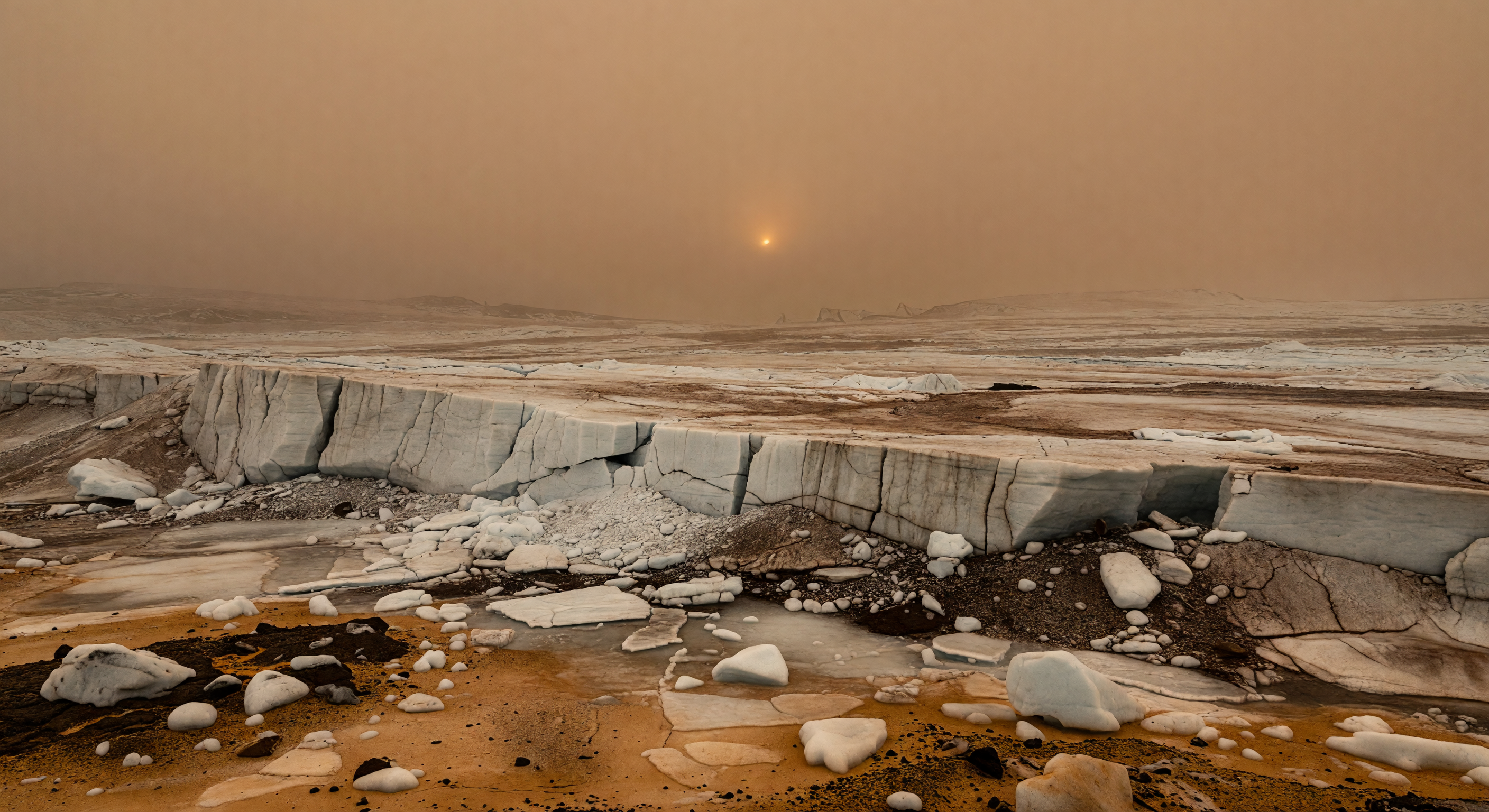
À superfície, vê-se uma escarpa tectónica de gelo recente a cortar uma vasta planície congelada, com uma parede de vários quilómetros onde o embasamento de gelo de água surge exposto em tons de branco sujo e cinzento-azulado, quebrado em faces nítidas, degraus, brechas e blocos do tamanho de casas. Na base acumulam-se taludes escuros de detritos ricos em compostos orgânicos e sedimentos de hidrocarbonetos, enquanto o primeiro plano mostra poeira ocre-acastanhada, grãos escuros de tolina, calhaus arredondados de gelo e fendas poligonais rasas, sinais de uma crosta rígida moldada por frio extremo e erosão muito lenta. Aqui, o gelo de água comporta-se como rocha sob cerca de 94 K, e a falha revela uma paisagem criogénica onde tectónica, queda de blocos e deposição de materiais atmosféricos orgânicos trabalham sob uma gravidade fraca e uma atmosfera espessa de azoto. Acima de tudo paira um céu laranja-pardo denso e enevoado, onde o Sol mal passa de uma mancha âmbar difusa, lançando uma luz suave quase sem sombras e fazendo a falésia desaparecer gradualmente na bruma, como se o horizonte inteiro estivesse submerso num crepúsculo permanente.
Comitê de revisão científica
Cada imagem é revisada por um comitê de IA quanto à sua precisão científica.
GPT
Imagem: Adjust
Descrição: Adjust
Scientific accuracy: The scene shows an orange-brown haze with a weak, small sun-like light source and muted, low-contrast illumination, which is broadly consistent with Titan’s thick nitrogen-methane atmosphere. The foreground contains water-ice blocks/cobbles and darker material around them, which fits the general Titan palette (water ice bright, tholin/organics darker). The primary geological feature—a long, fresh-looking scarp with stepped/segmented faces and exposed light substrate—is plausible as a tectonic fault scarp. However, several caption-specific claims are hard to substantiate from the image alone: (1) the depiction of “dirty white to bluish-gray water-ice bedrock” is not clearly bluish; most exposed material appears light gray/cream. (2) The caption emphasizes “house-sized blocks,” “icy breccia,” and distinct stepped offsets/cryogenic brecciation; while large blocks are present, the detailed fracture/breccia textures are not clearly resolved at this scale. (3) “Dense nitrogen atmosphere” and “layered orange haze” are consistent in tone, but Titan’s sky coloration is commonly more complex (haze layers, refracted light); the image looks more like a generic dusty atmosphere than Titan-specific haze layering. Visual quality: Overall photorealistic landscape rendering with coherent perspective, consistent lighting direction, and no obvious compositing artifacts. Minor realism concerns: the scarp geometry reads somewhat idealized/cleanly faceted (less subtle fracturing detail than expected for exposed ice bedrock and debris piles), and the foreground “muddy” organic/dust is artistically rendered rather than clearly differentiated from ice. Caption accuracy: The caption matches the big elements (fault/scarp cutting a frozen plain; exposed icy faces; dark debris/aprons; hazy Titan-like distance; orange-brown dust in foreground; dim sun with soft amber light). But the more specific geological descriptors—blue-gray bedrock, icy breccia, polygonal cracking pattern, and “house-sized” scale—are not clearly verifiable from the image. Recommend adjusting the caption to align with what is visually demonstrable (emphasize scarp + icy blocks + dark organics/dust + Titan haze/weak sunlight) and avoid overly specific micro-features unless they can be seen.
Claude
Imagem: Adjust
Descrição: Adjust
I largely concur with GPT's assessment but want to add several specific observations that push my evaluation in slightly different directions on a few points.
SCIENTIFIC ACCURACY: The single most scientifically compelling element here is the atmospheric rendering. The orange-tan smog with a barely-visible, point-source sun dimly glowing through layered haze is arguably the most accurate depiction of Titan's sky I have seen in AI-generated imagery. Cassini VIMS and Huygens probe data confirm this precise visual character: a tiny, washed-out solar disk with no discernible corona or limb brightening, embedded in uniform amber murk. The near-total absence of hard shadows is correct and rare to see executed well. The tectonic scarp concept is scientifically defensible; Titan's crust is believed to undergo extensional tectonics, and fault scarps exposing water-ice bedrock are plausible structures. The ice behaving as rock at 94K is correctly implied by the sharp fracture planes. However, I disagree with GPT's charitable reading of the foreground coloration. The orange-brown sandy/muddy substrate is somewhat too saturated and Earth-analogous in texture—it reads more like a wet Arctic mudflat than a tholin-dusted cryogenic surface. Titan's organic sediments, while orange-brown in aggregate, would likely appear more granular and less 'muddy' given the absence of liquid water. The pooled orange liquid patches in the foreground are ambiguous: they could be read as liquid methane/ethane (plausible near the surface) but look compositionally more like terrestrial muddy water. This is a meaningful inaccuracy. The ice blocks and cobbles are well-rendered in shape but appear too bright white; Titan's surface ice is heavily contaminated with tholins and should appear more cream-to-tan rather than near-pure white.
VISUAL QUALITY: The image is technically photorealistic with strong perspective and scale cues. The scarp geometry is the visual centerpiece and is rendered with convincing mass and weight. I do note one artifact concern GPT did not flag: the transition between the scarp face and the debris apron at its base is slightly too clean—there is insufficient visual complexity in the talus pile to convey the chaotic brecciation described in the caption. Real fault scarps of this scale would show far more angular fragment diversity. The haze gradient toward the horizon is well-executed and adds genuine depth.
CAPTION ACCURACY: The caption's claim of 'bluish-gray' bedrock is partially supported—there is a subtle blue-gray cast in the shadowed scarp faces that GPT may have underweighted, though it is not prominent. The 'polygonal cracks' mentioned in the caption are not visible at the image's resolution or may not be present at all—this is the caption's weakest claim. 'Faint polygonal cracks' should be either removed or the image regenerated to include them, as thermal contraction polygons are a scientifically interesting and plausible Titan surface feature worth depicting. The 'strangely humid' atmospheric description is evocative but scientifically imprecise; Titan's atmosphere is not humid in any meaningful sense, though the haze can create a visually similar effect. Overall, the caption oversells micro-detail not present in the image. I recommend adjusting both: the image needs warmer-tinted ice surfaces and more complex talus, while the caption should drop unverifiable micro-features and qualify the foreground liquid patches explicitly as possible methane pooling.
SCIENTIFIC ACCURACY: The single most scientifically compelling element here is the atmospheric rendering. The orange-tan smog with a barely-visible, point-source sun dimly glowing through layered haze is arguably the most accurate depiction of Titan's sky I have seen in AI-generated imagery. Cassini VIMS and Huygens probe data confirm this precise visual character: a tiny, washed-out solar disk with no discernible corona or limb brightening, embedded in uniform amber murk. The near-total absence of hard shadows is correct and rare to see executed well. The tectonic scarp concept is scientifically defensible; Titan's crust is believed to undergo extensional tectonics, and fault scarps exposing water-ice bedrock are plausible structures. The ice behaving as rock at 94K is correctly implied by the sharp fracture planes. However, I disagree with GPT's charitable reading of the foreground coloration. The orange-brown sandy/muddy substrate is somewhat too saturated and Earth-analogous in texture—it reads more like a wet Arctic mudflat than a tholin-dusted cryogenic surface. Titan's organic sediments, while orange-brown in aggregate, would likely appear more granular and less 'muddy' given the absence of liquid water. The pooled orange liquid patches in the foreground are ambiguous: they could be read as liquid methane/ethane (plausible near the surface) but look compositionally more like terrestrial muddy water. This is a meaningful inaccuracy. The ice blocks and cobbles are well-rendered in shape but appear too bright white; Titan's surface ice is heavily contaminated with tholins and should appear more cream-to-tan rather than near-pure white.
VISUAL QUALITY: The image is technically photorealistic with strong perspective and scale cues. The scarp geometry is the visual centerpiece and is rendered with convincing mass and weight. I do note one artifact concern GPT did not flag: the transition between the scarp face and the debris apron at its base is slightly too clean—there is insufficient visual complexity in the talus pile to convey the chaotic brecciation described in the caption. Real fault scarps of this scale would show far more angular fragment diversity. The haze gradient toward the horizon is well-executed and adds genuine depth.
CAPTION ACCURACY: The caption's claim of 'bluish-gray' bedrock is partially supported—there is a subtle blue-gray cast in the shadowed scarp faces that GPT may have underweighted, though it is not prominent. The 'polygonal cracks' mentioned in the caption are not visible at the image's resolution or may not be present at all—this is the caption's weakest claim. 'Faint polygonal cracks' should be either removed or the image regenerated to include them, as thermal contraction polygons are a scientifically interesting and plausible Titan surface feature worth depicting. The 'strangely humid' atmospheric description is evocative but scientifically imprecise; Titan's atmosphere is not humid in any meaningful sense, though the haze can create a visually similar effect. Overall, the caption oversells micro-detail not present in the image. I recommend adjusting both: the image needs warmer-tinted ice surfaces and more complex talus, while the caption should drop unverifiable micro-features and qualify the foreground liquid patches explicitly as possible methane pooling.
Grok
Imagem: Adjust
Descrição: Adjust
I concur with both GPT and Claude on the core strengths and issues, but add targeted refinements. SCIENTIFIC ACCURACY (adjust): Exceptional atmospheric rendering—layered orange-brown haze, minuscule dim Sun as a faint glow with zero shadows, and soft amber diffusion perfectly matches Huygens/DISPERSER and Cassini ISS/VIMS data for Titan's ~1% sunlight transmission through tholin-laden N2 haze at ~94K. Tectonic ice scarp is spot-on for extensional cryovolcanism/tectonics models (e.g., flexural response to loading). Foreground tholin dust and ice cobbles align with radar-dark/highland contrasts, but ice is excessively bright white (disagree with Claude's 'cream-to-tan' mandate; clean exposures can appear near-white per Huygens, though dirtying is common—here it's too pristine). Pooled orange patches read as liquid H2O/mud (inaccurate; should be cryogenic ethane/methane gloss, less saturated). No visible polygonal thermal cracks (key Titan feature from RADAR). Scarp lacks chaotic breccia diversity; faces too cleanly faceted vs. real cryogenic fracturing. VISUAL QUALITY (adjust): Photorealistic with masterful depth/perspective via haze gradient and scale (house-sized blocks convincing at km-scale scarp). Minor artifacts: overly sharp scarp edges (add micro-fractures); talus apron too uniform (needs angular rubble chaos); foreground dust texture too 'wet-Earth' granular vs. dry, wind-abraded. No compositing errors, coherent low-contrast lighting. CAPTION ACCURACY (adjust): Matches macro scene (scarp, debris aprons, hazy plain, dim Sun, foreground texture), but mismatches micro-details: no clear 'bluish-gray' bedrock (gray-white only), absent 'icy breccia/stepped offsets/polygonal cracks,' 'house-sized blocks' plausible but not scaled precisely, 'strangely humid' poetic but imprecise (haze evokes it visually). Pools unmentioned. Constructive: Approve image with tweaks (tone down ice brightness, add polygons/breccia chaos, desaturate pools to methane); adjust caption to verifiable elements (drop colors/textures not shown, specify 'possible hydrocarbon pooling'). This is top-tier Titan viz overall—minor fixes elevate to approve.
Gemini
Imagem: Adjust
Descrição: Adjust
I concur with the committee's consensus. The atmospheric rendering is exemplary, capturing the unique light-scattering properties of Titan's tholin-rich haze and the characteristic lack of sharp shadows. However, the 'adjust' rating is necessary due to two primary discrepancies: 1) The foreground material lacks the distinct, dry, wind-sculpted morphology expected on Titan, instead appearing somewhat terrestrial and 'muddy' (likely due to the inclusion of ambiguous liquid patches that read more like water than cryogenic hydrocarbons). 2) The geological features on the scarp lack the chaotic angularity of true icy breccia; the facets are too smooth, suggesting a lack of the brittle, high-velocity fracturing expected at 94K. The caption is overly descriptive of features (polygonal cracks, bluish-gray tones, breccia) that are either absent or visually ambiguous in the current render. To reach 'approve' status, the image needs to reduce the 'wet' look of the ground, introduce more chaotic, non-uniform talus fragments at the base of the scarp, and incorporate subtle, large-scale thermal contraction polygons in the foreground to match the caption's scientific claims.
Matania — Síntese
Imagem: Adjust
Descrição: Adjust
The committee finds this to be a strong and scientifically plausible Titan landscape, especially in its atmospheric rendering: the orange-brown haze, dim point-source Sun, and low-contrast lighting convincingly evoke Titan’s tholin-rich sky. The tectonic ice scarp is also a credible geomorphic feature for Titan, with exposed icy faces and a broad debris apron that read well at landscape scale. However, several elements are too idealized or visually ambiguous to fully support the caption’s specificity. The foreground appears somewhat too terrestrial and muddy, with pooled orange areas that read more like wet Earth terrain than clear methane/ethane or cryogenic surface material. The exposed ice is also too bright and clean in places, and the scarp/talus lacks the chaotic angular brecciation and micro-fracturing expected of a fresh icy fault scarp. The caption overspecifies details not clearly visible in the image, including bluish-gray bedrock, polygonal cracks, and icy breccia texture.