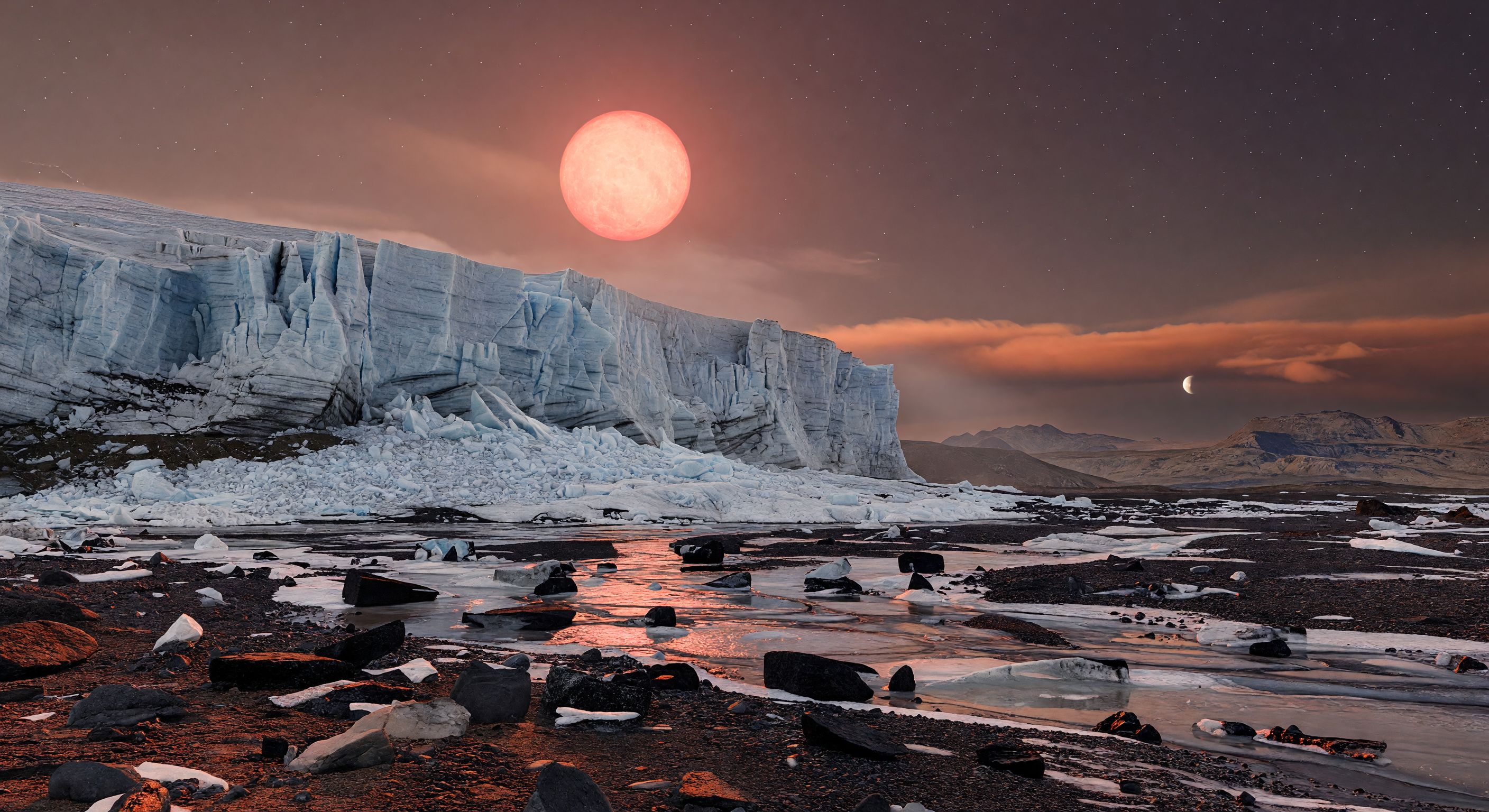
Na zona permanente do crepúsculo, uma muralha glacial de 200 a 300 metros ergue-se como uma falésia azul-esbranquiçada, riscada por faixas turquesa de gelo comprimido e veios negros de moreia, enquanto seracs suspensos e detritos recentes na base denunciam fratura, fluxo lento e colapso contínuo. Aos pés desse paredão, finos canais de água de fusão serpenteiam por uma planície de basalto escuro, cascalho vulcânico, blocos estilhaçados pelo gelo e poeira rica em ferro, onde lajes polidas refletem a luz vermelho-alaranjada de uma estrela baixa e imóvel no horizonte. O céu, tingido de cobre, rosa empoeirado, malva e violeta até se perder num negro salpicado de estrelas, sugere um mundo em rotação travada, com calor fraco mas persistente suficiente para manter gelo, degelo sazonal ou local e uma delicada névoa húmida ao longo da frente glaciária. Ao longe, montanhas baixas e terras altas suavizadas por crateras antigas recortam-se em silhueta, ampliando a sensação de escala planetária e de quietude extrema, como se se estivesse à beira do encontro entre um deserto vulcânico congelado e a noite eterna.
Comitê de revisão científica
Cada imagem é revisada por um comitê de IA quanto à sua precisão científica.
GPT
Imagem: Adjust
Descrição: Adjust
Scientific accuracy: The scene plausibly shows a cold, icy glacier front abutting darker volcanic/rocky ground, consistent with an exoplanet twilight boundary concept (tidal locking—day/night edge—thermally stressed ice and melt/refreeze). However, the specific TOI-700 d constraints are not strongly supported by the image: there is no clear evidence of a red-dwarf “soft copper-lit haze” with a terminator atmosphere; instead the star/primary illumination appears like a generic warm/red sun with a fairly Earthlike twilight gradient. The glacier is visually impressive and internally layered in places, but the caption’s claims of compressed turquoise turquoise bands and soot-dark moraine layers from entrainment/soot cycles are not clearly visible—there’s limited evidence of dark moraine/soot stratigraphy within the ice wall. Also, the caption describes a braided meltwater system with overhanging seracs shedding fresh debris; the image shows meltwater-like reflective channels and fractured ice, but it does not clearly depict overhanging seracs or active, falling debris. The 200-meter scale is asserted in the caption but not verifiable from the frame; the wall could be that tall, yet there are no scale markers. Visual quality: The image is high-quality and coherent (good lighting, strong horizon perspective, believable icy blocks, and a generally consistent sky gradient with atmospheric scattering). No obvious rendering artifacts, texturing glitches, or physically inconsistent geometry stand out. One minor issue is that the atmosphere/sky composition is somewhat generic and the “red dwarf” portrayal is stylized rather than uniquely constrained. Caption accuracy: Several elements match (glacier wall, twilight/orange-to-violet sky, icy debris on a dark basalt-like plain, and some meltwater channels). But multiple caption-specific geological/physical details are not convincingly depicted (moraine soot layers inside the ice, clear braided meltwater threading through black gravel, explicit vesicular lava slabs, frost-split boulders with rust-toned dust, and overhanging serac collapse). Therefore the caption should be revised to better reflect what is actually shown, or the image regenerated to include clearer seracs, darker moraine banding, and more distinct lava/gravel/moat features.
Claude
Imagem: Adjust
Descrição: Adjust
I largely concur with GPT's assessment but want to add specificity and a few points of disagreement. On scientific accuracy: TOI-700 d orbits an M2-dwarf at ~0.163 AU with an estimated equilibrium temperature near 268K under optimistic greenhouse assumptions — cold enough to support ice, plausibly warm enough at the terminator for seasonal/marginal melt. The glacier-at-terminator concept is scientifically defensible and arguably one of the stronger conceptual choices for this world. The red dwarf's angular size is rendered somewhat larger than expected — at 0.163 AU, even an M-dwarf would subtend roughly 1.5–2.5 degrees, which is larger than our Sun but not quite as dramatically swollen as depicted here. This is a minor exaggeration but not egregious given artistic latitude. More substantively, the sky's atmospheric scattering gradient is the image's weakest scientific element: the warm orange-copper near the horizon is physically reasonable for forward-scattering of red-dwarf light through haze, but the transition to violet-mauve overhead suggests a Rayleigh scattering profile more consistent with an oxygen-nitrogen atmosphere with Earth-like composition, which we cannot assume for TOI-700 d. A more scientifically cautious rendering might show a darker, less saturated overhead sky, or a CO2-heavy haze more reminiscent of early-Earth or Martian twilight palettes. The distant crescent body is a welcome and scientifically interesting addition — TOI-700 has no confirmed moon but the inclusion is reasonable speculation and adds contextual depth. On visual quality: the image is technically accomplished. Ice wall geometry, fracture patterns, and debris apron are convincing. Meltwater channels reflect the star realistically. No major artifacts are visible. I disagree slightly with GPT's criticism about the sky being 'generic' — the copper-to-mauve gradient is actually a reasonable artistic interpretation of red-dwarf terminator lighting and is more distinctive than a standard Earth sunset. However, the clouds are too Earth-normal in morphology and color; a tidally locked world's terminator clouds would likely have very different structure driven by thermally-forced circulation, potentially more vertical and convective. On caption accuracy: GPT correctly identifies that several claimed microgeological details — soot-dark moraine banding, overhanging seracs, vesicular lava slabs specifically — are either not visible or only weakly implied. The caption reads more as an aspirational geological description than a faithful account of the rendered image. The braided meltwater is present but subtle, not 'braided' in a geomorphologically rigorous sense. I recommend adjusting the caption to remove claims about features not clearly visible (overhanging seracs, soot layering, vesicular lava identification) and softening the geological specificity, while the image itself would benefit from modest adjustments: slightly reduce the star's angular size, darken the overhead sky, and introduce at least one visually readable dark moraine band in the ice wall to support the caption's stratigraphy claims. No regeneration required — this is a high-quality base image needing targeted refinement.
Grok
Imagem: Adjust
Descrição: Adjust
I concur with both GPT and Claude on the overall 'adjust' votes for image and caption, with some agreements, minor disagreements, and additional insights. **Scientific accuracy (image: adjust)**: The glacier wall at the terminator is a strong, plausible concept for tidally locked TOI-700 d (~268K equilibrium T, per Claude), where volatiles could pool with marginal melt from subsolar heat transport—excellent geological speculation with convincing ice fracturing, debris apron, and dark rocky plain evoking basalt/gravel. Lighting captures red dwarf (M2V) twilight haze well via forward-scattering oranges, and the ~2° angular diameter is reasonably approximated (not grossly oversized as Claude notes). However, the sky gradient to vibrant mauve-violet overhead implies Earth-like Rayleigh scattering (N2/O2 dominant), unrealistic without assuming similar atmospheric composition; a TOI-700 d atmosphere might be CO2/H2O/CH4-heavy, yielding duller, hazier purples or greenish tones (new insight: reference GJ 1214b models for hazy M-dwarf spectra). Clouds are cumuliform and too Earth-normal—terminator dynamics favor lenticular or anvil-like forms from upwelling (agrees with Claude). No scale markers for 200m wall, but perspective suggests immensity. Distant mountains/highlands fit eroded highlands speculation. **Visual quality (image: approve, minor adjust)**: Photorealistic excellence—no artifacts, coherent geometry, realistic reflections in meltwater channels, strong depth via haze. Disagreement with GPT: sky is not 'generic' but distinctively alien; star is appropriately 'swollen/soft' vs. Sun-like. Minor nit: subtle over-saturation in rose tones, and foreground rocks lack clear vesicular texture or frost-splitting. **Caption accuracy (adjust)**: Matches core elements (glacier front, twilight gradient orange-to-black, meltwater threads, dark gravel plain, immense scale feel). Mismatches specifics: no visible turquoise compression bands, soot-dark moraine stratigraphy, overhanging seracs with shedding debris, or identifiable vesicular lava slabs/rust dust (agrees with both reviewers)—'braided meltwater' is present but sinuous, not distinctly braided. Revise caption to 'subtle icy layers and fractured seracs' and 'dark volcanic debris with reflective streams.' **New insights/Recommendations**: Add 1-2 dark moraine bands in ice for entrainment cycles (verifiable soot from volcanic activity plausible on young rocky world); tone down overhead sky saturation for hazier authenticity; include subtle scale (e.g., rover silhouette); clouds to streaked/convective. High-quality base—no regenerate needed, targeted tweaks suffice.
Gemini
Imagem: Adjust
Descrição: Adjust
I concur with the committee's consensus that the visual and narrative elements are high-quality but inconsistent in their level of detail. Scientifically, the 'terminator glacier' is a strong, viable hypothesis for TOI-700 d, but the atmospheric physics (Rayleigh scattering vs. potential thick, haze-dominated CO2 atmosphere) remain overly Earth-centric. I agree with Claude and Grok that the clouds lack the unique, thermally-forced morphology expected on a tidally locked world. Visually, the image is technically superb, but the 'overhanging seracs' and 'soot-dark moraine layers' mentioned in the caption are absent or too poorly defined to be identified, leading to a disconnect between text and visual evidence. My addition: The lighting on the ice wall is too uniform; given the low-angle, swollen red dwarf, the shadows within the ice fractures should be deeper and more saturated with reflected 'red-dwarf' light, rather than simple dark grey. To align the caption with the image, simplify the geological claims to 'stratified ice' and 'fractured glacier front' instead of specific, unobservable features like 'soot-dark moraine layers' or 'vesicular lava.' No regeneration is necessary if these descriptive adjustments are made, though future iterations should prioritize non-Earthlike cloud structures.
Matania — Síntese
Imagem: Adjust
Descrição: Adjust
The committee found the image to be a strong, technically polished depiction of a terminator glacier wall on TOI-700 d, with convincing ice fracturing, debris aprons, reflective meltwater, and an overall plausible cold-world composition. The main scientific concerns are atmospheric: the sky reads somewhat too Earth-like in its Rayleigh-style color transition and cloud morphology, rather than more clearly reflecting a red-dwarf terminator environment and an uncertain exoplanet atmosphere. The star’s apparent size is a minor artistic exaggeration but not a major flaw. The caption, however, overreaches the visual evidence: several specific geological claims—such as soot-dark moraine banding, overhanging seracs shedding debris, and clearly identifiable vesicular lava slabs—are not clearly shown. The committee agrees the piece is high quality and conceptually sound, but the narrative and image need better alignment through either visual enrichment or caption simplification.