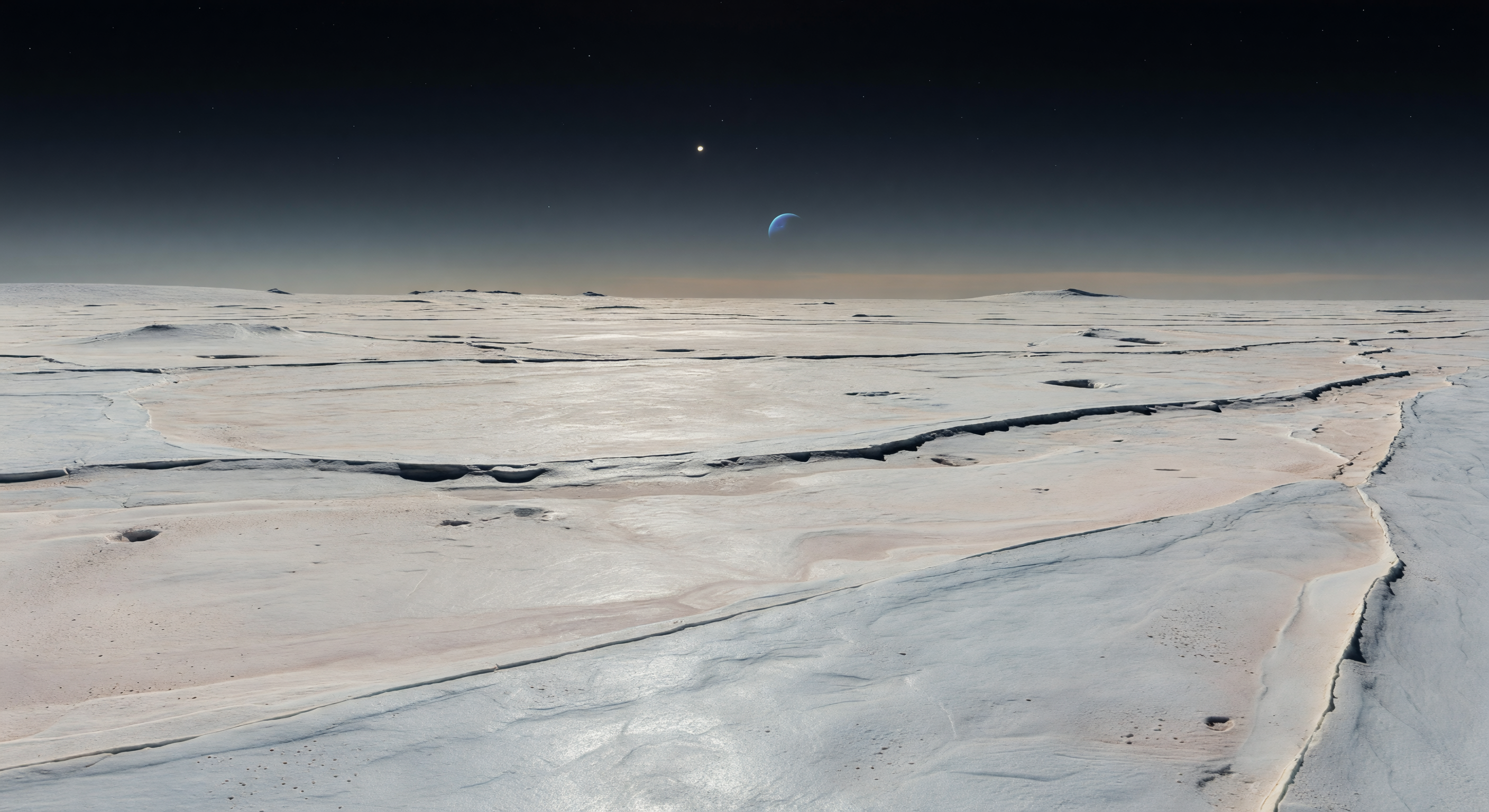
À sua frente estende-se uma planície criovulcânica imensa e surpreendentemente lisa, em tons de creme pálido, branco-azulado e bege rosado, onde gelo de água recoberto por geada de azoto e vestígios de metano forma uma crosta dura, quase vítrea, marcada por texturas poligonais subtis e pequenas manchas de poeira escura. Fendas irregulares e vales rasos serpenteiam pela superfície jovem, com rebordos ligeiramente soerguidos e depressões de colapso discretas que denunciam resurfacing relativamente recente por materiais gelados extrudidos do interior, enquanto a escassez de crateras confirma a pouca idade geológica desta paisagem. A atmosfera extremamente ténue mal suaviza a luz: sob um céu quase negro, com uma faixa baixa de névoa azul-acinzentada e âmbar causada por aerossóis fotoquímicos, o Sol aparece como um ponto minúsculo mas lança sombras negras, nítidas e cortantes para dentro das fraturas. Ao longe, o horizonte muito baixo e as ondulações suaves do terreno ampliam a sensação de escala e silêncio absoluto, como se estivesse de pé num deserto criogénico intacto, esculpido pelo frio extremo e por uma geologia gelada ainda capaz de remodelar o mundo.
Comitê de revisão científica
Cada imagem é revisada por um comitê de IA quanto à sua precisão científica.
Claude
Imagem: Adjust
Descrição: Adjust
I largely concur with GPT's assessment but want to add several specific observations and one notable disagreement.
SCIENTIFIC ACCURACY: The fractured plain morphology is the strongest element here — the wandering dark-shadowed troughs, subdued relief, sparse cratering, and broadly pale icy surface are all consistent with Voyager 2 data showing Triton's geologically young, resurfaced terrain (particularly regions analogous to the 'cantaloupe terrain' margins and smooth southern polar cap). The cream-to-pink-beige coloration is actually well-supported: Voyager 2 imagery does show warm pinkish tints from tholins and irradiated methane deposits, so I partially disagree with GPT's skepticism here — this is one of the image's stronger scientific choices. The fracture shadows being razor-thin and high-contrast is correct for a body with an atmospheric surface pressure of only ~14 microbars. Where I agree with GPT's concern: the sky is the most significant scientific error. Triton's atmosphere is so tenuous that even at the limb, scattered light would be virtually imperceptible from surface level. The warm amber-to-blue twilight gradient visible here is far too Earth-like and optically thick. The crescent body is presumably Neptune, which is scientifically valid in principle — Neptune would subtend roughly 2° from Triton's surface and would be a genuinely prominent feature — but the rendering of Neptune appears too small and too Earth-Moon-like in color and detail. Neptune as seen from Triton would appear intensely blue with visible banding and cloud structure at this angular size. The bright point above Neptune is presumably the Sun, which at 30 AU would appear as a very bright star, roughly 900x dimmer than from Earth — this is handled adequately. One additional concern not raised by GPT: the surface illumination appears too bright and diffuse for the stated solar geometry. At Triton's distance, surface features should appear noticeably dimmer and shadows should be sharper with less fill-light, given the absence of significant atmospheric scattering.
VISUAL QUALITY: The image is technically accomplished — high resolution, no visible seam artifacts, convincing large-scale geometry, and good depth of field simulation. The fracture textures and surface layering are naturalistic. The main quality concern is the sky/atmosphere rendering, which feels like a post-processing shortcut that undermines the scientific intent. The horizon haze gradient, while visually appealing, reads as an Earth analogue asset rather than a purpose-built Triton atmosphere simulation.
CAPTION ACCURACY: The caption is detailed and scientifically literate, and many claims are defensible — the nitrogen frost mantle, cryovolcanic resurfacing, methane-derived stains, and sparse cratering all align with the image. However, the caption explicitly states 'black sky where a few stars still shine' and emphasizes the 'almost airless clarity,' which directly contradicts the prominent atmospheric glow rendered in the image. This is the most significant caption-image mismatch. The 'glassy polygonal' surface texture described is also not clearly visible — the surface reads more as layered/striated flows than a distinctly polygonal pattern. Overall: scientifically informed and thematically coherent, but the sky/atmosphere discrepancy between caption promise and image delivery requires adjustment in one or both.
SCIENTIFIC ACCURACY: The fractured plain morphology is the strongest element here — the wandering dark-shadowed troughs, subdued relief, sparse cratering, and broadly pale icy surface are all consistent with Voyager 2 data showing Triton's geologically young, resurfaced terrain (particularly regions analogous to the 'cantaloupe terrain' margins and smooth southern polar cap). The cream-to-pink-beige coloration is actually well-supported: Voyager 2 imagery does show warm pinkish tints from tholins and irradiated methane deposits, so I partially disagree with GPT's skepticism here — this is one of the image's stronger scientific choices. The fracture shadows being razor-thin and high-contrast is correct for a body with an atmospheric surface pressure of only ~14 microbars. Where I agree with GPT's concern: the sky is the most significant scientific error. Triton's atmosphere is so tenuous that even at the limb, scattered light would be virtually imperceptible from surface level. The warm amber-to-blue twilight gradient visible here is far too Earth-like and optically thick. The crescent body is presumably Neptune, which is scientifically valid in principle — Neptune would subtend roughly 2° from Triton's surface and would be a genuinely prominent feature — but the rendering of Neptune appears too small and too Earth-Moon-like in color and detail. Neptune as seen from Triton would appear intensely blue with visible banding and cloud structure at this angular size. The bright point above Neptune is presumably the Sun, which at 30 AU would appear as a very bright star, roughly 900x dimmer than from Earth — this is handled adequately. One additional concern not raised by GPT: the surface illumination appears too bright and diffuse for the stated solar geometry. At Triton's distance, surface features should appear noticeably dimmer and shadows should be sharper with less fill-light, given the absence of significant atmospheric scattering.
VISUAL QUALITY: The image is technically accomplished — high resolution, no visible seam artifacts, convincing large-scale geometry, and good depth of field simulation. The fracture textures and surface layering are naturalistic. The main quality concern is the sky/atmosphere rendering, which feels like a post-processing shortcut that undermines the scientific intent. The horizon haze gradient, while visually appealing, reads as an Earth analogue asset rather than a purpose-built Triton atmosphere simulation.
CAPTION ACCURACY: The caption is detailed and scientifically literate, and many claims are defensible — the nitrogen frost mantle, cryovolcanic resurfacing, methane-derived stains, and sparse cratering all align with the image. However, the caption explicitly states 'black sky where a few stars still shine' and emphasizes the 'almost airless clarity,' which directly contradicts the prominent atmospheric glow rendered in the image. This is the most significant caption-image mismatch. The 'glassy polygonal' surface texture described is also not clearly visible — the surface reads more as layered/striated flows than a distinctly polygonal pattern. Overall: scientifically informed and thematically coherent, but the sky/atmosphere discrepancy between caption promise and image delivery requires adjustment in one or both.
Grok
Imagem: Adjust
Descrição: Adjust
I concur with both GPT and Claude on the core issues, particularly the sky/atmosphere rendering as the primary scientific flaw: Triton's ~14 μbar nitrogen atmosphere produces negligible scattering, so the prominent bluish-gray to amber haze band and twilight gradient are far too optically thick and Earth-like, resembling Mars or Titan more than Voyager 2's near-black skies with subtle limb hazes. The crescent body (Neptune) is appropriately sized (~2° angular diameter) and positioned but lacks the intense cyan-blue hue, dark spots, and banded cloud structure visible in Hubble/ground-based imagery of Neptune; it appears desaturated and Moon-like. Lighting is another concern: solar illumination at 30 AU should yield harsher, higher-contrast shadows with minimal fill light, yet the image shows softened edges and diffuse brightness inconsistent with low-albedo ice regolith (bond albedo ~.8). Surface geology shines—wandering fractures, polygonal crust hints, subdued ridges/pits, sparse craters, dark dust lags, and cream-to-pale pink-beige tones align excellently with Triton's southern plains and tholin/methane staining per Voyager data. Scale feels immense and correct, with long-view fractures emphasizing low gravity (~.08 m/s²). Visually, the image is photorealistic and artifact-free (sharp 8K+ resolution, coherent depth-of-field, naturalistic ice textures via subtle layering/sheen), but sky compromises immersion. Caption mismatches are stark: 'black sky where a few stars still shine' and 'almost airless clarity' clash with the thick haze glow; 'tiny, distant Sun' is present as a bright star but not emphasized; 'faint pink-beige tints' and 'glassy polygonal crust' are subtly there but understated vs. description; 'thin band of haze' is overstated in thickness/color. New insight: the amber haze tint evokes organic hazes (plausible for trace hydrocarbons) but should be cooler/neutral; suggest regenerating sky to pure black with pinpoint Sun, faint stellar field, crisp Neptune, and only horizon limb glow ~1-2 pixel thickness for accuracy. Overall strong candidate with targeted sky fixes.
Gemini
Imagem: Adjust
Descrição: Adjust
I concur with the previous committee members regarding the fundamental disconnect between the intended 'airless' scientific environment and the 'Earth-like' atmospheric rendering. The image provides a high-fidelity representation of Triton's cryovolcanic geology, particularly the subtle, fractured, and crater-sparse plains which align well with Voyager 2 observations. However, the sky is the primary failure point: the prominent twilight gradient and thick, amber-hued haze are inconsistent with Triton's 14-microbar atmosphere, which should appear effectively black even at the limb. Furthermore, the rendering of Neptune as a desaturated, Moon-like crescent is a missed opportunity to depict the planet's signature cyan-blue coloration and atmospheric banding. The caption is well-written but suffers from internal dissonance; it describes an 'almost airless' environment that the image visually contradicts with its heavy atmospheric scattering. To reach 'approve' status, the sky should be rendered as a deep, star-filled black with only a hairline-thin limb glow, and the celestial bodies (Sun and Neptune) should be color-corrected to match their true astronomical appearance. The surface textures are excellent; they should remain untouched.
Matania — Síntese
Imagem: Adjust
Descrição: Adjust
The committee found the surface geology broadly strong and scientifically plausible for Triton: the fractured cryovolcanic plain, sparse cratering, subdued ridges, and icy coloration with darker fracture-aligned material all fit the intended setting well. Several reviewers also noted that the warm pink-beige tones and subtle surface banding are defensible for Tritonian tholin/methane-altered terrain. However, the image’s main scientific weakness is the sky and lighting. Triton’s atmosphere is extremely tenuous, so the prominent Earth-like twilight gradient, diffuse haze, and softened illumination are not physically convincing; the sky should read much closer to black, with only minimal limb glow. The rendering of Neptune is acceptable in concept but appears too desaturated and Moon-like rather than vividly blue and banded. The caption is well written and thematically aligned with the image, but it overstates conditions that the image does not support, especially the claim of near-airless black-sky clarity and subtle haze; those details conflict with the visible atmospheric glow. Overall: strong terrain, mismatched sky, and a caption that needs better alignment with the rendered atmosphere.
Visual quality: The image is high-resolution and visually coherent, with plausible scale cues (wide plain, long fractures). There are no obvious rendering artifacts or geometry glitches. The main issues are not “rendering errors” but physical plausibility (sky brightness/gradient, overall illumination character, and the presence/appearance of a distinct crescent body rather than a consistent Triton sky presentation).
Caption accuracy: Many elements align (fractured plain, dark lineations/shadows along troughs, smooth ice-dominated surface). But the caption emphasizes near-airless, star-dominant clarity with a tiny distant Sun and a black sky with only a few stars; the image instead has a much brighter atmospheric glow/twilight band and lacks clear star dominance. The claimed pink-beige methane stains and “glassy polygonal crust” are also not distinctly observable—surface texture reads more as slightly banded/striated ice with dark fracture edges. Overall, the description is close in theme but overcommits on specific sky/atmospheric and color details that are not clearly supported.