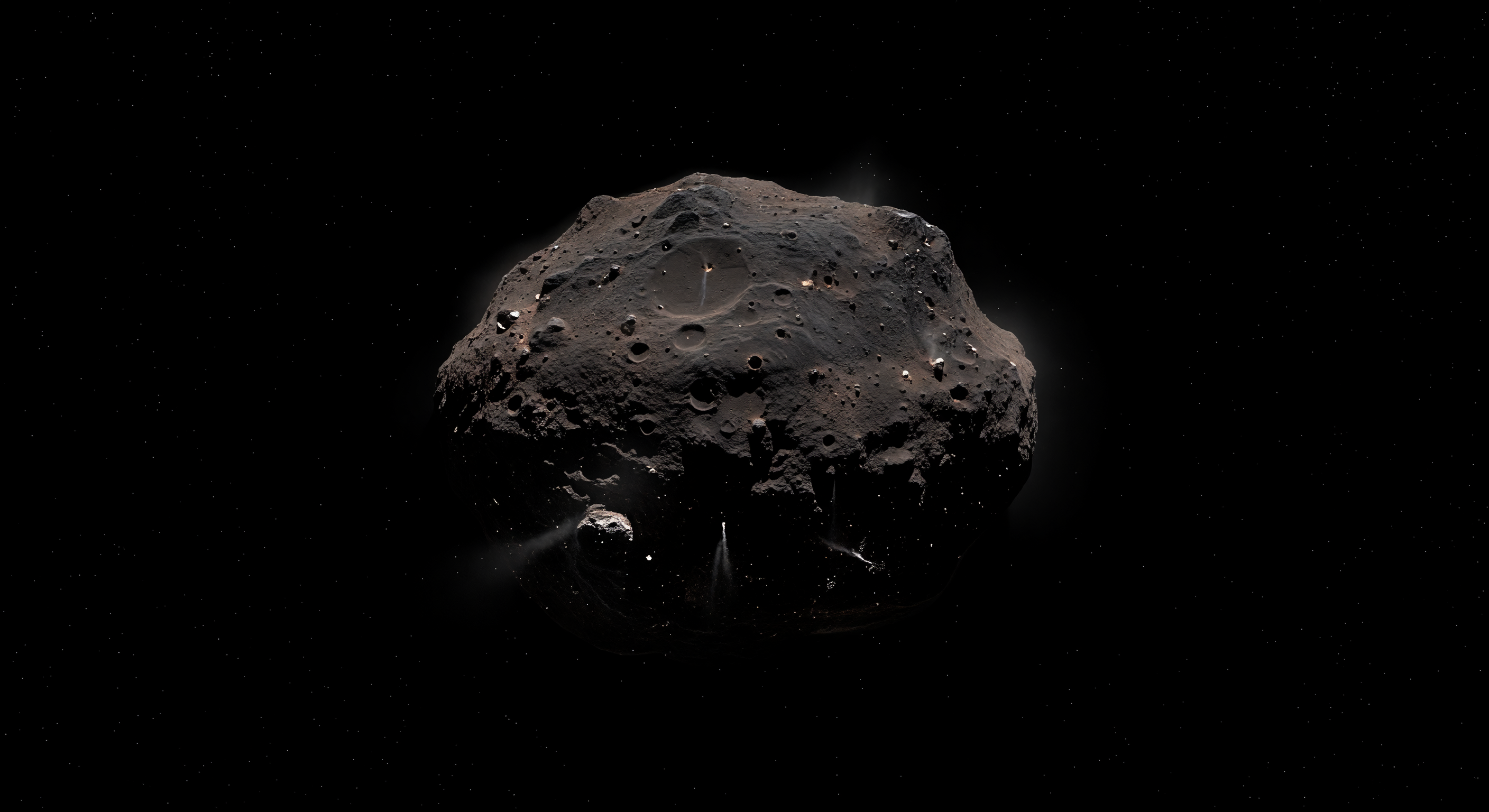
Scientific confidence: Medium
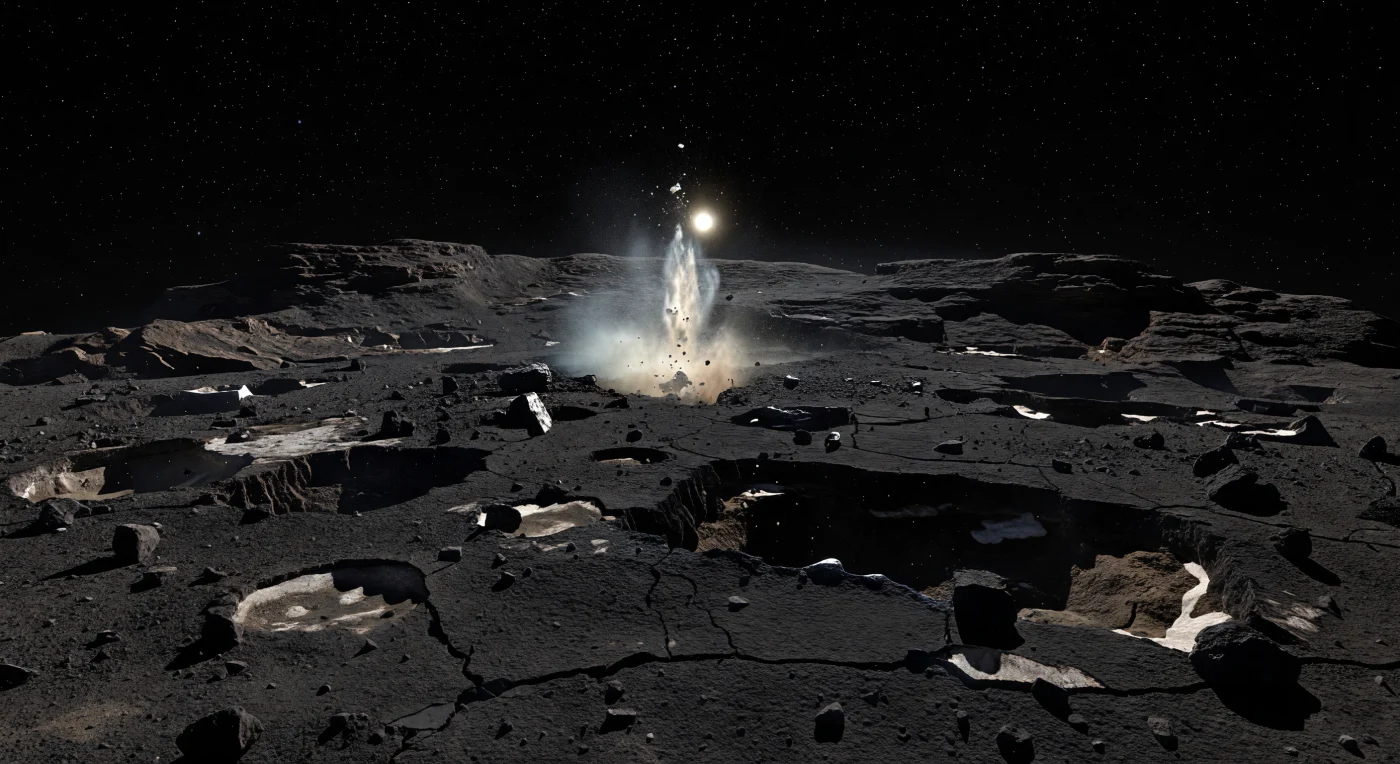
You stand on a sunlit plateau of crust so dark it swallows the light—an organic-rich, carbonaceous surface darker than coal, split by jagged fissures, shallow collapse pits, and broken ledges dusted with brittle black regolith and scattered angular boulders. From a crack facing the Sun, a brilliant jet bursts upward in vacuum, driven by sublimating ice beneath the refractory crust; pale beige dust, icy grains, and darker clumps shimmer and drift slowly aloft, revealing both the comet’s intense local activity and its almost nonexistent gravity. Along fracture walls, small dirty-ice patches glint gray-white through tan-stained dust, while beyond them the ground drops toward a sharply curved, strangely close horizon lined with hummocks, cliffs, overhangs, and collapsed hollows on a tiny, porous nucleus only a few kilometers across. Above it all, the sky remains perfectly black and star-filled even in daylight, the slightly enlarged Sun casting hard white light and razor-edged shadows that make the erupting plume glow like a luminous wound in an otherwise charcoal world.

From the rim of this vast collapse basin, the ground looks darker than charcoal: a brittle, organic-rich crust split into knife-edged plates, dusty rubble, and angular boulders perched in gravity so weak they seem barely attached to the surface. Ahead, steep scarps, fractured terraces, and undercut ledges plunge into an interior swallowed by near-total darkness, while a few freshly broken faces gleam faintly gray-white where dirty ice and frost have been exposed beneath the black mantle. In the airless vacuum, sunlight falls with brutal clarity from a small white Sun, carving razor-sharp shadows and flashing off icy patches with no haze to soften the contrast; only a faint wisp of dust rising from a shaded crack hints that sublimation is still reshaping the terrain. The sharply curved horizon and the immense, silent drop give the uncanny sense of standing on a tiny, active world whose fragile surface is part frozen rubble, part primordial crust, and constantly altered as buried volatiles escape to space.

At dawn near the terminator, sunlight rakes almost horizontally across a field of soot-black hummocks, jagged ridges, and shallow troughs, igniting razor-thin crests while the hollows remain swallowed in absolute shadow. The ground is darker than charcoal because it is mantled by an organic-rich cometary crust with an albedo of only about 4 percent, broken into fractured slabs, perched boulders, crumbly talus, and smooth pockets of settled black dust, while faint silver-gray frost and dirty ice survive only in the deepest, coldest recesses. In the comet’s feeble gravity, small scarps can stay surprisingly steep, overhangs persist, and even dust grains lifted by sparse sunward jets drift upward with a slow, hovering grace against a sky that stays perfectly black and star-filled despite the sunrise. The nearby, gently curved horizon and the stark, airless light make the landscape feel intimate yet uncanny—a tiny active world where sunlight, volatile ice, and dark carbon-rich material are constantly reshaping the surface.

You stand beside a cliff tens of meters high, its layered face almost blacker than charcoal, where brittle organic-rich dust and ice have fractured into undercut overhangs and house-sized angular boulders that seem impossibly poised in the comet’s feeble gravity. At the base, a narrow fresh crack slices through the dark crust to reveal dirty gray-white ice, and from it a thin sublimation plume lifts gas and fine dust in a slow, delicate fountain, each sunlit grain glowing silvery tan as it drifts into the airless void. The ground around you is a jumble of sharp rubble, hummocky regolith, and small collapse pits, while the sharply curved horizon betrays the tiny scale of this irregular nucleus. Above it all hangs a pure black sky with faint stars and a hard white Sun, whose razor-edged light leaves most of the soot-dark surface nearly lightless and turns this active fracture into a stark, fleeting glimpse of cometary material escaping directly into space.

You stand on a tiny, silent nucleus where the horizon curls away unnervingly close, a broad plain of ultra-dark fallback dust and powdery regolith spread out like soot, broken by scattered angular blocks, crusty organic-rich plates, shallow pits, and a few dull gray-white ice patches caught in hollows. The surface is darker than charcoal because it is coated in complex carbon-rich material with a reflectivity of only a few percent, while its fragile, low-density cometary body and feeble gravity let fine grains lie barely anchored, with the occasional particle drifting just above the ground. Far from the Sun, all activity has frozen into dormancy—no jets, no haze, no atmosphere—so the sky remains a pure star-filled black, pierced by a tiny, intensely bright solar disk that throws faint but razor-sharp shadows across the plain. In the distance, jagged ridges and knobby hills rise abruptly from this miniature world, making the landscape feel both intimate and immense, as if you are standing on a piece of primordial dark ice and dust suspended alone in interplanetary night.
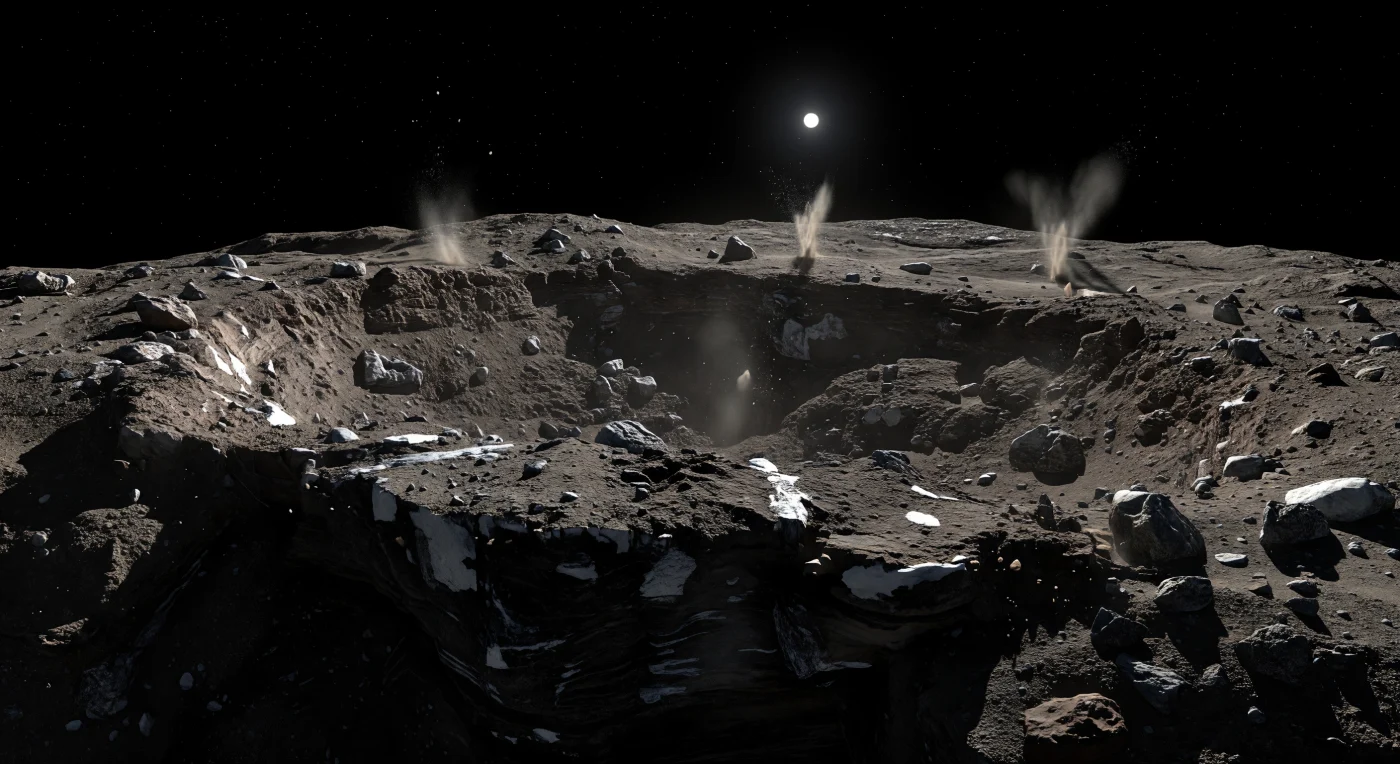
A black-brown overhang several meters deep juts out above a lightless pit with an implausible delicacy, its charcoal-dark crust so nonreflective that the sunlit rim seems to glow against the vacuum black. Up close, the ledge resolves into a brittle mixture of organic-rich dust, porous ice-laced rubble, fractured blocks, and thin crustal layers, with a few freshly exposed dirty-white ice patches flashing in the harsh sunlight while the underside vanishes into absolute shadow. The nearby horizon drops away with startling curvature, a reminder that this is a tiny, weakly bound nucleus only a few kilometers across, where gravity is so feeble that dust grains and pebbles can drift near the edge and talus does not settle as it would on a larger world. Farther off, narrow jets of gas and dust rise from sun-warmed fractures like pale fountains, showing how buried volatiles sublime through one of the darkest surfaces in the Solar System and continually reshape this fragile, active landscape.

You stand on a softly sloping blanket of velvety regolith so dark it absorbs nearly all the sunlight, a carbon-rich mantle of dust and dirty ice where faint grain-flow streaks run downhill between half-buried blocks, isolated pebbles, and thin breaks exposing fractured crust beneath. Here and there, tiny bright scars of water ice glint from fresh collapses, while the horizon curves unexpectedly close and nearby ridges, pits, and overhanging edges look unnaturally sharp—signs of a nucleus only a few kilometers across, with gravity so weak that even dust can drift in slow ballistic arcs above the ground. Overhead, against a sky black as interplanetary space, a pale streamer from an active vent sweeps past like a suspended brushstroke, its gas and entrained grains falling back in long, lazy trajectories to mantle the slope again. The scene feels both silent and restless: a fragile landscape built from organic-rich crust, loose fallback debris, and intermittent ice, constantly reworked by outgassing under harsh, shadow-cutting sunlight.

You are standing on an irregular nucleus barely 15 by 8 kilometers across, where the horizon curves unnervingly close and jagged hummocks, layered scarps, collapse pits, and overhanging ledges rise from a surface blacker than charcoal. The ground is a crust of extremely dark, organic-rich material split by polygonal fissures and razor cracks, and from several aligned fractures violent sublimation jets burst into the vacuum, lofting tan-gray dust and darker carbon-rich grains in ballistic plumes that form a storm-like veil without any true atmosphere or wind. Sunlight strikes this near-black terrain with brutal clarity, casting knife-edged shadows while backlighting the exhaust so that individual particles glitter above dirty ice patches, boulders, and smooth drifts of fallback dust in the comet’s feeble gravity. The effect is both alien and scientifically revealing: a fragile, porous small world actively shedding gas and dust as hidden ices turn directly to vapor, reshaping its own surface grain by grain.
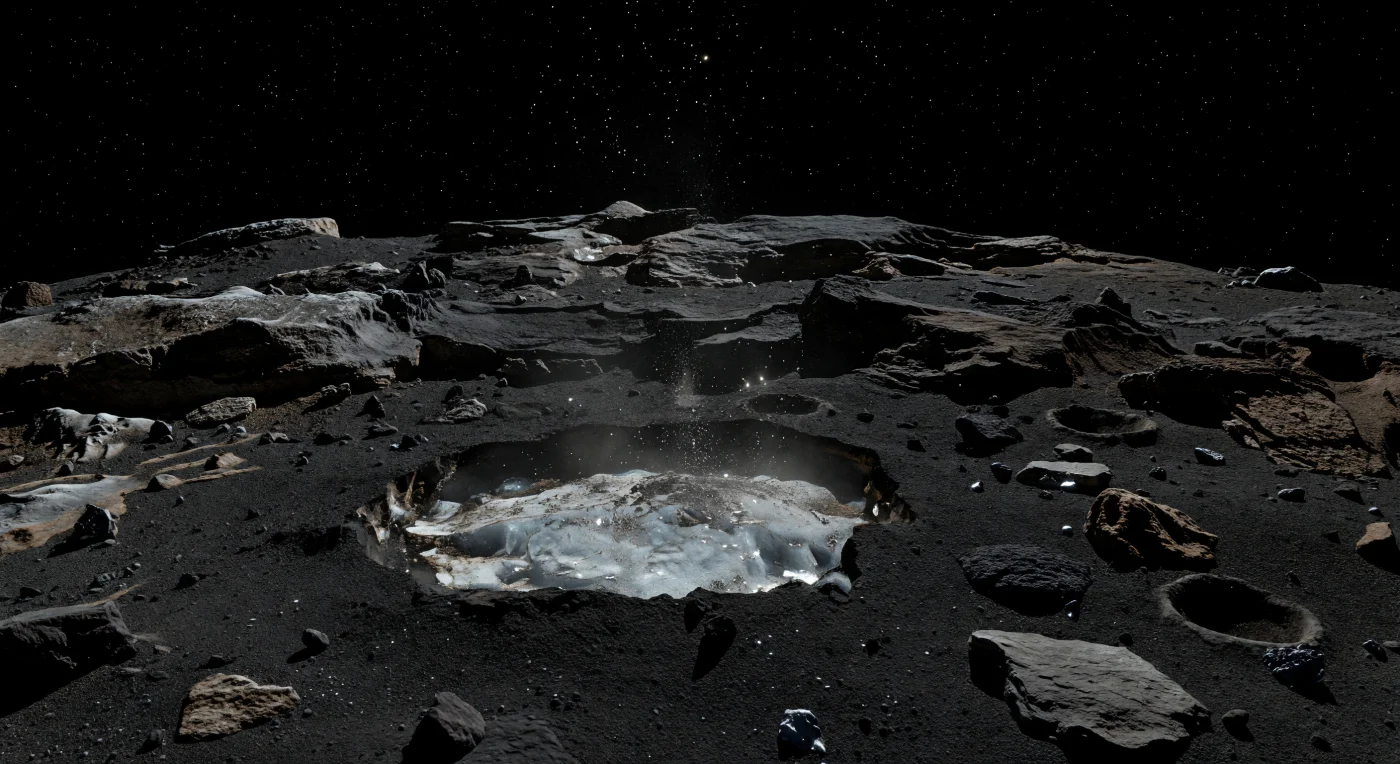
A freshly torn erosion scar breaks through the comet’s almost charcoal-black, organic-rich crust, revealing a fragile patch of dirty ice mottled white and bluish gray, its jagged edges already being eaten back by sunlight. Around it, the surface is a rubble of fractured crustal plates, angular blocks, pepper-fine dark dust, and small collapsed pits, while a faint gas seep from tiny cracks lifts glittering ice grains and dust in slow, graceful arcs that only make sense in the nucleus’s feeble gravity. The stark lighting—hard white Sun, razor-edged shadows, black vacuum sky—underscores how dark this world really is: the crust reflects only a few percent of the light, so the newly exposed volatile-rich material shines with startling intensity by comparison. With the close horizon curving sharply and distant scarps rising over a body only about 15 by 8 kilometers across, the scene feels both intimate and immense, a silent frozen surface briefly coming alive as buried ices sublimate directly into space.

Inside this sheltered hollow, the ground is almost swallowed by darkness: a black-brown granular crust of organics, dust, and dirty ice lies between angular boulders and fractured ledges, with only thin frost films and a few icy patches catching starlight in faint silver glints. Jagged scarps, layered crustal faces, collapsed overhangs, and hummocky mounds rise around the depression, while the close, gently curved horizon reveals the tiny scale of this weak-gravity nucleus, where even house-sized blocks sit precariously on slopes. The surface is among the darkest known in the Solar System, reflecting only about four percent of the light that reaches it, so illumination here comes mainly from stars and a barely perceptible diffuse glow near the horizon from distant activity on the far sunlit side. Above, the sky remains perfectly black and razor-clear, with no atmosphere to scatter light—only an occasional ghostlike veil of dust and ice grains lifting almost weightlessly into the vacuum, making the hollow feel silent, frozen, and profoundly otherworldly.