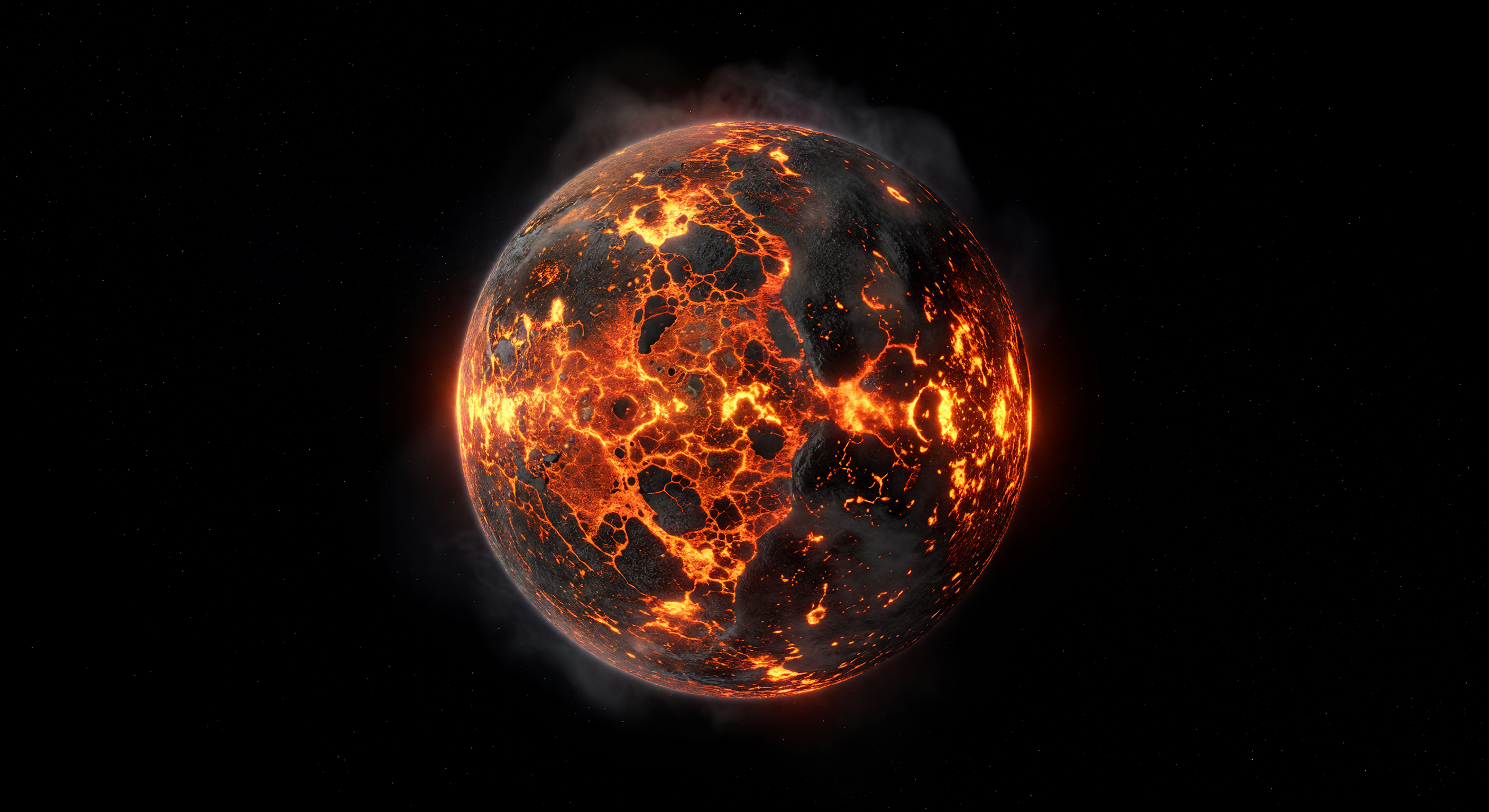
Scientific confidence: Speculative
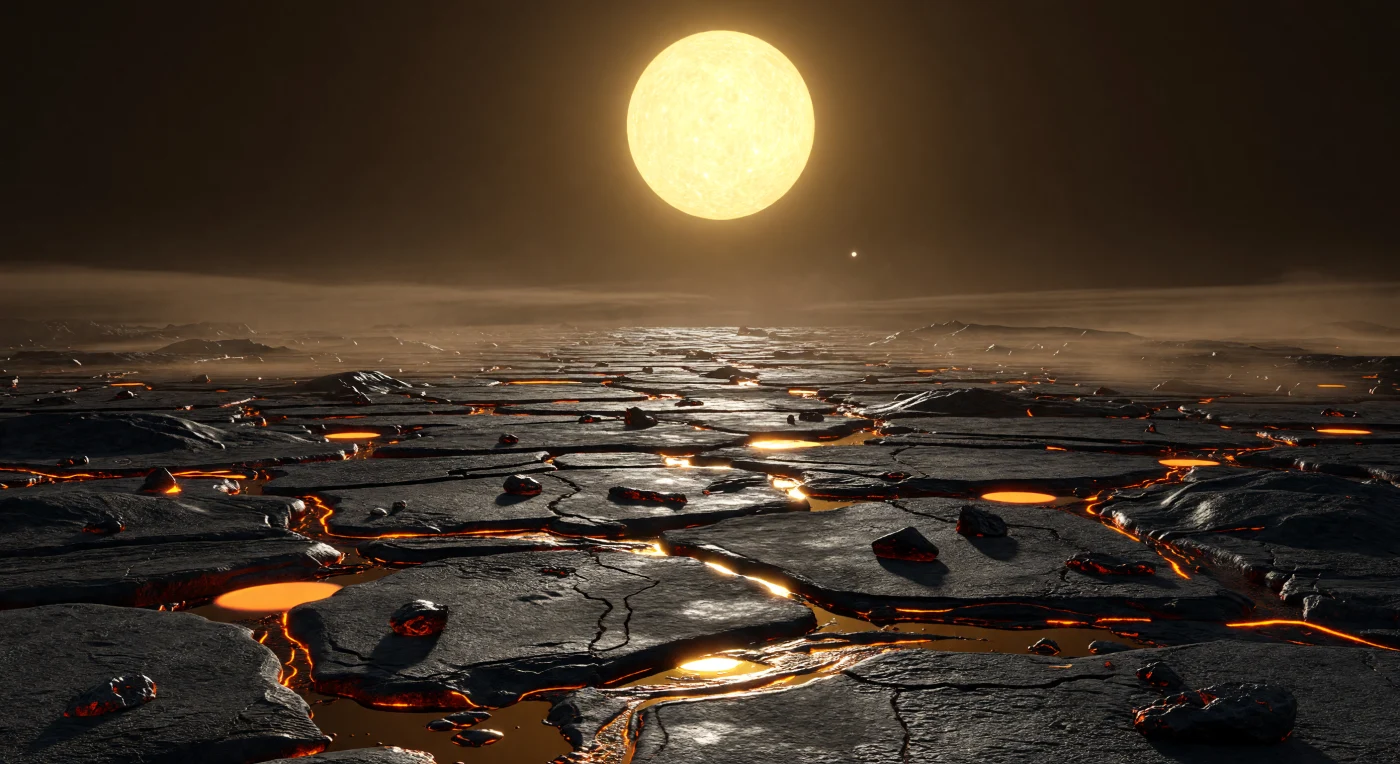
At ground level, the surface appears as a vast mosaic of charcoal-black basalt and partly glassified silicate crust, broken into irregular rafts whose edges have crumpled into low pressure ridges as they slowly drift over a semi-molten interior. Between these dark plates, incandescent seams of magma burn orange to yellow-orange, with occasional white-hot pinpoints where the crust thins, casting an eerie underglow that mixes with the brutal yellow-white light of the enormous fixed star overhead. The fractured plains stretch toward the horizon in fields of warped polygons, brittle cracks, frozen black lava drips, and stranded angular boulders, while shimmering heat and a smoky mineral-vapor haze soften the distance into a luminous blur. This is the face of an ultra-hot tidally locked super-Earth, where surface rock can partially melt, convection can buckle the crust into rafts, and even the air may be laced with silicate vapor and volcanic gases instead of water clouds.

From this shattered basalt shoreline, the surface falls away into a silicate ocean so hot it glows white-yellow near the substellar center and deepens to orange farther out, its molten skin broken into drifting black polygonal crust rafts veined with incandescent cracks. Under crushing super-Earth gravity, the rocks at your feet look compacted and pressure-ridged, strewn with glossy obsidian-like ejecta and thin quenched crusts where liquid stone briefly froze before being swallowed again by the heat. Overhead, a white-gold star hangs almost fixed near the zenith, enormous in the smoky bronze sky, while a thin atmosphere of vaporized rock and mineral condensates blurs the horizon with haze, shimmer, and wavering mirages. Low volcanic rises and dark promontories protrude from the luminous sea like islands in a planetary foundry, revealing a permanent dayside world where silicates melt, convect, crack, and re-solidify in a harsh equilibrium of fire and stone.

At the line between permanent day and permanent night, a vast plain of black obsidian and basaltic glass stretches to a low, subtly curved horizon, its polished surface broken into heavy polygonal plates by cycles of melting and re-solidifying under crushing super-Earth gravity. Red-orange lava glows through the fractures like fire beneath dark glass, while broad pressure ridges, iron-rich boulders, tilted slabs, and low volcanic spatter mounds cast impossibly long shadows from the huge orange-yellow star fixed on the horizon. A thin mineral atmosphere and drifting silicate vapor soften the fierce glare into bands of smoky gold and copper near the skyline, fading quickly upward into charcoal and near-black where a few faint stars emerge, and heat shimmer blurs the incandescent lava fields descending toward the hotter hemisphere. With no water, no ice, and no life—only molten rock, volcanic glass, and a sky stained by vaporized stone—the scene feels both geologically familiar and utterly alien, as if you are standing on the edge of a world still being forged.
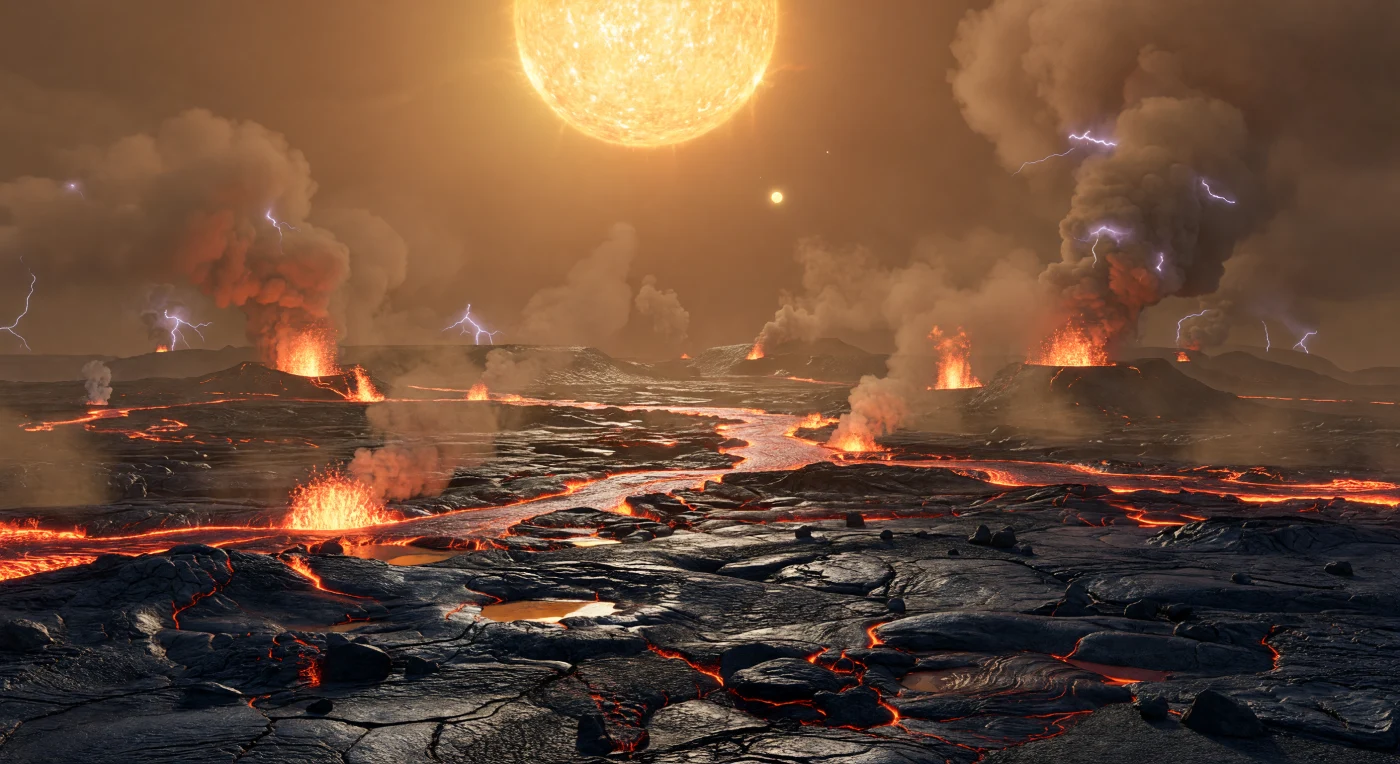
You stand on a crushingly heavy plain of dark, gunmetal volcanic crust, where glossy black plates, jagged clinker, and house-sized boulders stretch across a rifted landscape under gravity more than twice Earth’s. For kilometers at a time, straight fissures split the mafic to ultramafic surface and erupt continuous curtains of white-orange silicate lava, feeding braided molten rivers, glowing levees, crusted ponds, and rafts of cooling rock veined with dull red cracks. Above the fractures, mineral-rich vapor and ash-like silicate particles billow into a dense amber-gray atmosphere, building charged storm clouds that flash with brief violet-white lightning while the immense nearby star glares through the haze, its light diffused into a metallic, furnace-hot glow. The scene is both alien and geologically coherent: an intensely irradiated, likely tidally locked super-Earth where rock can melt, volcanic gases can sustain a secondary atmosphere, and vast tectono-volcanic fissures may dominate the dayside like wounds across a world of fire.
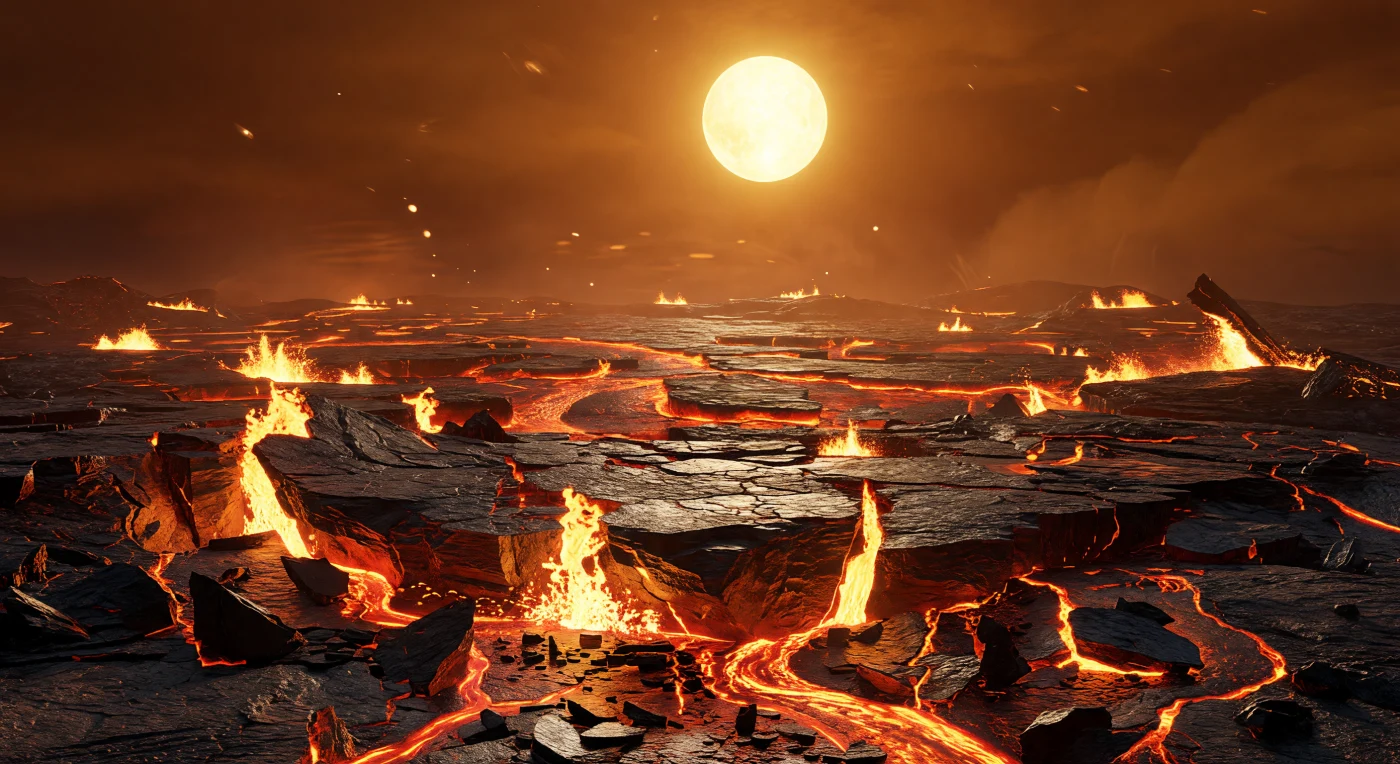
You stand at the shattered rim of a permanent dayside magma sea, where heavy slabs of black, glassy silicate crust tilt at impossible angles and plunge into glowing orange trenches, while fresh yellow-white melt wells upward through long shear cracks and pressure fractures. Under the planet’s strong gravity, the terrain looks dense and brutal—collapse scarps, fused lava ledges, angular boulders, and partially crusted channels of molten rock all draining toward an incandescent plain that stretches to the horizon in rafts, streaks, and low volcanic swells. This is rock behaving like sea ice at furnace temperatures: ultrahot basaltic to ultramafic crust forms, thickens, breaks, and founders back into a convecting magma ocean, while a mineral-rich silicate-vapor atmosphere blurs the scene with violent thermal shimmer and refractive distortion. Above, a huge white-gold stellar disk burns through a copper and smoky amber sky, flooding the cliffs with harsh light and painting their undersides with lava glow, so that every surface feels both molten and monumental.
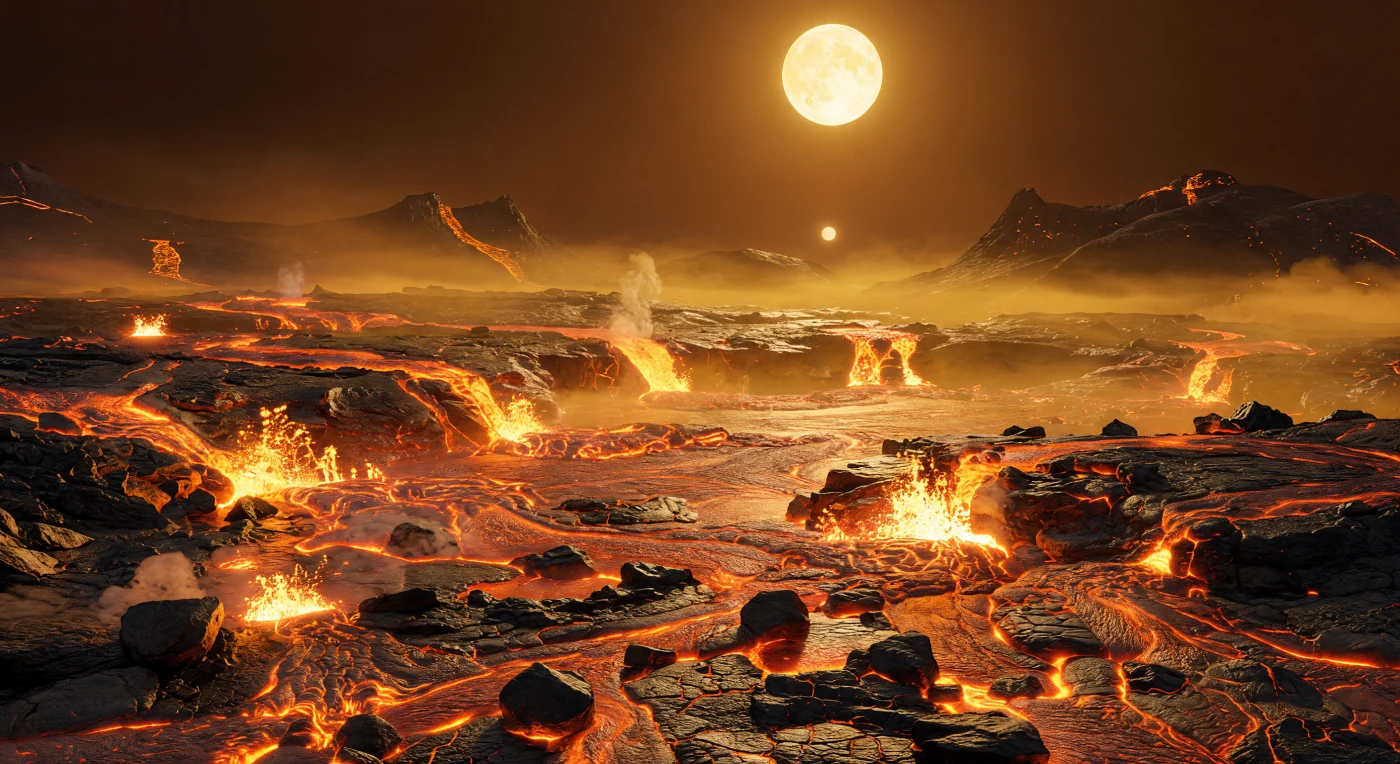
At the edge of a molten inland sea, braided rivers of silicate lava blaze from bright orange to yellow-white as they spill between black, glassy basaltic levees and collapse outward into unstable delta fronts. Under crushing gravity, the terrain looks squat, dense, and brutally compact: vitrified boulders, ropy frozen flows, and cracked obsidian-like crusts crowd the foreground, while white-hot splash zones and glowing blocks mark places where fresh magma founders into the basin. A low golden fog of rock vapor clings to the surface, rising from lava hot enough to melt and vaporize silicate minerals, and above it the sky deepens from smoky amber and bronze near the horizon to sooty brown-black overhead. Dominating everything is a huge white-yellow star, nearly overhead, whose savage light flashes from the molten channels and turns this volcanic shoreline into a shimmering, heat-warped world of perpetual incandescent noon.

You stand on an immense plain of matte-black basalt, its surface broken into cooling polygons, pressure-wrinkled ridges, shattered lava slabs, and squat sharp boulders pressed low by gravity several times stronger than Earth’s. In the bitter permanent night, the rock is dusted here and there with a thin silver-gray condensate—likely minerals that once existed as vapor over the superheated hemisphere and froze onto the coldest exposed surfaces—while only a few narrow red-orange cracks betray magma still glowing deep below the crust. The air is so tenuous that the sky is nearly pure black, crowded with hard, steady stars and cut by razor-sharp shadows, with almost no scattering to soften the scene. Far off, the horizon forms an unnaturally thin ember-red line: the distant boundary of the incandescent dayside, a faint reminder that this frozen basalt desert is only one face of a world shaped by extreme heat, volcanism, and tidal locking.

At the edge of perpetual day, jagged volcanic highlands of shattered black and metallic-brown clinker crouch under crushing gravity, their broken slabs, angular boulder fields, and collapsed lava ridges looking compacted and brutally heavy rather than towering. Deep fissures thread through the basaltic and ultramafic rubble, glowing a dull cherry red where subsurface heat still seeps upward, while a blazing golden-white star hangs fixed on the horizon and throws impossibly long shadows across the razor-edged ground. Overhead, the sky fades from charcoal-black into bands of bronze and smoky amber as silicate vapor and condensed rock dust are swept sideways in fast, near-supersonic winds, turning the twilight into a haze of metal-toned light and thermal shimmer. This is a lava-world terminator shaped by tidal locking, relentless heating, and a mineral-rich atmosphere in constant motion—an immense, hostile frontier where even the rocks seem half-molten and the horizon never changes.

Across the permanent nightside, a vast basalt basin lies crushed flat under roughly 2.4 times Earth’s gravity, its dark volcanic floor broken into dense, low lava crusts, fractured slabs, and squat ridges instead of towering landforms. A thin, patchy frost of condensed rock vapor dusts the surface in pale gray-beige streaks, gathering in cracks, hollows, and behind boulders where silicate and metal-rich vapors have cooled and settled out of the atmosphere like a matte mineral ash rather than ice. The sky above is almost pure black and star-filled, with only a faint near-horizon haze, while far away a continuous crimson-orange band marks the unseen incandescent hemisphere, casting a dim red rim light over frost-coated rocks and the distant low crater rims. Standing here, you would see a world shaped by molten stone, vaporized minerals, and relentless heat contrast—a silent volcanic plain stretching to a curved horizon, alien not because it is chaotic, but because everything has been pressed into broad, heavy, otherworldly stillness.
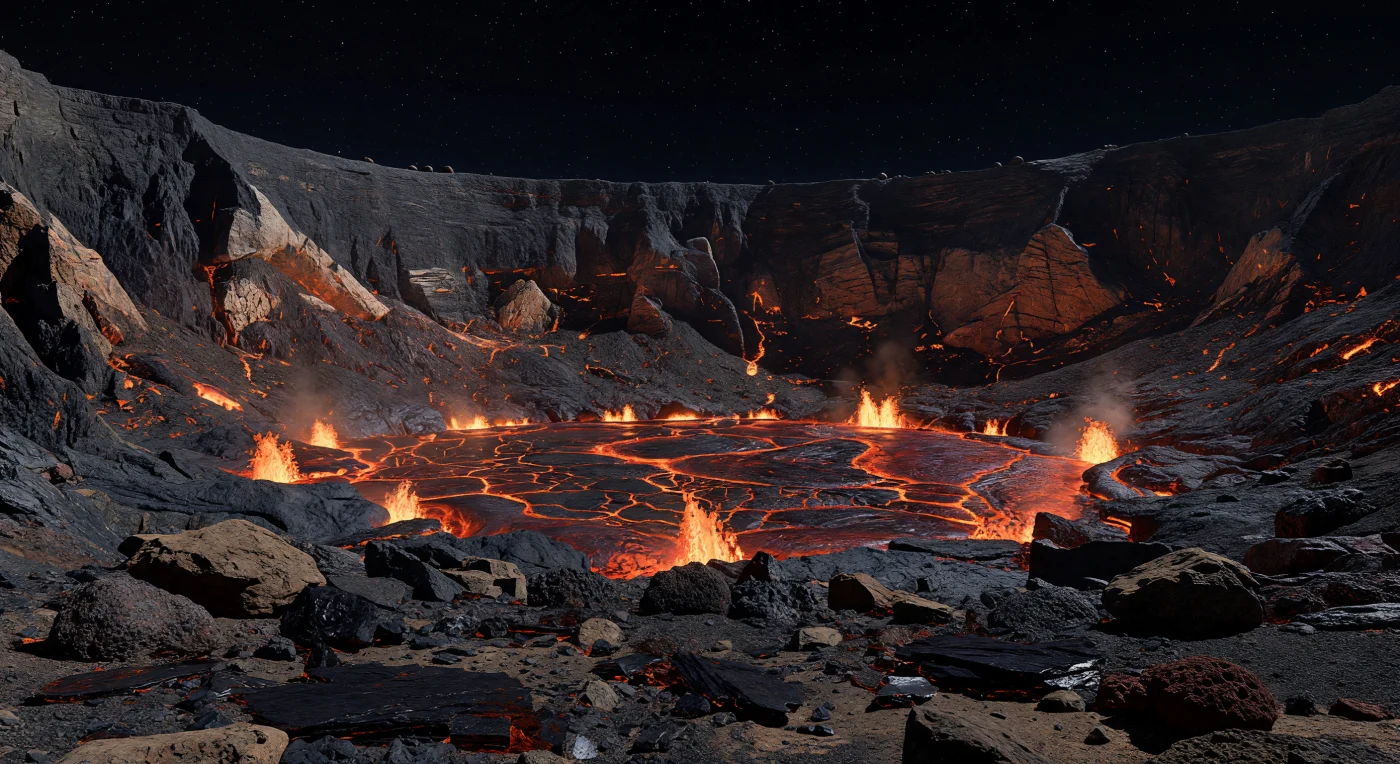
You stand on the floor of an immense nightside caldera where towering black basaltic and ultramafic walls rise almost vertically into a star-filled sky, their fractured ledges, talus slopes, and welded spatter deposits flickering with orange light from a lava lake below. The lake is a restless sheet of molten silicate rock: a dark crust repeatedly cools, cracks into polygonal plates, and founders back into brighter magma, while short, heavy lava fountains arc low under the world’s crushing gravity and scatter glowing spatter along the shore. Around your feet lie glossy volcanic glass, vesicular scoria, and dense obsidian-like slabs, all sharply shadowed in the near-airless darkness, with only a faint mineral haze wavering above the incandescent surface. Far beyond the rim, a few bright points from the outer planetary system hang in the deep charcoal sky, while the caldera’s vast scale and the magma’s relentless overturn hint at a geologically active superheated crust where rock itself behaves like a sea.
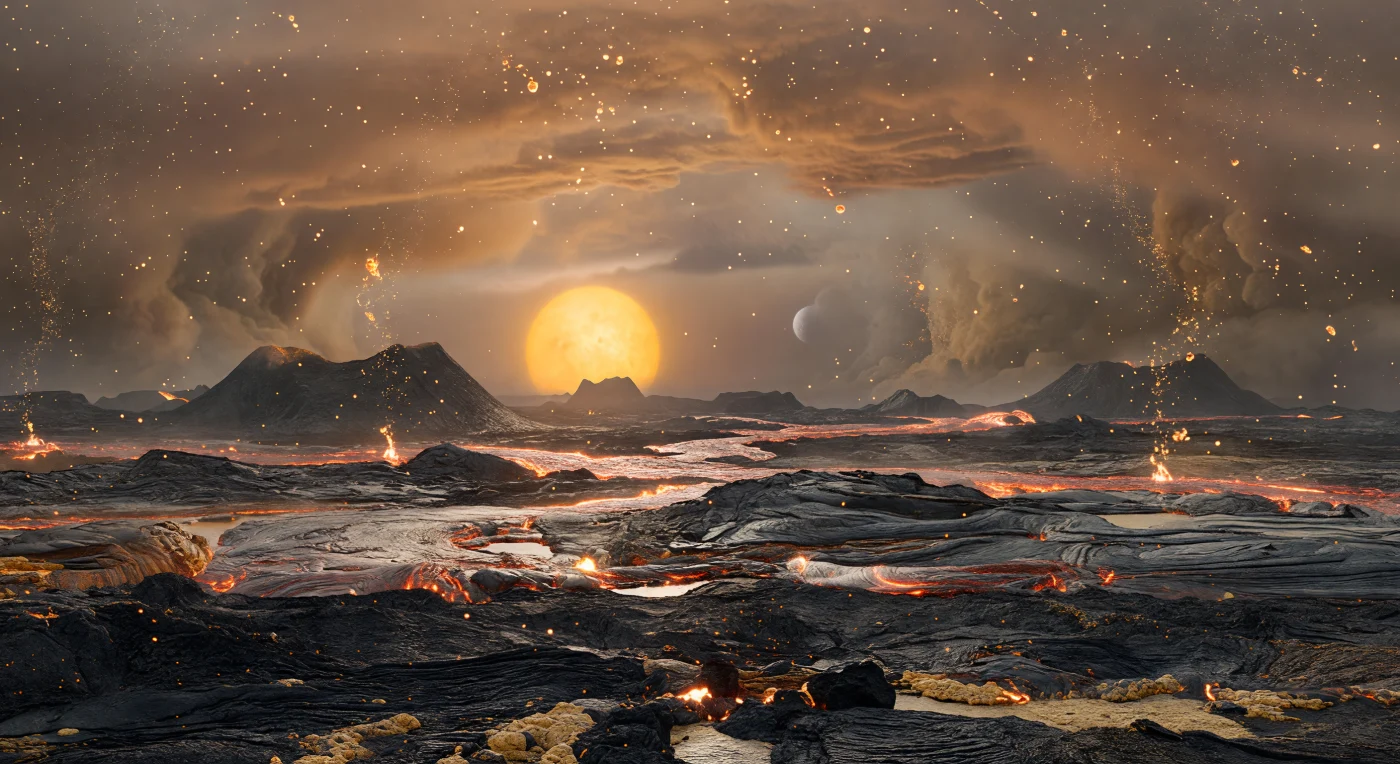
At the edge of the eternal dayside, a global storm of rock vapor and mineral ash rolls across a dark volcanic plain, turning the enormous nearby star into a smeared amber disk behind copper-gray haze. Under crushing gravity, the surface looks squat and heavy: black basalt, ultramafic lava crust, pressure ridges, shattered clinker, and obsidian-glazed sheets are dusted in ash-gray, ochre, and bronze condensates while sluggish channels of molten silicate glow orange to white through the cracks. The air itself is part of the geology here—a superheated, mineral-rich atmosphere where silicate aerosols scatter the light into dull gold and copper tones, softening shadows as fiery droplets of semi-molten rock fall like rain and burst into tiny luminous splashes. Low shield volcanoes, collapsed pits, and distant lava rivers fade into the storm wall, giving the scene an oppressive planetary scale that reflects the extreme conditions on a tidally locked super-Earth hot enough for stone to melt and enter the sky.

From this shattered plateau at eternal twilight, the ground is a dense mosaic of dark basalt slabs and black silicate glass, their polygonal fractures gleaming like obsidian where warm yellow-white starlight skims the surface at a near-horizontal angle. One half of the sky glows with a smoky amber haze of mineral vapor, while the other drops quickly into near-black, where the system’s giant companion appears as an extraordinarily bright, star-like beacon above plains of cooled lava and ash. Along the dayside horizon, deep orange-red lava lakes and incandescent volcanic ridges leak light through vast fissures and terraced breaks in the crust, hinting at rock hot enough to soften and melt under relentless irradiation. The immense gravity and extreme heat make everything feel brutally compact and massive—boulders squat low, cliffs look pressure-shattered rather than delicate, and the entire landscape seems forged from crushed basalt, glassy lava crust, and slowly convecting fire.