Scientific confidence: Speculative

From this vantage within the bloated upper atmosphere, there is no ground at all—only immense, continent-spanning decks of luminous haze flowing away in polished bands of champagne gold, ivory, and pale amber, their smooth brilliance broken by jet-stream ribbons, scalloped shear lines, braided turbulence, and towering storm walls that rise like mountain ranges made entirely of cloud. These glowing plains are layers of hydrogen and helium loaded with vaporized metals and silicate condensates, where iron-bearing aerosols and mineral haze scatter the fierce white-yellow light of the nearby F-type star into a radiant, metallic mist. In the deeper troughs between brighter strata, the atmosphere falls away into darker veils, while isolated dense clumps and curling Kelvin–Helmholtz billows reveal winds racing at kilometers per second through a world locked under permanent day. Above it all, the swollen sky blazes white-gold rather than black, and the star hangs as an overlarge, searing disk, making the whole scene feel less like weather and more like standing over an incandescent ocean of vapor the size of a planet.

Beneath an enormous white-yellow stellar disk that looms nearly overhead, the atmosphere opens into a boundless expanse of cloud plains with no land, no ocean, and no true horizon—only the subtle curvature of a swollen gas giant vanishing into glare. The clouds below look strangely metallic, layered in silvery cream, pale brass, champagne gold, and faint copper, their smooth upper surfaces continually broken by continent-scale convective towers, scalloped bands, and deep troughs twisted by winds racing at several kilometers per second. In this ultra-hot, permanently sunlit sky, intense irradiation vaporizes refractory materials such as iron, enriching the hydrogen-helium atmosphere with metal-bearing vapor and condensate haze that scatter the light into a washed-out white-gold brilliance. Heat shimmer and refractive mirage make the far cloud decks seem to liquefy, giving the whole scene the unsettling feeling of hovering above a radiant furnace made entirely of storm, light, and vapor.

At the permanent boundary between blazing day and endless night, the atmosphere itself masquerades as terrain: a dark, undulating plateau of metallic haze and condensate clouds stretches away in charcoal, bronze, and gunmetal folds, split by chasms that reveal hotter, ember-red layers glowing far below. Across the mid-distance rises an immense shear wall of compressed storm towers and shredded cloud anvils, where iron-rich droplets begin to condense as gases rushing from the intensely heated hemisphere slam into cooler darkness at winds of several kilometers per second, twisting the clouds into braided jets, giant vortices, and rippling instability bands thousands of kilometers high. On one horizon, the white-yellow F-type star hangs forever low, warped by dense bronze haze and casting fierce metallic reflections across rain curtains and cloud tops; on the other, the sky falls abruptly into indigo and near-black, making the day-night divide feel like the edge of two different worlds. There is no ground here—only an inflated gas giant’s violent upper atmosphere, sculpted into vast suspended escarpments and planet-sized whirlpools, where vaporized metals, high-pressure haze, and liquid iron precipitation create a scene both beautiful and profoundly hostile.
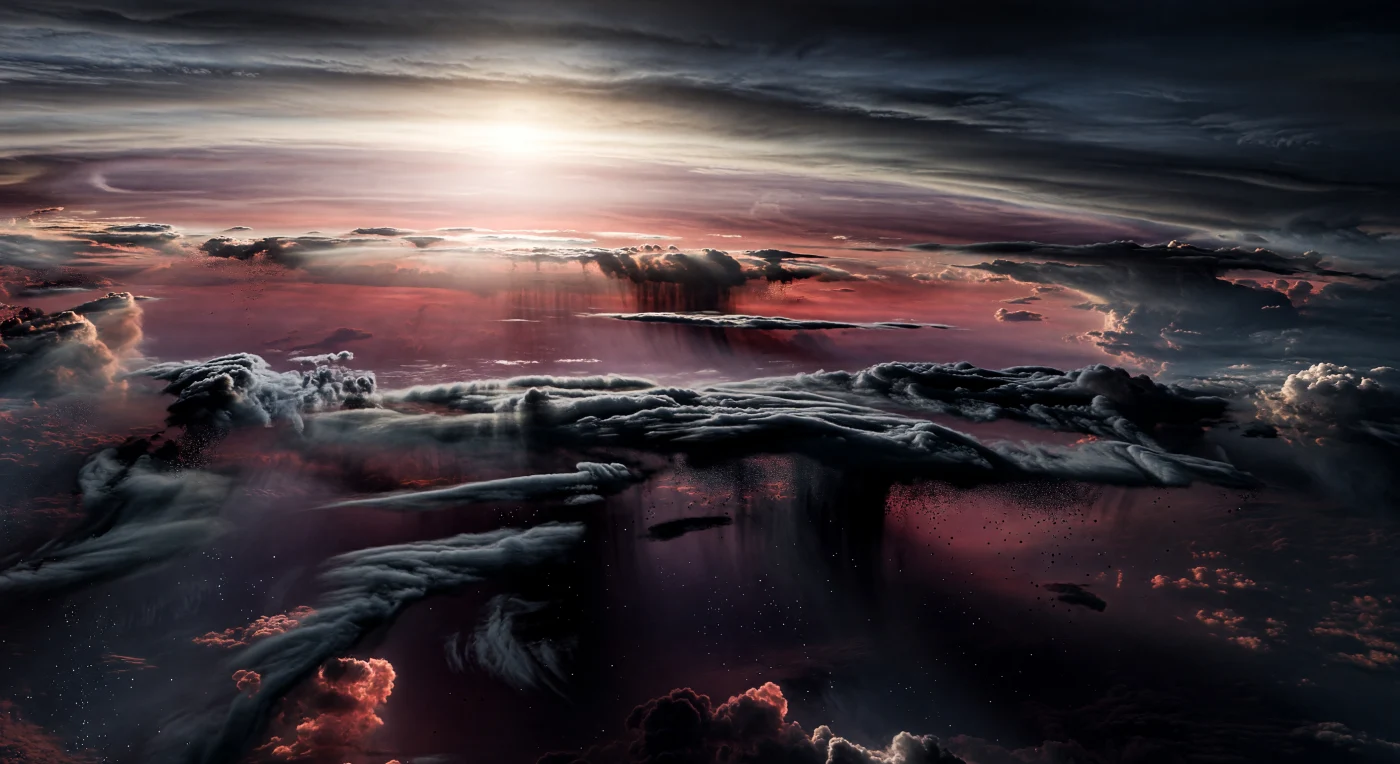
You appear to be suspended within a colossal twilight weather system, where no surface exists—only layer upon layer of atmosphere rolling away along the planet’s curved limb. Ahead, the dayside horizon burns as a white-gold band, and its sideways light catches towering gunmetal cloud banks and black-metal curtains of falling iron droplets, which condense here as vapor from the furnace-hot hemisphere is swept into cooler air by winds racing at several kilometers per second. Smoky violet, copper, and ember-red haze reveals immense shear waves, braided streamers, and eddies sculpted by those supersonic flows, while far below, a faint red thermal glow leaks up from deeper, hotter layers of the gas giant’s inflated atmosphere. The effect is both beautiful and hostile: storm walls hundreds of kilometers high loom like moving architecture, and the tiny-looking streaks of iron rain vanish into a darkness that is not night alone, but the descending depth of an alien sky.

Here, there is no ground at all—only a vast abyss of hydrogen and helium storm layers, carved into colossal black cloud canyons and towering, knife-edged walls by winds racing at kilometers per second across the permanent night side. From deeper, hotter levels of the atmosphere, a dim crimson furnace-glow seeps upward through the murk, revealing slanting sheets of metallic rain: iron that was vaporized on the scorching day side, carried around the planet, and condensed into liquid droplets in this cooler darkness. The air is thick with iron haze, mineral condensates, and smoky aerosols, so the sky remains utterly starless, swallowing distance until only maroon underlighting and brief iron-silver flashes mark the falling drops. Suspended in this lightless weather system, you would be surrounded by a continent-scale stormscape of heat, metal, and shadow, an alien atmosphere behaving less like sky than a deep, turbulent ocean turned inside out.

There is no ground here—only a descending abyss of atmosphere, where luminous crimson and burnt-orange gas glows from within and vast dark convective columns rise like continent-sized towers through the haze. In these deeper layers of an ultra-hot hydrogen-helium envelope, iron and other metals can exist as vapor, then condense into dense mineral and iron-rich mists that shred into drifting veils and re-evaporate as violent winds sweep them across the day–night boundary at several kilometers per second. The faint white-yellow star above is almost erased by the overlying murk, leaving the scene lit mainly by the planet’s own heat: a diffuse furnace glow that reveals black cloud chasms, bronze opacity, and blurred shadow lanes stretching through stacked atmospheric strata. Suspended within this roiling weather system, you would feel engulfed by a planet-wide metallic storm, an immense vertical wilderness of heat and turbulence extending for hundreds to thousands of kilometers in every direction.

You are suspended above no ground at all, only an immense atmospheric terrain of cloud decks and metallic haze stretched in ruler-straight ribbons to a vanishing horizon, where silver-gray, bronze, and gunmetal bands run for thousands of kilometers under fierce slanting light. These elongated filaments and rolling wave trains are the visible signature of an ultra-hot, tidally locked gas giant’s supersonic eastward jetstream, where extreme zonal shear sculpts laminar streaks, braided lanes, and Kelvin–Helmholtz-like ripples through iron-bearing vapor and mineral condensates. In the cooler reaches of this twilight corridor, fine shafts of liquid iron rain fall from sparse cloud layers into deeper copper-brown and charcoal atmospheres below, while towering cloud walls rise tens of kilometers like escarpments in a sky graded from white-gold glare toward smoky violet darkness. The nearby white-yellow star hangs low on the horizon, slightly swollen by the close orbit, casting hard metallic highlights across every filament and making the whole scene feel less like weather than a planet-sized river of glowing metal and wind.
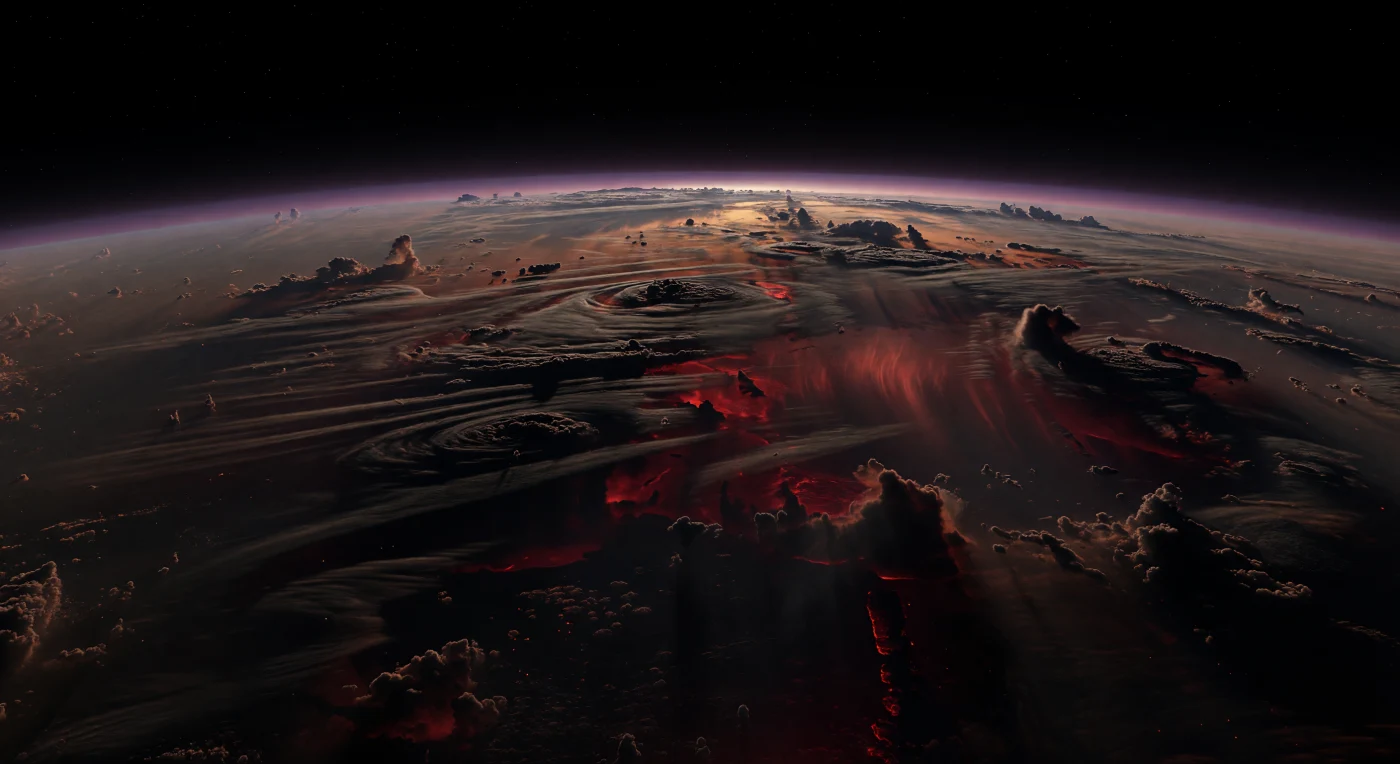
Suspended in a rare high-altitude clearing above the permanent night side, you would see no ground at all—only an immense, curved horizon of rust-black and gunmetal cloud tops stretching planet-wide beneath a nearly black sky, with a faint violet-magenta glow tracing the distant limb and a few stars showing through the thin haze. The clouds below are not gentle weather but iron-rich atmospheric bands sculpted by winds racing at kilometers per second, their flattened streaks, scalloped vortices, and towering plumes spanning continental scales across this bloated gas giant’s upper atmosphere. Through dark gaps in the deck, deeper and hotter layers radiate a deep crimson ember-light, so the whole scene seems lit from below by a buried furnace, with subtle veils of metallic precipitation descending into the darkness where vaporized metals likely condense on the cooler hemisphere. It is an alien weather world of heat, chemistry, and motion—an endless airborne abyss where thermal glow replaces sunlight and the true scale is measured not by mountains or seas, but by storms larger than worlds.
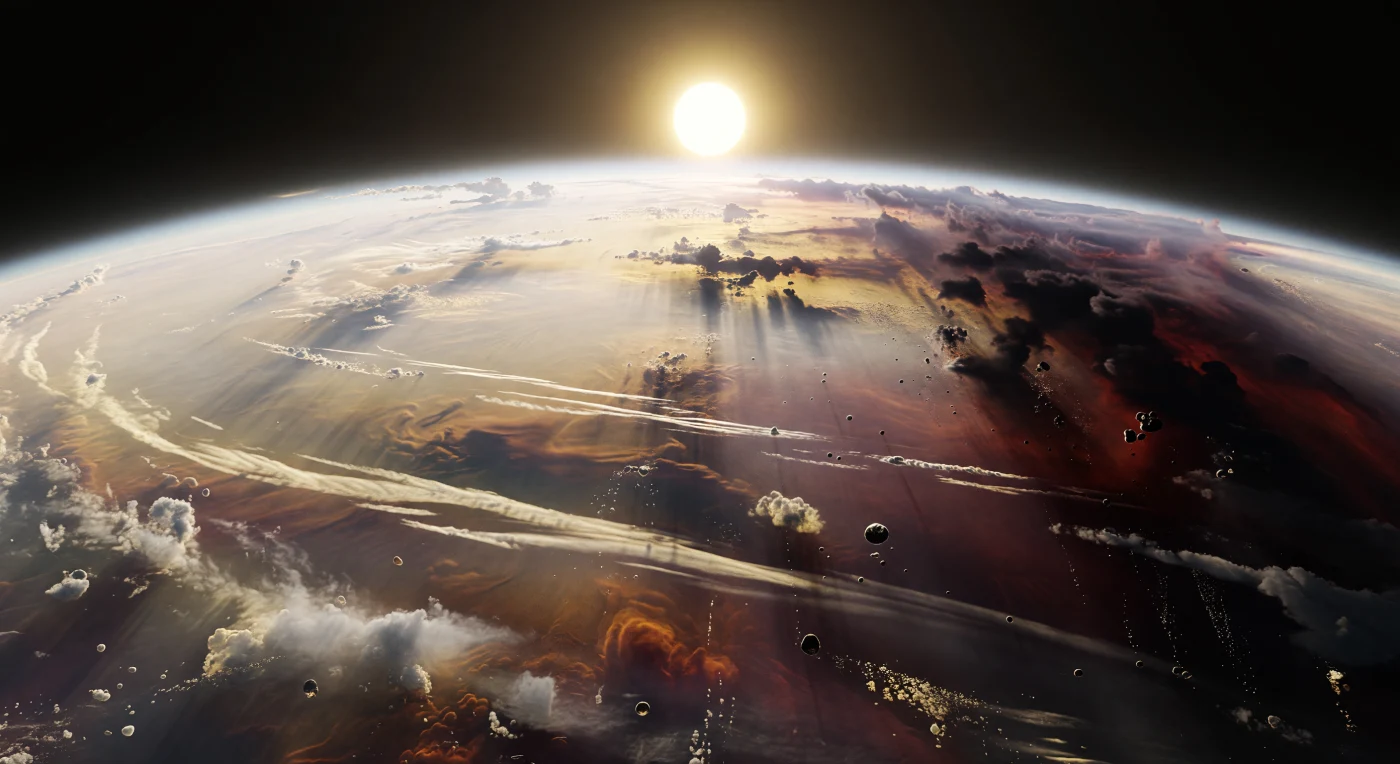
At the planet’s limb, the atmosphere itself becomes the landscape: immense stacked sheets of white-gold haze curve away beneath you, fading through amber, copper, and smoky violet into a night hemisphere stained black-red by deeper storm layers. Just beyond the horizon, the swollen F-type star blazes through the terminator, backlighting razor-thin cloud ribbons and scalloped wave bands sculpted by winds racing at several kilometers per second across this tidally locked ultra-hot Jupiter. There is no ground anywhere—only colossal atmospheric architecture in a bloated, low-density gas giant where silicate and metal vapors glow on the permanent day side, then cool and condense toward the dark side. In the deeper gloom, sparse curtains of storm cloud release reflective streaks of liquid iron rain, a metallic weather falling through an abyss so vast that entire cloud anvils seem continental against the planet’s luminous curved edge.
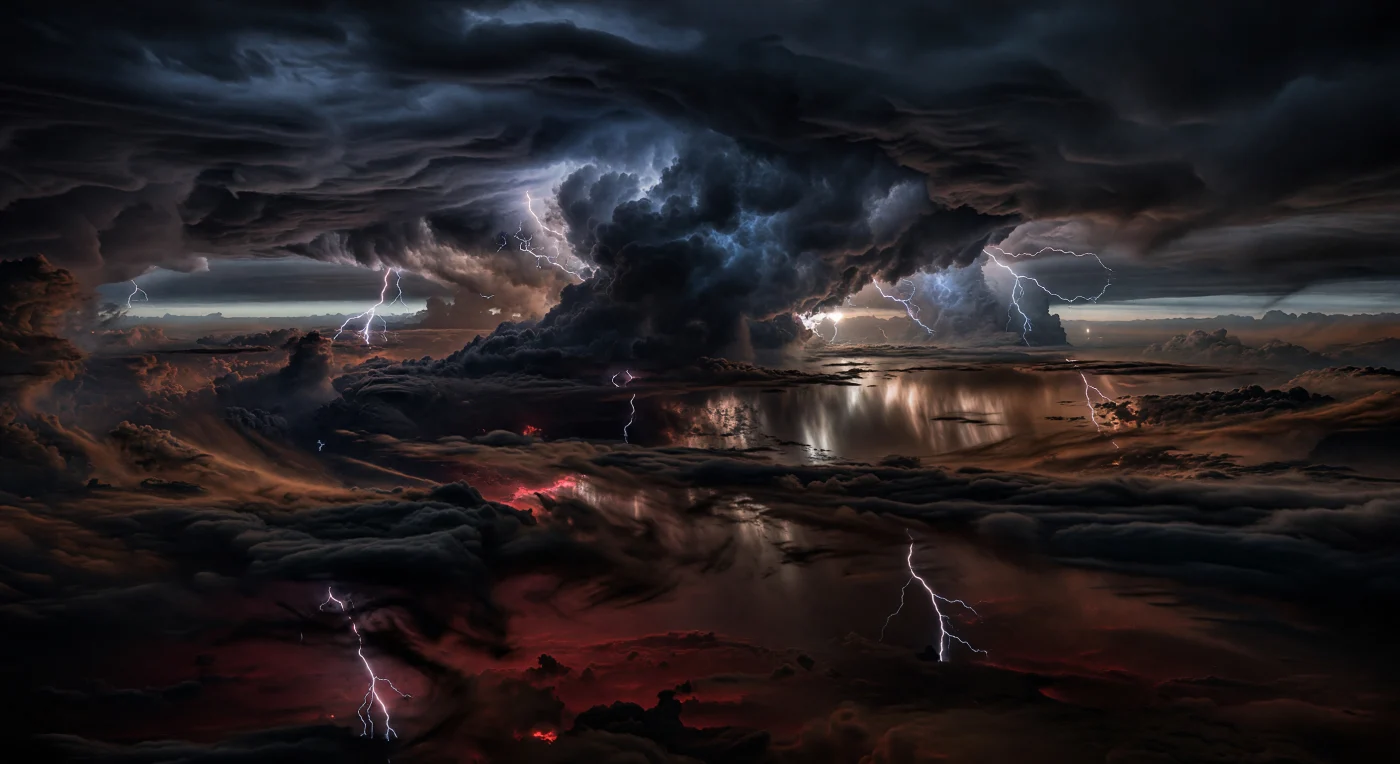
There is no ground here—only a plunging abyss of atmosphere, where colossal indigo-black storm towers surge upward and downward through layers of hydrogen, helium, and metallic vapor, their flanks briefly carved into view by blue-white lightning. In the foreground, rust-brown iron-condensate clouds and dark metallic haze are shredded into streamers by winds racing at kilometers per second, while shimmering curtains of liquid iron fall from cooler decks above and fade into the deeper heat below, where they can partially re-vaporize. The dim ember-red glow rising from beneath is the radiance of hotter atmospheric layers, underlighting the storm vault in crimson and bronze and emphasizing that this is an ultra-hot gas giant with no solid surface, only immense convective structure hundreds of kilometers tall. Far off, a faint twilight band marks the transition toward the permanently daylit hemisphere, but overhead the opaque canopy swallows the stars, leaving you suspended inside a thunderous, metallic night unlike anything in the Solar System.