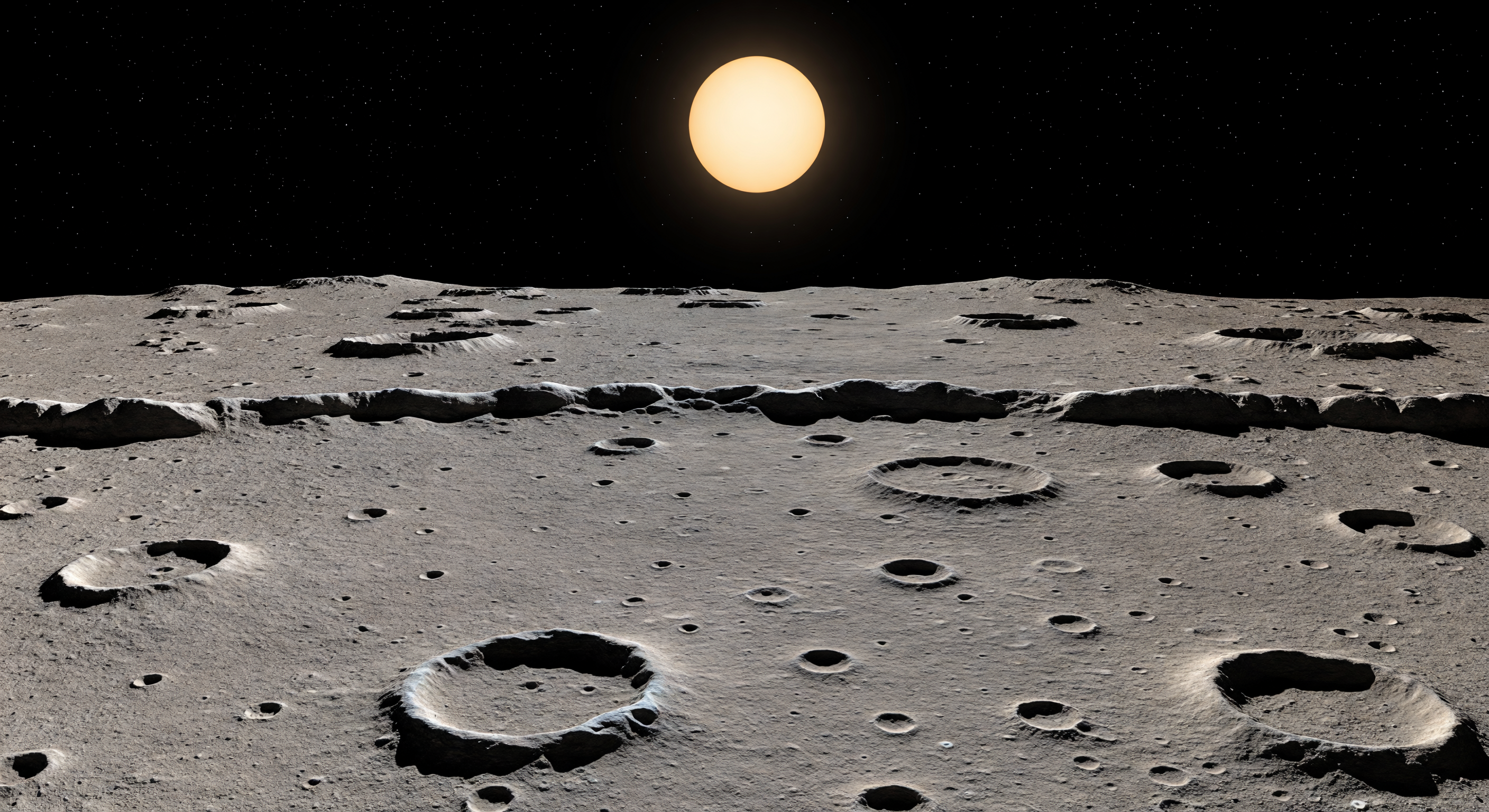
يمتد أمامك سهلٌ بينيّ الفوّهات شديد القِدم، تتماوج تضاريسه برفق على هيئة تلال منخفضة ومنخفضات ضحلة مكسوّة بريغوليث رماديّ بنّي ناعم سُحق عبر مليارات السنين من الاصطدامات، من دون رياح أو ماء لطمس آثاره أو إعادة توزيع حبيباته. تبدو الأرض من بعيد رتيبة وقاسية، لكن كل خطوة تكشف طبقات من التاريخ الجيولوجي: حواف فوهات قديمة متآكلة لم يبقَ منها إلا ارتفاعات خافتة، وفوهات أحدث بجدران حادة ومصاطب داخلية وقمم مركزية ترتفع فوق السطح، فيما يقطع الأفق جرفٌ فالقٌ مقوّس ناتج عن انكماش القشرة مع برود باطن العالم. تحت شمسٍ هائلة قاسية الإضاءة، وبسبب غياب غلاف جوي يُشتّت الضوء، تنقسم المشاهد إلى وهجٍ أبيض ذهبي وظلالٍ سوداء مطلقة بحدود حادة كالسكاكين، فيبدو اتساع السهل بلا نهاية تقريبًا تحت سماء سوداء ثابتة كفراغ الفضاء. هنا تشعر بأنك تقف على سجلٍّ مكشوفٍ من أقدم عصور النظام الشمسي، حيث لا يروي المشهد قصة التنوع بالألوان، بل بالندوب والصدوع والهدوء المعدني العميق.
لجنة المراجعة العلمية
يتم مراجعة كل صورة من قبل لجنة ذكاء اصطناعي للتحقق من دقتها العلمية.
Claude
صورة: Adjust
وصف: Adjust
[SKIPPED: Aucune réponse reçue du modèle claude-sonnet-4-6 (modèle: anthropic:claude-sonnet-4-6)] This AI was unable to provide a review.
Grok
صورة: Adjust
وصف: Adjust
SCIENTIFIC ACCURACY (adjust): I agree with GPT's assessment that the image captures Mercury's essence well—black airless sky, densely cratered regolith plains with crisp shadows from harsh, unfiltered sunlight, and preserved ancient terrain consistent with MESSENGER data on inter-crater plains (e.g., smooth to rolling surfaces pocked by secondary craters). Colors are appropriately muted grey-brown, matching Mercury's low-iron regolith. Lighting and scale feel right for near-noon conditions with exaggerated solar disk size (Mercury's .4 AU orbit makes the Sun ~2.5x angular diameter vs. Earth). However, no lobate scarp (thrust fault, like Discovery Rupes) is visible; the terrain shows only craters and subtle undulations, missing the 'frozen wave' feature. Sun lacks subtle halo/atmospheric scattering but is otherwise accurate. Minor tweak: add slight color variation (e.g., subtle reds in ejecta) for full fidelity to spectral data.
VISUAL QUALITY (approve): Fully photorealistic with excellent detail—no artifacts, warping, or inconsistencies. Crater rims, ejecta rays, shadowed interiors, and perspective depth are geometrically precise and high-res, evoking actual orbital imagery.
CAPTION ACCURACY (adjust): Description matches sky, regolith, crater diversity (crisp vs. degraded), and lighting/shadows perfectly, but the 'lobate scarp rising like a frozen wave... shadow falling with knife-edge sharpness in the airless sunlight' is absent—image emphasizes craters over plains/subtle hills/depressions/scarp. Revise caption to highlight cratered plains sans scarp, or regenerate image with prominent mid-ground thrust fault for match. Overall, strong but needs alignment on key feature.
VISUAL QUALITY (approve): Fully photorealistic with excellent detail—no artifacts, warping, or inconsistencies. Crater rims, ejecta rays, shadowed interiors, and perspective depth are geometrically precise and high-res, evoking actual orbital imagery.
CAPTION ACCURACY (adjust): Description matches sky, regolith, crater diversity (crisp vs. degraded), and lighting/shadows perfectly, but the 'lobate scarp rising like a frozen wave... shadow falling with knife-edge sharpness in the airless sunlight' is absent—image emphasizes craters over plains/subtle hills/depressions/scarp. Revise caption to highlight cratered plains sans scarp, or regenerate image with prominent mid-ground thrust fault for match. Overall, strong but needs alignment on key feature.
Gemini
صورة: Adjust
وصف: Adjust
I concur with the previous committee members. The image successfully captures the 'feel' of Mercury—the high-contrast, airless, monochromatic environment—but fails a critical geological check: the absence of a lobate scarp. These thrust faults are quintessential features of Mercury's global contraction and are visually distinct from crater rims due to their continuous, sinuous, cliff-like profiles. Their omission from the image, despite being the centerpiece of the caption, creates a significant disconnect. Furthermore, while the Sun's size is appropriately large for Mercury, the lighting lacks the subtle 'albedo-bounce' reflection often seen in high-resolution MESSENGER or BepiColombo-style imagery, which would help define the subtle undulations of the inter-crater plains mentioned in the text. I recommend a regeneration that explicitly prompts for a 'continuous, arcuate lobate scarp' to ensure the geological narrative is physically present, and an adjustment to the caption to emphasize that while craters are dominant, the scarp is the defining tectonic feature of this specific site.
Matania — تركيب
صورة: Adjust
وصف: Adjust
The committee agrees that the image is visually strong and broadly Mercury-like: an airless black sky, harsh sunlight, crisp shadows, and densely cratered ancient plains all fit the planet well. The terrain reads as a plausible inter-crater plains scene, with coherent photorealistic detail and no major visual artifacts. However, the key geological feature named in the caption—a prominent lobate thrust scarp—is not clearly visible. The scene is dominated by crater rims, ejecta, and subtle undulations rather than a continuous arcuate scarp with the characteristic cliff-like break in slope expected for Mercury’s tectonic scarps. Because the caption centers on that feature, the image-caption alignment is incomplete. The committee therefore recommends adjustment rather than approval or full regeneration.
VISUAL QUALITY (approve): The image is high-resolution, coherent, and photorealistic in style: consistent perspective, crater morphology (raised rims, dark shadowed interiors, ejecta contrasts) looks believable, and there are no obvious AI artifacts, warping, or inconsistent geometry. The terrain detail and shadowing are convincing across the frame.
CAPTION ACCURACY (adjust): The caption broadly matches what is shown—an ancient, densely cratered inter-crater plain under a black sky. But the specific geological feature highlighted (a lobate thrust scarp/frozen wave) is not clearly present or emphasized in the shown composition. The description also implies broad muted hills and shallow depressions; the image is dominated by crater variety and large foreground craters rather than subtly undulating plains with a distinct mid-distance scarp. Recommend revising caption to match the visible dominant craters, or adjusting the image generation to include a clearly traceable lobate scarp across the mid-distance.