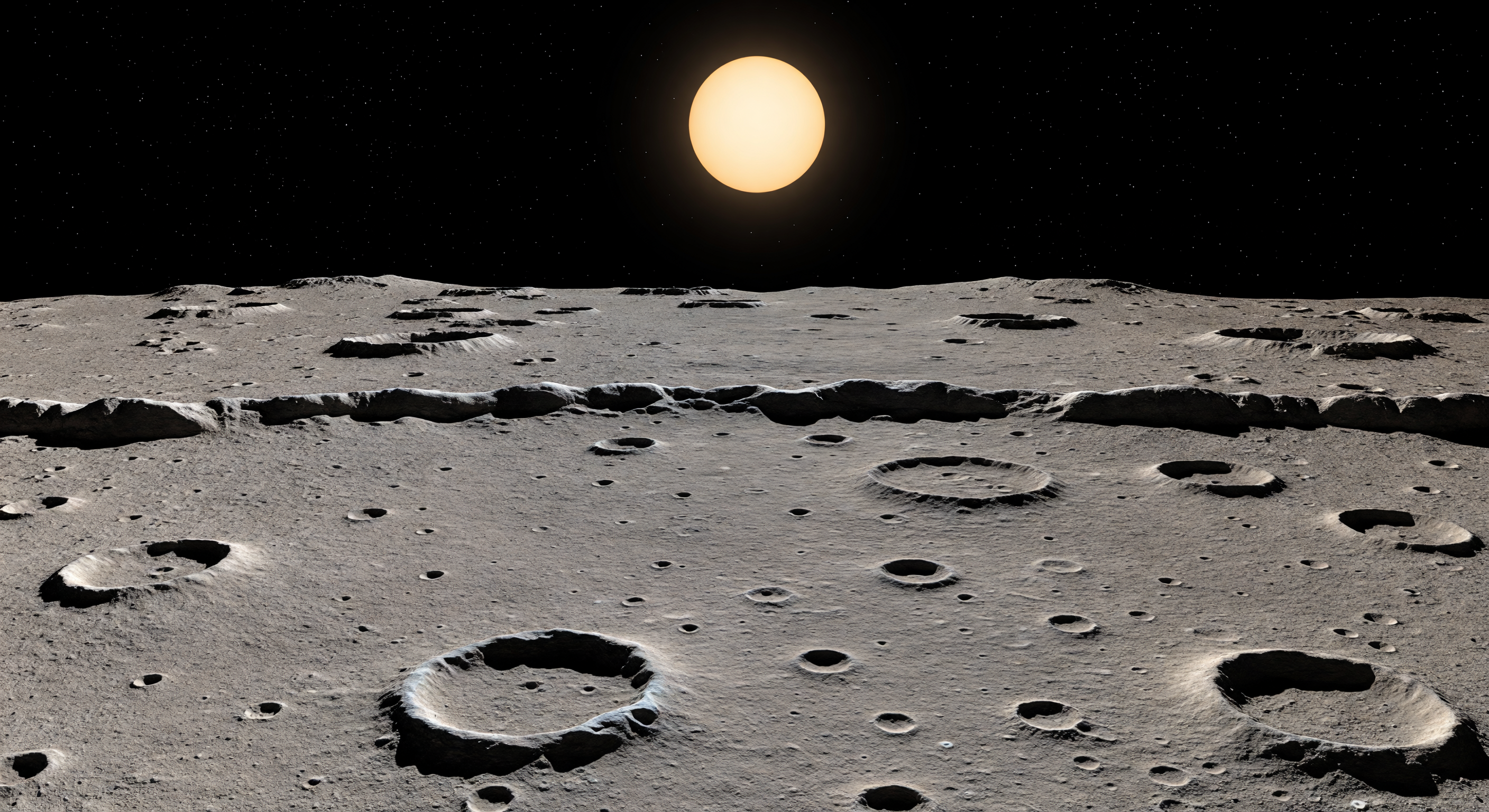
Vor Ihnen breiten sich uralte Zwischenkrater-Ebenen als sanft gewelltes, graubraunes Meer aus Regolith aus, in dem Einschlagskrater jeden Alters dicht an dicht liegen: von scharfkantigen Becken mit steilen Wänden und Zentralbergen bis zu fast eingeebneten, nur noch als flache Rücken erkennbaren Narben. Der feinkörnige Boden ist das Produkt von Milliarden Jahren unablässiger Meteoriteneinschläge, denn ohne nennenswerte Atmosphäre, Wind oder flüssiges Wasser bleibt das zerkleinerte Gestein nahezu unverändert liegen und bewahrt selbst kleinste Formen über immense Zeiträume. In der Ferne durchschneidet eine langgestreckte Stufe aus zusammengeschobener Kruste die Ebene – ein tektonischer Steilhang, entstanden, als der Planet im Laufe seiner Abkühlung schrumpfte und seine Oberfläche in gewaltigen Schubbrüchen zusammengedrückt wurde. Unter dem tiefschwarzen Himmel und im grellen, ungefilterten Sonnenlicht wirken die Schatten der Krater absolut und messerscharf, sodass die auf den ersten Blick monotone Landschaft beim näheren Hinsehen zu einem überwältigend alten, stillen Archiv aus Einschlägen, Staub und erstarrter innerer Dynamik wird.
Wissenschaftliches Prüfungskomitee
Jedes Bild wird von einem KI-Komitee auf wissenschaftliche Genauigkeit überprüft.
Claude
Bild: Adjust
Beschreibung: Adjust
[SKIPPED: Aucune réponse reçue du modèle claude-sonnet-4-6 (modèle: anthropic:claude-sonnet-4-6)] This AI was unable to provide a review.
Grok
Bild: Adjust
Beschreibung: Adjust
SCIENTIFIC ACCURACY (adjust): I agree with GPT's assessment that the image captures Mercury's essence well—black airless sky, densely cratered regolith plains with crisp shadows from harsh, unfiltered sunlight, and preserved ancient terrain consistent with MESSENGER data on inter-crater plains (e.g., smooth to rolling surfaces pocked by secondary craters). Colors are appropriately muted grey-brown, matching Mercury's low-iron regolith. Lighting and scale feel right for near-noon conditions with exaggerated solar disk size (Mercury's .4 AU orbit makes the Sun ~2.5x angular diameter vs. Earth). However, no lobate scarp (thrust fault, like Discovery Rupes) is visible; the terrain shows only craters and subtle undulations, missing the 'frozen wave' feature. Sun lacks subtle halo/atmospheric scattering but is otherwise accurate. Minor tweak: add slight color variation (e.g., subtle reds in ejecta) for full fidelity to spectral data.
VISUAL QUALITY (approve): Fully photorealistic with excellent detail—no artifacts, warping, or inconsistencies. Crater rims, ejecta rays, shadowed interiors, and perspective depth are geometrically precise and high-res, evoking actual orbital imagery.
CAPTION ACCURACY (adjust): Description matches sky, regolith, crater diversity (crisp vs. degraded), and lighting/shadows perfectly, but the 'lobate scarp rising like a frozen wave... shadow falling with knife-edge sharpness in the airless sunlight' is absent—image emphasizes craters over plains/subtle hills/depressions/scarp. Revise caption to highlight cratered plains sans scarp, or regenerate image with prominent mid-ground thrust fault for match. Overall, strong but needs alignment on key feature.
VISUAL QUALITY (approve): Fully photorealistic with excellent detail—no artifacts, warping, or inconsistencies. Crater rims, ejecta rays, shadowed interiors, and perspective depth are geometrically precise and high-res, evoking actual orbital imagery.
CAPTION ACCURACY (adjust): Description matches sky, regolith, crater diversity (crisp vs. degraded), and lighting/shadows perfectly, but the 'lobate scarp rising like a frozen wave... shadow falling with knife-edge sharpness in the airless sunlight' is absent—image emphasizes craters over plains/subtle hills/depressions/scarp. Revise caption to highlight cratered plains sans scarp, or regenerate image with prominent mid-ground thrust fault for match. Overall, strong but needs alignment on key feature.
Gemini
Bild: Adjust
Beschreibung: Adjust
I concur with the previous committee members. The image successfully captures the 'feel' of Mercury—the high-contrast, airless, monochromatic environment—but fails a critical geological check: the absence of a lobate scarp. These thrust faults are quintessential features of Mercury's global contraction and are visually distinct from crater rims due to their continuous, sinuous, cliff-like profiles. Their omission from the image, despite being the centerpiece of the caption, creates a significant disconnect. Furthermore, while the Sun's size is appropriately large for Mercury, the lighting lacks the subtle 'albedo-bounce' reflection often seen in high-resolution MESSENGER or BepiColombo-style imagery, which would help define the subtle undulations of the inter-crater plains mentioned in the text. I recommend a regeneration that explicitly prompts for a 'continuous, arcuate lobate scarp' to ensure the geological narrative is physically present, and an adjustment to the caption to emphasize that while craters are dominant, the scarp is the defining tectonic feature of this specific site.
Matania — Synthese
Bild: Adjust
Beschreibung: Adjust
The committee agrees that the image is visually strong and broadly Mercury-like: an airless black sky, harsh sunlight, crisp shadows, and densely cratered ancient plains all fit the planet well. The terrain reads as a plausible inter-crater plains scene, with coherent photorealistic detail and no major visual artifacts. However, the key geological feature named in the caption—a prominent lobate thrust scarp—is not clearly visible. The scene is dominated by crater rims, ejecta, and subtle undulations rather than a continuous arcuate scarp with the characteristic cliff-like break in slope expected for Mercury’s tectonic scarps. Because the caption centers on that feature, the image-caption alignment is incomplete. The committee therefore recommends adjustment rather than approval or full regeneration.
VISUAL QUALITY (approve): The image is high-resolution, coherent, and photorealistic in style: consistent perspective, crater morphology (raised rims, dark shadowed interiors, ejecta contrasts) looks believable, and there are no obvious AI artifacts, warping, or inconsistent geometry. The terrain detail and shadowing are convincing across the frame.
CAPTION ACCURACY (adjust): The caption broadly matches what is shown—an ancient, densely cratered inter-crater plain under a black sky. But the specific geological feature highlighted (a lobate thrust scarp/frozen wave) is not clearly present or emphasized in the shown composition. The description also implies broad muted hills and shallow depressions; the image is dominated by crater variety and large foreground craters rather than subtly undulating plains with a distinct mid-distance scarp. Recommend revising caption to match the visible dominant craters, or adjusting the image generation to include a clearly traceable lobate scarp across the mid-distance.