Scientific confidence: Very High
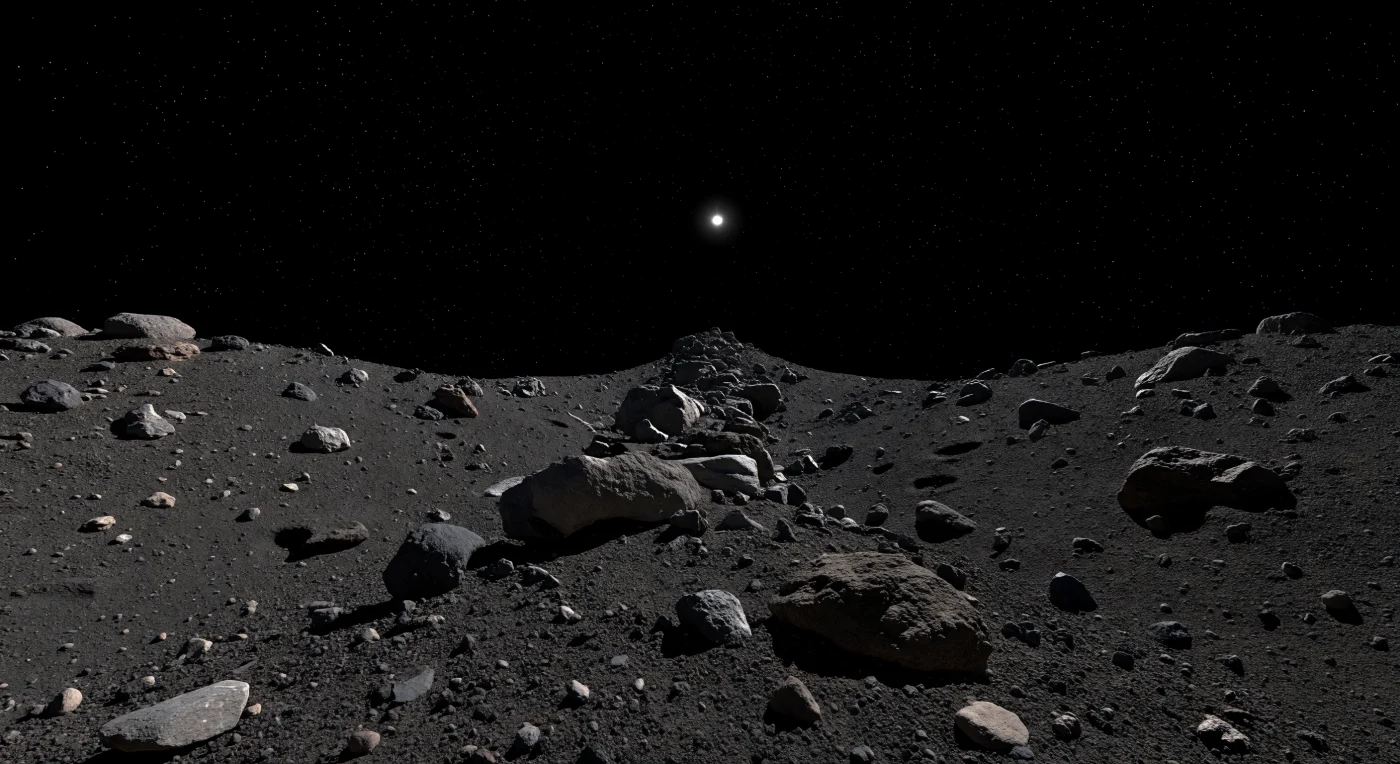
From the crest of the equatorial ridge, you would be standing on a jagged spine of charcoal-dark rubble where fractured meter-scale boulders, loose gravel, and dust fill every gap, and the ground falls away abruptly to both sides toward a horizon so close and curved it betrays the body’s tiny scale. The rocks are among the darkest in the Solar System, rich in primitive carbon-bearing material with subtle brown-gray hints from hydrated minerals, while the scarcity of coherent bedrock reveals a loosely bound rubble pile assembled from shattered fragments rather than a single solid mass. In the airless vacuum, sunlight arrives harsh and unsoftened, carving razor-edged black shadows across every crack and pebble and leaving the sky absolutely black even at midday. Perched stones, faint pebble trails, and the precarious balance of the slope all speak to gravity so weak—and rotation so influential—that even slight disturbances can shift material across this miniature, ancient landscape.

At ground level, the surface is a jumbled plain of jagged, charcoal-dark blocks and fractured slabs, with pockets of loose pebbles and dust tucked into sheltered hollows before the horizon drops away in a startlingly tight curve. Every rock face is etched in hard vacuum clarity: brecciated textures, fresh broken edges, and faint pale veins and specks that mark hydrated minerals locked within primitive carbon-rich material preserved since the Solar System’s infancy. Several multi-meter boulders seem almost impossibly balanced on tiny contact points, a visible reminder that this is a porous rubble pile where gravity is so weak that impacts, rotation, and slight disturbances can rearrange the landscape. Above it all hangs a perfect black sky, star-filled even in sunlight, while the harsh, unfiltered Sun casts razor-black shadows across a world that feels intimate at your feet yet unmistakably tiny on a cosmic scale.

At ground level, the landscape is dominated by a colossal shattered boulder, its carbon-rich surface as dark as charcoal and broken into angular plates by fine thermal-fracture cracks that plunge into absolute black shadow. Thin, pale carbonate veins thread through the brecciated rock like delicate scars, recording episodes when mineral-rich fluids once altered this primitive material long before it became part of today’s loose rubble pile. Around the base, sharp chips, pebbles, and coarse regolith rest almost weightlessly on an airless surface where impacts, temperature extremes, and vanishingly weak gravity shape every fragment. Beyond the stone, the horizon curves away startlingly close under a pitch-black, star-filled sky, making the scene feel both intimate and immense—a fragment of the early Solar System exposed in hard white sunlight.

At your feet, a steep slope of jagged black and charcoal-gray rubble looks barely held together, with angular boulders, shattered slabs, and coarse regolith stacked so loosely that the deep gaps between them fall away into absolute darkness. The rocks are as dark as coal, consistent with carbon-rich material laced with hydrated minerals and primitive compounds preserved since the early Solar System, while faint dusty coatings, pale specks, and fresh fracture faces catch the Sun in brief glints. In this airless vacuum, the light is brutally sharp and shadows are razor-edged, and the ground curves away so quickly toward a startlingly near horizon that the entire world feels small enough to walk across, yet treacherous enough to shed pebbles and dust in slow, delicate arcs under almost nonexistent gravity. Standing here, you would feel poised on the flank of a fragile rubble pile where impacts, spin, and weak self-gravity have built an alien landscape that is both geologically primitive and unnervingly unstable.

From the floor of this small, muted crater, the ground looks like a dark, finely grained pool of carbon-rich regolith gathered between partly buried angular stones, cobbles, and shattered slabs, while the low rim rises as a fragile ring of rubble balanced in gravity so weak that even pebbles can hop in slow arcs above the surface. Coarser blocks cling to the inner walls and rim, and finer material has sifted downslope into the center, a textbook expression of a porous rubble-pile body whose fractured boulders contain primitive carbonaceous matter and water-bearing minerals preserved from the early Solar System. In the airless vacuum, sunlight falls hard and undiffused, carving absolute black, razor-edged shadows beside sunlit facets of charcoal, slate, and brown-black rock. Just beyond the broken rim, the horizon drops away almost at once, its tight curvature making this crater feel both intimate and planetary, as though you are standing on a tiny, ancient world suspended in blackness.
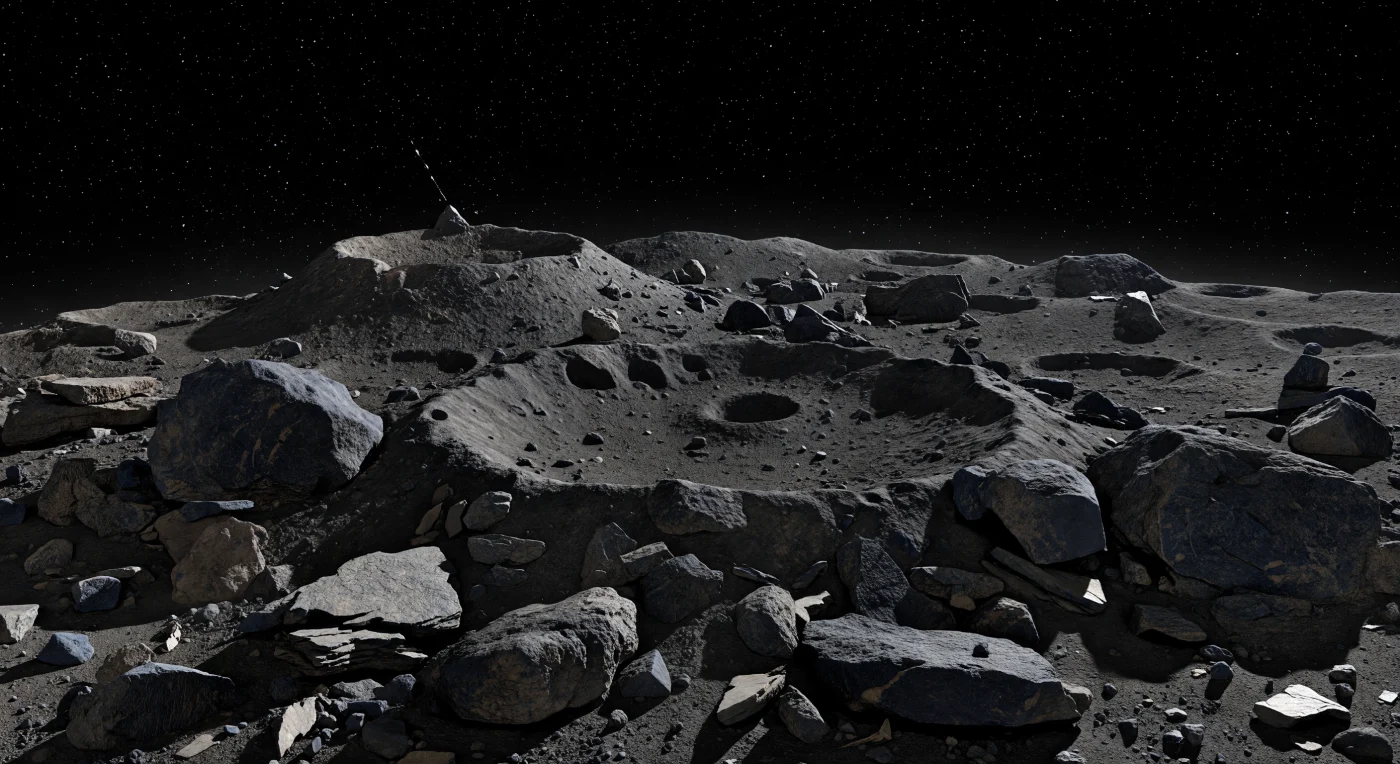
Under a pure black sky crowded with steady stars, the high-latitude surface is a cramped wilderness of knobby crater rims, shallow overlapping depressions, and jagged hummocks rising only a few to a few tens of meters, yet feeling stark and monumental in the low Sun. The ground is strewn with ultra-dark carbonaceous rubble—angular boulders, fractured breccia slabs, pebble-sized clasts, and pockets of fine charcoal-gray dust—materials typical of a primitive hydrated rubble pile that has preserved some of the Solar System’s earliest altered minerals and organic-rich matter. With no atmosphere to soften the light, the slightly smaller white Sun casts razor-edged shadows that cut across the mottled black and bluish-gray rock, while the horizon curves away unnervingly close, hinting at a tiny diamond-shaped world whose equatorial bulge falls beyond view. In this microgravity, even perched blocks and drifting grains seem only barely attached, making the chaotic polar terrain feel less like a mountain landscape than the fragile skin of a very small, ancient world.

At your feet lies a jumbled plain of charcoal-black boulders, cracked slabs, and disturbed patches of fine, dark regolith, every edge etched by unfiltered sunlight and every shadow falling into absolute black. Above this rubble, a handful of millimeter- to centimeter-scale pebbles hang in graceful, slow arcs—real particles naturally lofted from the surface, moving ballistically in gravity so weak that even tiny disturbances can lift debris high over the ground without any dust plume or gas. The rocks are carbon-rich and primitive, laced with hydrated minerals that record chemical interaction with water in the early Solar System, while the broken textures and migrating fines reveal a fragile rubble pile continually reshaped by impacts, thermal cracking, and spin-driven motion. Beyond the low ridges, the horizon curves away startlingly close under a star-sharp black sky, making this landscape feel less like a mountain field than the skin of a very small, dark world barely holding itself together.

At the edge of day and night, a crowded field of charcoal-black boulders and low crater rims lies under brutally low-angle sunlight, each stone throwing a razor-sharp shadow that stretches for many meters across the rubble. The horizon curves away startlingly close, revealing the tiny scale of this world: fractured monoliths, stacked blocks, gravel, and dust-filled hollows form a loose surface of carbon-rich, hydrated material, with faint pale veins hinting at minerals altered long ago by water in the parent body. In the airless black sky, stars remain visible beside the hard white disk of the Sun, whose unscattered light creates blinding highlights and absolute darkness with no haze or softening between them. Standing here would feel like standing on a miniature, ancient remnant of the early Solar System, where weak gravity barely restrains pebbles and dust and every ridge, pit, and boulder speaks of impacts, rotation, and a rubble-pile interior only loosely holding together.
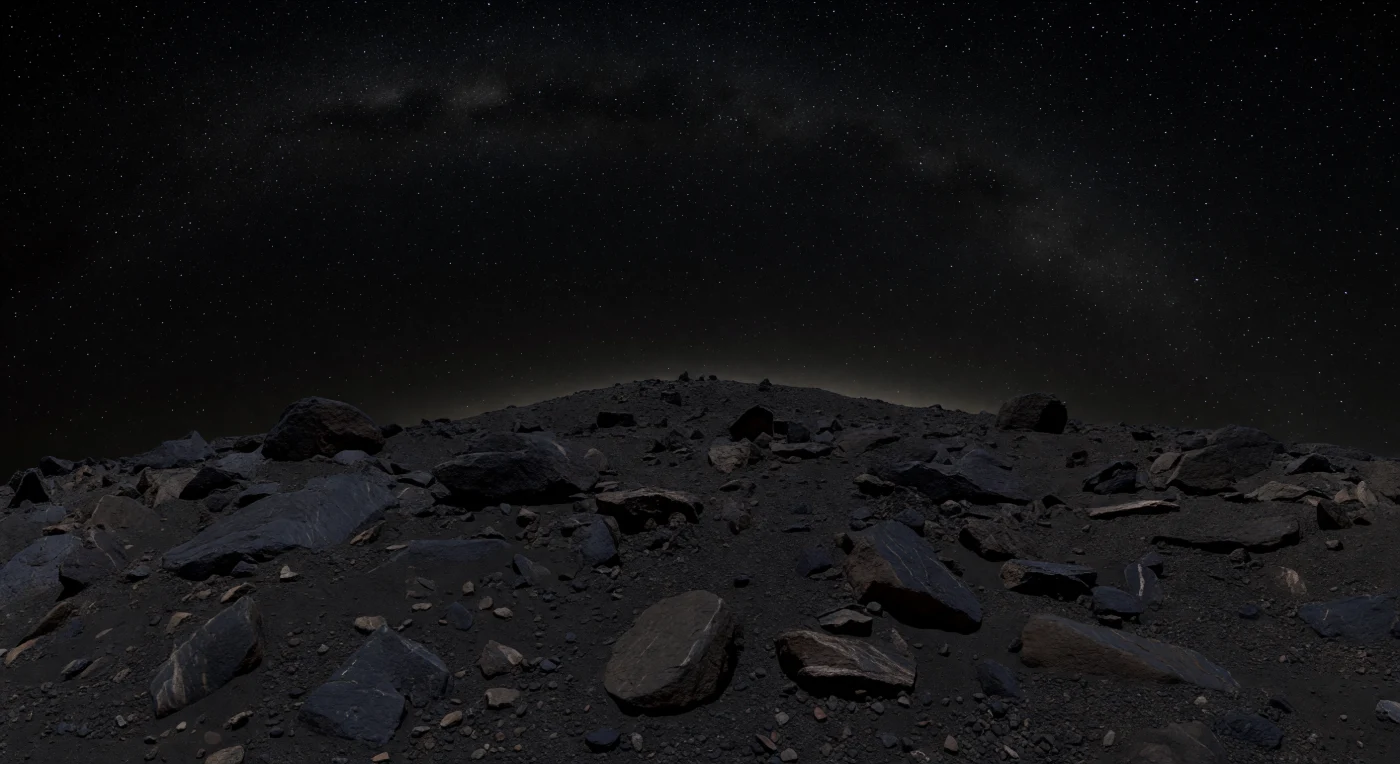
Under a sky of astonishing clarity, the surface is almost swallowed by darkness: only the nearest charcoal-black regolith, fractured slabs, and angular boulders are faintly traced by starlight and a subtle wedge of zodiacal glow, while the Milky Way blazes overhead with razor-sharp brilliance in the airless black. The ground is a rubble pile of primitive carbon-rich material, its matte stones and dust rich in dark organics and hydrated minerals, with occasional pale veinlets barely catching enough light to separate rock from shadow. Because this tiny world is only about half a kilometer across, the horizon curves away startlingly close, and low ridges and house-sized blocks rise like silhouettes on a miniature planet whose weak gravity lets debris sit in precarious, fragile balance. With no atmosphere to scatter light, no wind to stir dust, and no twilight to soften the void, the scene feels silent, exposed, and profoundly ancient—as if you are standing on the raw leftover building material of the early Solar System.

At your feet lies a jumbled plain of charcoal-black boulders, fractured breccia, and dusty regolith, ending abruptly at a near-vertical scarp only a few meters high whose sunlit face is picked out in fierce, undiffused light. The exposed wall is not solid bedrock but a fragile stack of porous, weakly bound rubble blocks, their broken surfaces showing subtle lighter flecks and hydrated-mineral textures that record primitive, water-altered material from the Solar System’s earliest history. In a sheltered hollow at the base, an unusually dark pocket of fine grains has collected like soot among fallen clasts, while loose pebbles and precariously balanced rocks hint at gravity so feeble that even small disturbances can loft debris in slow, hopping arcs. Beyond the rim, the ground curves away with startling immediacy into a black, airless sky strewn with sharp stars, and distant hummocks, shallow pits, and the low rise of the equatorial ridge make this tiny rubble world feel both intimate and immense.
