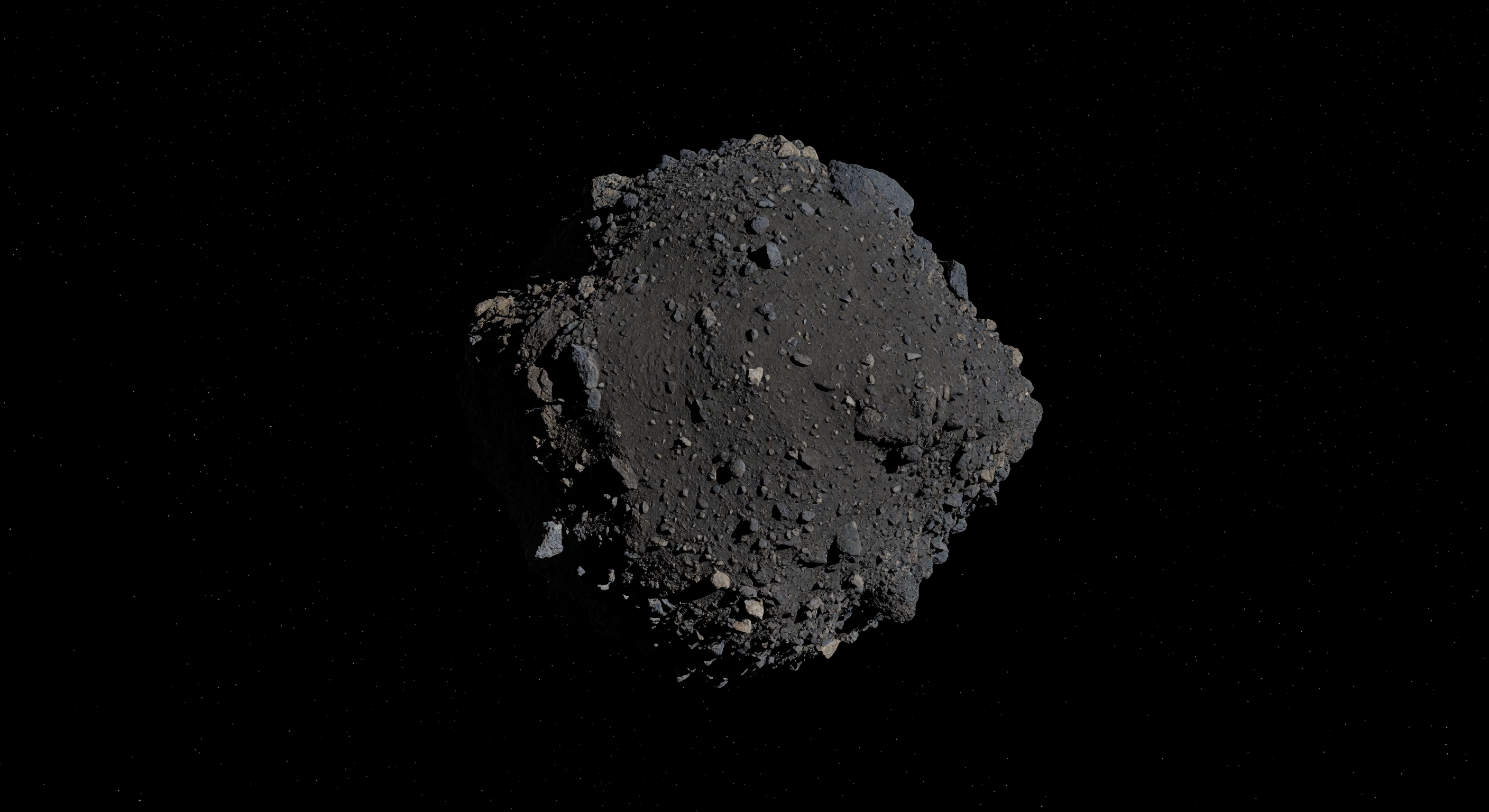
Scientific confidence: Very High

At ground level, the scene is a tight, almost tactile field of matte-black and charcoal boulders, their porous, fractured faces riddled with tiny pits, brittle flakes, and dust-filled cracks that low, undiffused sunlight throws into stark relief. Pebbles and coarse gravel lodge in the gaps between larger clasts, hinting at a surface made not of solid bedrock alone but of primitive carbon-rich rubble, rich in hydrated minerals and preserved from the earliest history of the Solar System. The terrain is only gently uneven, yet in this feeble gravity every precariously nested fragment suggests a world barely holding itself together, a loose aggregate of dark debris with vast empty space hidden within. Just beyond the rock garden, the ground curves away almost immediately beneath a perfectly black sky strewn with sharp stars, making the landscape feel both miniature and immense at once.
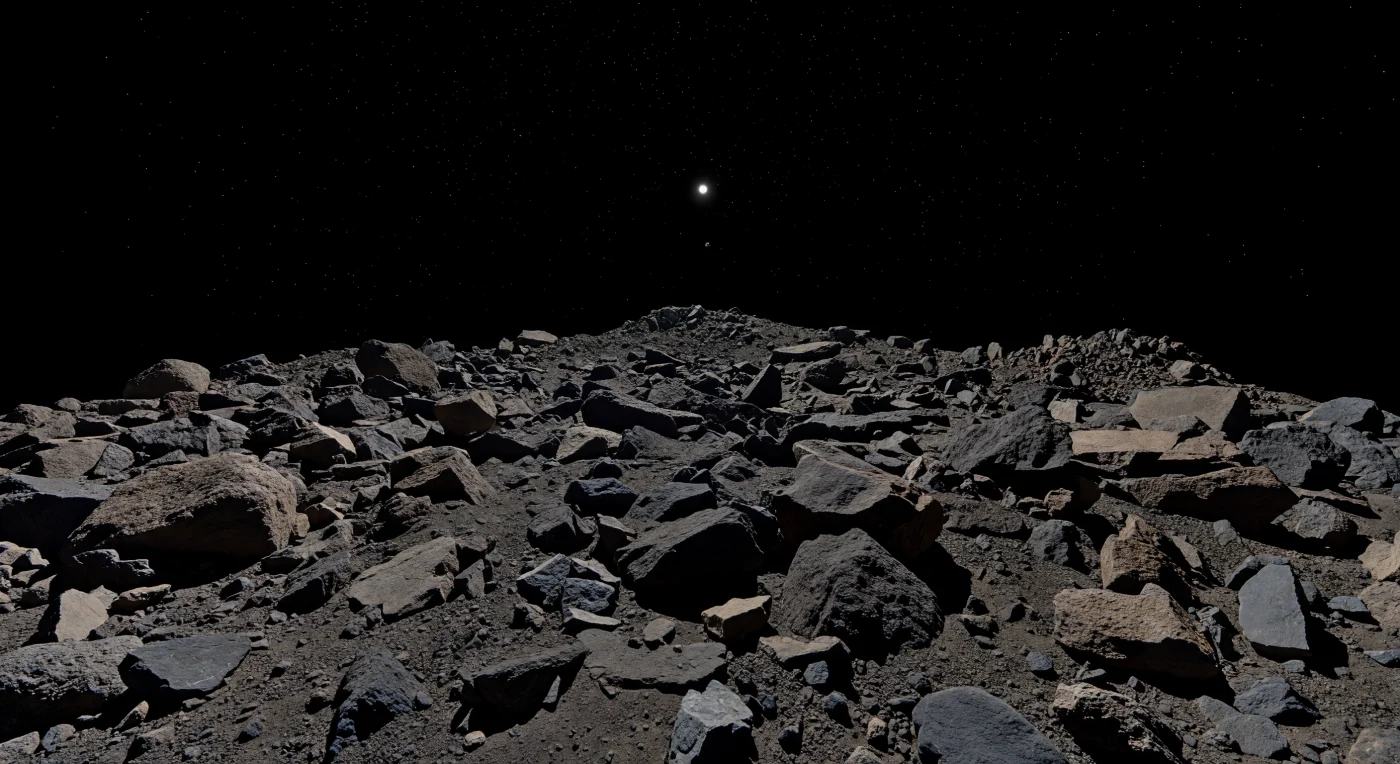
At ground level on the equatorial crest, the surface is a chaotic pavement of angular, charcoal-black boulders, fractured slabs, and pockets of coarse dark regolith, all curving away so quickly that the horizon feels only a few dozen meters distant. These matte, low-albedo rocks are primitive carbonaceous material rich in hydrated minerals and organic-bearing compounds, preserved from the early Solar System and broken into a fragile rubble pile by ancient disruption and reassembly. In the asteroid’s extraordinarily weak gravity, perched stones and loosely packed fragments seem barely anchored, while the small, hard white Sun throws perfectly sharp black shadows across every crack, pore, and jagged edge under a sky that remains utterly black even in full daylight. The result is an eerie, intimate landscape where “distant” rises are only tens of meters high, yet everything feels precarious, ancient, and profoundly otherworldly.
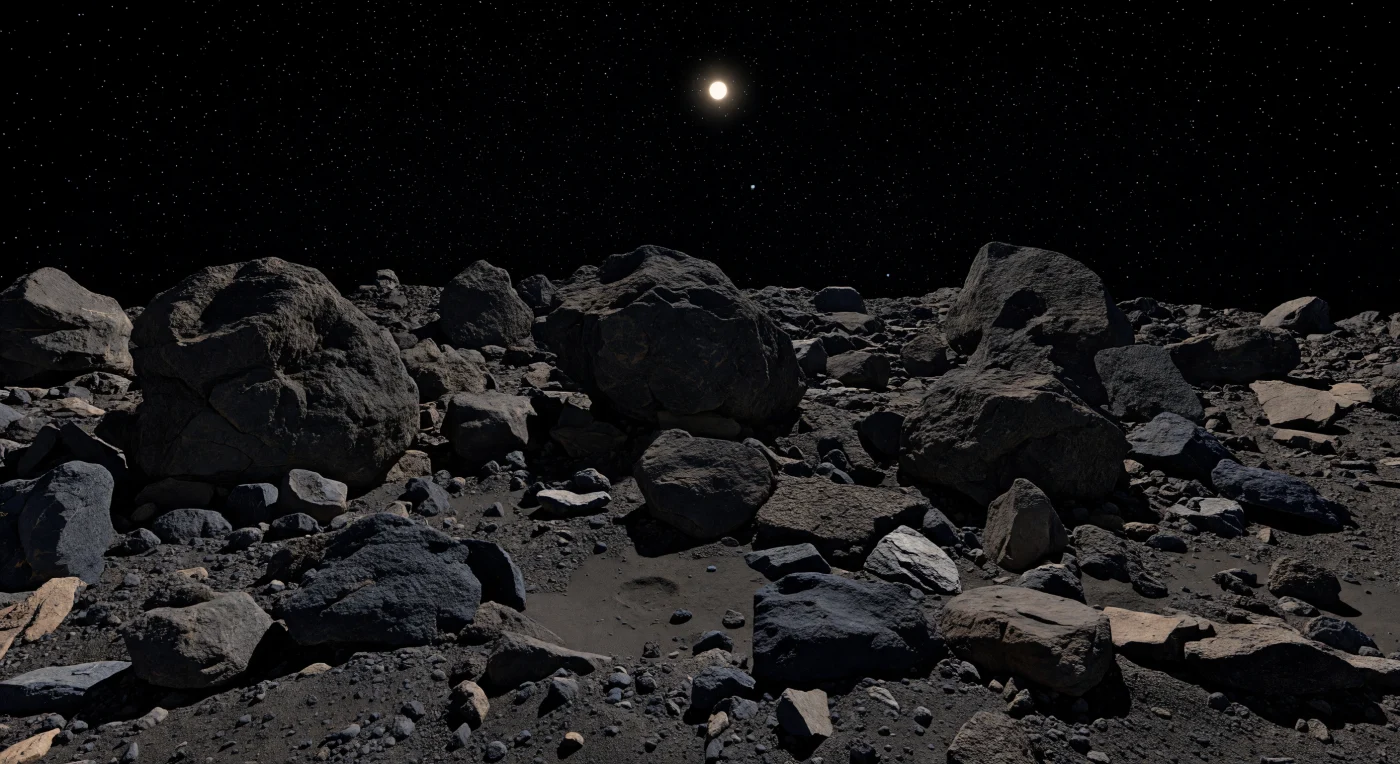
From ground level, the landscape is a forest of dark monoliths: fractured charcoal-black boulders tens of meters high jut abruptly from a chaotic plain of angular rubble, pebbly clasts, and patches of fine dust, their matte faces broken by sharp fissures and crumbly brecciated edges. In the harsh, undiffused sunlight of an airless world, every crack and gap becomes a lightless well of absolute black shadow, while the close, strongly curved horizon drops away after a surprisingly short distance, revealing the tiny scale of this rubble-pile body. These rocks are primitive carbonaceous material—organic-rich and containing hydrated minerals—preserved from the early Solar System, with no wind, water, or atmosphere to soften their jagged textures, only impacts, fracturing, and the feeble pull of gravity arranging them into precarious stacks and unstable talus. Under a pitch-black sky pricked with steady stars, the scene feels both monumental and miniature at once: “mountains” only a few stories tall, standing silent on a world so small that a powerful leap could send you drifting into space.

A fresh artificial crater breaks the otherwise armored surface as a shallow, sharply cut depression ringed by chaotic ejecta—overturned black fragments, scattered cobbles, and a few slightly lighter fresh fracture faces standing out against the asteroid’s nearly charcoal-dark ground. Every pebble, dust pocket, and rough slab is etched by low, oblique sunlight into stark relief, with razor-edged shadows cast across a rubble-rich regolith made of primitive carbonaceous material that preserves hydrated minerals and organic compounds from the early Solar System. The crater’s modest depth and the clustering of meter-scale boulders reveal the strange scale of this tiny rubble-pile world: the horizon curves away only a short distance off, and hummocks just tens of meters high loom like mountains in gravity so weak that rocks are only barely held in place. Above it all, the sky is an absolute vacuum-black, without haze or weather of any kind, making the scene feel at once intimate and immense—as if you are standing inside a newly opened wound in one of the Solar System’s darkest relics.
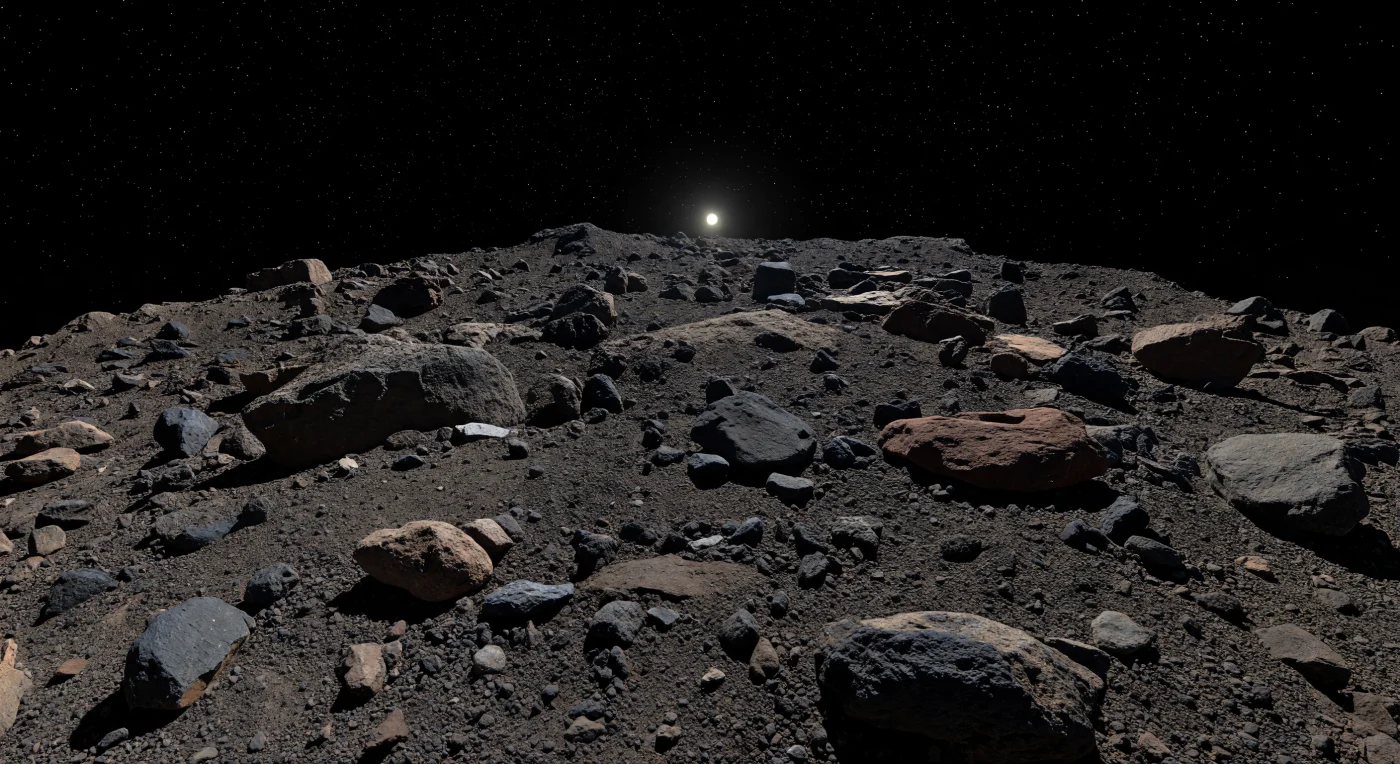
From just centimeters above the surface, you look across a jumble of charcoal-dark cobbles, fractured boulders, and dust-choked gaps toward a horizon so close and so strongly curved that the ground seems to wrap away beneath your feet, revealing the tiny scale of this miniature world. The landscape is built from primitive carbon-rich rubble—matte black to deep slate-gray stones, porous breccia-like blocks, and faint rusty-brown hints of hydrated minerals—loosely assembled under gravity so feeble that pebbles and slabs appear delicately perched at improbable angles. In the airless vacuum, there is no haze, no softening, no atmospheric glow: only a pure black sky, hard sunlight, and absolute shadows cut with razor edges across the rough regolith and scattered meter-scale monoliths. The effect is both intimate and uncanny, as if you are standing on a barely held-together relic from the early Solar System, its battered surface curving away after only a short walk.

From this low perch on an upper-latitude slope, you would be surrounded by a chaotic carpet of charcoal-black and deep gray rubble—angular boulders, broken carbonaceous clasts, coarse regolith, and rough bedrock patches—spilling downslope toward terrain that drops away so quickly the horizon curves close and tight. Several enormous blocks sit improbably balanced above you on tiny contact points, a striking effect of microgravity on a porous rubble-pile world only about 900 meters across, where even “high ground” rises only tens of meters and shallow impact hollows and rubble aprons remain sharply preserved. The surface is made of primitive, extremely dark C-type material rich in hydrated minerals and organic-bearing carbonaceous rock, with no wind or water to soften its textures, only vacuum weathering and impacts to fracture and rearrange the debris. Overhead, the sky is a pure black void scattered with hard, unwavering stars, while the small white Sun casts fierce, razor-edged shadows so absolute that every stone looks cut from darkness itself.

From within this shallow hollow, the ground looks almost velvety: an unusually smooth patch of soot-dark regolith has pooled between rough rims of embedded cobbles and jagged boulders, its fine grains resting so delicately that even tiny pebbles cast razor-sharp black shadows. The surrounding rock is primitive carbon-rich material, porous and fractured, with subtle brown-gray tones that hint at hydrated minerals preserved since the earliest Solar System, while the hollow itself likely traps finer particles that settle here under feeble gravity after impacts loft them across the surface. Beyond the rim, low rises only tens of meters high already seem to fall away toward a startlingly close, curved horizon, revealing how tiny this rubble-pile world really is. Above it all, a perfectly black sky studded with hard bright stars and lit by an uncompromising white Sun makes the scene feel silent, stark, and almost weightless.

At the edge of day and night, a field of jagged, plate-like boulders and shattered charcoal-black rubble lies under a small white Sun, whose low angle throws impossibly long, perfectly sharp shadows across the regolith with no twilight to soften them. The ground is a dark carbonaceous mix of fractured breccias, coarse gravel, and pockets of fine dust, material preserved from the early Solar System and altered by water-bearing minerals and organic chemistry before being assembled into this porous rubble-pile body. In the almost nonexistent gravity, meter-scale blocks seem barely anchored, perched on subtle slopes and ridges that rise only tens of meters before the horizon drops away in a close, unmistakable curve, making the landscape feel like an entire world reduced to the scale of a gravel hill. Above it all, the sky remains utterly black even in daylight, and the stark bands of blinding sun and absolute shadow make standing here feel both intimate and precarious, as if one strong leap could leave the surface behind.
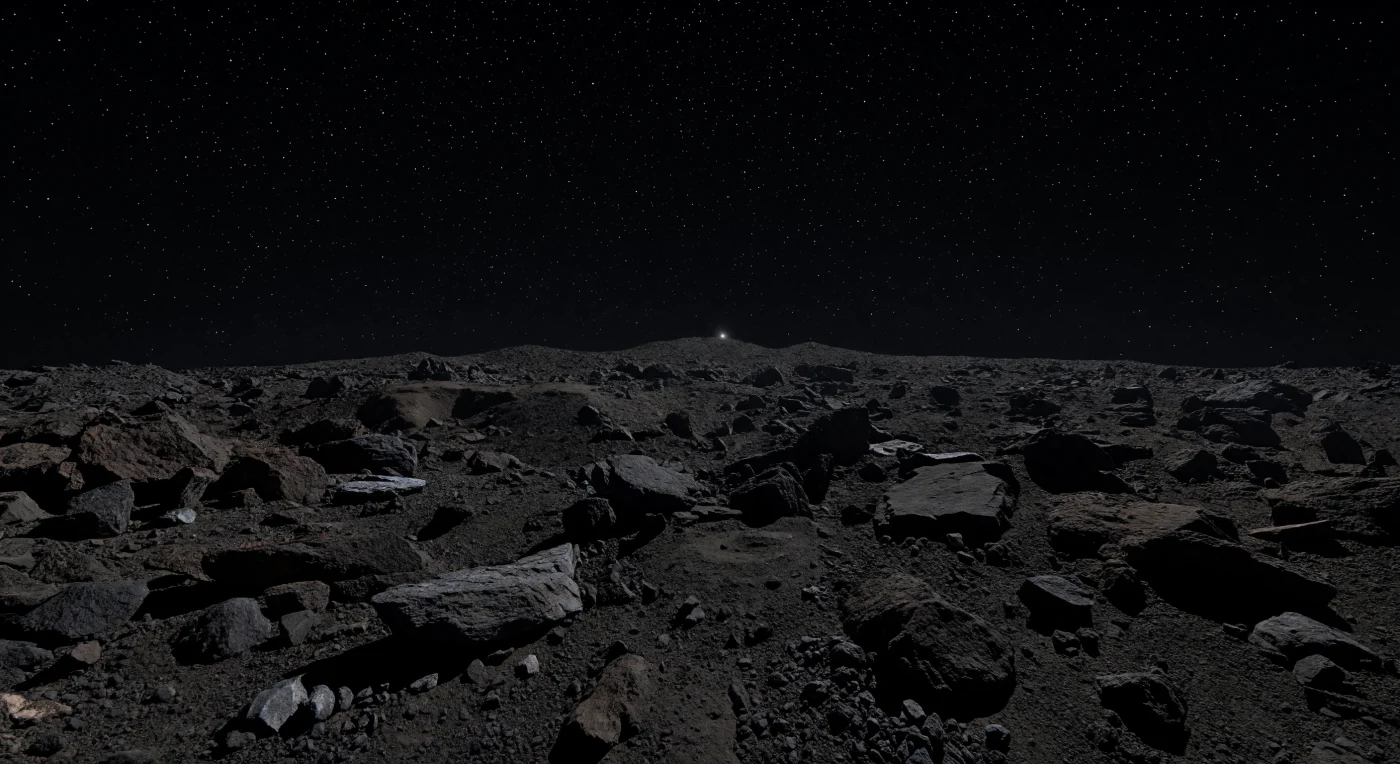
At night, the surface becomes a field of near-total silhouettes: jagged boulders, fractured slabs, coarse gravel, and dust-filled hollows fading into blackness beneath a sky crowded with perfectly sharp stars. Only the faintest steel-gray edging traces a few nearby rocks, lit indirectly by sunlight reflected from distant terrain, while unlit faces drop abruptly into absolute dark—a stark effect of the complete absence of atmosphere, haze, or any weather at all. The ground is made of extremely dark, carbon-rich primitive material akin to hydrated carbonaceous chondrites, piled into a rubble-strewn landscape of low ridges, shallow micro-craters, and broken bedrock that speaks to a porous, fragile body assembled from debris. From this low vantage, the horizon curves away alarmingly close, making the entire world feel tiny and precarious, as if you are standing on a black, crumbling island of ancient Solar System matter adrift in open space.

At your feet, a single charcoal-black boulder fills the scene, its fragile carbon-rich surface riddled with micropores, splintered fracture lines, and crumbly edges where fresh pale-gray chips have broken through the darker space-weathered crust. Around it lies a jumbled carpet of angular pebbles, gravel, dust, and small blocky fragments—part of a rubble-pile landscape so loosely held by gravity that even this rough ground belongs to a world only about 900 meters wide, with a horizon that drops away in a surprisingly tight curve. In the airless vacuum, harsh sunlight falls unsoftened, carving every pore and crack into sharp relief and casting absolute black shadows, while the sky remains pitch black and star-filled even in daytime. These exceptionally dark, primitive rocks are rich in carbon-bearing and hydrated minerals, preserving material from the earliest Solar System in a setting that feels both intimate and profoundly alien.