Scientific confidence: High

From this low vantage on a comparatively fresh crater rim, jagged blocks of ice-rich breccia thrust up through dark umber regolith, their dirty-white and faintly bluish faces blazing in the Sun while nearby crevices fall instantly into black, knife-edged shadow. The rim is a mixture of shattered water ice and silicate-rich debris excavated by impact, with pale ejecta streaks and exposed icy patches standing out against the ancient, charcoal-brown plains beyond—terrain so densely cratered that it records billions of years of relentless bombardment with little resurfacing to erase the scars. In the airless stillness there is no haze to soften distance, only stark vacuum clarity under a pure black sky, where the Sun is a small, fierce disk and every surface texture appears unnervingly crisp. Standing here, you would feel the immense age of the landscape and the strange contrast between brilliant frozen rock and the muted, battered world stretching outward in all directions.

From this low icy ridge, the outer rings of the immense impact structure sweep away in pale ash-gray arcs and broader charcoal troughs, their concentric curves stretching so far that the moon’s own curvature begins to show beneath a pure black sky. The ground is a frozen rubble of dirty water ice, dark carbon-rich dust, angular silicate boulders, and shattered impact breccia, preserving an ancient surface that has been battered for eons with little resurfacing to erase the scars. A tiny, fiercely bright Sun skims the horizon, casting razor-sharp shadows for kilometers across the ridges and crater rims, while bright frost flashes against otherwise soot-dark regolith in the airless, crystal-clear light. Hanging low above it all, the giant banded disk of Jupiter underscores the scale and stillness of this ice-rock wasteland, where colossal impact rings and softened craters record one of the oldest, most heavily bombarded landscapes in the Solar System.
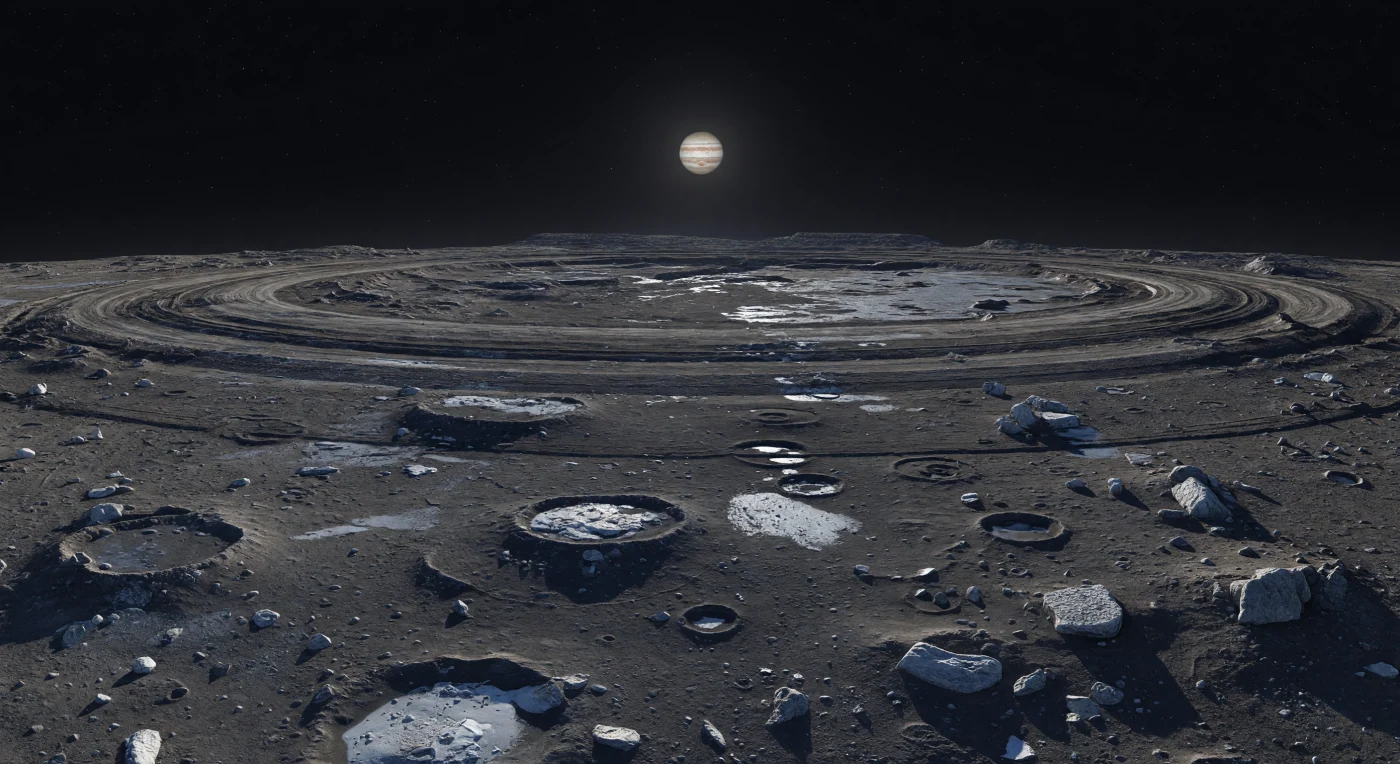
From this frozen vantage, the horizon is etched by immense, shallow arcs—ancient impact rings so old that countless later craters have softened them into low scarps and broad troughs that sweep across the landscape for hundreds of kilometers. Under a black, airless sky and the weak, sharp sunlight of the outer Solar System, the ground shows a dark mixture of rock and water-ice regolith in smoky browns, ash grays, and dirty white, strewn with angular silicate boulders, fractured icy blocks, and small fresh scars where brighter frost and cleaner ice have been newly exposed. The terrain’s gentle relief reflects a world with little resurfacing: instead of jagged mountains, there are subdued hummocks, broken crater rims, and faint concentric lineations preserving the battered structure of an enormous multiring basin. Everything feels both starkly still and colossal, a planetary crust preserving eons of bombardment in razor-sharp vacuum clarity.

You stand on an ancient plain of dark, densely pitted regolith where dirty water ice and silicate rock have been pulverized by eons of impacts into a charcoal-brown surface mottled with pale ejecta splashes and angular shattered clasts. In every direction, overlapping shallow craters, softened rims, faint scarps, and low hummocks record a bombardment history so old and so continuous that the landscape reads like a vast icy-rock palimpsest, preserved in crisp detail by low gravity and the complete absence of air, weather, or erosion. Above this frozen, silent ground, the black daytime sky is dominated by a nearly motionless Jupiter, hanging about 7–8 degrees wide—far larger than Earth’s Moon appears from home—with muted cream, tan, and rust bands resolved across its cloud tops. The distant horizon remains unnaturally sharp under the tiny, brilliant Sun, whose stark overhead light carves hard-edged black shadows beneath every stone and crater lip, making the stillness and scale of this battered world feel immense.
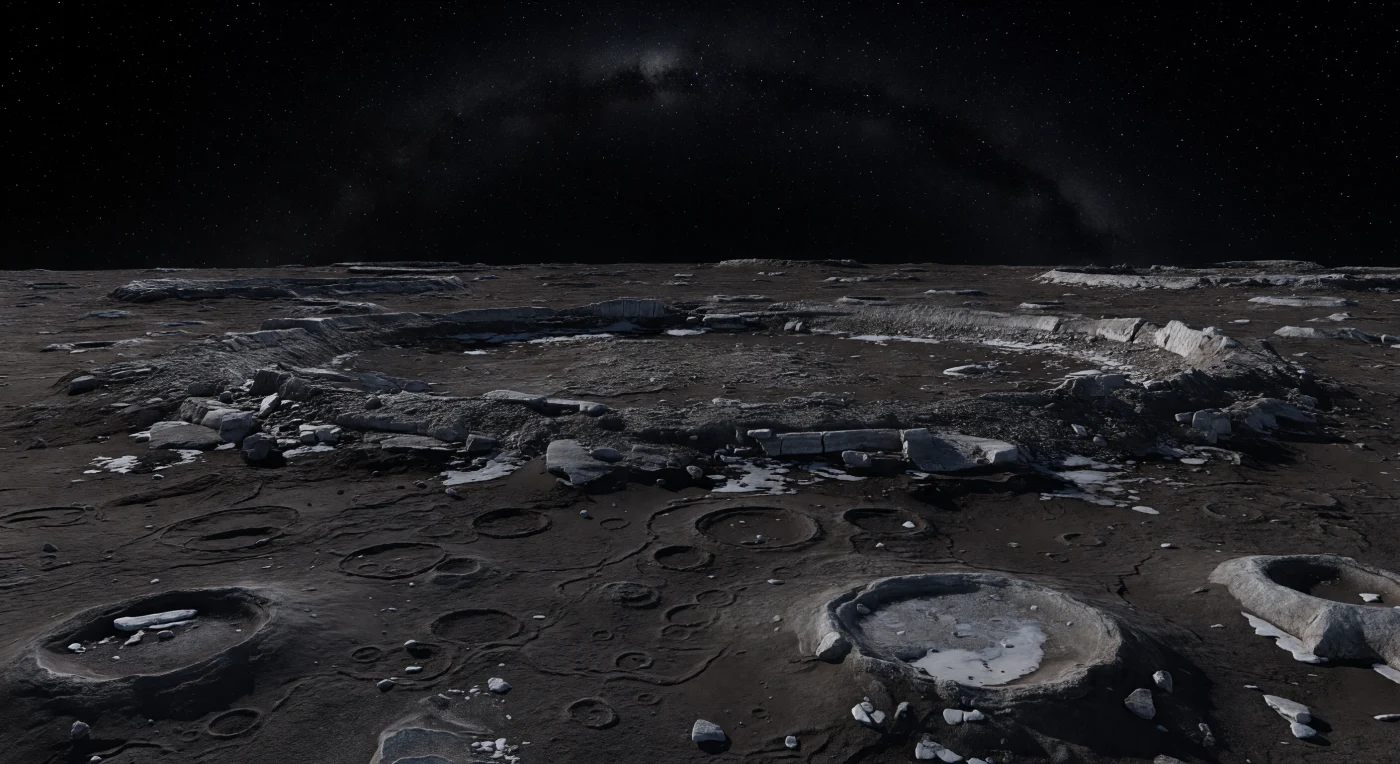
Under a sky so clear it is almost unnerving, the ancient plain stretches away as a field of near-black hummocks, softened crater rims, and shallow circular depressions, their low icy-rock crests caught only by faint silvery glints from starlight and the bright arch of the Milky Way. The ground is a dark mixture of water-ice bedrock and silicate-rich regolith, mantled in brown-black and charcoal dust, with scattered dirty-white frost patches and pale icy fragments exposed along sharper edges where impacts have broken through the darker surface. Every horizon records immense age: degraded crater rims, low ejecta ridges, and overlapping palimpsest scars extend for tens of kilometers, preserved with razor clarity because there is essentially no atmosphere here to blur, scatter light, or soften shadows. On this hemisphere the giant primary is forever absent, leaving only the cold, hard contrast of a vacuum night and the overwhelming sense of standing on one of the Solar System’s oldest, least altered surfaces.
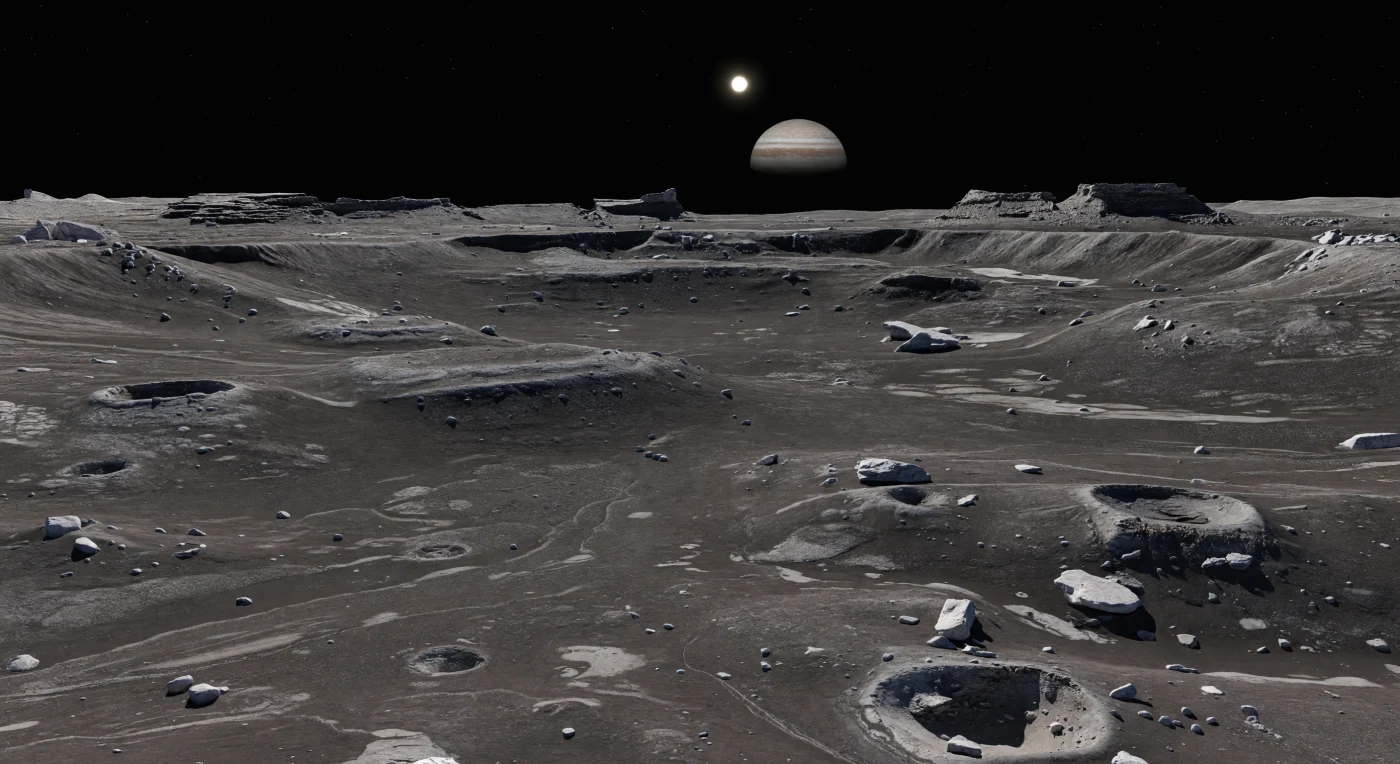
From the floor of this immense ghost basin, the land rolls away in dark taupe-gray and charcoal tones, a gently undulating plain of ancient ice-rock regolith broken by low hummocks, softened terraces, shallow troughs, and scattered angular boulders half-buried in fine, dusky ejecta. The ground is a frozen mixture of dirty water ice, silicate-rich dust, and impact-shattered breccia, preserved for immense spans of time because there is no flowing water, no volcanism, almost no active resurfacing—only relentless impact gardening and the slow viscous relaxation that has softened this colossal crater without erasing it. Far off, degraded rim fragments and isolated massifs still stand razor-sharp against a black sky, their unnatural clarity a result of the complete lack of atmosphere, while the small hard Sun casts stark black shadows and occasional dull glints from cleaner ice faces. Hanging low above the horizon, a huge banded Jupiter deepens the sense of scale and desolation, making the basin feel less like a crater than the worn floor of an ancient world-sized wound.

From this low vantage, the uplands unfold as a chaotic palimpsest of overlapping bowl-shaped craters, broken rims, and saddle-like ridges, so densely packed that no untouched ground survives between them. The dark, dusty regolith is strewn with angular ice-rock fragments, shattered silicate-rich blocks, and occasional brighter scars where dirty water ice has been freshly exposed, all lit by a distant Sun that casts razor-edged shadows across the ancient terrain. These highlands record an immense span of bombardment on a crust made of mixed rock and water ice, preserved because the surface has seen little tectonic or volcanic renewal; in the weak gravity, even softened crater rims still stand out with surprising crispness. Beneath the pure black sky, with stars still visible and the giant banded disk of Jupiter looming over one hemisphere, the landscape feels vast, cold, and almost timeless—a frozen archive of impacts written over itself again and again.

From this low vantage, the land stretches away as a dark, muted plain of powdery brown-gray regolith, its surface so finely mantled that ancient impacts survive only as softened swells, shallow dimples, and half-buried scars layered over one another to the horizon. The sooty veneer is thought to be impact-processed debris mixed with darker rocky material, draped over an ice-rich crust; only where tiny fresh craterlets have punched through does dirty water ice flash pale against the charcoal ground in crisp ejecta flecks and exposed rims. In the airless cold, the small Sun casts razor-sharp shadows and the black sky offers no haze to soften distance, so even far-off broad crater rims and ghostly multi-ring silhouettes remain starkly visible, emphasizing a surface that has changed little for billions of years. Standing here would feel eerily still and immense: a frozen ice-and-rock world where colossal age is written not in towering mountains, but in the quiet, subdued topography of relentless bombardment.

From the rim of an ancient, softened crater at local sunrise, the ground is a jumbled plain of dark brown-gray regolith, ice-cemented breccia, and shattered silicate-rich blocks, every surface pitted by countless overlapping impacts. One fractured wall catches the first low sunlight and flares white to faint bluish white where fresh frost and exposed water ice cling to ledges, cracks, and broken terraces, while the opposing slope plunges straight into blue-black shadow with a knife-edge boundary sharpened by vacuum and the near-total absence of an atmosphere. Beyond the rim, gently rolling cratered plains and immense, worn impact-ring landforms fade into the distance instead of rising into mountains, revealing an ancient crust of mixed rock and ice shaped overwhelmingly by bombardment rather than volcanism or tectonic renewal. Overhead the sky remains perfectly black even in daylight, the Sun a tiny, fierce disk casting long, crisp shadows across the frozen rubble, and if Jupiter stands above the horizon its vast muted bands dwarf the sunlight itself, making the landscape feel both starkly still and immeasurably vast.

You stand on a dark, heavily cratered plain of silicate-rich debris and dirty water ice, where overlapping impact scars, frost-cemented boulders, and shattered breccia stretch outward in stark, airless clarity. Ahead, the ancient basin margin rises in step-like scarps a few hundred meters high, its tilted blocks of fractured ice-rock crust broken into jagged fault faces and dark rubble aprons, with fresh breaks exposing subdued silver-white streaks of cleaner ice. This subdued but immense topography reflects a surface shaped overwhelmingly by impacts and preserved for eons with little resurfacing, while low gravity helps the sharp edges of scarps, crater rims, and collapsed ledges remain strikingly crisp. Under a black sky and a small, hard Sun, razor-edged shadows flood every fracture, and a colossal banded planet hanging low above the horizon makes the frozen silence and planetary scale feel almost overwhelming.
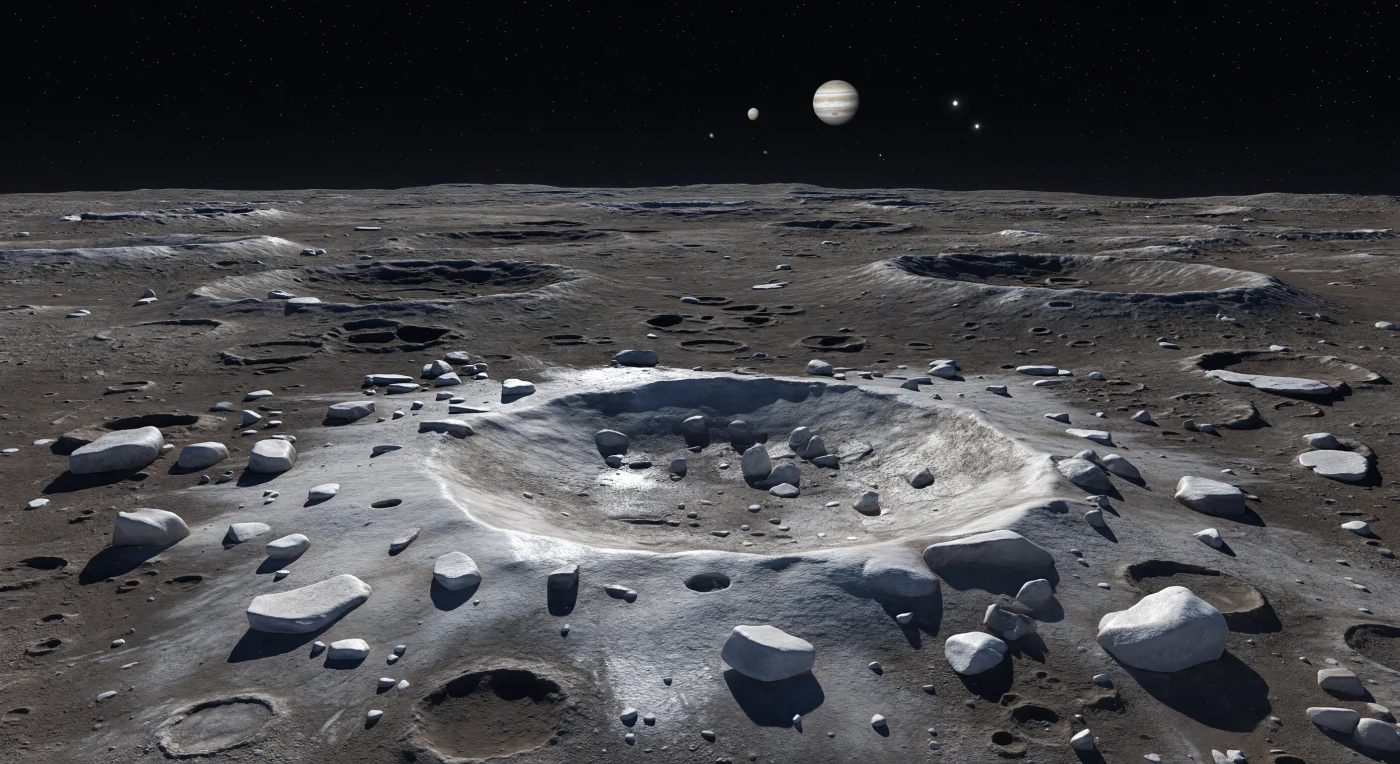
Under a small, fiercely bright Sun, a fresh impact ejecta blanket spreads across the foreground in pale ash-gray and dirty white, where frost-rich icy regolith, darker silicate dust, and angular ice-rock blocks gleam against Callisto’s much older, charcoal-brown cratered crust. The low gravity and airless vacuum preserve every sharp fragment and hard-edged shadow, from fist-sized shards to meter-scale slabs, while overlapping secondary craterlets, hummocky ridges, and shallow pits record the violence of the impact that excavated this brighter ice from below the darkened surface. Beyond the subdued relief, the horizon curves over immense palimpsest plains—ancient impact scars softened by time but never erased—showing why this moon is one of the most heavily cratered large worlds in the Solar System. In the black sky above, tiny disk-like Ganymede and the brilliant pinpoints of Europa and Io hang motionless over the stark landscape, making the scene feel at once desolate, frozen, and vast beyond human scale.

Under a sky so black it seems carved from space itself, the ancient surface falls into a dim blue-brown twilight as the giant planet eclipses the distant Sun, hanging overhead as an enormous dark disk with only the faintest amber rim and ghostly reflected glow. At your feet lie frost-stiffened gravel, angular impact breccia, dirty water-ice, and scattered bright icy fragments, while every horizon is crowded with softened crater rims, secondary crater chains, low ejecta ridges, and immense multi-ring scars—the preserved record of billions of years of bombardment on an airless world made of mixed rock and ice. With no atmosphere to blur the view, the landscape remains unnervingly crisp despite the near-darkness, and the moon’s low gravity leaves even vast impact structures broad and subdued rather than mountainous. In this weak Jovian shine and starlight, the ground absorbs nearly all illumination, turning the frozen plains into a stark, silent archive of the outer Solar System.
