Scientific confidence: Low

In the profound night of the far-facing uplands, the ground rises and falls in a jumble of crater rims, broken ledges, and rust-dark boulders, all rendered in deep maroon-brown and muted umber against a sky of absolute black. The nearest rocks and dusty regolith show the texture of a weak, porous crust—friable, impact-gardened material scattered into angular blocks and shallow ejecta blankets by countless collisions in an airless environment where no wind or water has ever softened the land. With gravity only a tiny fraction of Earth’s, relief appears oddly dramatic for such a small world: precarious boulders perch on sharp slopes, low ridges cut the horizon, and mid-distance hollows fade quickly into near-total darkness under nothing more than faint starlight. Above, the stars burn with exceptional clarity, unblurred by any atmosphere, while the absence of planetary glow leaves the landscape feeling stark, silent, and immeasurably remote.

Inside the vast basin, a smoother floor of rusty red-brown regolith stretches away in low rolling swells, littered with dark porous rubble, scattered breccia, and small sharp boulders, until it is abruptly broken by kilometer-wide patches of pale fractured ground that shine dirty white to icy gray in the hard sunlight. These bright exposures likely mark subsurface material excavated by impact—either unusually reflective rock or ice-rich, highly porous crust—split into polygonal slabs, brittle shattered plates, and angular block fields that gleam against the moon’s sulfur-stained, space-weathered surface. Around you, steep crater walls climb as lumpy scarps and slump terraces under gravity so weak that debris can perch precariously on the slopes, while the distorted horizon betrays the tiny world’s irregular, potato-like shape. Above the airless black sky, the Sun is a small, fierce disk casting razor-edged shadows, and Jupiter looms enormous overhead, making the scene feel both intimate and impossibly vast.

From a knife-edged crest on Pan crater’s rim, the ground is littered with angular brick-red breccia, porous fractured outcrops, and pockets of powdery maroon dust that spill steeply into a vast, hummocky basin. The crater floor is broken by slump blocks, low ejecta ridges, and subtle terraces along shattered inner walls, their precarious forms preserved by gravity so weak that boulders can cling to improbably steep slopes on this misshapen, highly porous world. Over the uneven horizon, Jupiter hangs immense in a perfectly black sky, its cream and brown cloud bands flooding the darkness with a faint reflected glow while the distant Sun casts hard, cold light and razor-sharp shadows across the dark irradiated surface. Standing here, the scale feels unsettlingly alien: a giant impact hollow opening beneath your feet, red dust and broken rock underfoot, and an airless void so clear and stark that every ridge, shadow, and towering planetary backdrop appears almost painfully sharp.
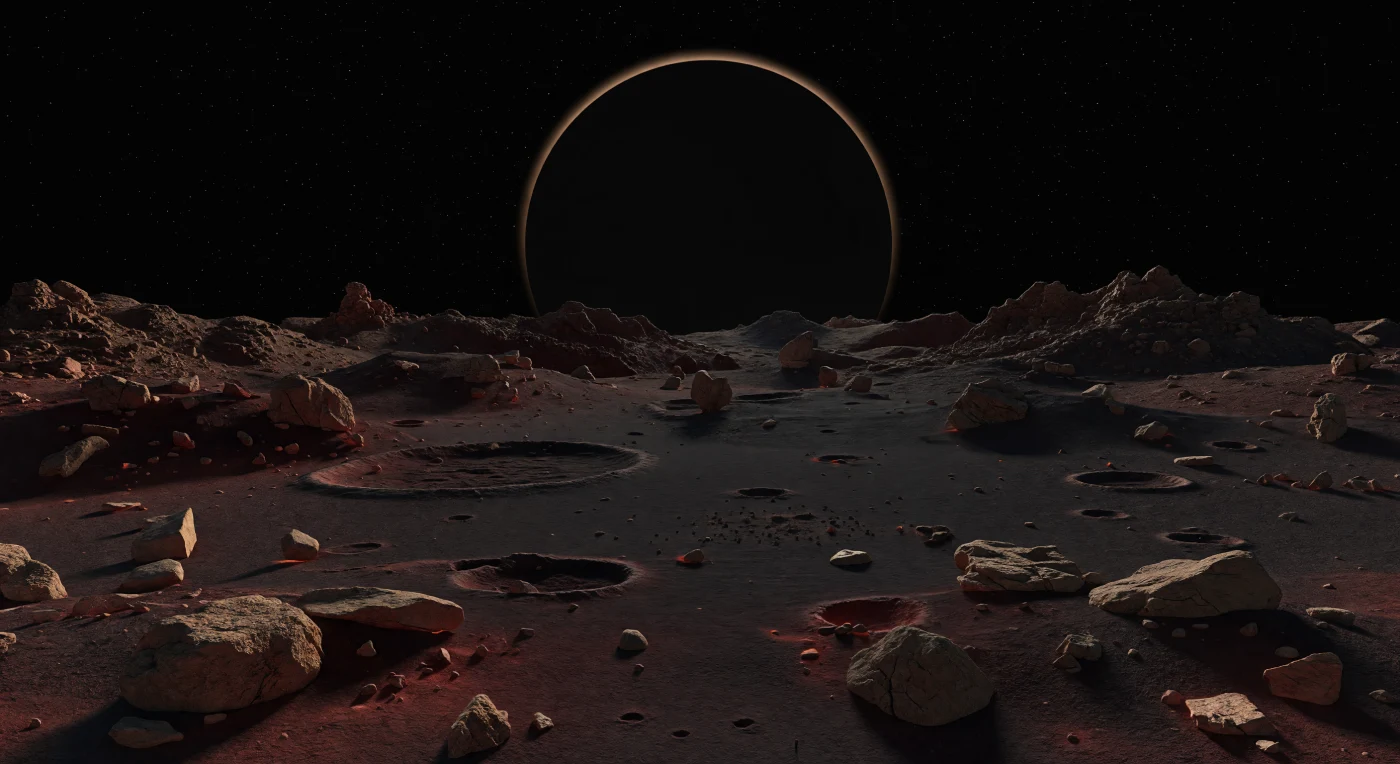
The eclipse drops this battered plain into an eerie coldfall: a broad sweep of dark rust-red regolith and brown-gray impact debris fades into blue-black shadow, while scattered angular boulders, fractured breccia, and dust-filled hollows catch only the faintest coppery glint along their edges. In the weak gravity of this tiny, irregular moon, ejecta can remain loosely draped across shallow depressions and steep, lumpy ridges, leaving a landscape of perched blocks, softened crater rims, and jagged massifs that rise oddly against the horizon. Overhead, the giant black disk of Jupiter blots out the distant Sun, its silhouette edged by a razor-thin amber atmospheric glow, while stars remain visible in the airless sky because there is no atmosphere to scatter light. The result is both intimate and immense: fist-sized stones lie at your feet, but beyond them stretches a frozen-looking wilderness shaped by impacts, porosity, and relentless radiation, all under the looming presence of the largest world in the system.

You stand at the foot of a towering, fractured scarp where bright facula-like layers—cream, pale beige, and tinged with faint bluish gray—break through the moon’s otherwise dark brick-red crust, as if an impact or landslip has freshly exposed ice-rich or unusually porous material beneath radiation-darkened surface rock. Below the cliff, a chaotic apron of angular talus sprawls across the ground: rusty regolith, shattered slabs, and precariously balanced boulders lie frozen in place by gravity so weak that steep, unconsolidated slopes can endure for ages, while razor-edged shadows pool in narrow crevices untouched by any air or weather. The landscape feels both intimate and immense, with jagged ridges and crater rims rising abruptly along an uneven horizon that betrays the body’s small, irregular shape. Overhead, the sky is a pure black vacuum scattered with faint stars, the Sun a small hard spark, and Jupiter hangs enormous above the escarpment, its banded disk casting a silent reminder that this ancient, airless rubble world survives deep inside a harsh giant-planet environment.

At your feet, the ground is a dense field of dark rust-red dust and reddish-brown granules, every few centimeters broken by tiny bowl-shaped impact pits, crisp raised rims, and overlapping hollows that look freshly cut despite their great age. Scattered among the porous regolith are angular charcoal-dark chips and occasional dull, dirty-white icy flecks, hints of a low-density, irradiated crust where rock and ice are mixed and shattered by constant micrometeoroid bombardment. In the moon’s feeble gravity, even the smallest ridges, perched clasts, and steep crater lips hold their shape, while a low Sun casts knife-edged shadows across the miniature terrain under an airless, perfectly black sky. Just beyond the abruptly close, uneven horizon of reddish rubble, Jupiter hangs immense and softly banded, its reflected glow barely touching the darkness and making this intimate landscape feel at once microscopic in texture and vast in its alien setting.

You are standing on a razor-thin ridge of dark brick-red crust, where fractured, porous rock and loose angular debris cling precariously in gravity so weak that boulders and shattered slabs seem barely anchored to the ground. Fresh breaks reveal brighter, frostlike patches of dirty water ice mixed into the brecciated silicate-rich material, while steep talus, crisp crater rims, jagged hollows, and broken scarps testify to a landscape shaped almost entirely by impacts, tidal stressing, and the slow settling of dry rubble in an airless environment. The horizon falls away with startling speed, emphasizing the tiny, irregular body beneath your feet, and beyond it the terrain dissolves into lumpy uplands, shadowed notches, and chains of ruined ridges. Overhead, an immense banded giant fills the black sky, its reflected glow faintly warming the otherwise stark sunlight and softening the deepest shadows, creating an uncanny stillness in a world with no air, no weather, and no sound.

At the floor of this sheltered hollow, the ground looks eerily calm: a broad, shallow basin draped in an almost unbroken sheet of dark reddish-brown fines, so smooth and uniform that only a few scattered pebbles, half-buried angular fragments, and faint circular pits disturb its surface. The material appears like ponded regolith—dust and granular debris that has migrated downslope and settled in the moon’s extremely weak gravity—while the basin edges rise into porous, fractured, crater-softened rock, where perched boulders and subdued rims hint at repeated impacts and slow mass movement on a body too small to hold a true atmosphere. Above the oddly near, strongly curved horizon, the sky is a pure vacuum black, the Sun burns as a hard white point, and every ripple, pebble, and rim break throws a razor-sharp shadow across the muted brick-red dust. If Jupiter hangs low beyond the basin wall, its enormous banded disk makes the scene feel even stranger: a tiny world under harsh, crystal-clear light, intimate in scale yet suspended deep within a giant planet’s domain.
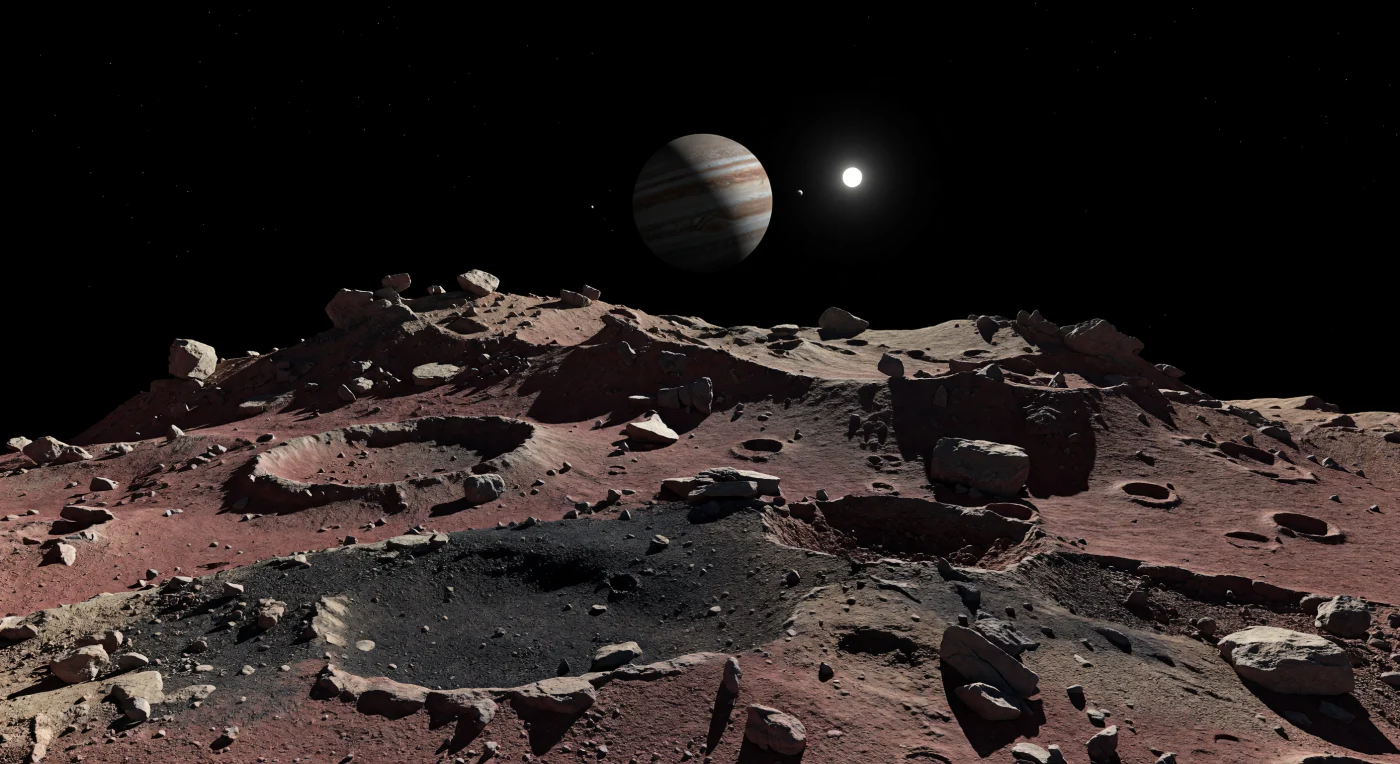
From this summit-like rise, the ground is a chaos of coarse red-brown stone and dusty shadowed hollows, with angular boulders and fractured crater-rim blocks seeming barely anchored to the moon’s feeble gravity. The landscape is entirely impact-sculpted: overlapping shallow craters, sharp scarps, hummocky ridges, and elongated depressions wrinkle an irregular horizon that curves away within only a few tens of kilometers, revealing just how tiny and misshapen this porous, low-density world is. In the hard, cold-white sunlight of the outer Solar System, every edge blazes and every shadow falls black and razor-sharp, with occasional pale gray patches in fractured shade hinting at fresher excavated material or ice-rich substrate beneath the dark reddish regolith. Above it all hangs Jupiter, immense and banded against a star-pricked black sky, with one or two tiny neighboring moons shining nearby, a breathtaking reminder that this silent rubble-strewn high point orbits deep within a giant planet’s powerful realm.
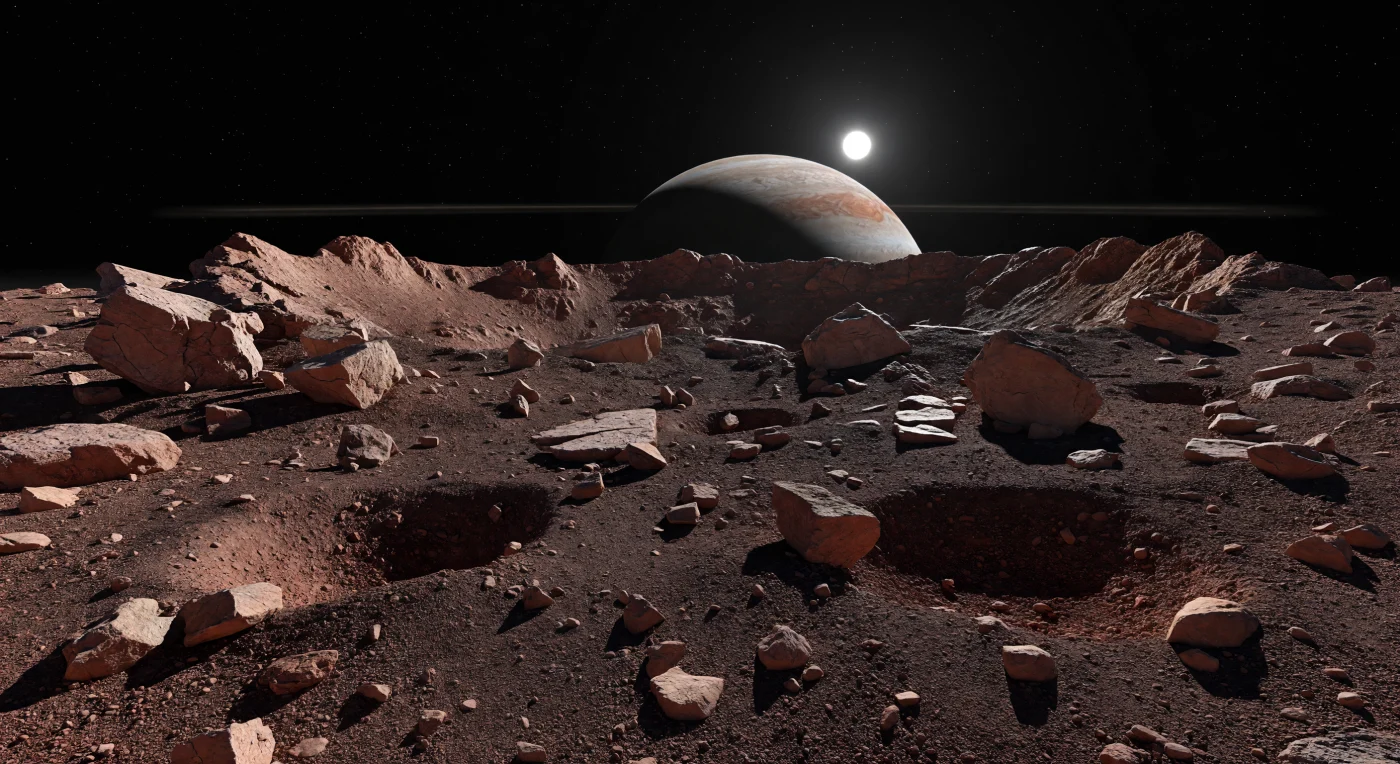
You stand on a broad apron of impact debris where meter-scale fragments and house-sized shattered blocks lie strewn in chaotic heaps across a dark umber-red blanket of coarse gravel, pebbly regolith, and dust, the uneven horizon rising into low ejecta hummocks and the subdued relief of an ancient crater. The reddish material likely records a porous mixture of rocky matter and water-rich ice altered by relentless irradiation, while fresh breaks expose slightly brighter tan and gray faces; in this vanishingly weak gravity, steep slopes, perched boulders, and precarious slabs can persist far more easily than on larger worlds. With no atmosphere to soften the light, the distant Sun paints every edge with brutal clarity, carving pitch-black shadow wells beneath the rubble as faint stars remain visible in the daytime sky. Against that blackness, near the plane of the giant planet’s rings, a barely detectable thread of gossamer dust hints at the constant micrometeoroid bombardment that helps build and refresh this desolate ejecta field.
