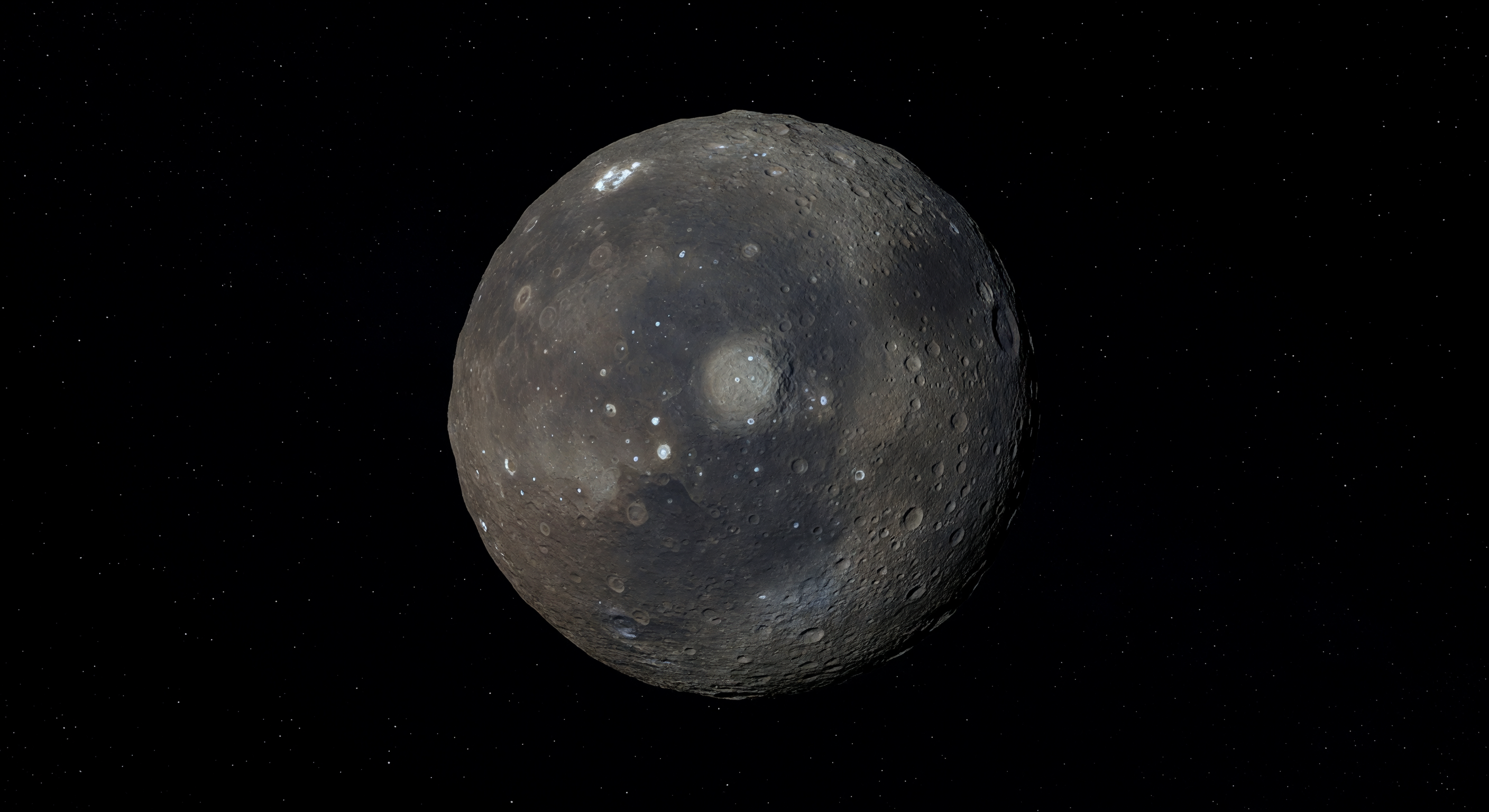
Scientific confidence: High
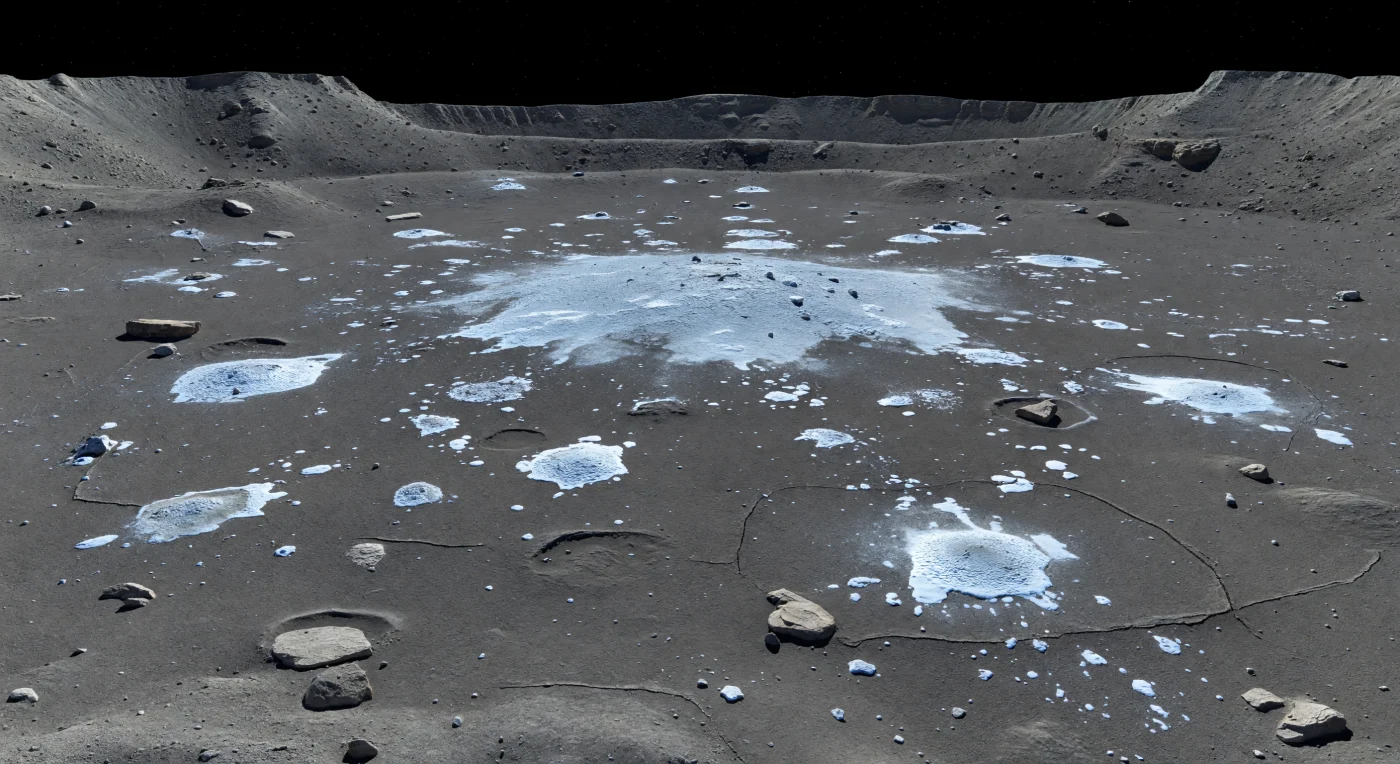
Across the dark floor of Occator, the Vinalia bright patches spread out as irregular islands and crusty splashes of bluish-white salt, stark against smooth gray plains of fine-grained hydrated silicates and compacted dust. These high-albedo deposits are rich in sodium carbonate and other salts left behind as brines reached the surface and froze or sublimated away, part of a landscape reshaped by cryovolcanic resurfacing, low fractures, and subtle polygonal cracking. In the hard, cold midmorning sunlight, every edge looks unnaturally sharp: black shadows cut beneath broken slabs and scattered boulders, while the brightest crusts flash with icy glints under a Sun much smaller than seen from Earth. Beyond them, the crater’s distant inner walls rise in crisp terraces against a pure black sky, where the lack of a true atmosphere leaves the scene silent, airless, and immense.
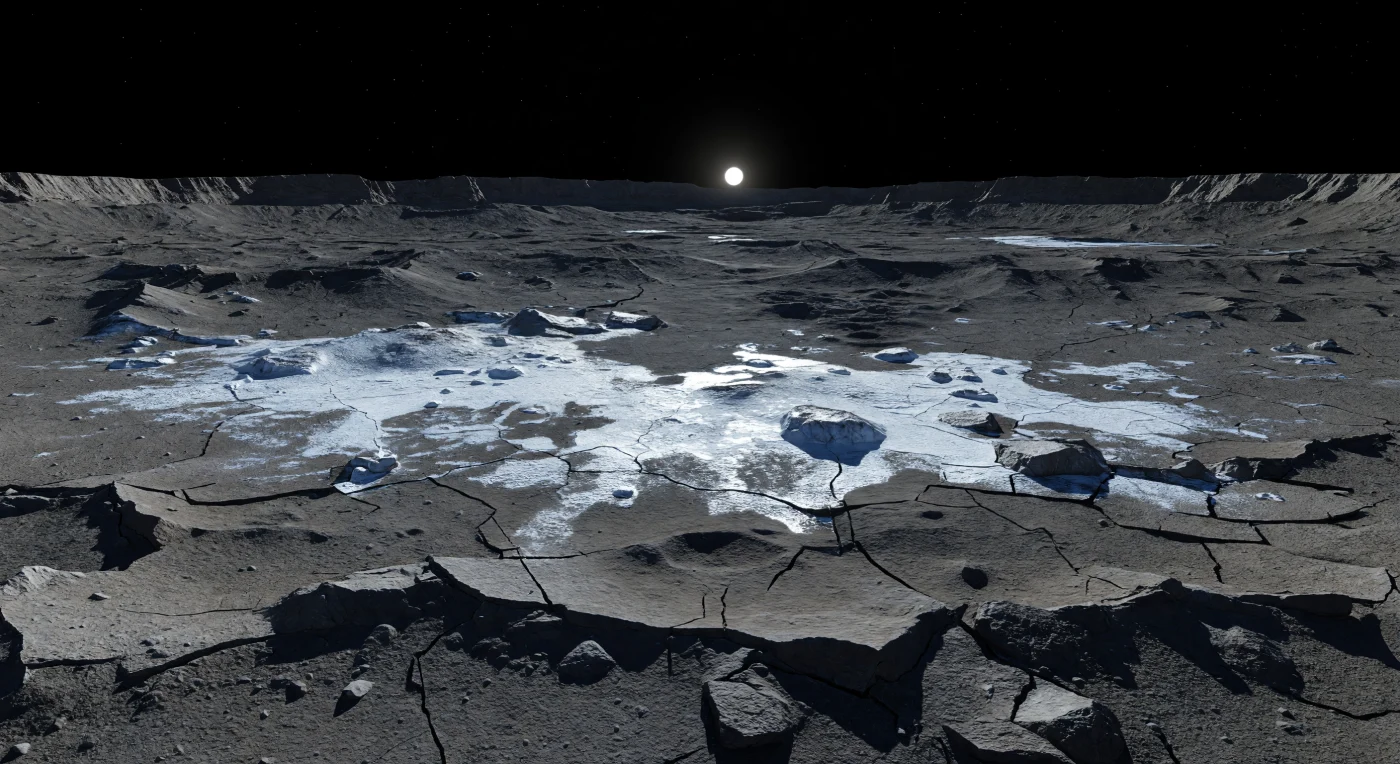
At local dawn on the fractured floor of Occator, dazzling patches of Cerealia Facula blaze across the crater interior like fresh snow under a black, star-pricked sky, their sodium-carbonate crusts glowing white against charcoal regolith and broken gray ridges of hydrated, impact-shattered rock. The tiny Sun rises as a hard brilliant disk with no atmospheric halo, and in the near vacuum its low light throws razor-sharp shadows from every crack, pit, and uplifted block while the brightest salts flash with an almost metallic glare. These reflective deposits are thought to have formed when salty brines rose from the subsurface and reached the surface, where water quickly vanished into space or froze away, leaving behind crusts, domes, and vein-like evaporitic residues on the darker crater floor. With distant terraces and rugged rimlines enclosing the basin, the scene feels immense and utterly still—an airless, low-gravity landscape where ancient impact scars and cryovolcanic brine activity remain preserved in cold, desolate clarity.
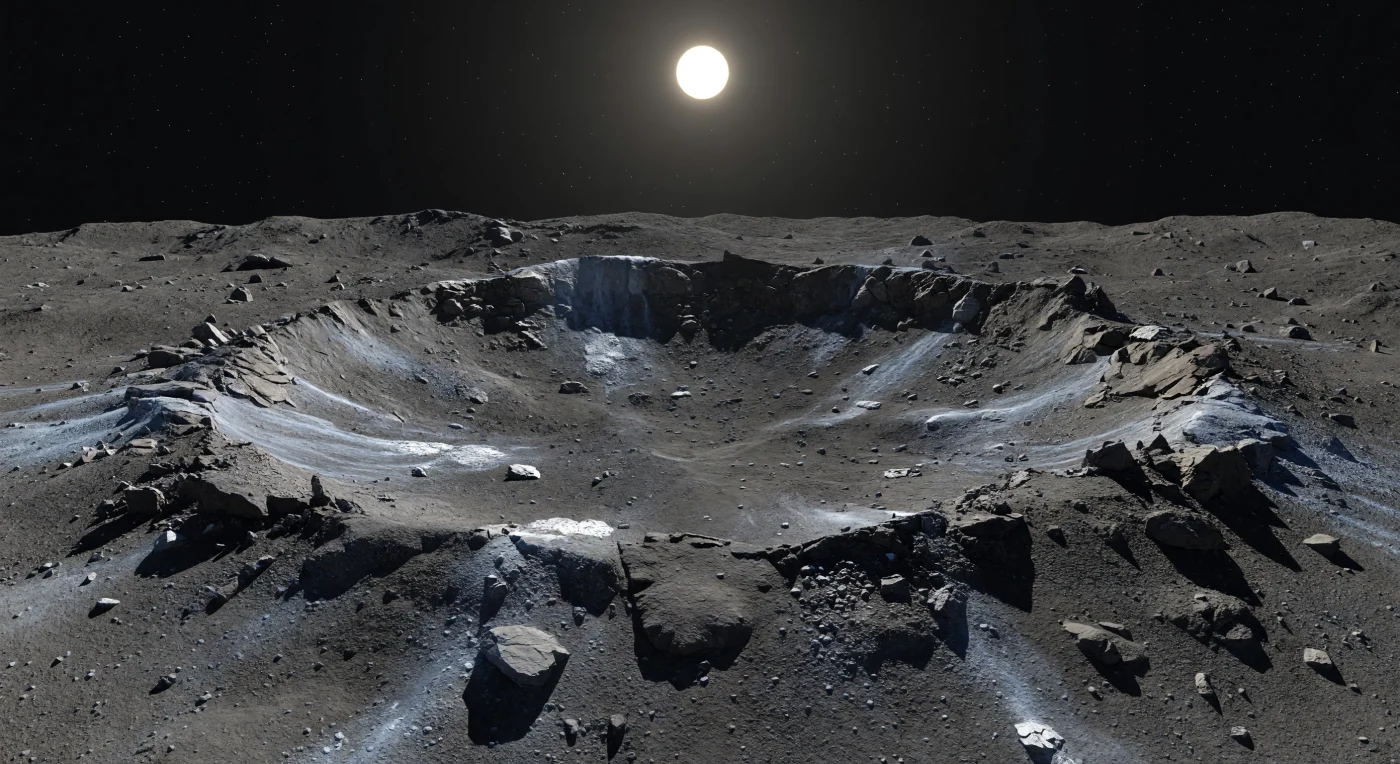
You stand on a raw impact landscape where the ground is strewn with jagged rim rubble, fractured slabs, and angular boulders cast across a broad ejecta plain, their crisp edges preserved by near-vacuum stillness and almost no erosion. Across the usual dark, carbon- and clay-rich regolith, fresh material from the young crater lies in brighter, subtly bluish streaks and pale salt-rich patches, hinting at a crust laced with hydrated minerals, brines, and traces of near-surface ice excavated by the impact. In the middle distance, the uplifted rim rises in a broken arc of terraces, slumps, and shattered crestlines, while beyond it the cratered plain curves gently away under the small-world horizon. Overhead, a black sky and a hard, distant Sun flood the scene with cold, unforgiving light, carving every stone and hollow into razor-sharp black shadow and giving the entire landscape the stark, frozen clarity of a world suspended between rock and ice.
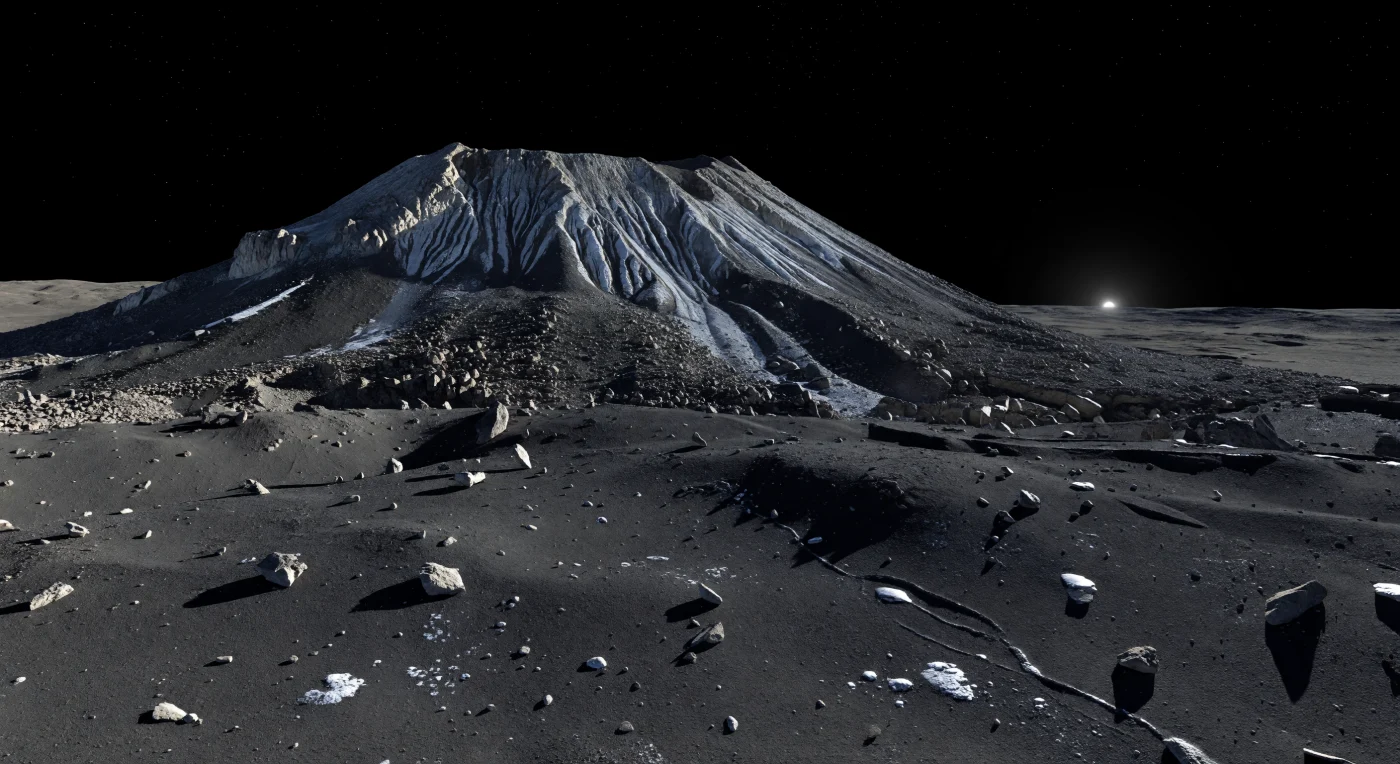
At the foot of the mountain, a dark charcoal plain of carbon-rich regolith lies strewn with angular blocks and dusty fragments, interrupted here and there by brilliant white patches where salts and buried ice reach the surface. Ahuna Mons surges upward with startling abruptness, its pale gray, faintly bluish cryovolcanic flanks carved into deep flutes, scarps, and debris chutes that speak of icy, salt-bearing material once rising from the interior and later collapsing into broad talus aprons. In the black, airless sky, the Sun hangs small and hard-edged above a nearby curved horizon, casting cold light that ignites bright upper-slope streaks while every recess and gully falls into razor-sharp, absolute shadow. The result is a landscape that feels both frozen and geologically alive: a volatile-rich world where brines, salts, and ice have built a lone mountain that towers over the ancient impact plain like a monument from another kind of volcanism.
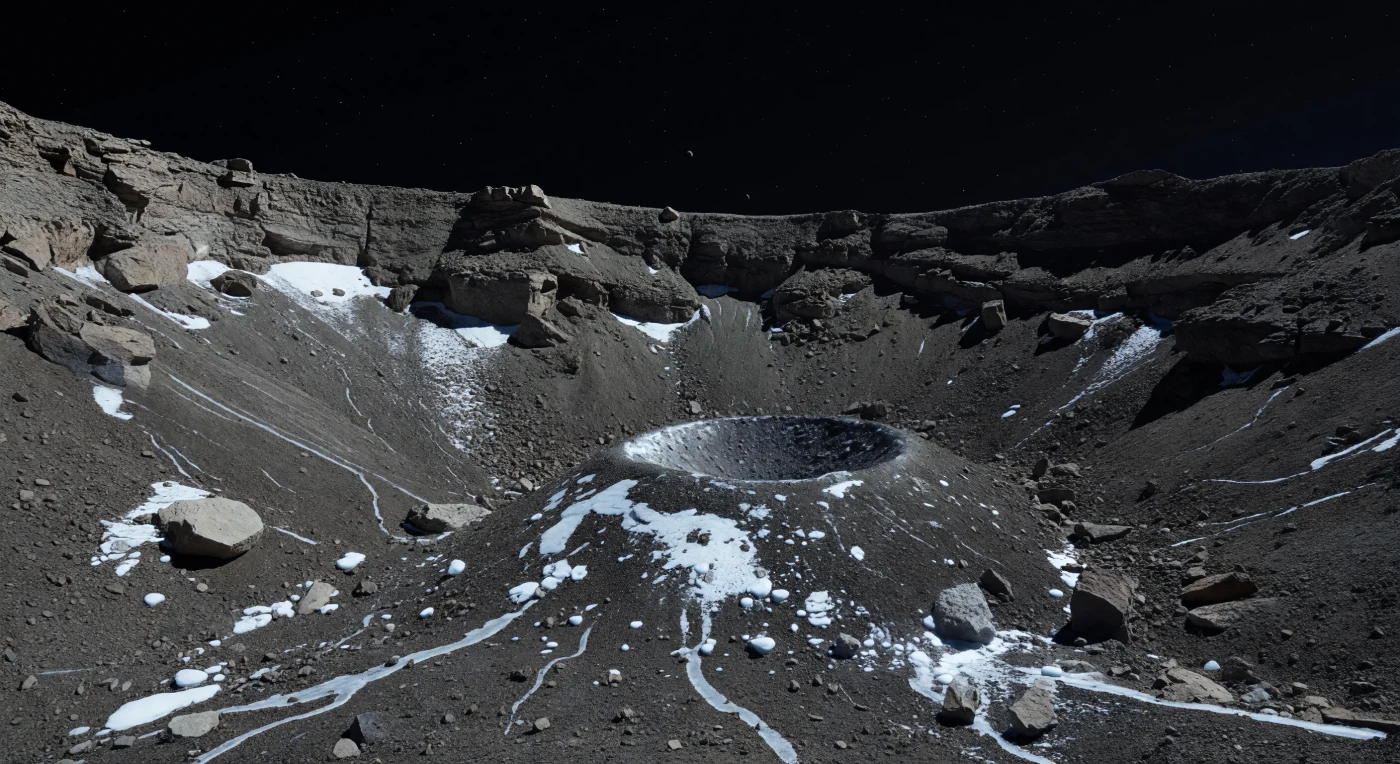
From the floor of this young crater, the wall rises steeply overhead in shattered charcoal and brown-gray layers, its crumbly regolith and angular breccia interrupted by dazzling streaks and patches of exposed water ice. Thin icy veneers, vein-like seams, and freshly fallen frost-bright rubble spill downslope in granular slumps, their crisp, uneroded edges preserved by the near-vacuum and the absence of weather, while nearby alcoves drop into almost absolute blackness under hard sunlight. The stark contrast reflects a volatile-rich crust in which ice lies close to darker, ammoniated phyllosilicate-bearing material, excavated and exposed by recent impact-driven mass wasting. Beneath a perfectly black sky and a smaller, distant Sun, the scene feels at once frozen and unstable: house-sized blocks perch above long talus fans, shadows cut like knives, and the brightest icy surfaces gleam with a faint cold-blue cast against the subdued silicate ground.
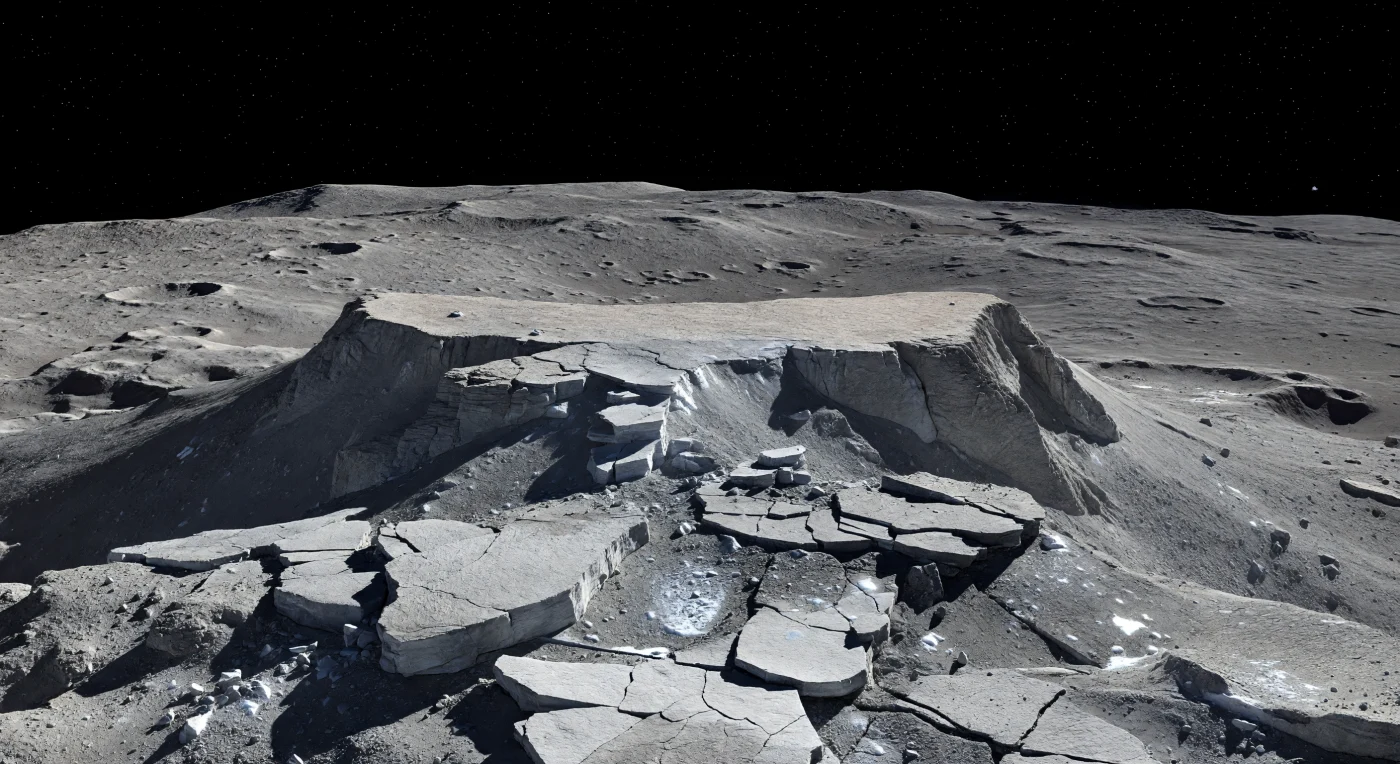
From the shattered crest of Ahuna Mons, you stand among angular slabs and broken ledges of pale gray icy rock, their sharp edges rimmed with cold light while black chasms and razor-shadowed fractures cut through the summit. The mountain’s crust is a frozen mix of hydrated rock, salts, and briny materials, with occasional bright glints where water ice or salt-rich surfaces are freshly exposed, while dark regolith dust gathers in cracks between brittle plates and talus blocks. Beyond the steep drop-offs, immense cratered plains spread outward in muted gray and brownish tones, their low rims, ejecta blankets, and smoother cryovolcanically altered patches bending subtly into a curved horizon that reveals the small scale and weak gravity of this world. Overhead, the sky remains perfectly black and seeded with stars even in daytime, because almost no atmosphere exists to scatter sunlight—only stark reflected illumination from beyond a ridge, turning the entire landscape into a silent, high-contrast panorama of ancient impacts, frozen brines, and cryovolcanic upheaval.
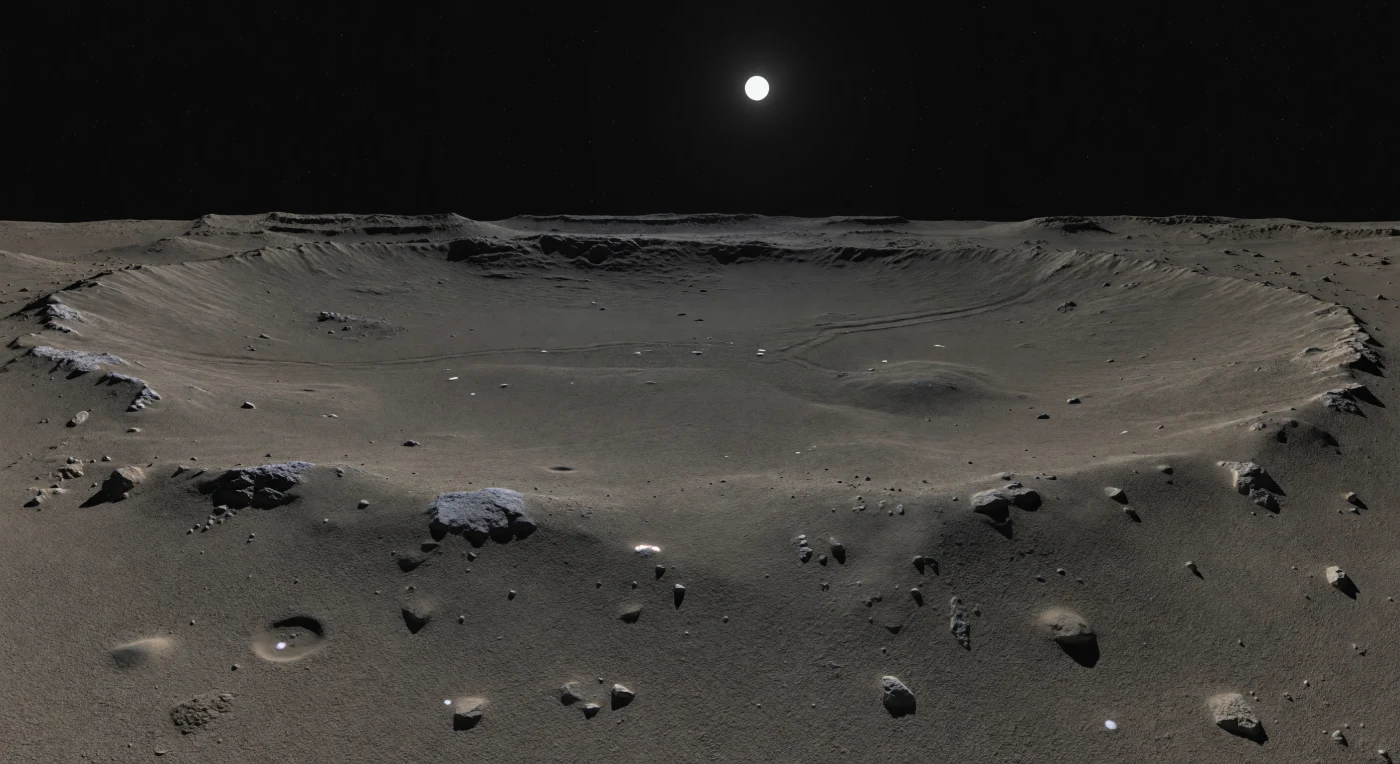
From the floor of this immense relaxed basin, the landscape stretches away as a subdued sea of muted brown-charcoal regolith, its fine dust and gray hydrated silicate grains broken only by sparse angular blocks and faint, half-buried craterlets. Ancient impacts have been softened by long-term viscous relaxation in a volatile-rich crust, so former crater rims survive only as low swells and shallow troughs that barely rise against the far horizon, hinting at the basin’s enormous scale. In the weak sunlight, a small hard-white Sun hangs in a pure black sky where a few stars still glimmer, casting crisp shadows across darker carbon-rich dust and occasional tiny pale flecks of exposed icy material tucked into sheltered hollows. The scene feels stark and eerily quiet—an old, airless world whose surface records both impact bombardment and the slow geological yielding of ice-, salt-, and clay-bearing ground over deep time.
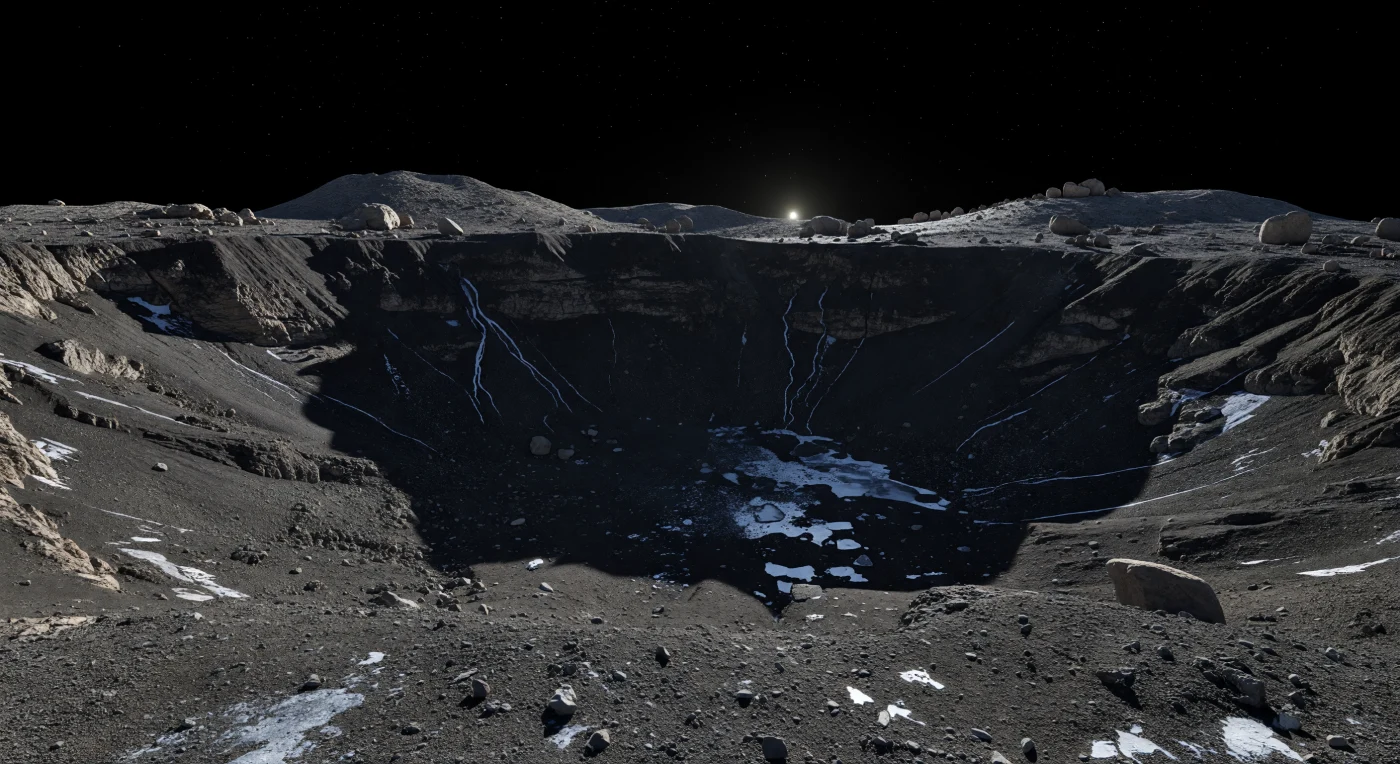
At the edge of this polar crater, you stand on a brittle plain of charcoal-gray regolith—clay-rich, salt-bearing, and littered with sharp impact-shattered rocks—while the ground falls away into an interior so cold and dark it is almost pure black, broken only by faint silver-blue flashes from frost films and exposed water ice. The steep walls descend in terraces and fractured ledges, their talus slopes and subtle bright streaks marking where ice can persist for geologic time in permanent shadow, protected in a near-vacuum so thin it offers no haze, no weather, and no softening of light. Above, the far rim rises like a ring of low mountains, glowing pale gray-gold under a small, distant Sun whose grazing rays cast knife-edged shadows across boulders the size of houses and debris fields frozen in place by weak gravity. Against the black sky, stars remain visible even in daylight, heightening the uncanny stillness of a world where dark hydrated minerals, salts, and cold-trapped ice preserve a record of both ancient impacts and buried volatiles.
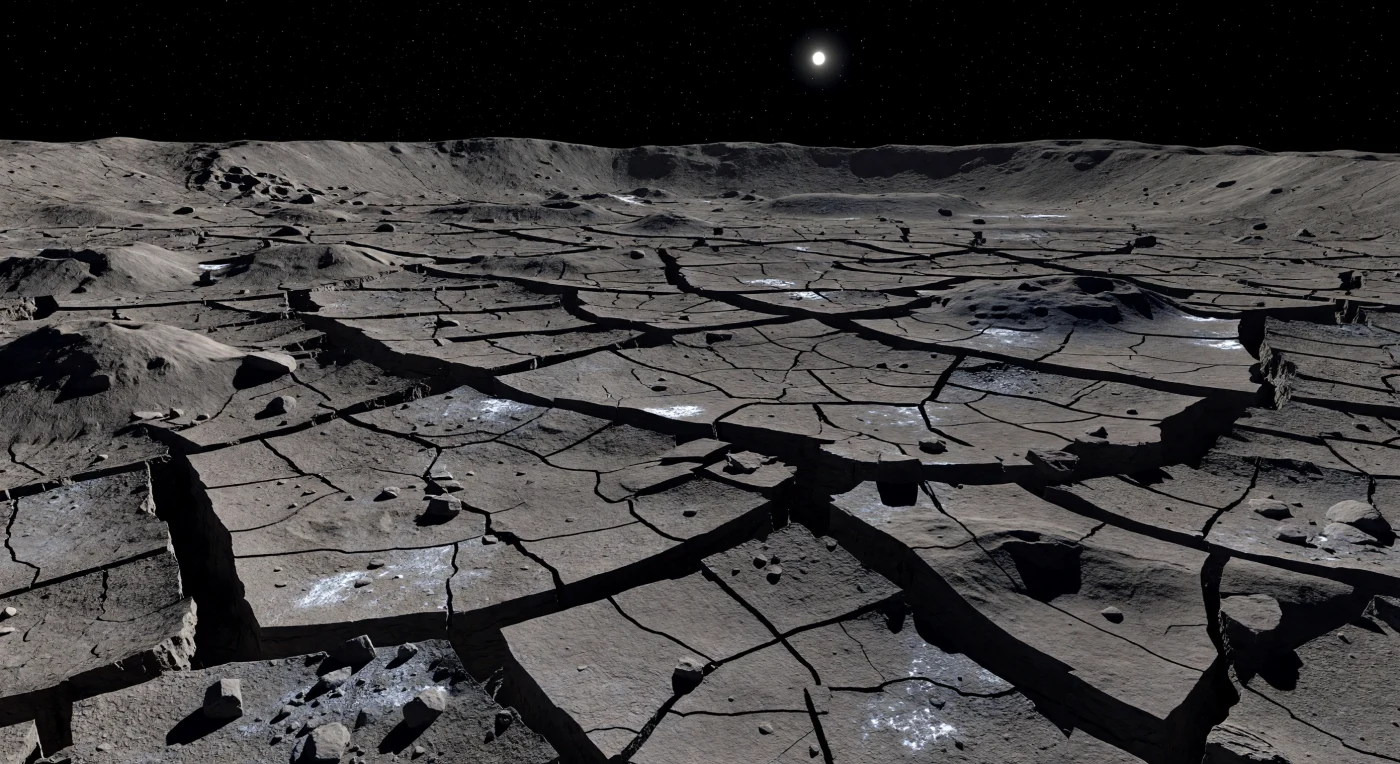
From the floor of this enormous basin, the ground appears split apart into a vast geometric web of radial and concentric troughs, where medium-dark, clay-rich crust has fractured into stepped graben, tilted slabs, and sagging polygonal plates strewn with angular breccia and powdery gray regolith. In the hard, low sunlight, every trench casts a razor-edged shadow, revealing a landscape shaped not by wind or flowing water but by tectonic collapse in a volatile-rich crust containing hydrated minerals, salts, and pockets of ice that survive only in protected, colder cracks as pale bright patches. The black sky and tiny white Sun make the scene feel stark and airless, with no haze to soften the view as the broken terrain stretches for kilometers and fades only with curvature toward the subdued inner rim. Standing here, you would feel the strange combination of fragility and immensity: a frozen surface of ancient impacts and subsurface brines, preserved in exquisite sharpness by near vacuum and extremely weak gravity.
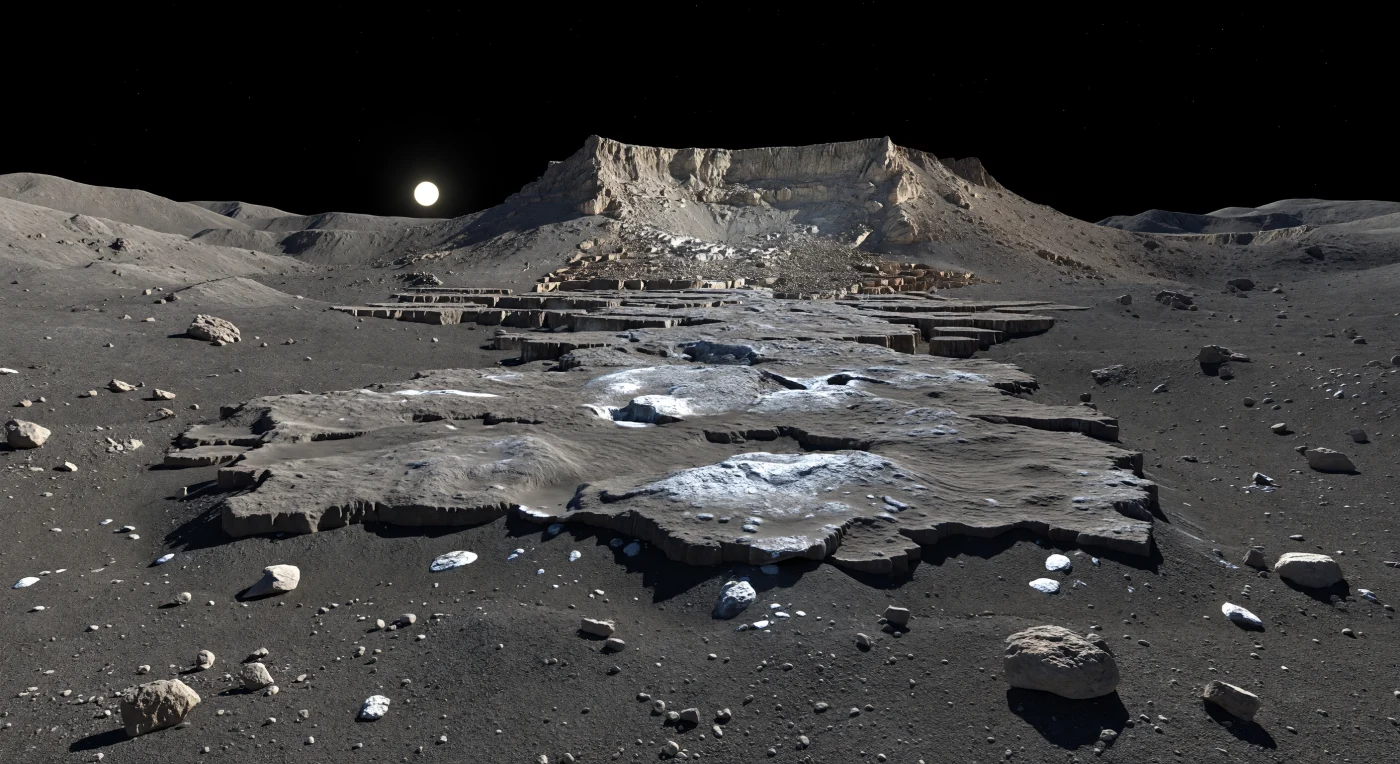
From the floor of this immense impact basin, a dark, broad tongue of debris spills out from the steep crater wall like a frozen wave, its hummocky surface, ridged lobate edges, and collapsed megablocks picked out in razor-sharp shadow by the low white Sun. Underfoot lie charcoal and brown-gray regolith, fractured boulders from meter scale to the size of houses, and rubble rich in hydrated silicates, with occasional small bright flecks of sodium-carbonate salts and hints of pale ice tucked into colder crevices—evidence of a crust shaped not only by impact, but by water-bearing minerals and buried volatiles. The landslide’s flow-like form reflects debris mechanically weakened by ice and salts in this low-gravity, near-vacuum world, where material can slump and spread for kilometers across the basin floor while retaining crisp textures no air or weather ever softens. Above the escarpment, beyond slumped ledges and talus aprons, distant crater rims fade into a black sky with no haze at all, making the scene feel both silent and colossal, as if you are standing inside the exposed anatomy of a small, ancient protoplanet.
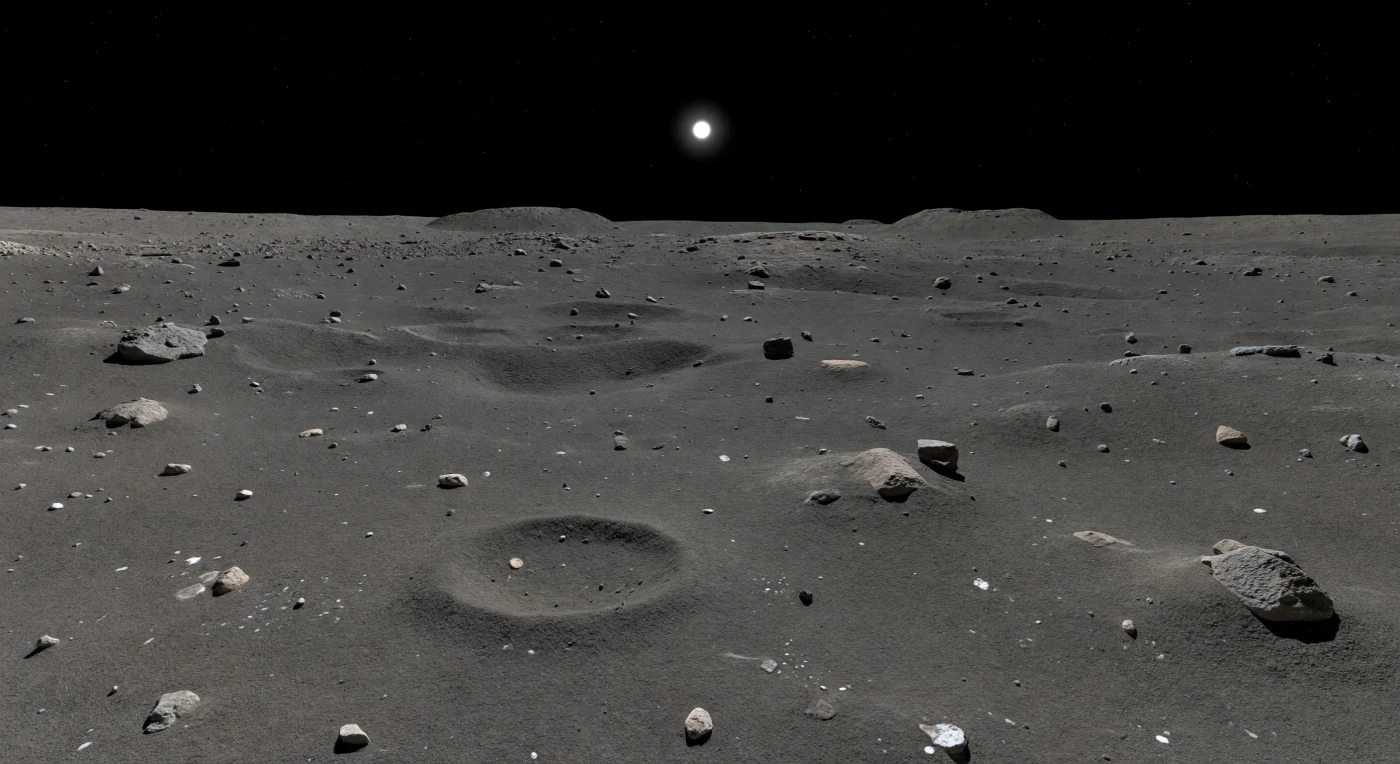
At local noon, the equatorial plain stretches out as a broad sheet of dark, powdery regolith—charcoal, slate, and ash gray—broken only by softened little craters, pebble-strewn patches, and scattered angular blocks of fractured rock casting razor-sharp shadows. The ground is rich in hydrated, clay-bearing minerals mixed with ancient impact debris, a dry frozen soil slowly churned by countless micrometeoroid strikes in weak gravity, with only the occasional tiny white fleck hinting at exposed salts or trace near-surface ice. Because this world is so small, the horizon feels unnervingly close, only a few kilometers away, where low rises and muted crater rims sit starkly outlined without haze in the pure black vacuum sky. Overhead, the Sun appears as a small but ferociously bright disk, flooding the plain with hard, cool-white light that makes the landscape feel both miniature and immense, as if you were standing inside a silent, airless geological archive from the earliest Solar System.
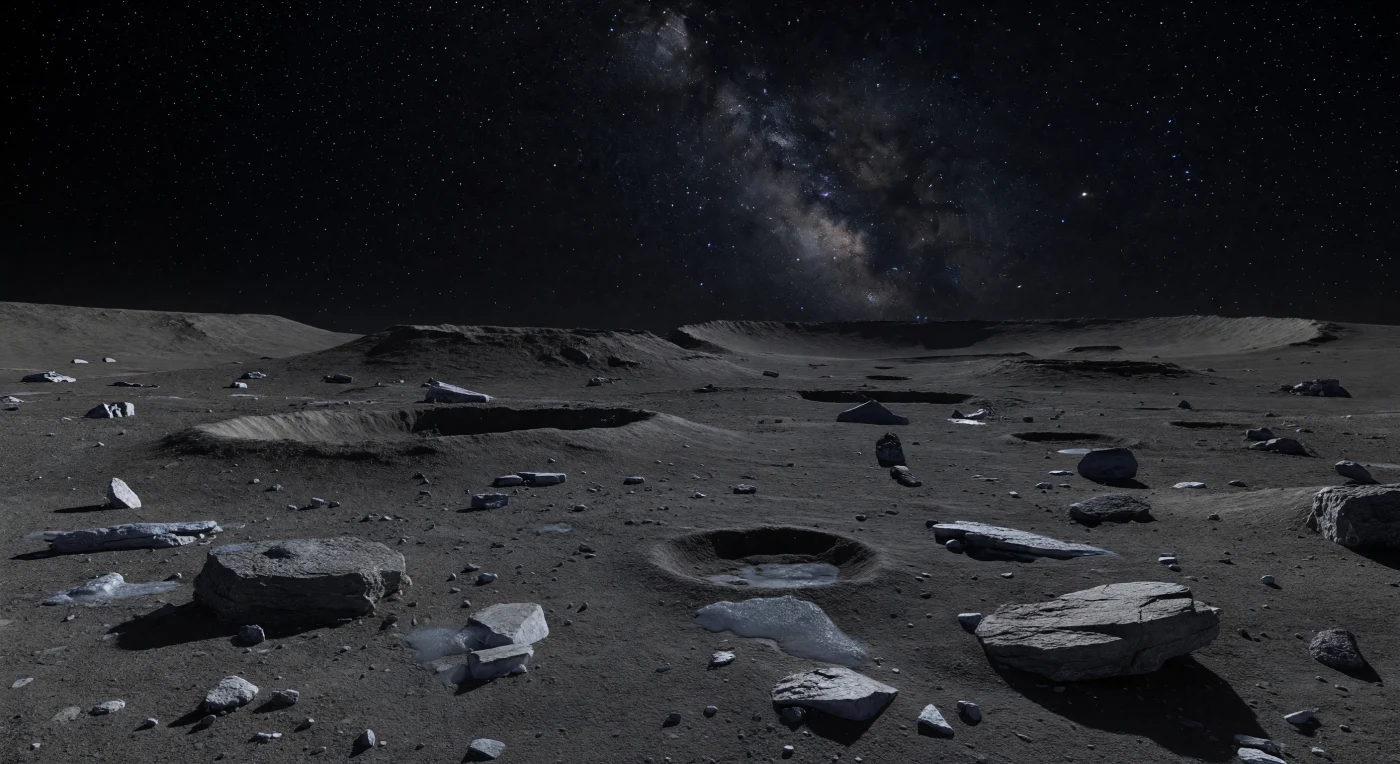
Under a sky as black as interplanetary space, a broad charcoal-gray plain stretches away in silence, its powdery regolith broken by scattered angular boulders, fractured slabs, and the softened rims of ancient impact craters barely emerging in the dim light. With almost no atmosphere to scatter sunlight or blur the view, the stars burn with needle-sharp clarity and the Milky Way arches overhead like a luminous river, while a brilliant planet-like point hangs motionless above the horizon. The ground is a mix of hydrated rocky material and fine impact debris, with occasional dull flecks of water ice hiding in shadowed hollows, hinting at the volatile-rich crust below; in the distance, low hummocks and a subdued crater rim curve gently with the small world’s horizon. Standing here would feel like standing on a frozen, fossilized remnant of early planetary formation, where vacuum, low gravity, and billions of years of impacts have shaped a landscape both starkly simple and profoundly alien.