Scientific confidence: High

An immense plain of brilliant nitrogen and carbon-monoxide ice stretches to a hazy horizon, its surface broken into vast polygonal cells where the frozen plain slowly overturns by solid-state convection, carrying darker tholin dust and fine ice grains into shallow troughs and low ridges. In the middle distance, jagged mountains of rock-hard water ice rise abruptly from the volatile ices like stranded massifs, their steep cliffs and fractured faces made possible by weak gravity, while glacier-like tongues of brighter frost gather at their bases under the Sun’s tiny, far-off light. Above them, delicate blue atmospheric haze forms thin luminous bands across an otherwise black sky, and hanging over it all is the colossal disk of Charon, cratered and gray-brown with a faint reddish polar stain, so large it seems to crowd the heavens. Standing here, you would feel the scale of a world both silent and active: a frozen basin reshaped by slow internal motion, beneath crisp blue-gray shadows and the cold glow of the outer solar system.
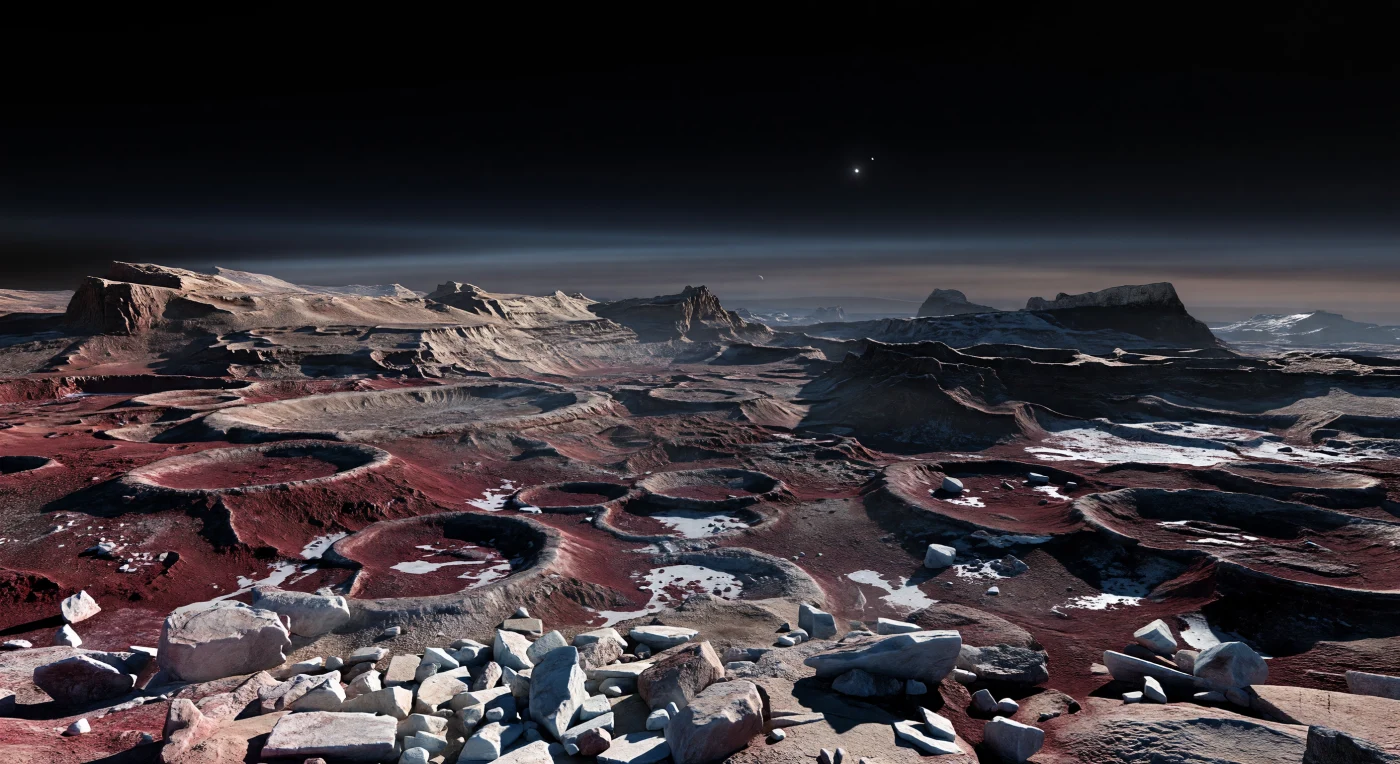
At ground level, the badlands stretch away as a maze of ancient crater rims, jagged scarps, and fractured uplands stained rust-red, crimson, and dark brown by tholins—complex organic residues formed when sunlight and radiation alter methane and nitrogen ices over immense spans of time. Beneath that reddish mantle, the landscape is built from bedrock-hard water ice, broken into sharp, angular boulders and ridges, with faint patches of nitrogen and methane frost lingering in cold shadowed hollows across this deeply eroded, impact-scarred terrain. The distant Sun appears tiny yet piercing, casting long, razor-edged shadows across the brittle ice-rich regolith, while a thin nitrogen atmosphere layers the horizon in blue-gray and purple-brown haze, turning the daylight into a dim, smoky twilight despite the blackness of space above. Standing here, you would feel the vast age and scale of this frozen wilderness—kilometer-wide crater walls and sublimation-carved troughs fading into murky highlands, with every cold gleam of exposed ice and every dark organic stain speaking of chemistry, impacts, and erosion in the far outer solar system.

At the edge of a frozen basin, a smooth expanse of nitrogen ice stretches to the horizon like a pale, motionless sea, its surface broken into broad polygonal cells where the volatile ice slowly overturns by convection over geologic time. Rising from it are immense blocky massifs of water ice—icebergs in the truest planetary sense—kilometers across and buoyant because rigid water ice is less dense than the softer nitrogen ice surrounding it, their fractured blue-gray faces dusted with bright methane frost and streaked with darker tholin-rich material. In the weak, distant sunlight, the plain gleams faintly while long cold shadows deepen every cliff and trough, and far-off chains of detached mountains emphasize the enormous scale of this active glacial landscape shaped by sublimation, frost transport, and exotic cryogenic geology. Above the black sky, delicate blue atmospheric haze forms luminous layers near the horizon, and a dark, cratered moon hangs fixed and unmoving, making the scene feel both eerily still and astonishingly alive.

From the rim of this 3.5-kilometer-high cryovolcanic mountain, the ground breaks into pale hummocks, fractured ridges, and lobate frozen flows of water-ice bedrock dusted with nitrogen, methane, and carbon monoxide frost, their silvery surfaces catching the weak, razor-sharp light of a Sun reduced to a brilliant point. Ahead, the vast central depression drops away for tens of kilometers, its scalloped, fluted walls and steep ice terraces vanishing into blue-black shadow, a landscape shaped by the slow extrusion of viscous cryolava under gravity so feeble that cliffs and relief can remain stark and exaggerated. Beyond the summit, ancient icy uplands and subdued cratered plains fade toward a horizon lined with a thin bluish haze, the visible edge of a tenuous atmosphere layered with delicate mist. Overhead, in a sky still dark enough for stars, a huge crescent moon hangs above the frozen caldera, making the scene feel at once silent, immense, and profoundly alien.
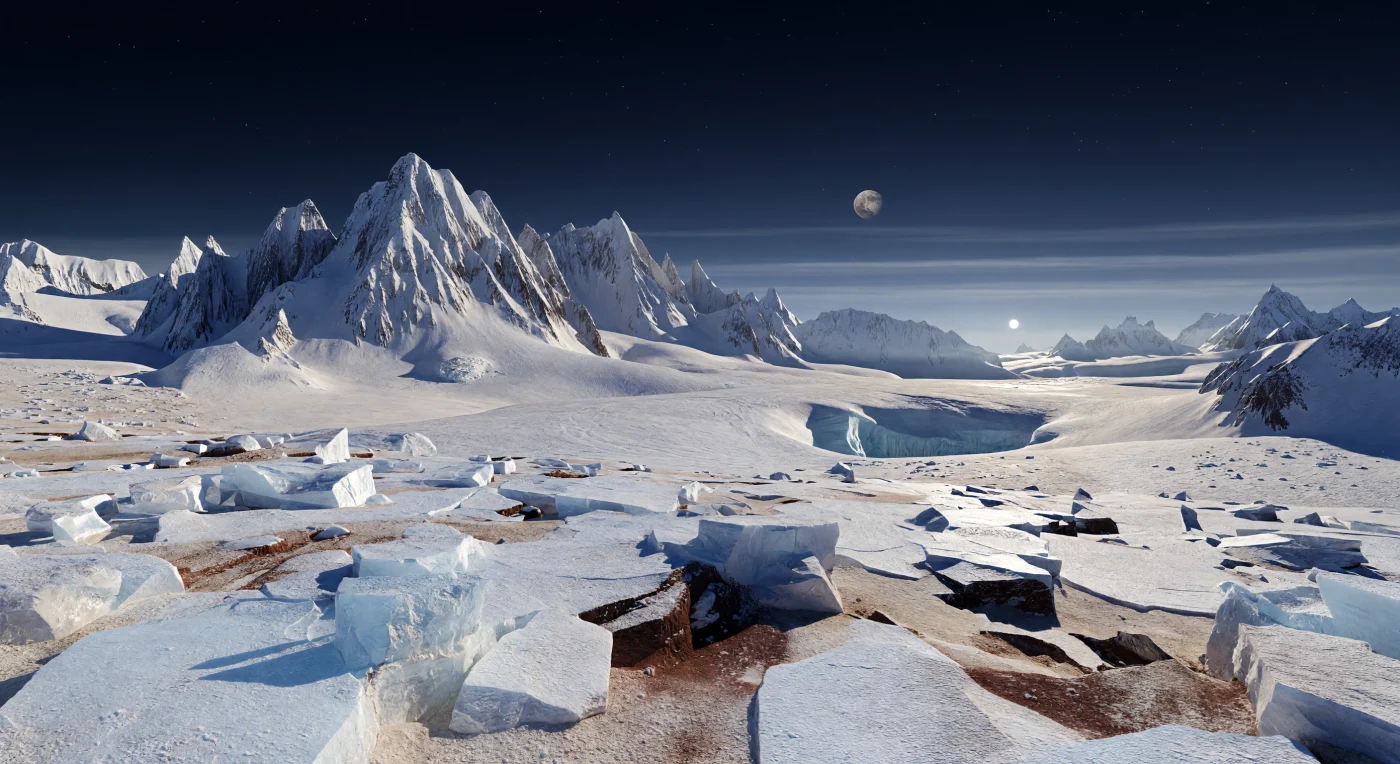
At your feet, fractured blocks of water ice—rock-hard in this deep cryogenic cold—are dusted with pale methane and nitrogen frost, while darker reddish tholin grains collect in sheltered cracks like soot from ancient chemistry. Ahead, the steep, knife-edged peaks of Tenzing Montes rise some 6.2 kilometers into a navy-black sky, their extraordinary height exaggerated by weak gravity and their slopes lit by the first sharp glint of a tiny, distant Sun. The dawn reveals broad aprons of volatile ice pooled around the mountains and merging into brighter, smoother plains, where sublimation textures, pits, and faint polygonal patterns record the slow movement and seasonal reworking of frozen nitrogen and methane rather than any flowing liquid. Above the horizon, a faint blue glow and delicate haze layers from the thin nitrogen atmosphere soften the sunrise just enough for stars to remain visible, making the whole frozen massif feel both airless and hauntingly alive.
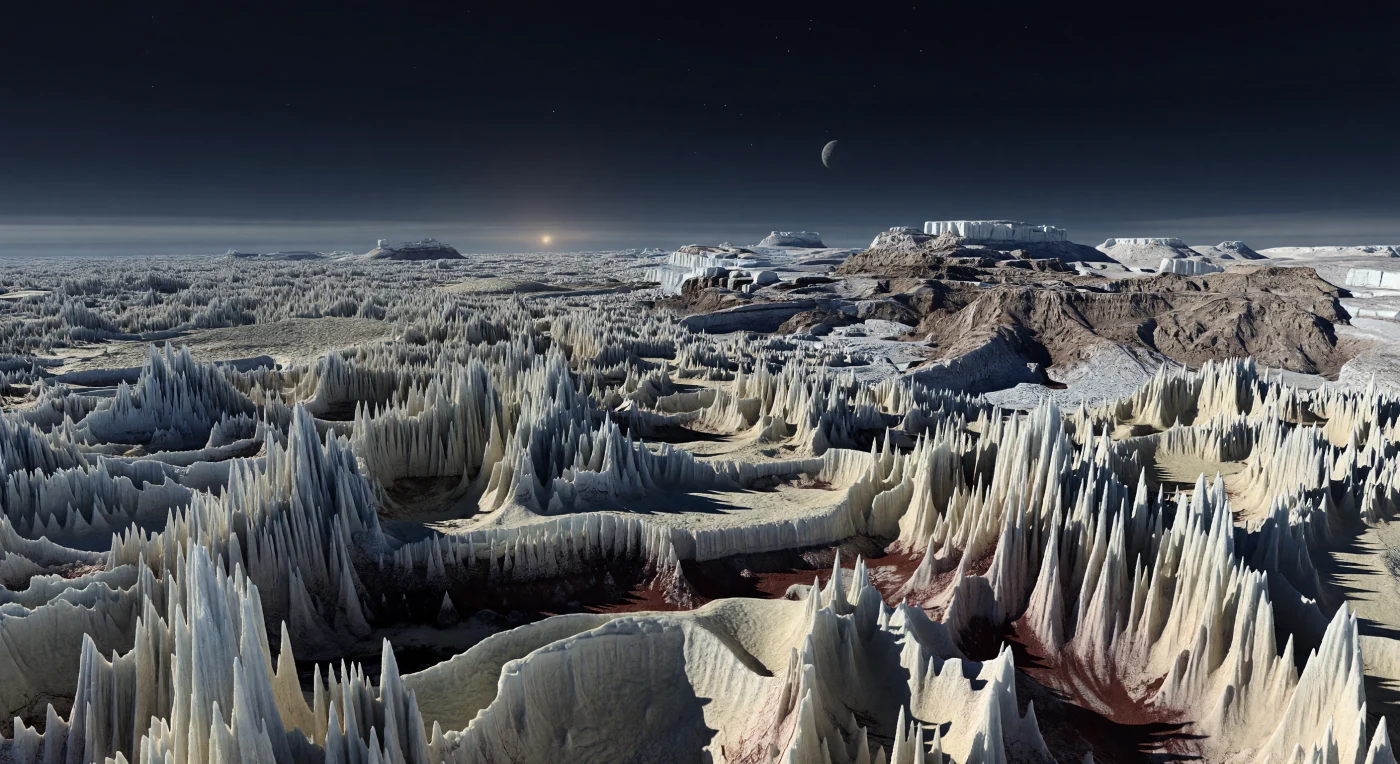
At ground level, the landscape rises into a frozen maze of knife-edged ridges and towering penitente-like blades, their pale methane- and nitrogen-rich ice glowing faintly under a tiny, distant Sun while deep bowls between them fall into cold blue-gray shadow. These spires, soaring up to about 500 meters above the troughs, have been carved not by wind or flowing water but by sublimation, as volatile ices slowly turn directly to gas in the brutal cold, leaving behind fluted faces, serrated crests, and dark reddish-brown tholin-rich lag in sheltered hollows. Beyond the foreground, the blade fields stretch toward fractured scarps and blocky mountains of stronger water ice, with a faint bluish haze lying low against a nearly black sky, hinting at the thin nitrogen atmosphere above. The effect is both majestic and unsettling: an immense, silent wilderness of brittle ice and shadow where every ridge looks sharp enough to cut the dim light itself.

Under a night that lasts for days, a frozen plain of pale ammonia-bearing frost and water ice stretches to an almost impossibly distant horizon, its surface etched with polygonal cracks, low pressure ridges, lobate cryovolcanic flows, and shallow pits where reddish tholin dust has settled into the coldest hollows. In the weak gravity, hard blocks of water ice sit like scattered stone across the foreground while far-off domes and rugged massifs rise with uncanny sharpness, their older impact scars partly softened by mantles of volatile ice—evidence that even here, geology remains active through cryovolcanism and slow reshaping by frozen nitrogen, methane, and ammonia-rich materials rather than liquid water. Above, the near-black sky is crowded with stars seen through an atmosphere so thin it offers almost no veil, while a faint bluish haze clings to the horizon and Charon hangs fixed as a dim crescent, suspended motionless by tidal locking. Somewhere among the constellations, Earth glimmers as a tiny blue point, and in the starlight and weak Charon-shine the plain gleams with cold blue-gray highlights, leaving cracks and pit edges drowned in shadows black enough to make the landscape feel endless.
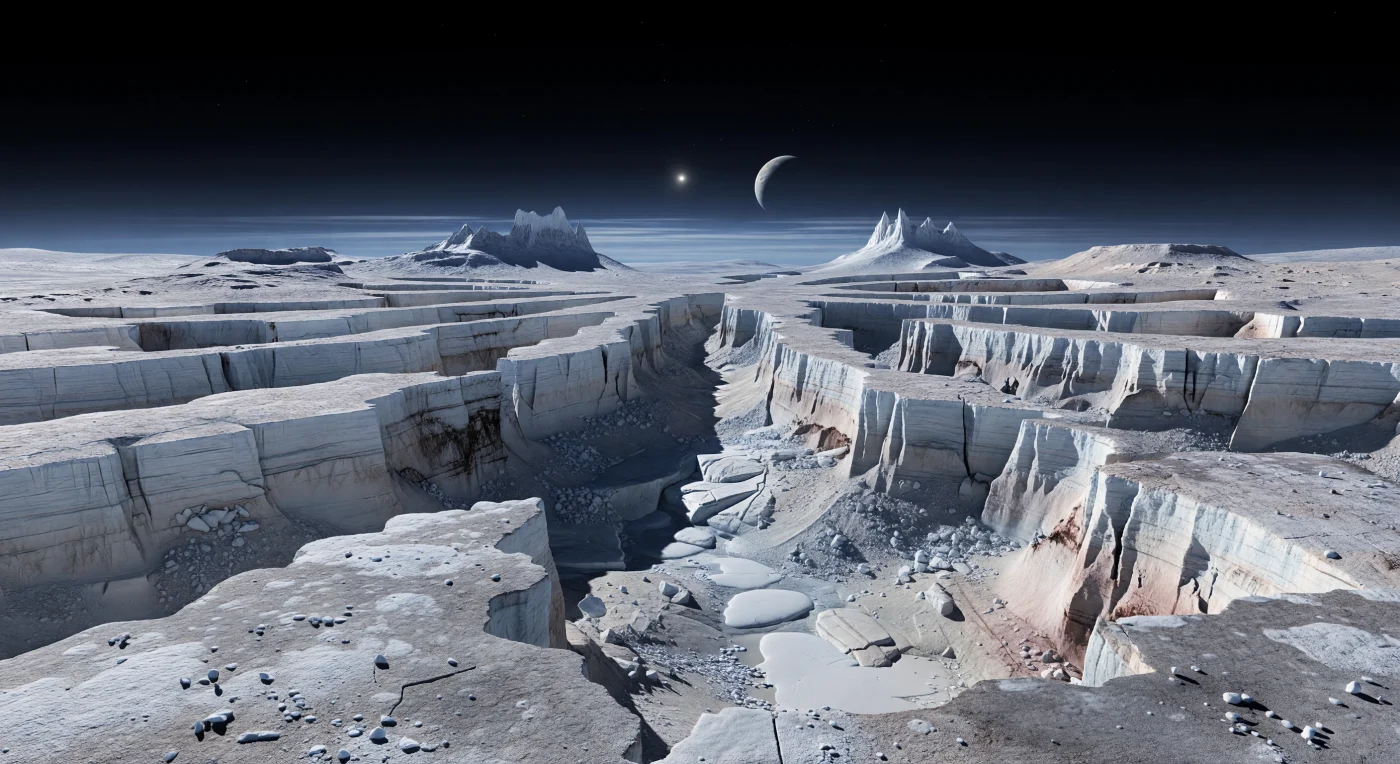
From a fractured rim of steel-gray water-ice bedrock, you look across an immense frozen tectonic hub where six vast canyons radiate from a subtle central uplift, their spoke-like chasms slicing the landscape with astonishing symmetry. Sheer, terraced walls expose layered deposits of bright nitrogen and methane ice in pale white, bluish frost, and faint pink-beige bands, while darker tholin-stained dust gathers on ledges and in sheltered hollows, recording chemical processing under weak sunlight and extreme cold. The tiny distant Sun casts hard, razor-edged shadows into canyon floors strewn with collapsed blocks, talus, polygonal fractures, and slow-creeping tongues of volatile ice, revealing a brittle crust deformed by extensional faulting rather than flowing rock. Above the silent scene, a near-black sky is lined at the horizon with delicate bluish haze layers from the tenuous nitrogen atmosphere, and beyond the uplift, sharp water-ice mountains rise with improbable crispness in the low gravity, making the entire panorama feel both airless and hauntingly alive.

A many-kilometer-wide glacier of volatile ice pours gently downslope from the bright plains into the floor of an ancient crater, its pale nitrogen-rich surface tinted with faint bluish whites, muted tan tholin dust, and crossed by soft flow bands, shallow troughs, and polygonal sublimation textures that record motion too slow for the eye to see. Dark, angular blocks of water ice—hard as bedrock here—ride within the softer frozen mass like rafts, while the crater’s worn rim, terraced slopes, and rugged icy knobs reveal a landscape shaped not by liquid water or weather, but by impact, sublimation, and the creep of exotic ices in extreme cold. Along the horizon, sharp water-ice mountains rise steeply in the weak gravity, their fractured faces and distant cratered uplands fading into a delicate blue atmospheric haze beneath a sky that is otherwise black. The Sun hangs low as a tiny, star-like point, casting long blue-gray shadows across the glacier and making this silent scene feel immense, frozen, and unexpectedly alive on a glacial timescale.
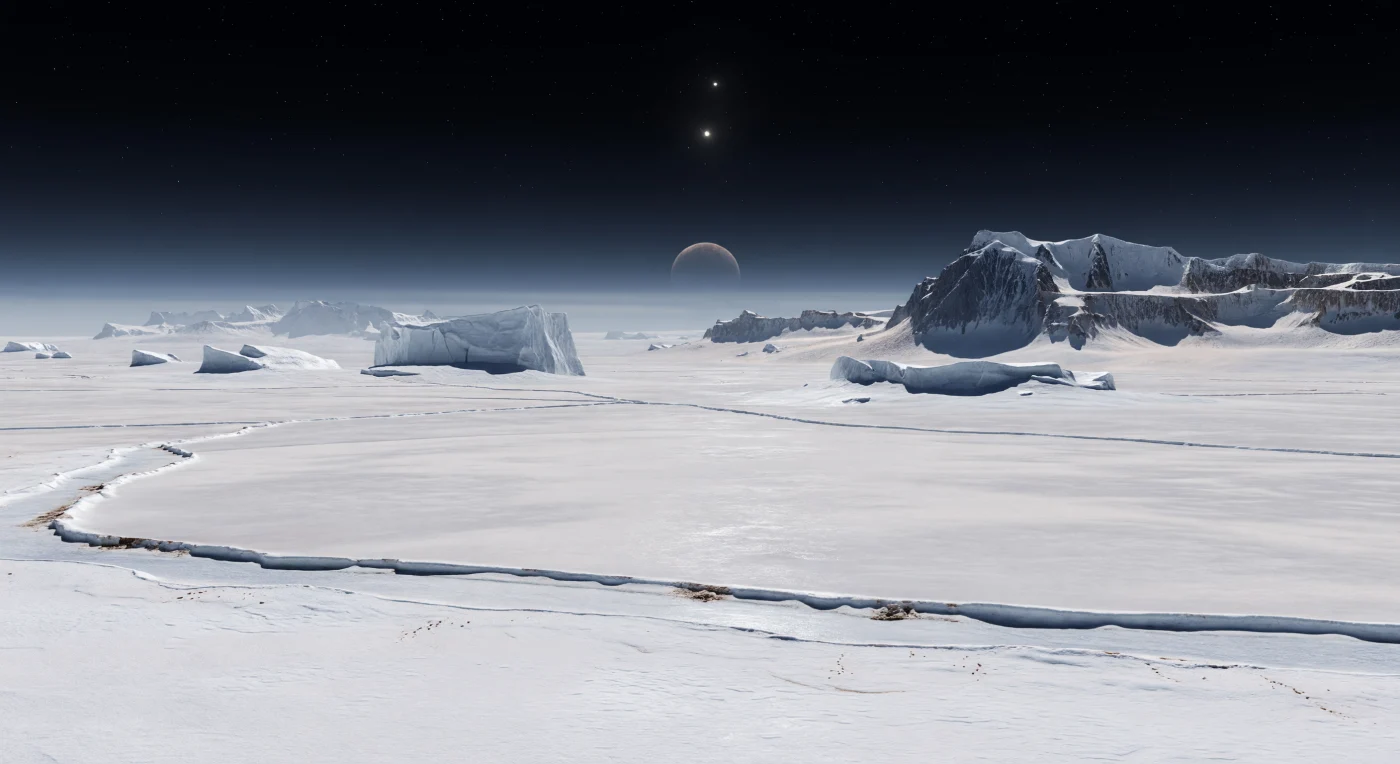
You stand in a broad trough marking the boundary of a giant convection cell, where bright nitrogen ice has piled into low ridges streaked with darker methane-rich and tholin-stained debris, while the surrounding plains spread away in astonishingly smooth, pale polygons. These cells are the surface expression of slow overturning within Sputnik Planitia’s thick sheet of volatile ice, where nitrogen behaves almost like an ultra-cold glacier, rising and sinking over geological time as sublimation and flow subtly sculpt the ground underfoot. On the horizon, great blocks and mountain chains of hard water ice—strong as bedrock at these temperatures—loom like stranded rafts in the softer frozen plain, their shadowed faces tinted blue-black beneath patches of frost. Above, a black sky fades to a delicate blue haze near the horizon, a tiny hard-edged Sun throws razor-sharp shadows across the ridges, and a large distant moon hangs fixed in the stillness, making the whole frozen basin feel immense, silent, and profoundly alien.

At ground level, the frozen plain stretches away in pale nitrogen and methane ice, its broad polygonal cells, shallow sublimation pits, and frost-softened ridges broken here and there by blocks of dark, rock-hard water ice dusted with rusty tholin particles. Beyond, immense mountains of water ice rise in jagged walls several kilometers high, their flanks feeding bright glaciers of volatile ice into the lowlands while ancient cratered uplands fade into the murk below a sunset sky unlike any on Earth. Overhead, space is already nearly black, but along the horizon the thin nitrogen atmosphere glows in stacked bands of deep cobalt, indigo, and violet haze reaching roughly 200 kilometers upward, with the lowest layers dense enough to veil the bases of the far terrain and the highest still transparent enough for faint stars to show through. The Sun appears only as a tiny, fierce point sinking into the twilight, casting a cold amber-white rim of light across the ice and leaving the receding globe of Charon and the mountain skyline in haunting silhouette.
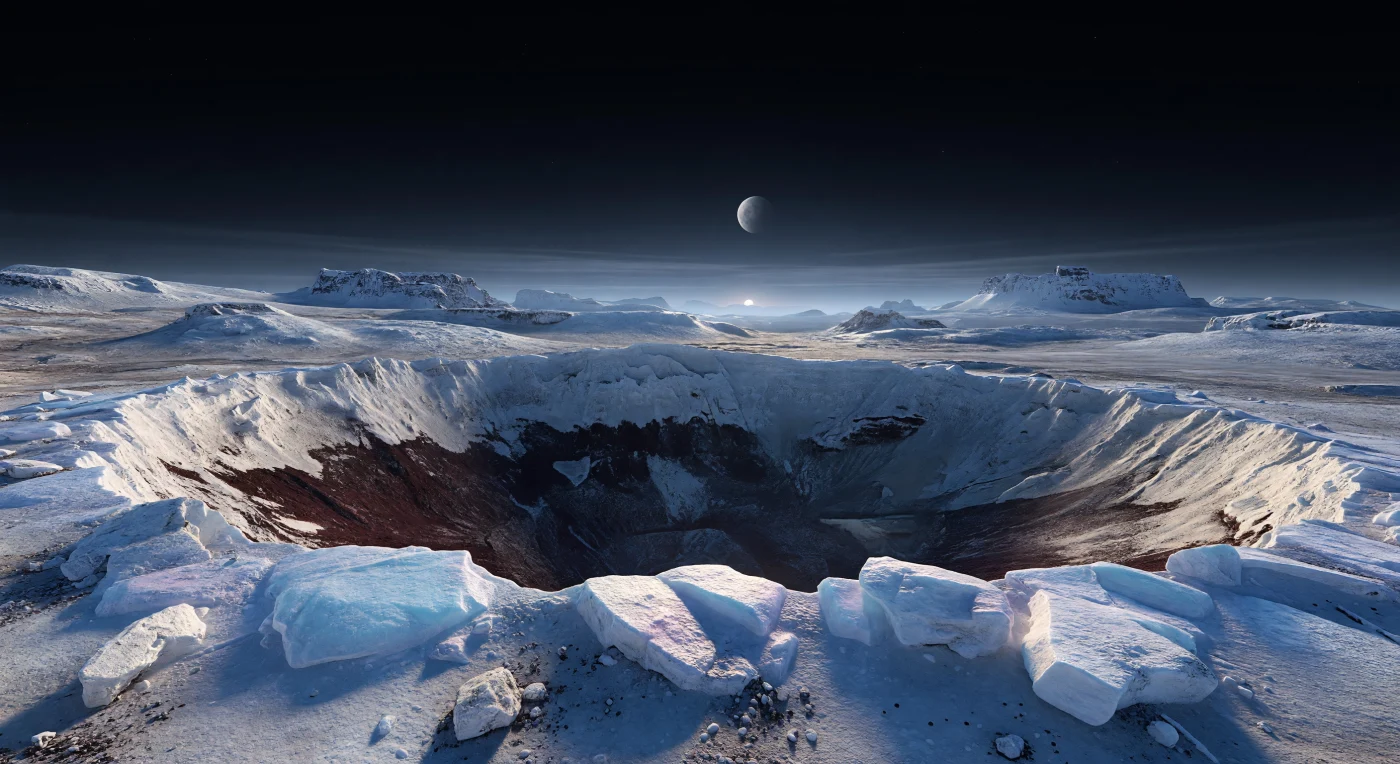
At the crater’s edge, brittle slabs of water-ice bedrock are glazed with methane frost and patches of nitrogen ice, so bright in the Sun’s last grazing light that they shimmer white, pale cyan, and faint lavender against the encroaching dark. Beyond your feet, the rim falls steeply into a vast shadowed bowl where reddish-brown tholin deposits—complex organic residues made by radiation processing of atmospheric gases—collect along terraces and lower slopes, tracing slow sublimation, frost migration, and downslope movement in this intensely cold environment. Farther out, ancient icy uplands and blocky mountains rise with improbable steepness under weak gravity, while near the horizon a thin nitrogen atmosphere lays down delicate blue haze bands that barely soften the blackness of space. Above it all hangs Charon as a large, bright disk in the twilight sky, making the frozen silence and immense scale of this distant landscape feel both starkly alien and physically real.

Under a sky that is almost black even at midday, the ancient highlands stretch away as a frozen wilderness of battered water-ice bedrock, where overlapping craters, broken ice blocks, scalloped sublimation pits, and thin veneers of methane and nitrogen frost are dusted with dark reddish tholins in the hollows. On the horizon, jagged mountains of rock-hard water ice rise far steeper than their height would suggest on Earth, while a faint blue haze clings to the surface in delicate layers, betraying the presence of an atmosphere so tenuous that stars still shine through it. At the center of the sky, a brilliant blue-green Neptune partly covers the tiny distant Sun, turning the land into an eerie eclipse-lit twilight and tracing crater rims, frost crystals, and fractured troughs with a cold silver-blue glow. Elsewhere hangs Charon as a dim crescent, its night side barely outlined by reflected light, adding to the immense, desiccated stillness of a landscape sculpted not by rain or rivers, but by impacts, deep cold, and the slow escape and redeposition of volatile ices.

A broad plain of frozen ammonia-water cryolava stretches away in pale whites and faint blue-cyans, its smooth to subtly hummocky surface broken by shallow winding channels, lobate flow fronts, and low pressure ridges where the viscous slurry chilled and stiffened in weak gravity. Darker blocks of water-ice bedrock jut through the brighter volatile-rich crust, while long fractures, troughs, and collapsed pits mark tectonic disruption above a recently mobilized interior, making this sparsely cratered field look strikingly young. On the higher ridges, a dusting of methane frost catches the tiny, distant Sun with cold glints, beneath a black sky softened near the horizon by thin blue atmospheric haze. Far off, jagged water-ice mountains rise improbably high, giving the scene a grand, eerie scale and reminding you that even here, in this silent deep-freeze, the landscape is still being reshaped.

Under Charon’s cold, fixed glow, Belton Regio spreads out as a vast field of overlapping craters and fractured uplands, where deep crimson, maroon, and umber tholin deposits drape a foundation of hard water ice and gather between frost-bright ridges. Thin veneers of methane and nitrogen ice cling to crater rims and pool in shadowed hollows, their pale bluish-white sheen sharply contrasting with the darker organic material, while polygonal cracks, sublimation pits, and dark ejecta stains record eons of impacts and slow surface change in extreme cold. In the weak gravity, distant water-ice massifs rise surprisingly steep against a black, star-filled sky, and faint blue-gray haze layers hover low on the horizon above an atmosphere so tenuous that the landscape remains startlingly crisp across immense distances. With no sunlight at all—only dim reflected light from the giant companion overhead—the scene feels silent and spectral, as if the ground itself is breathing back a muted red-brown glow from the frozen chemistry of the outer solar system.
