Scientific confidence: High

A vast north-polar plain of water-ice bedrock stretches away in subdued swells, its surface stained deep brick-red and maroon by a thin, uneven veneer of tholins—complex organic residues formed when methane and other gases are irradiated, likely after escaping from its companion world and settling here in the polar cold. At your feet, frost-crusted granular ice breaks into polygonal plates and angular blocks, while pale gray-white patches show through where the dark coating thins, and farther out low ridges, faint tectonic fractures, and softened crater rims cast razor-sharp black shadows in the weak, hard sunlight of the distant Sun. The airless sky is perfectly black, with no haze to soften the scene, and the close, strongly curved horizon reveals the small size of this icy body as the darkened plain rolls onward into gently undulating uplands. Hanging motionless low above that horizon is a large gray-tan disk with subtle markings, a constant presence in this tidally locked system, making the frozen silence and immense scale feel even more uncanny.
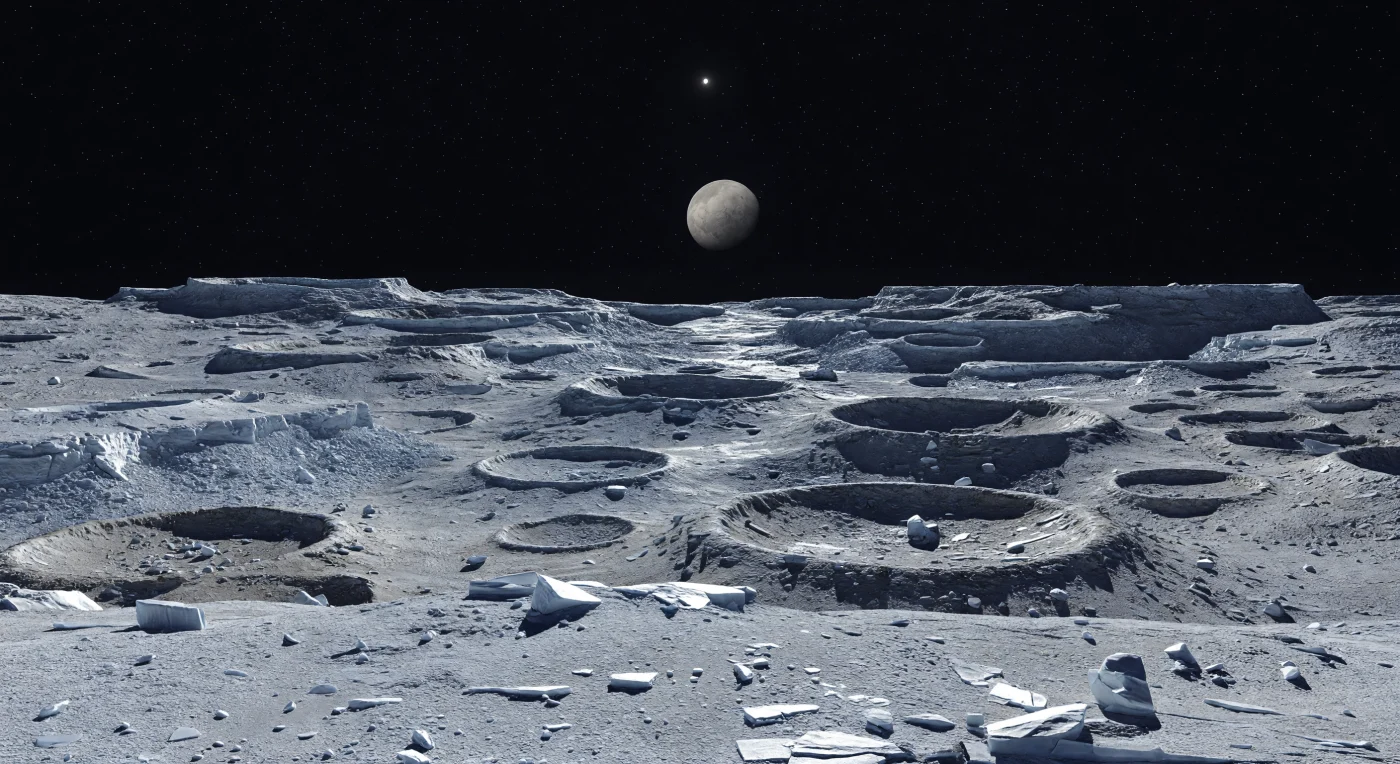
Across these ancient highlands, pale gray and bluish-gray ground stretches in a maze of overlapping impact scars, where shallow, softened craters, low hummocky ejecta, and fractured plains record a surface battered for billions of years. The crust here is dominated by water ice hardened into bedrock that breaks like stone, mixed with darker rocky material and littered with angular blocks and talus shed from crater walls and brittle slabs. In the airless cold, the black sky offers no haze to blur the view: distant rims and rugged uplands remain unnervingly sharp under the tiny, intense Sun, while deep shadows pool ink-black inside crater bowls and exposed ice flashes with cold highlights. Hanging low above the horizon, the companion world appears far larger than the Sun, reinforcing the eerie scale of this frozen landscape and the weak gravity that lets its stark relief endure.

From the shattered rim of a northern polar crater, pale walls of hard water ice plunge in steep terraces to a basin floor stained deep red-brown, where a thin mantle of radiation-processed organic material has collected in hollows and between low hummocks. Every ledge, fracture, and boulder looks unnaturally crisp in the airless cold, preserved by weak gravity and the near-total absence of erosion, while the tiny distant Sun throws razor-edged black shadows across bluish-white ice and occasional bright glints from cleaner exposed surfaces. Beyond the crater, heavily cratered polar uplands and low icy ridges stretch toward a subtly curved horizon, their clarity undimmed by haze or dust. Overhead, the sky is pure vacuum-black, with faint stars and the looming disk of Pluto fixed in place, making the scene feel both frozen in time and immense beyond any earthly scale.
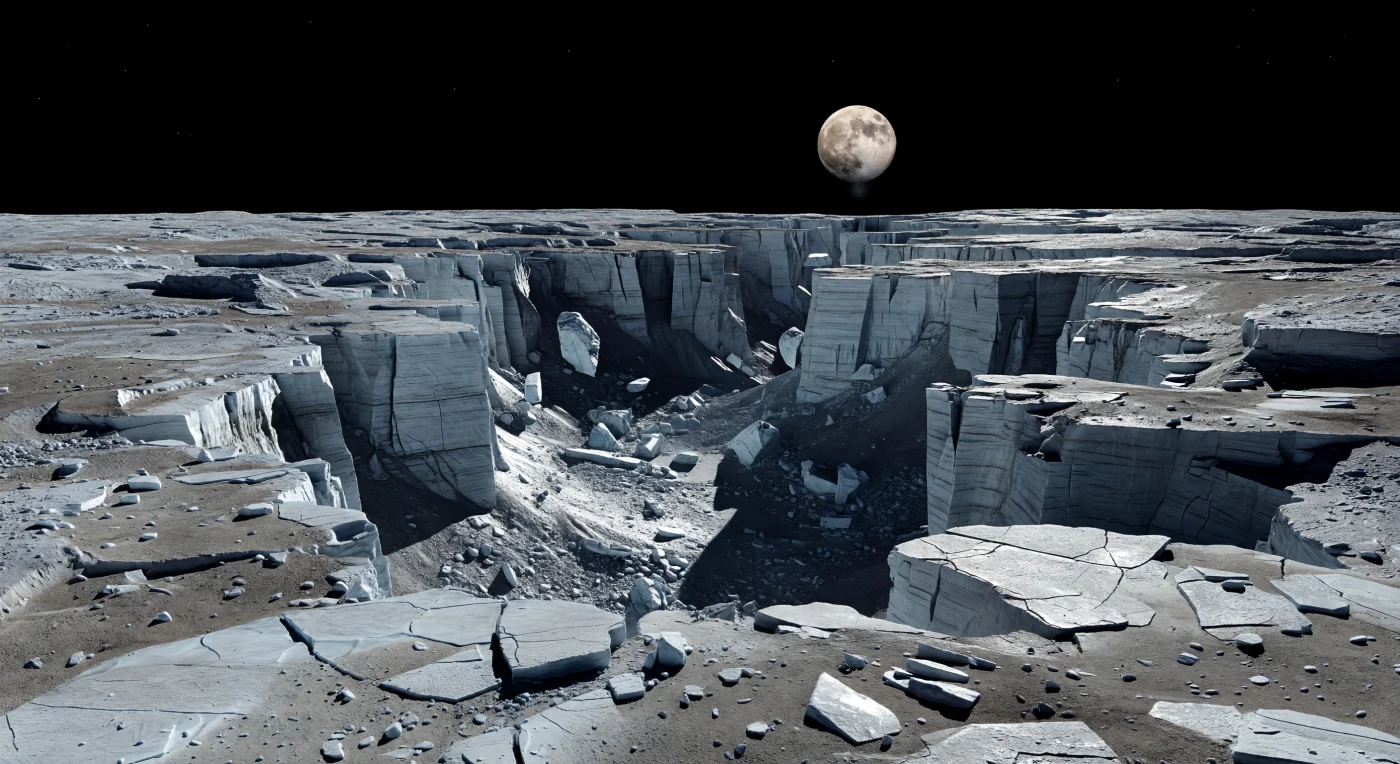
From the rim, the ground is a brittle terrace of silver-gray and pale bluish water-ice bedrock dusted with darker particulate lag, where tiny angular boulders and sharp fracture patterns lead the eye to an abrupt drop into a colossal fault-bounded chasm. Kilometer-high cliffs of rock-hard ice plunge almost vertically into blackness, broken into stepped scarps, detached crustal blocks, polygonally cracked walls, and frozen slump aprons that record the stretching and breaking of an ancient icy crust in this low-gravity world. With no atmosphere to soften the view, the small distant Sun casts hard, cold light and knife-edged shadows that exaggerate every ledge and fissure, while the canyon system marches toward the horizon through linked grabens and shattered uplands into cratered plains beyond. Above the stark charcoal-and-steel landscape, a huge softly mottled disk hangs in the black sky, making the scene feel both eerily silent and immense—as if you are standing at the edge of a frozen tectonic wound carved into an airless shell.

Long, nearly parallel rifts carve the frozen plain into a stark geometry of trenches, step-faulted ridges, and tilted crustal blocks that march toward the curved horizon, their pale gray ice facets blazing in sunlight while adjacent walls vanish into absolute black shadow. Under this moon’s airless sky, the ground is a cryogenic mix of water-ice bedrock, frost-dusted regolith, and ice-cemented rocky debris, fractured by ancient extensional tectonics that split the crust into graben and left sharp scarps unusually crisp because there is no atmosphere, liquid, or active erosion to soften them. The low gravity lets these icy landforms stand tall and steep, so that even scattered impact craters and isolated uplifted blocks feel immense against the repeating bands of the rift system. Above the silent landscape, a small hard Sun and the fixed disk of its companion world hang over a black sky, making the scene feel both mathematically orderly and profoundly alien.

A vast, calm plain of pale gray to faintly blue ice stretches away in gentle undulations to a low horizon, its immense scale marked only by tiny craterlets, a few softened impact scars, and scattered blocks of fractured ice resting on smooth, cryovolcanically resurfaced bedrock. Under hard, distant sunlight, the frozen surface gleams with a cold metallic sheen, while shallow troughs, wrinkle-like rises, and broad flow patterns hint that this landscape was once flooded not by molten rock but by slurries of water-rich, ammonia-bearing ice that spread and froze in the deep outer cold. With no atmosphere to soften the view, every shadow falls razor-sharp into blue-black darkness beneath a perfectly black sky, where the Sun burns as a small white point and a larger companion world hangs fixed above the horizon. Standing here would feel like standing on the hushed skin of an ancient icy shell—airless, silent, and monumental, shaped by impacts, tectonic strain, and the slow freezing of material erupted from within.

From the frozen floor of Vulcan Planitia, you face a solitary mountain of ancient water-ice bedrock, a blocky gray massif rising kilometers above the surrounding plain like a stranded fragment of older crust. Its cliffs are split into sharp slabs, terraces, and towering buttresses that remain startlingly crisp in Charon’s feeble gravity, while a dark, shallow moat of dusty regolith and shadowed debris encircles its base, cleanly separating it from the smoother plains that later flooded around it. Those plains stretch to a distant, subtly curved horizon in subdued bluish-gray tones, their lobate margins, faint ridges, and polygonal cracks hinting at cryovolcanic resurfacing by slushy water ice mixed with rocky material and traces of ammonia, all now frozen solid in airless cold. Under a tiny, fierce Sun, the vacuum sky is pure black, shadows fall like knife cuts across the trough and rubble-strewn foreground, and far above the horizon the disk of Pluto hangs motionless, making the entire scene feel vast, silent, and uncannily still.

You stand on the floor of a titanic tectonic canyon where water ice, frozen so hard in the deep cold that it behaves like bedrock, has shattered into a chaos of angular blocks from boulder size to low hills, their pale bluish-gray faces strewn with rubble, dark dust, and faint reddish-brown organic stains caught in the cracks. Between the tilted slabs, narrow fissures fall away into blackness, while collapsed talus aprons and slump-scarred ledges pile against immense canyon walls that rise in terraces and fault-cut cliffs, their relief made even more dramatic by the moon’s weak gravity. With no atmosphere to soften the view, the tiny distant Sun casts razor-sharp shadows and reveals every crystalline fracture from your feet to the far escarpments, where the chasma seems to open into an even broader frozen wilderness. Above the rim hangs Pluto, enormous and softly mottled against a pure black sky, a constant companion suspended over this silent, airless landscape.

You stand at the frozen edge of a cryovolcanic embayment, where a broad scalloped front of younger water-ammonia ice has pushed across older cratered uplands, its smoother, paler surface broken only by low pressure ridges, hummocks, and faint polygonal cracks. The boundary is written more in texture than color: blunt lobes and icy toes wrap around ancient knobs and half-buried crater rims, showing how cold, slushy cryofloods once spread here and then hardened into rock-like ice under brutal outer Solar System cold. Beyond the front, the darker ground turns rough and shattered, strewn with angular water-ice blocks and worn impact scars whose sharp relief is preserved by weak gravity and the total absence of air. Above the black horizon hangs a distant world-sized disk, while the tiny Sun casts razor-edged shadows across a landscape so still, crisp, and immense that every meter of frozen terrain feels suspended in vacuum and deep time.

A broad, gently rolling plain of gray-white ice stretches to a low curved horizon, its frozen surface littered with crisp granular frost, fractured blocks of water-ice bedrock, and faint polygonal cracks left by ancient contraction and tectonic stress. In the airless black sky, an enormous, perfectly still disk hangs above the landscape, filling the view with tan, cream, brown, and brilliant white patterns whose reflected light softly lifts the harshest shadows cast by the distant Sun. This quiet terrain is shaped not by wind or flowing liquid, but by cryogenic geology in a vacuum: hard water ice mixed with darker irradiated contaminants, subtly ridged and hummocky under extremely weak gravity and intense cold. Standing here, you would feel the immense stillness of the outer Solar System—every edge razor sharp, every shadow cold and precise, and the giant world overhead fixed forever above an open frozen wilderness.

Beneath a perfectly black, airless sky, the far side’s ancient surface stretches away as a frozen wilderness of fractured water-ice bedrock, charcoal-dark dust, and ice-cemented rubble, barely revealed by the faintest silver touch of starlight. Overlapping impact craters, low tectonic ridges, and collapsed icy debris lie in near-total shadow, while isolated outcrops and crater walls stand with surprisingly stark relief in the weak gravity, rising above the low-curved horizon like the bones of a dead world. With no atmosphere to soften the view, every star burns sharp and steady, and the Milky Way arcs overhead in luminous detail, casting the only natural night illumination across this silent terrain. Standing here would feel like occupying a vast, frozen vacuum where geology is written in water ice and rock, and where the emptiness of the outer Solar System presses in from every direction.
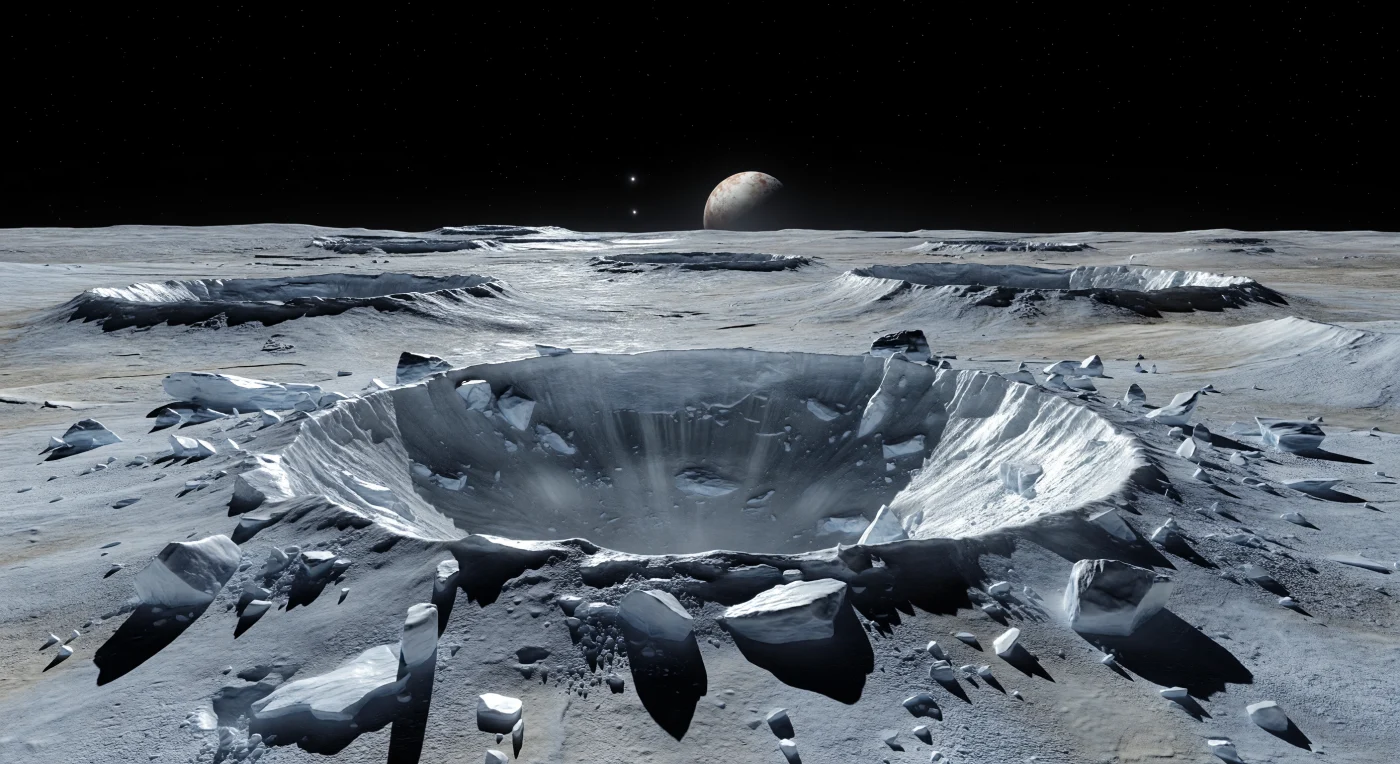
From the edge of a remarkably young impact crater, the landscape is a study in frozen violence: a sharply raised rim drops into steep terraced walls strewn with shattered blocks of water-ice bedrock, while bright white and pale gray ejecta radiate across the older, darker ground like a fresh dusting of frost. That brilliance is real geology—recent excavation has exposed clean water ice from beneath a space-weathered surface of grayer, contaminant-darkened ice, and the crater’s crisp crest, slump scarps, hummocky ejecta, and secondary pits all signal that little time has passed since the impact. In the weak sunlight of the far outer Solar System, every jagged boulder throws a long black shadow across the airless terrain, and fresh ice faces flash with hard silver glints under a tiny, piercing Sun. Above the immense silent bowl, a black sky without haze or cloud is anchored by the fixed disk of Pluto low on the horizon, making the scene feel both intimate in its fractured detail and enormous in its frozen, tectonic stillness.
