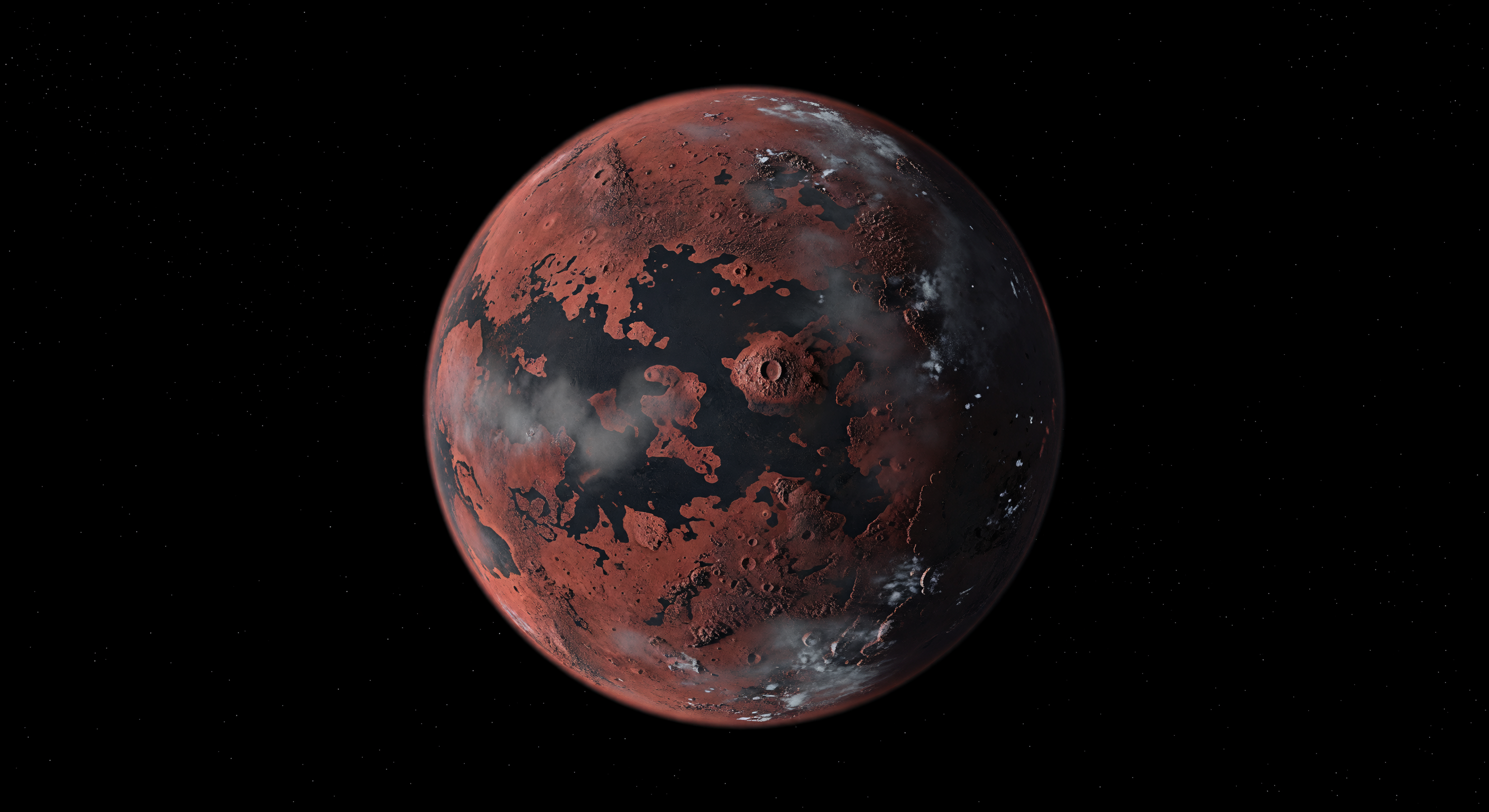
Scientific confidence: Speculative

You stand at the edge of an immense volcanic plain where cracked charcoal-black basalt runs unbroken to a horizon blurred by reddish haze, its surface split into polygonal cooling fractures and littered with angular blocks, ropey lava skins, clinker-edged flow fronts, and shallow collapse pits. Low shield vents and gently swollen volcanic domes rise subtly from the flats, clues to repeated eruptions of dense mafic lava that resurfaced this terrain over long spans of time, while sparse iron-tinged dust settles only in sheltered fissures on an otherwise dry, uneroded landscape. Fixed high overhead, the reddish-orange disk of the star glows slightly larger than the Sun yet far dimmer, bathing the black-purple rock in muted near-infrared-rich light that casts short, warm shadows and turns noon into a strange, subdued twilight. The silence feels planetary in scale: no water, no life, only young-looking volcanic crust shaped chiefly by heat loss, lava emplacement, thermal cracking, and relentless stellar irradiation under a sky the color of faded embers.
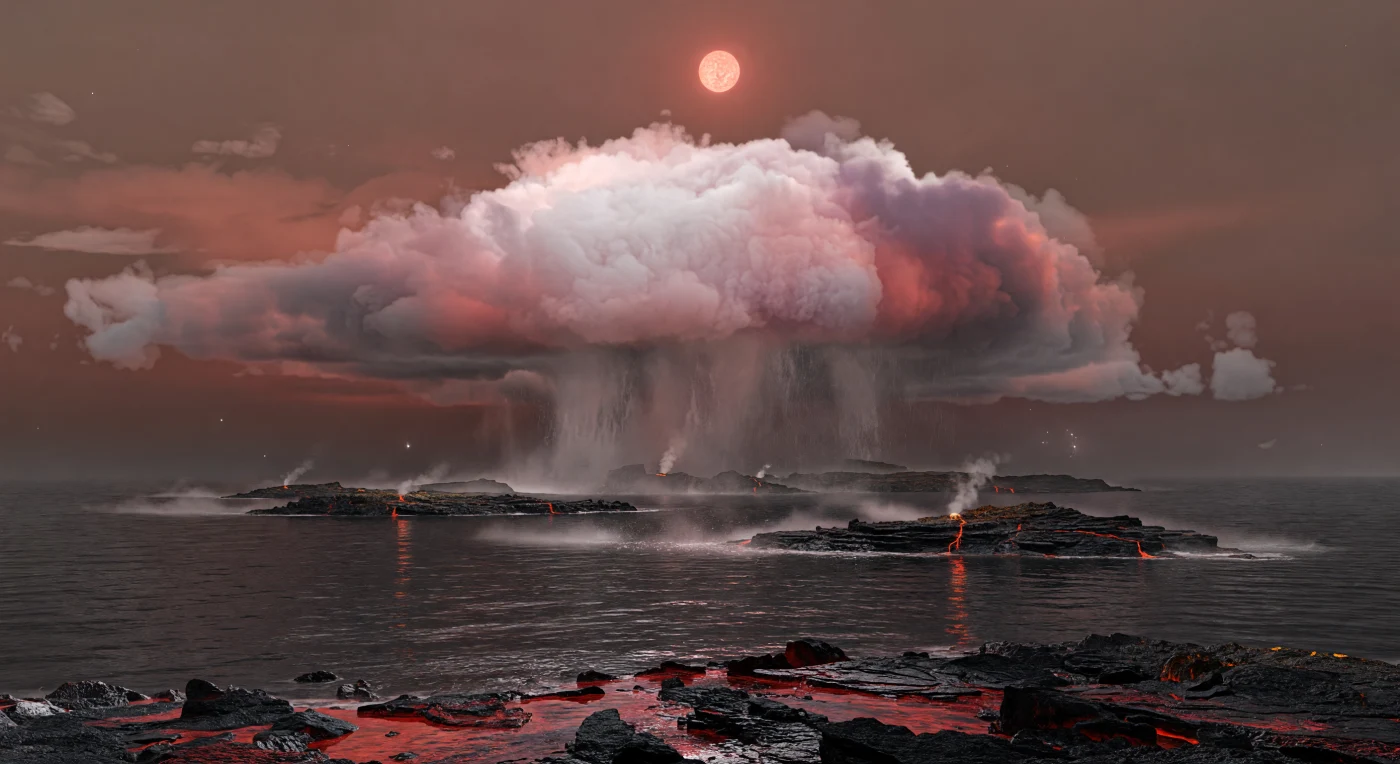
At the edge of a black basalt shore, you face a steel-dark ocean flecked with crimson and burnt-orange reflections, its wind-ruffled surface fading toward tiny volcanic islands that rise like broken cinders beneath a sky-filling storm crown. Overhead, the dim reddish disk of the host star hangs nearly fixed above the substellar region, illuminating a towering convective cloud dome whose bright white core softens into pink, mauve, and smoky red margins as rain shafts and vapor columns descend into the sea. Wet obsidian-like boulders, iron-stained tide pools, sulfur-tinged vents, and fresh lava terraces suggest active basaltic volcanism, while the dense, humid air and persistent cloud shield fit a tidally influenced world where heat and moisture may be concentrated on the permanent dayside. The result is both habitable-zone possibility and climatic extremity: a warm, red-lit seascape where water, volcanic rock, and heavy atmosphere interact on a scale that makes every island seem fragile beneath the immense, perpetual weather of an alien noon.
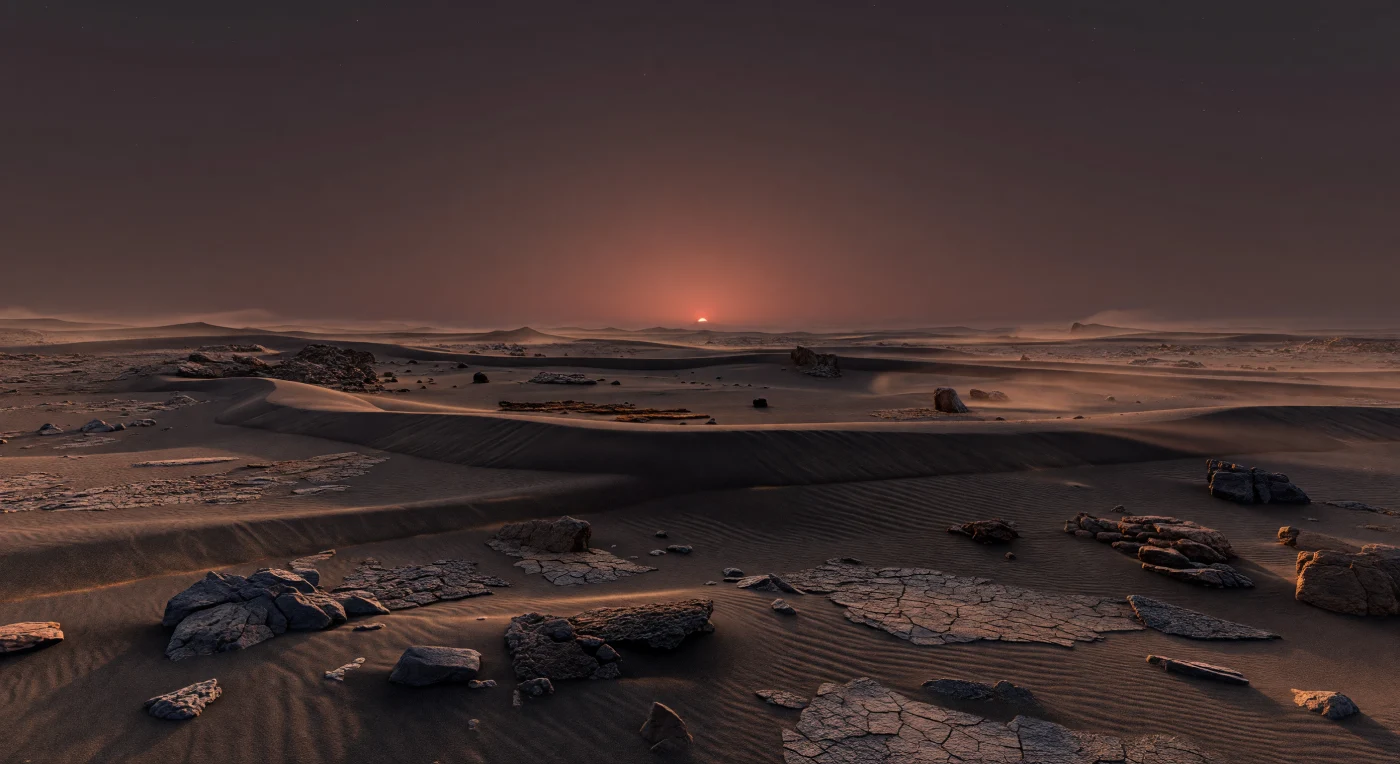
From the ground, the terminator plain appears endless: long, ruler-straight dunes of charcoal basaltic sand and rust-brown dust run parallel across a desiccated steppe, their rippled surfaces broken by jagged lava boulders, vesicular basalt ledges, and polygonal crust plates split by repeated thermal stress. A dim, swollen red sun hovers permanently near the horizon, bathing the landscape in copper light that stretches shadows for kilometers and turns thin bands of suspended mineral haze into glowing ember-colored veils against a sky that fades from smoky maroon to near-black. The dark sand’s matte finish and the fractured volcanic rock suggest a dry, volatile-poor surface shaped by persistent winds, abrasion, and the long-term effects of intense stellar activity on a rocky world. Standing here, you would feel caught between day and night on a vast frozen-burning frontier, where low-angle red light makes every ridge, buried block, and dune crest seem both intimate in detail and monumental in scale.

At the edge of perpetual twilight, a colossal escarpment of dark basalt and iron-rich rock towers above a gravel plain, its terraces, shattered cliffs, and immense talus fans lit on one side by a fixed reddish-orange star and swallowed on the other by violet-black night. The low, broad disk on the horizon casts dim, coppery light through a thin, dusty atmosphere, producing long soft-edged shadows while fierce crosswinds drive streamers of red-brown dust around fractured bedrock, angular boulders, and frost-lined cracks where volatile ices may briefly survive in permanent shade. The landscape speaks of ancient tectonic uplift, impact damage, and relentless mechanical weathering rather than flowing water: ravines, collapsed rockfalls, eroded benches, and softened crater rims are etched into the highlands at a scale that dwarfs the foreground rubble. Standing here would feel like inhabiting the boundary between two worlds at once—one smoldering under red-dwarf twilight, the other vanishing into frozen darkness.
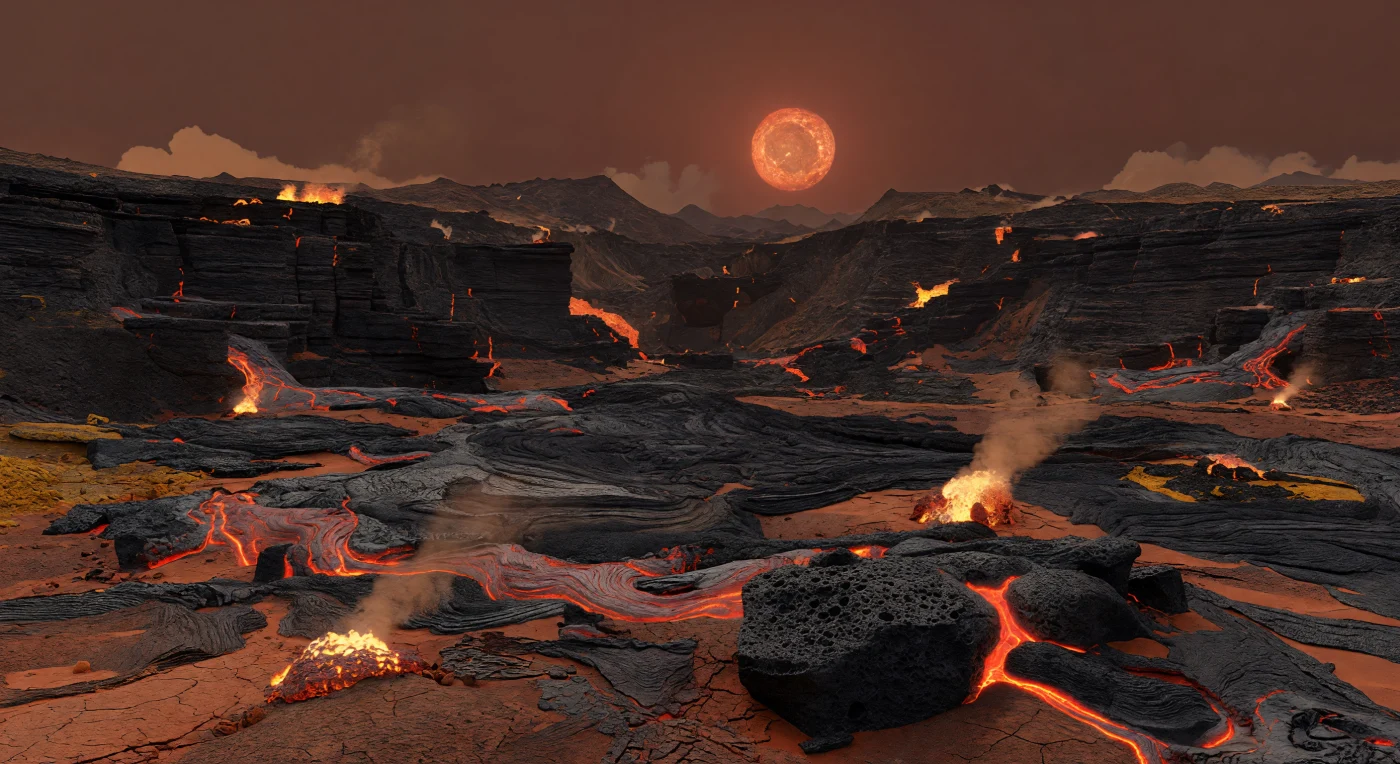
From the rift floor, you would be surrounded by black volcanic highlands split open into immense trenches, where stepped fault walls rise hundreds of meters and car-sized blocks of vesicular basalt lie scattered across fractured lava plains. Narrow fissures glow with fresh molten rock, feeding ropey pahoehoe flows whose orange-red light flickers across wrinkled older basalts, while sulfur-stained fumaroles paint the cracked ground in pale yellow and rusty orange. This is a plausible terminator-zone volcanic landscape on a rocky world likely shaped by tidal locking or strong tidal stresses, where basaltic volcanism, crustal extension, desiccation, and a thin dust-laden atmosphere could combine to preserve stark fault scarps, collapsed lava tubes, and broad rift valleys. Above it all, a dim red dwarf hangs permanently low through volcanic haze, casting soft copper and ember light that turns the horizon smoky and immense, making the scene feel both geologically familiar and profoundly alien.
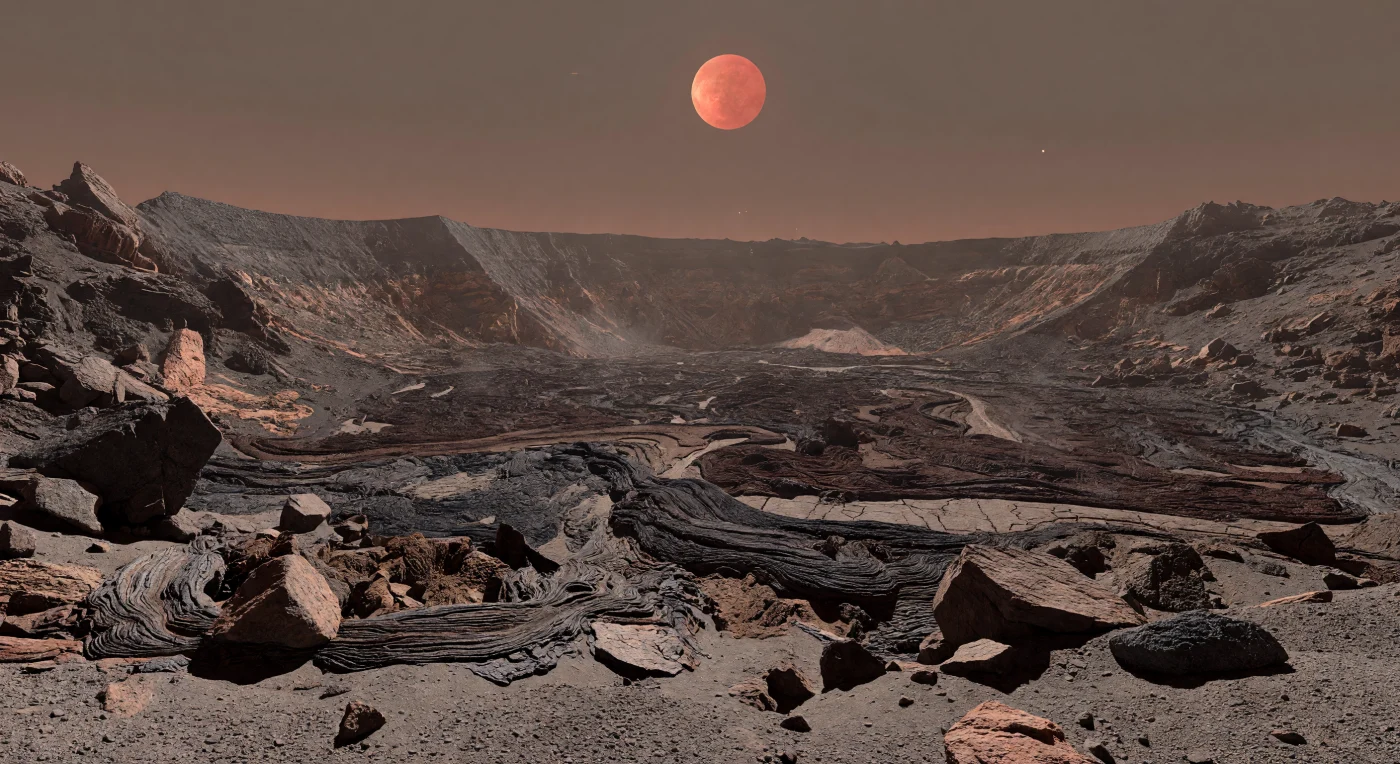
From the rim of an immense volcanic caldera, the ground falls away in shattered terraces of vesicular basalt, ash-gray tephra, and brown-black lava crusts toward a sunken floor scored by cooled channels, pressure ridges, clinker fields, and roped pahoehoe textures. Fumarolic vents and polygonal thermal cracks hint at prolonged volcanic resurfacing on a dry, desiccated rocky world, where oxidized dust gathers in hollows and house-sized basalt blocks lie scattered across steep inner scarps. Overhead, the host star’s broad salmon-red disk hangs almost motionless near the zenith, bathing the landscape in dim red-orange light that softens shadows, glints faintly from glassy basalt, and fades the far caldera wall into a reddish haze many kilometers away. Standing here, you would feel surrounded by colossal silence and heat-warped stillness, in a place shaped less by water or wind than by fire, fracture, and the unearthly spectrum of a red dwarf sun.

At the floor of a vast boundary valley, dense pink-orange fog drifts like a slow river through broken basalt, iron-stained dust, and heaps of angular volcanic rubble, while the land rises sharply into opposing worlds of light and cold. One wall, turned toward the ever-low red dwarf, glows in subdued crimson and reveals stacked lava flows, weathered ledges, and black spires under permanent oblique illumination; the other remains locked in shadow, its fractured rock whitened by frost and crystalline ice where cold air pools and moisture freezes into rime. This stark contrast is exactly what scientists expect in a tidally influenced terminator environment, where warmer air from the day side can meet denser night-side drainage, creating persistent fog, soft scattered light, and sharp microclimates over only a few kilometers. Beneath a dim maroon sky, with the reddish star hanging near the horizon and the valley narrowing into distant mountains, the scene feels immense and eerily still—as if you are standing at the seam between two climates on a world lit forever by twilight.

At the edge of eternal day, wet black basalt glistens under the low, copper-red disk of the star, while fractured pillow lava, glassy pebbles, and spray-slick boulders line a coast battered by a cold, near-ink sea. Beyond the foreground, jagged sea stacks and broader shield-like volcanic islands rise hundreds of meters from the water, their wave-cut cliffs, talus slopes, collapsed lava tubes, and occasional columnar faces revealing a landscape built by basaltic eruptions and relentless marine erosion. White surf detonates against the dark rock and sends mist into bands of gray fog that drift through the channels, softening the horizon as the sky grades from smoky orange-red near the star to violet dusk and then into a night already seeded with stars. If this world retains even a modest atmosphere and ocean, a tidally locked setting like this terminator coast could be one of its most stable environments—cold, wind-whipped, and austere, suspended between permanent daylight and permanent dark.

At the edge of eternal day and night, a black, sluggish sea presses against immense walls of blue-white ice streaked with dirty gray dust and ash, their fractured faces split into buttresses, crevasses, and overhangs that loom hundreds of meters above the shore. House-sized boulders, frozen spray, and crusts of refrozen brine crowd the waterline, while thin mist from sublimating ice drifts along the cliff base, hinting at an atmosphere cold and tenuous yet thick enough to blur the distance. Low on the copper-red horizon, the parent star hangs as a dim, swollen ember, casting weak reddish light that glints off wave crests and wet ice instead of the bright glare familiar on Earth. In this tidally locked terminator zone, where deep red illumination replaces white daylight and the ocean absorbs most of the light into near-ink darkness, the landscape feels both geologically active and profoundly still—an austere boundary world of frost, rock, and permanent twilight.
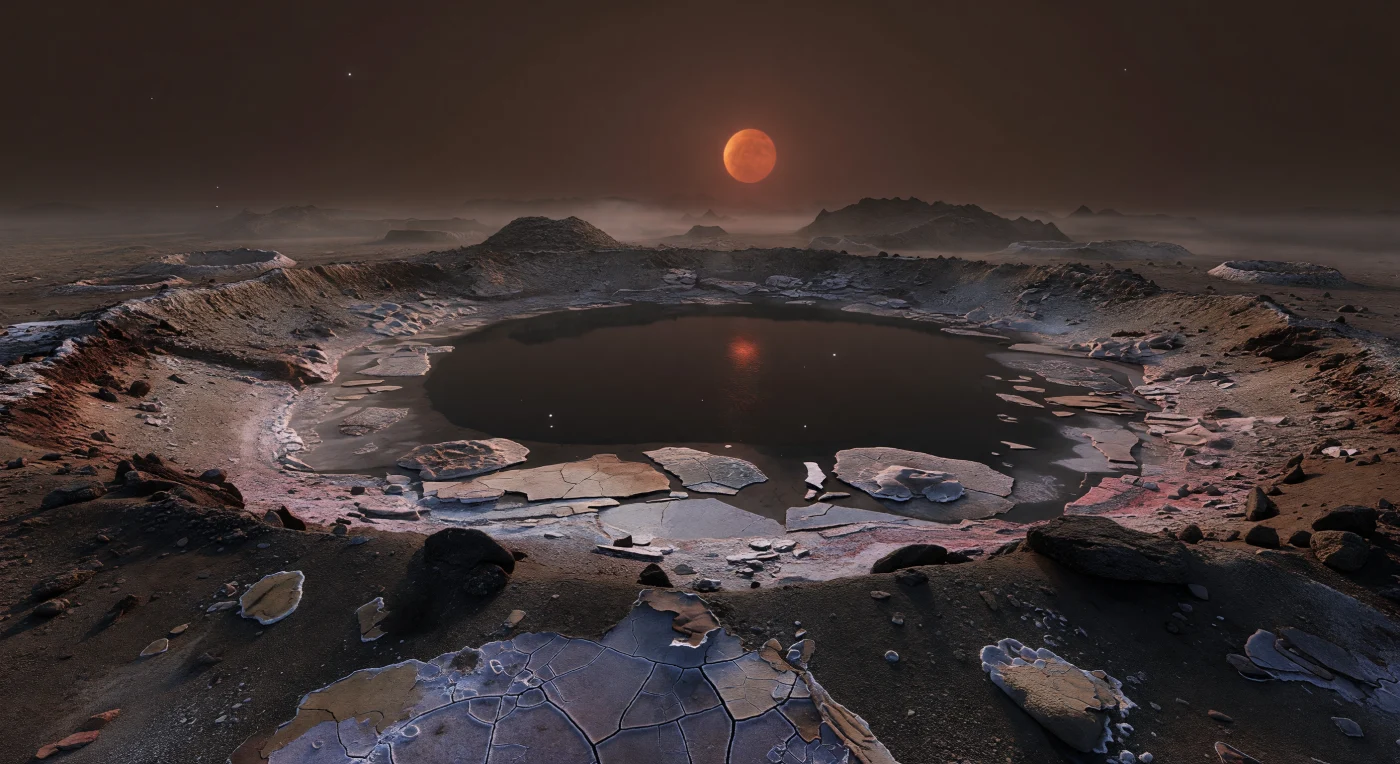
From the cracked salt flats at your feet, the ground falls into an immense ancient basin whose center is occupied by a nearly black, mirror-smooth lake of hypersaline brine, reflecting the dim red disk near the horizon as a blurred copper stain. Around this dark oval, angular ice rafts and pressure-ridged margins are frozen in place among pale evaporite crusts—beige, pink-white, and rust-stained minerals left behind by repeated freezing, sublimation, and concentration of dissolved salts in a cold, tenuous atmosphere. The scalloped rim exposes basaltic bedrock and shattered impact breccia, while low fog drifts across the floor and softens distant craterlets and jagged uplifts, making the basin feel both vast and strangely muffled. Under the weak crimson side-light of a red dwarf, every surface—charcoal dust, frost-coated stones, dirty ice, and salt flakes—glows faintly warm against the planetary cold, creating a landscape that is austere, chemically complex, and profoundly alien.

Across this high, permanent night-side plateau, fractured slabs of ancient basalt lie like shattered black glass, their sharp edges traced with bluish-white hoarfrost and frozen volatiles that catch the only light available: vast auroral curtains in deep magenta, crimson, and muted red-violet sweeping from horizon to horizon. The ground is a desiccated mosaic of vesicular lava, pressure-ridged folds, polygonal contraction cracks, and frost-rimmed boulders dusted with iron-dark sediment, while beyond the foreground the land drops into shadowed escarpments and serrated mountain silhouettes that emphasize the immense scale of the plateau. Here, under an almost star-crowded black sky with no host star visible, the glow likely comes from charged particles driven by an active red dwarf stirring a tenuous atmosphere or exosphere, producing aurora far richer in reds than the green displays familiar on Earth. In the air-thin cold, every surface gleams faintly with colored reflections and soft icy glints, making the scene feel at once geologically ancient, brutally quiet, and profoundly otherworldly.

You stand on a high, airless plateau of charcoal-black basalt and shattered impact rock, where overlapping craters carve the anti-stellar landscape into a maze of steep rims, descending paths, and shadow-filled bowls that stretch to distant basin walls under a perfectly black sky. In the deepest, permanently unlit floors, volatile frosts and ices have survived for ages as silver-blue sheets, patchy cyan veneers, and crystalline rime, their subtle metallic glint revealing cold traps where no atmosphere, liquid water, or wind-driven erosion can disturb them. The terrain is geologically ancient yet sharply preserved: younger impacts slice cleanly across older rims, blocky ejecta and tall boulders lie where they fell, and only slow micrometeorite bombardment has softened the oldest edges. Far overhead, against a dense starfield, Alpha Centauri A and B shine as a bright paired beacon, casting the faintest razor-edged highlights across the frost while most of this frozen wasteland fades into immense, silent darkness.

Under an almost airless black sky, a frozen continent stretches away in perpetual night: blue-black ice fractured into pressure ridges and yawning crevasses, with wind-shaped snow dunes and glassy crusts catching only the faintest starlight. Jagged basaltic nunataks rise through the ice like dark islands, their sharp faces etched against a dim red-orange glow on the far horizon—the distant terminator, where the system’s red dwarf never fully climbs into view from this hemisphere. Thin ice fog clings close to the ground, softening the immense escarpments and crevasse fields while occasional crimson auroral veils ripple low overhead, plausibly driven by energetic stellar particles interacting with a tenuous atmosphere or magnetosphere. In this extreme cold, frost and exposed water ice likely persist as brittle, sublimation-sculpted surfaces rather than liquid reservoirs, creating a stark landscape where rock, volatile ice, and darkness define a world of planetary-scale stillness.

At the edge of perpetual night, the ground stretches away in an immense mosaic of frost-shattered polygons, where charcoal basaltic dust and dark rock fragments are stitched together by blue-white ice and rims of sparkling hoarfrost. Shallow troughs, stone-sorted borders, and low pressure ridges record the slow mechanical work of cryogenic cracking, sublimation, and the expansion of ice-cemented sediment under extreme cold, while distant mesas and broken crater rims barely rise from the plain to reveal its kilometer scale. The dim red dwarf hangs fixed on the horizon as a flattened ember, casting weak reddish light sideways across the frozen surface so that every crystal, boulder, and fracture glows faintly against an almost black sky. With only a tenuous atmosphere and a trace of drifting ice haze, the scene feels desiccated, ancient, and eerily still—as if you are standing on a world where the boundary between day and night has been frozen into the landscape itself.

At the edge of perpetual day, a 60-meter scarp of dirty ice and dark volcanic debris rises from the plain like a frozen, eroding wall, its layered face striped with soot-black dust, rusty mineral stains, and dimly translucent ice lenses. Sunwarmed fractures vent thin jets of vapor that drag grains and frost into low plumes skimming across rubble fans, while the ground underfoot is a harsh mix of angular boulders, polygon-cracked crust, and pale sublimation residue left behind as volatile ices retreat into the cold. The thin atmosphere near collapse leaves the sky almost black overhead, deepening to a rust-red haze along the horizon where suspended dust catches the light of the star hanging permanently low and oversized, bathing the landscape in muted red-orange. For a brief instant a stellar flare whitens its core and sharpens the scene—crimson highlights ignite along the cliff bands, drifting dust flashes salmon-pink, and distant mountains and ancient crater rims emerge with startling clarity before the dim, frozen twilight returns.