Scientific confidence: Medium
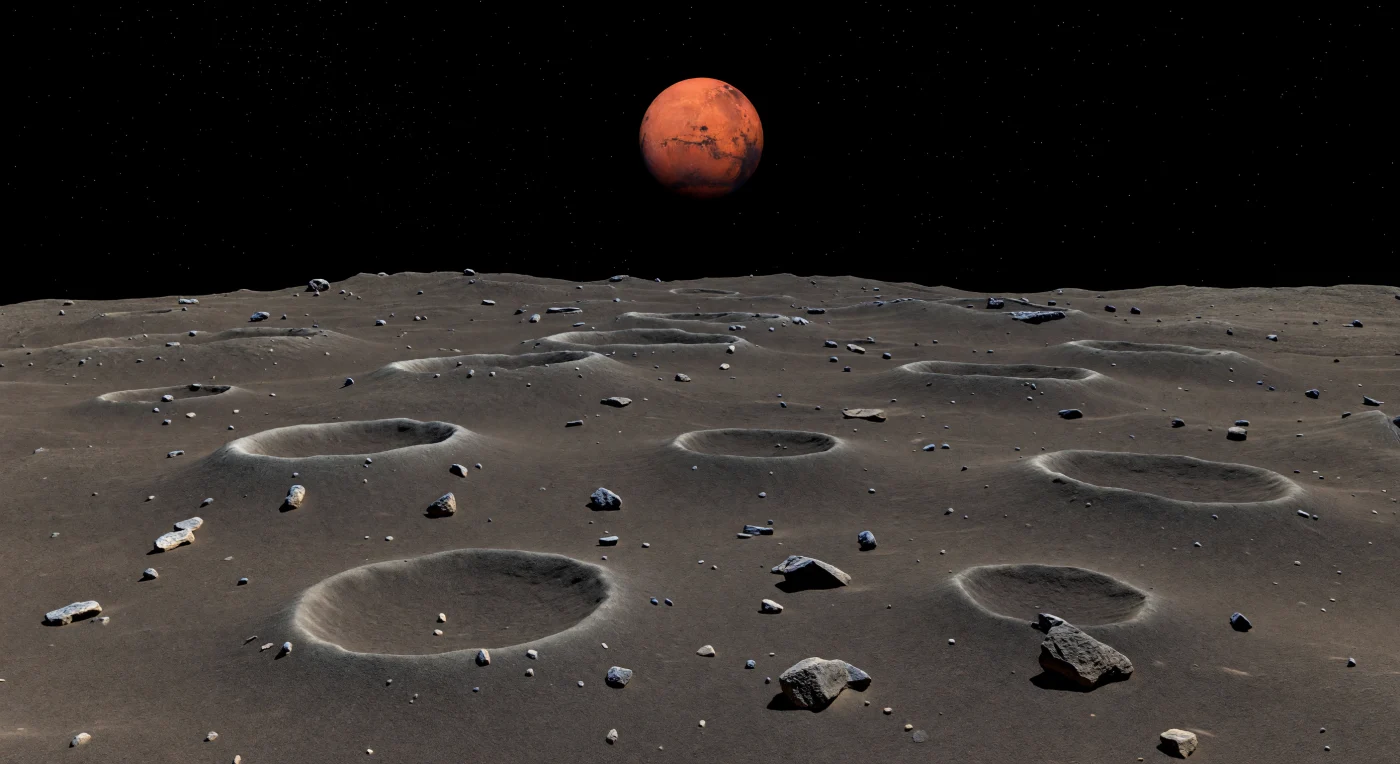
Across a gently rolling plain of charcoal-dark, carbon-rich dust and porous rubble, a cluster of fresh microcraters breaks the usual smooth mantle with crisp rims, steep bowl-shaped interiors, and delicate sprays of blocky ejecta. Slightly brighter cool-gray fragments exposed by these recent impacts stand out against the older, darker regolith, revealing material that space weathering has not yet muted on this tiny, airless moon. In the near-overhead Sun, shadows shrink to razor-thin black slivers beneath fist-sized rocks and meter-scale crater edges, while the weak gravity makes every little pit and scattered block feel strangely exaggerated against a horizon that curves away alarmingly close. Above the stark black sky, where a few faint stars survive beyond the solar glare, the immense rust-red disk of Mars hangs motionless, making the scene feel at once intimate in detail and vast in planetary scale.

From the floor of this shallow impact crater, the landscape feels strangely hushed and delicate: a broad, subtly concave expanse of ash-brown to charcoal-gray dust lies ponded between low, softly slumped walls, its remarkably smooth surface interrupted only by a few angular stones and tiny micro-craters. The ground is made of ultra-fine regolith—dry, powdery debris produced by countless impacts and slowly migrated downslope in gravity so weak that crater rims, talus aprons, and even rough bedrock have been muted into subdued forms, with faint streaks marking where dust has crept along the inner slopes. Under a pure black sky, the small, hard Sun casts razor-edged shadows that reveal the complete absence of atmosphere, while the dark, carbonaceous material absorbs most of the light and leaves the terrain matte and somber. Above the crater rim, Mars hangs enormous and nearly fixed in place, a rust-red world dominating the vacuum and making this quiet hollow feel both intimate and impossibly exposed.

From the low, rounded rim of Swift crater, you look out over a broad, shallow impact bowl whose softened contours are almost swallowed by a thick blanket of fine regolith in taupe, gray-brown, and charcoal tones. Small ejecta blocks and half-buried boulders lie scattered across the dusty crest, their edges muted by powdery debris that has accumulated over time in this moon’s extremely weak gravity, where impacts churn dark, likely carbonaceous material into a loose, insulating surface mantle. Oblique sunlight throws long, razor-sharp shadows across tiny pits, hollows, and faint slump textures on the crater floor, exaggerating relief that is actually gentle rather than cliff-like, while the irregular horizon curves away quickly enough to reveal just how small this airless world is. Above it all, a black sky with visible stars frames the immense disk of Mars hanging off to one side, making the silence, scale, and starkness of the vacuum feel immediate and profoundly alien.

You stand on a tiny, airless plain where dark gray-brown regolith lies like talcum-fine carbonaceous dust, draped over buried rock and softened craterlets, with scattered pebbles and angular fragments casting razor-sharp black shadows in the hard sunlight. The ground rises and falls in low hummocks and muted rims, and the horizon curves away startlingly close, revealing the moon’s miniature scale and extremely weak gravity, which allows thick impact-made dust to mantle and smooth the landscape instead of being reworked by wind or water. Above this subdued, charcoal-colored surface, a pure black sky holds steady stars even in daylight, untouched by haze or atmospheric glow. Dominating everything is the immense rust-red disk of Mars, hanging nearly motionless overhead with bright polar whiteness and faint cloud streaks, turning this silent regolith plain into a stark balcony suspended in deep space.

At the edge of day, a gently rolling plain of dark, carbon-rich regolith stretches beneath a perfectly black sky, its muted gray-brown surface broken by shallow craters, half-buried boulders, and low hummocks softened under an unusually fine blanket of dust. The Sun, smaller than it appears from Earth and skimming the horizon, throws razor-sharp light across the airless ground, carving the landscape into alternating bands of pale warmth and pitch-black shadow that run unbroken for hundreds of meters. In this feeble gravity, delicate crater rims and precariously resting rocks seem almost impossibly undisturbed, while the tiny moon’s curvature subtly closes the horizon at an intimate distance. On the side facing Mars, a faint reddish glow from the giant planet hanging low overhead seeps into the deepest darkness, just enough to reveal texture in the shadowed rubble and remind you that this stark, silent world is built from primitive, porous material and shaped almost entirely by impacts.

On this far side of the tiny moon, the land is almost swallowed by darkness: a low, cratered plain of charcoal regolith, where softly rounded hummocks, half-buried breccia blocks, and shallow dust-filled pits emerge only as faint starlit edges. The horizon feels startlingly close and sharply curved, a reminder that this world is only a few kilometers across, with gravity so weak that countless impacts have slowly gardened its fine, carbon-rich soil into a muted, smoothed blanket that softens rims and blends ejecta into broad, subdued depressions. Above it all, the sky is a pure black vacuum crowded with exquisitely crisp stars right down to the ground line, uninterrupted by haze, airglow, or the looming disk that would dominate the opposite hemisphere. In the absence of sunlight, the surface reflects almost nothing, leaving you in a silence of deep shadow where scale feels intimate underfoot and infinite overhead.

At ground level, the terrain stretches away as a miniature badlands of low knobby rises, softened crater rims, and shallow bowl-like hollows, all carved by countless impacts and mantled by an unusually thick blanket of ultra-fine dust. The surface is dark charcoal to muted brown, rich in space-weathered carbonaceous material, with angular breccia blocks and occasional brighter fresh fragments protruding from slopes where the regolith has shifted in the moon’s feeble gravity. With no atmosphere to blur distance, every pebble, fractured block, and subdued crater remnant remains unnervingly sharp from foreground to horizon, while hard side lighting from the small Sun cuts razor-black shadows that reveal relief only meters to tens of meters high. Above this silent, airless landscape, stars remain visible in the black sky and Mars hangs enormous over the horizon, turning the scene into a stark lesson in impact geology on one of the Solar System’s smallest, darkest worlds.

Under a sky of perfect black, the plain stretches away as a dim, charcoal blanket of carbon-rich dust, its pebble-sized grains, scattered meter-scale boulders, and softened shallow pits only barely teased into view by the ruddy glow of mars-shine. The terrain is ancient and airless: a thick mantle of fine regolith has muted old impact scars into low crater swells and subdued hummocks, with no atmosphere, water, volcanism, or tectonic activity to refresh the surface—only eons of impacts grinding rock into dark powder in a hard vacuum. One side of the heavens is filled by enormous, gibbous Mars, fixed in place above the horizon by synchronous rotation, its reflected red-orange light casting faint, soft-edged shadows across a world where gravity is so weak and relief so dust-softened that even the landscape seems to whisper. Overhead, the Milky Way blazes with razor-sharp clarity, and beyond the barely visible foreground the low rises of this tiny moon fade quickly into darkness, making the scene feel both intimate and immeasurably vast.

A dark, gently rolling plain of carbon-rich dust stretches to a startlingly close, curved horizon, its softened craterlets and half-buried boulders revealing a tiny world mantled in extremely fine regolith under almost negligible gravity. As eclipse begins, the Sun’s hard white glare is cut away with unnerving speed: long black shadows smear across the muted charcoal and ochre surface, then dissolve altogether as direct light vanishes and only a faint rusty glow reflected from the immense disk of Mars remains. The rocks are primitive, porous, and asteroid-like, matte against the vacuum, while the airless sky turns from stark black to a deeper abyss crowded with sharpening stars. Standing here would feel like watching daylight collapse in silence, with a nearby planet hanging overhead as a shifting crescent and the surrounding landscape sinking into cold, otherworldly darkness.

At ground level, the usual smooth blanket of dark, charcoal-brown regolith is broken by a rough impact exposure where angular slabs of primitive carbonaceous rock and impact breccia protrude through the dust, their fresher fracture faces a slightly lighter gray against the darker mantle. The terrain is subtly uneven rather than dramatic: half-filled micro-craters, low hummocks of fine debris draped over buried blocks, and a shallow degraded hollow all record endless impact gardening on an airless body with no volcanism, water, or tectonic resurfacing to erase the scars. In the tiny moon’s extraordinarily weak gravity, blocks seem delicately perched and crater edges remain crisp with minimal collapse, while the hard white Sun—smaller than seen from Earth and shining at only about 43 percent of terrestrial daylight—casts razor-sharp black shadows across the rubble. Above this intimate, dusty landscape, the sky is pure black and Mars hangs immense and rust-red near the horizon, making the scene feel at once miniature underfoot and vast beyond comprehension.
