Scientific confidence: High

You stand on a vast, nearly level plain of brilliant sulfur dioxide frost, so white it flashes under the hard sunlight, with pale cream and faint yellow sulfur crusts fringing shallow polygonal cracks and low ridges in the brittle, granular surface. The black daytime sky is startlingly airless—there is no blue haze at all, only a tiny fierce Sun casting razor-sharp shadows across scattered silicate fragments and powdery sulfur dust caught in slight hollows, while a few distant stars may still glimmer beyond the glare. Far across the low-gravity horizon, dark charcoal and red-brown volcanic stain fields interrupt the luminous frost, traces of sulfur-rich fallout and silicate volcanism on a world constantly resurfaced by tidal heating. With no weather, no water, and almost no atmosphere to soften the view, the landscape feels unnervingly still and immense, a frozen volcanic skin suspended in absolute silence.

You stand on a young volcanic plain of brittle sulfur crust and ash-like dust, where mustard-yellow and ochre ground is broken by polygonal sublimation cracks, low hummocks, and dazzling white patches of sulfur dioxide frost pooled in colder hollows. Thin black and deep red fallout streaks hint at eruptions beyond the horizon, while a few shallow collapse pits and far-off steep silicate massifs reveal a crust continually resurfaced by relentless tidal heating rather than rivers, wind, or rain. Above this dry, airless-looking expanse, the sky is almost pure black under an atmosphere so tenuous that sunlight remains stark and unsmoothed, casting razor-edged shadows across every fracture and frost crust. Dominating everything is enormous banded Jupiter, fixed above the horizon like a suspended wall in the sky, making the immense sulfur plain feel at once frozen, volcanic, and profoundly alien.

At ground level, the plain is coated in fine, powdery fallout that shifts from deep crimson and brick red underfoot to brilliant yellow sulfur farther out, with scattered black lava blocks and cracked crust plates interrupting the dusty surface. These colors record active volcanism: red Pele-type plume deposits are thought to include short-chain sulfur allotropes mixed with dark silicate ash, while colder hollows preserve bright patches of sulfur dioxide frost on a world so geologically restless that impact craters are quickly erased. On the horizon, a dark patera lies like a vast volcanic scar, its black crust rimmed by faint reddish staining and topped by a delicate sulfurous haze that barely rises into an otherwise airless, space-black sky. The sunlight is hard and unforgiving here, casting razor-sharp shadows across the granular ground and making the low scarps and isolated mountain blocks seem unnaturally crisp in the weak gravity, as if the whole landscape has been frozen in the aftermath of an immense eruption.

A dark, lobate sheet of silicate lava pushes slowly over a dazzling white sulfur dioxide frost field, its thick crust shattered into jagged plates and clinker-like rubble, with only a few narrow orange-red fractures betraying the intense heat still locked within. Where black rock meets bright frost, the frozen sulfur dioxide flashes directly into gas, raising a low, umbrella-shaped white plume and a faint bluish haze that clings to the ground—an eruption driven not by weather, but by heat and sublimation in an almost airless environment. Beyond the contact front, the plain spreads out in vivid yellows, creams, and rusty sulfurous stains, broken by scattered boulders, subtle volcanic ridges, distant patera rims, and steep mountains made to look even stranger under low gravity and a hard, unforgiving Sun. Above it all hangs a black sky, with crisp shadows, a shrunken brilliant Sun, and the immense presence of Jupiter, making the scene feel both starkly scientific and profoundly alien.
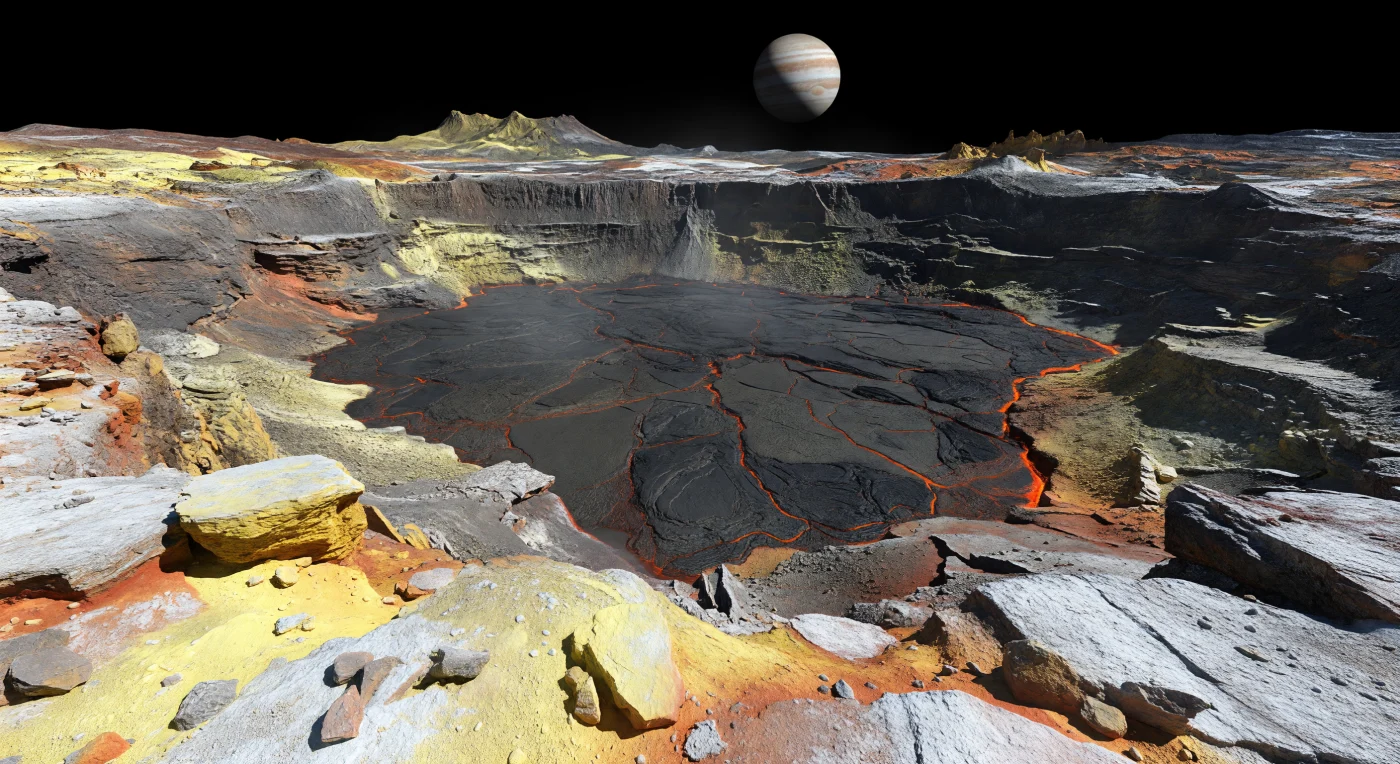
From the shattered rim of a vast volcanic depression, you look down over a horseshoe-shaped abyss where steep, terraced walls plunge to a floor of broken black lava crust, split into drifting plates by thin seams of dull orange melt. The foreground is a brittle mix of sulfur-stained rock, pale sulfur dioxide frost, and granular yellow dust, all etched by sharp fault scarps and angular boulders that seem extra jagged in the low gravity and harsh sunlight. This landscape is the product of relentless tidal heating, which melts silicate rock from within and keeps enormous lava lakes and paterae active, constantly resurfacing the ground with fresh volcanic material while sulfur and sulfur dioxide condense as vivid coatings in cooler areas. Above it all hangs black space instead of a blue sky, and in the stark, razor-edged daylight the glowing fractures, immense scale, and absolute dryness make the overlook feel less like a crater’s edge than the lip of a living, planetary furnace.

You stand on a sulfur-bright plain where a fresh fissure slices diagonally through yellow crust and white sulfur dioxide frost, its black-red margins glowing as fountains of molten silicate erupt in incandescent orange arcs and rain back as spatter, bombs, and jagged clots across the ground. The scene is lit by two stark sources at once: hard, cold sunlight under a sky that remains almost completely black because the atmosphere is only a tenuous veil of sulfur dioxide, and the fierce self-light of the eruption, which sets nearby frost, dust, and fractured lava crust aglow. Around the vent, a localized translucent haze of volcanic gas and fine ash rises and shimmers, while beyond it the land stretches in mottled yellows, reds, whites, and blacks, broken by collapse pits, low hummocks, distant patera-like hollows, and steep isolated mountains built and reshaped by relentless tidal heating. With almost no impact craters to interrupt the resurfaced terrain and a giant banded planet looming huge above the horizon, the landscape feels both airless and violently alive—the Solar System’s most extreme volcanism playing out in low gravity at a scale that dwarfs the eye.

A colossal fault-block mountain erupts from the volcanic plain like a broken slab of crust, its gray-brown silicate cliffs soaring more than ten kilometers upward in impossible steepness, with yellow sulfur dust, brilliant white sulfur dioxide frost, and dark avalanche scars painting every ledge and fracture. In the low, hard sunlight, the massif throws immense razor-edged shadows across talus fields and collapse blocks, while the surrounding ground resolves into a dry mosaic of sulfur-rich regolith, patchy frost pooled in cold traps, muted pyroclastic stains, and distant black lava remnants left by continual resurfacing. This is a tectonic giant rather than a volcano: a mountain uplifted and shattered by stresses generated deep within a tidally heated rocky crust, then relentlessly modified by landslides in weak gravity and by frost and sulfur cycling in an atmosphere too thin to soften the stark relief. Beneath a nearly black sky, with only a faint haze hugging low ground and a vast banded Jupiter hanging overhead, the landscape feels unnervingly still and immense, as if you are standing at the foot of a world where rock, sulfur, and fire are constantly remaking the surface.
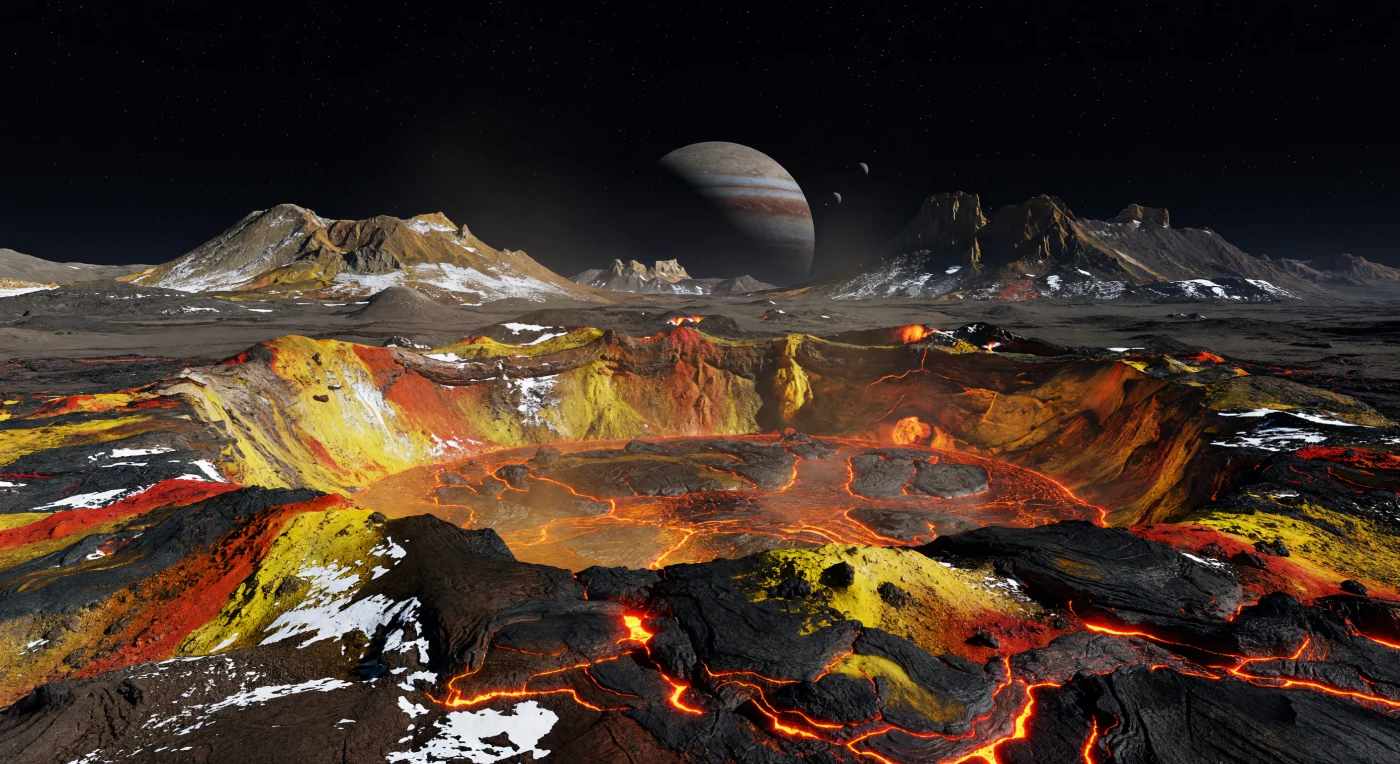
At the edge of the dark volcanic depression, a vast lava lake burns through a shifting mosaic of black crustal rafts, its orange-yellow glow pouring from red fissures and reflecting off jagged silicate walls stained with sulfur in yellows, ochres, and deep rust-reds. In the weak gravity, the patera’s scalloped scarps and isolated mountains rise with startling steepness, while patches of white sulfur dioxide frost cling to the coldest shadows only a short distance from rock hot enough to shimmer. This is a silicate world resurfaced again and again by intense volcanism, where tidal flexing from a giant neighboring planet drives internal heating powerful enough to sustain some of the hottest eruptions known, erasing most impact craters almost as fast as they form. Above, the sky is airless and perfectly black, stars remain razor-sharp, and the lava’s flickering light—sometimes joined by a faint cold sheen from the giant planet overhead—casts hard shadows across a landscape that feels both frozen in vacuum and violently alive.

You stand in a cold, enclosed basin where a broad floor of brilliant white sulfur dioxide frost lies smooth and crusty between jumbles of dark, angular talus, all at the base of a towering silicate massif that rises with strangely exaggerated height in the moon’s low gravity. The cliffs above are fractured into sharp scarps and knife-edged buttresses of black and dark brown volcanic rock, while their sunlit crests burn yellow to orange with sulfur-rich deposits, touched here and there by red and faint greenish stains from volcanic gases and seepage. In the basin’s blue-black shadow, the light is brutally crisp and almost absent beyond the direct Sun, because the sulfur dioxide atmosphere is far too thin to scatter much illumination, leaving razor-edged shadows across the frost and making the interior feel airless, silent, and intensely cold. This is a geologically young surface, renewed by tidal-heating-driven volcanism, tectonic uplift, collapse, and frost trapping rather than by impacts, so the stark contrast between the white plain, the blocky rubble, and the immense wall of rock captures a world that is being continually remade.

At the edge of dawn, a broad sulfur plain stretches away in mottled yellows, oranges, ochres, and frost-white patches, its fine crust broken by shallow polygon cracks, low hummocks, and scattered black volcanic grains that cast long, razor-sharp shadows under a tiny rising Sun. Beyond the low horizon, a distant volcanic vent sends up an immense umbrella plume, a translucent white to pale blue arc soaring hundreds of kilometers into black space, its outer rim silver-lit while faint internal bands and wisps betray the flow of sulfur dioxide gas and entrained particles. The surrounding ground is subtly stained with red-orange and dark sulfurous fallout, evidence of repeated plume deposition on a world where tidal flexing continually melts rock, drives violent eruptions, and resurfaces the landscape so quickly that impact craters are rare. With almost no true sky above you—only vacuum, a trace exospheric haze, and the cold glare of sunrise—the scene feels both stark and colossal, as if the horizon itself has become the base of a planetary-scale fountain.

You stand at the foot of a colossal escarpment where tan-gray silicate crust rises sheer for kilometers, its face split into sharp vertical fractures, fresh collapse scars, and stacked cliff bands untouched by water or wind erosion. Spilling from the base, a vast debris apron spreads across the plain in sulfur-yellow dust, rusty brown landslide tongues, angular talus, and giant detached blocks, with dirty-white sulfur dioxide frost lingering only in the coldest shadows. This is a landscape built by relentless tidal heating: a tectonized volcanic crust continually broken, uplifted, and sent downslope by mass wasting under weak gravity, all beneath an almost airless black sky where the Sun casts razor-edged shadows and isolated frost patches flash with hard brilliance. Low overhead, Jupiter looms enormous and softly banded, making the scene feel at once starkly beautiful and violently active—a frozen moment in a world that is constantly remaking itself.

At ground level, the plain stretches away as a brittle mosaic of saffron sulfur, bright white sulfur-dioxide frost, rusty red plume fallout, greenish staining, and charcoal-black lava residue, all spread across low volcanic terrain that looks repeatedly broken, buried, and remade. The crust is a dry granular mix of silicate rock, sintered ash, clinker-like basaltic fragments, and crusted sulfur plates, with shallow patera-like depressions and subdued flow fronts hinting at relentless resurfacing driven by powerful tidal heating deep inside the moon. In the near vacuum, the daylight sky is almost black, the Sun shines smaller and harsher than it does from Earth, shadows cut with knife-edge sharpness, and even far mesas and isolated mountains remain unnervingly crisp because there is almost no atmosphere to soften them. Over it all hangs Jupiter as an enormous banded disk, turning this sulfurous volcanic wilderness into a scene of immense scale and constant geological upheaval.

You stand on a young volcanic plain so dark it seems to swallow the little light available, its sulfur-rich surface only faintly revealing mottled basaltic crust, scattered sulfur dioxide frost, and muted stains of yellow-gray and rusty orange. Along the far horizon, shallow paterae, low ridges of frozen plume fallout, angular boulders, and steep fault-block mountains emerge in silhouette beneath a tenuous, patchy cyan-green glow that clings close to the ground and fades quickly upward—an atmospheric emission produced as charged particles from the giant planet’s magnetosphere excite a nanobar sulfur dioxide atmosphere, not the flowing curtains seen in Earth’s denser air. Overhead, the sky remains almost perfectly black and star-filled, with the enormous banded disk of the parent planet looming above the horizon and casting only the faintest reflected shine across the still, airless landscape. The scene feels immense, cold, and utterly alien: a resurfaced world of relentless volcanism momentarily at rest, where even the “aurora” is a low whisper of plasma over sulfur and stone.

In deep eclipse twilight, the sulfur-streaked plain fades to muted yellows, rusty reds, and black silicate crusts as a fresh white veneer of sulfur dioxide frost rapidly brightens across cold hollows, rock edges, and darker flats. Broken basaltic lava, fractured lobes of frozen flow, sparse pyroclastic stains, and the rim of a shallow patera stretch outward toward abrupt, impossibly steep mountains whose towering profiles are exaggerated by low gravity, while the scarcity of impact craters reveals a surface constantly renewed by intense volcanism. The air is almost absent—only a collapsing near-surface SO2 haze remains as the gas condenses in the sudden chill—so the sky turns nearly black, with faint stars emerging above the vast, silent plains. Dominating everything is the enormous dark disk overhead, its face nearly swallowed by shadow except for a razor-thin sunlit rim, casting a dim, eerie reflected glow that makes the frost glint pale against one of the most geologically violent landscapes in the Solar System.

Under a near-black sky, a broad volcanic plain fades into shadow, its fractured silicate crust and sulfur-rich hummocks barely revealed by dim Jupiterlight, scattered starlight, and the distant ember-glow of active lava fields. Patches of pale sulfur dioxide frost glint cold blue-gray against yellow-orange sulfur crusts and dark pyroclastic dust, while far off, steep fault-block mountains rise abruptly from the smooth, recently resurfaced terrain—a landscape with almost no impact craters because relentless volcanism continually buries the old surface. Near the horizon, a faint umbrella-shaped plume hangs above an active vent, softly lit from below by incandescent lava and edged with tenuous sulfur dioxide haze, hinting at the tidal heating that powers the most intense volcanism in the Solar System. Low in the sky, enormous banded Jupiter casts a weak, ghostly illumination over the immense plain, making the tiny foreground ridges and scattered boulders feel fragile against a world built of rock, frost, sulfur, ash, and fire.
