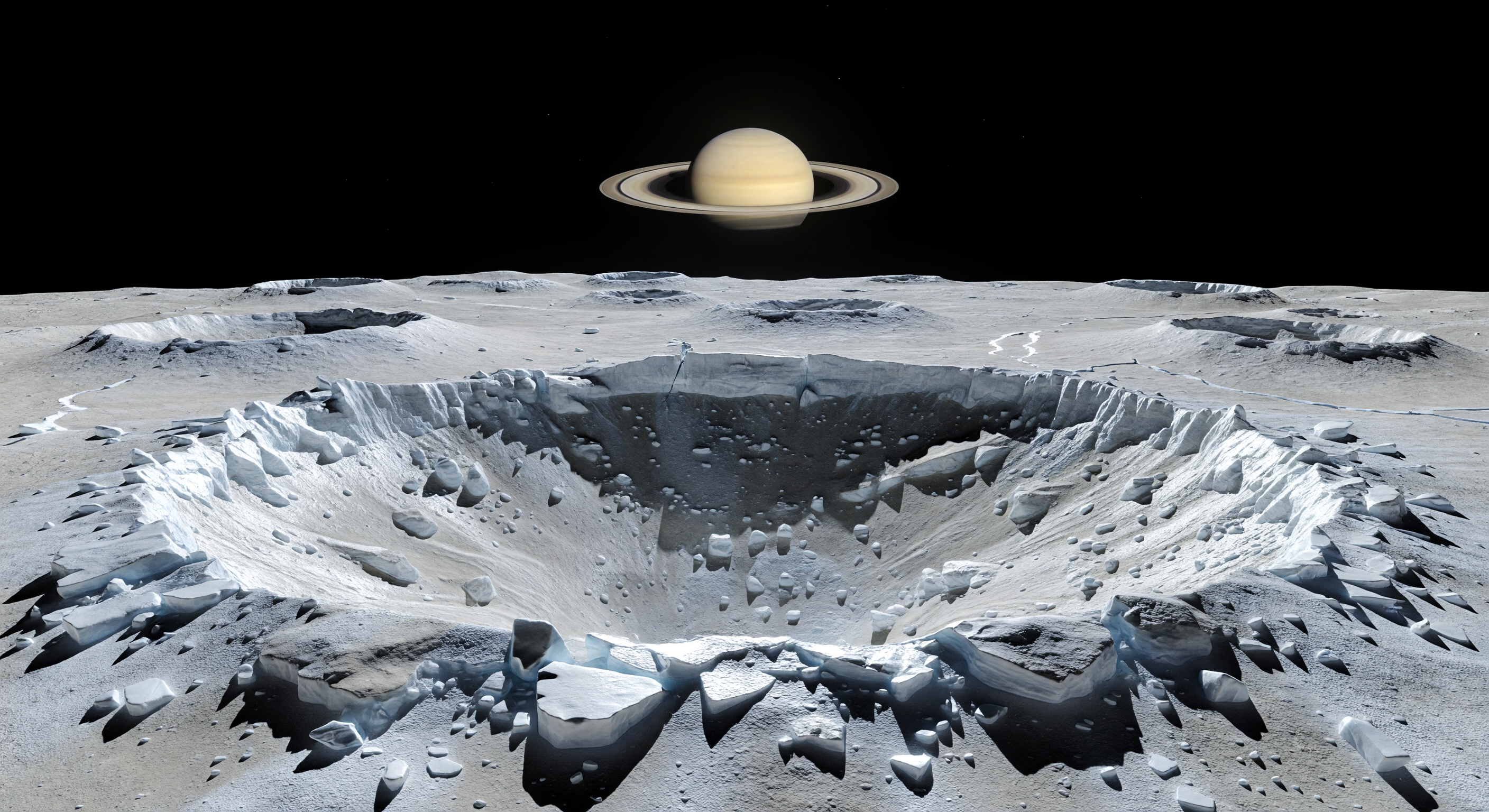
From the rim of this young impact crater, the ground blazes with fresh water ice: shattered bright-white ejecta, bluish fracture faces, and jagged blocks scattered across older, duller regolith stained by traces of darker non-ice material. The crater’s interior plunges steeply into terraced walls and slump benches, where low gravity and the absence of weather preserve razor-sharp edges, boulder fields, and crisp layers with almost no softening over time. Under hard, airless sunlight, every ridge throws a black, knife-edged shadow, while the low curved horizon reveals a landscape of crater-crowded icy plains, fault scarps, and bright tectonic lineaments stretching into extraordinary clarity. Above it all, the vacuum sky is pure black, and the immense disk of Saturn with its thin ring arc hangs over the frozen scene, making the scale and silence feel almost overwhelming.
Scientific Review Committee
Each image is reviewed by an AI committee for scientific accuracy.
GPT
Image: Adjust
Caption: Adjust
Scientific accuracy (adjust): The scene clearly depicts an icy, heavily cratered landscape consistent with Dione’s general setting (water-ice regolith, bright icy materials, low apparent erosion). However, several elements diverge from known Dione appearance/composition: (1) The horizon shows an unnaturally smooth, uniform “plains” rim with limited crater density compared to Dione’s highly cratered terrain in many regions; (2) The crater morphology is present (steep interior, blocky ejecta), but the description emphasizes very sharp, razor-edge terracing and minimal softening—here the interior looks somewhat smoothed/architecturally coherent rather than exhibiting the varied block distributions and layered ejecta patterns typical of real impact excavation; (3) The color contrasts suggest strong bluish fracture faces and dark non-ice staining, but in the image the bluish/gray “fracture” areas are relatively subtle and the ejecta is dominated by very bright, uniform ice with limited darker contamination; (4) Saturn and its rings are shown as a bright, well-defined disk with a ring arc—plausible in principle for imagery near Saturn, but the ring geometry/brightness and the scale relative to the horizon aren’t verifiable here and may be stylized. Visual quality (adjust): The image is high-resolution and mostly photorealistic in terms of lighting, shadow direction, and particulate ejecta. There are still signs of AI/CG styling: ejecta blocks appear overly consistent in shape and sharpness across the foreground, fracture/edge detail is unusually “clean,” and the crater walls/interior texture has a slightly synthetic uniformity. Caption accuracy (adjust): The caption’s core concepts (fresh impact crater, bright water-ice ejecta, blocky debris, airless lighting with crisp shadows, vacuum black sky, and Saturn in the background) match the image. However, the caption claims extensive bluish fracture faces, darker non-ice staining, crater-crowded icy plains, fault scarps, and extraordinary clarity of tectonic lineaments—none of those additional landforms/lineaments are clearly shown or can be confirmed from the provided view. The ‘terraced walls and slump benches’ idea is partially represented, but the specific emphasis on those features (and on far-reaching tectonic lineaments) is not well supported by the image composition.
Claude
Image: Adjust
Caption: Adjust
I largely concur with GPT's assessment but want to add several specific observations and a few disagreements. SCIENTIFIC ACCURACY: The fundamental setting is plausible for Dione — water-ice dominated surface, airless black sky, hard unidirectional sunlight casting crisp shadows, and Saturn visible overhead. However, I flag several specific issues GPT partially addressed: (1) Saturn's apparent angular size is significantly overestimated. From Dione at ~377,000 km orbital distance, Saturn subtends roughly 1.9–2.0 degrees — impressive but not the enormous disk shown here, which appears perhaps 3–4x too large relative to the horizon scale. This is a recurring problem in AI space art and meaningfully distorts the sense of scale. (2) Saturn's ring geometry appears slightly off — the rings look nearly edge-on to face-on ambiguously, and the ring shadow on Saturn's disk is not rendered with appropriate precision. (3) The crater's interior darkness is plausible (thermal shadowing, older regolith exposed by excavation), but the transition from bright ejecta rim to dark interior is unnaturally abrupt, more reminiscent of a stylized rendering than actual impact crater photometry. (4) I partially disagree with GPT on crater morphology — the steep walls, blocky floor debris, and rim structure are actually reasonably consistent with a fresh impact crater in low-gravity icy terrain. The lack of central peak is appropriate for a crater of this apparent size on an icy body. (5) The surrounding plains terrain visible at the horizon is indeed too smooth and lacks the density of secondary craters and lineaments Dione is known for (the 'wispy terrain' tectonic scarps are notably absent). VISUAL QUALITY: The foreground ejecta field is the strongest element — the mix of angular blocks, ice brightness variation, and shadow detail is convincing. However, GPT is correct that the blocks are too geometrically consistent and clean-edged, lacking the size-frequency distribution randomness of real impact ejecta. The crater interior texture has a suspiciously uniform granularity suggesting a tiled or procedurally generated surface rather than true geological complexity. The rim crest is too architecturally crisp. Saturn's rendering is competent but slightly stylized. CAPTION ACCURACY: The caption performs well describing the foreground crater features present in the image. However, 'bluish fracture faces' are barely perceptible — the image is predominantly gray-white with minimal color differentiation. 'Fault scarps and bright tectonic lineaments stretching into extraordinary clarity' are simply not visible in the rendered background terrain. The description of 'terraced walls and slump benches' overstates what is shown. These are not minor omissions — the caption describes features that would significantly improve scientific authenticity but were not successfully rendered. The caption reads as aspirational documentation of what should be shown rather than what is. Overall: solid concept with meaningful scientific grounding, but Saturn scale, terrain detail, and caption-image fidelity need targeted revision before approval.
Grok
Image: Adjust
Caption: Adjust
I concur with both GPT and Claude on the overall 'adjust' ratings for image and caption, with some agreements, minor disagreements, and additional insights below. SCIENTIFIC ACCURACY (adjust): Core elements are strong—water-ice dominated bright ejecta, blocky debris fields, steep terraced crater walls, crisp airless shadows under hard sunlight, black vacuum sky, and Saturn with rings visible are all consistent with Dione's trailing hemisphere (highly cratered icy plains). Low-gravity preservation of sharp edges aligns with real Cassini imagery of fresh craters like Inktomi. However, agreements with reviewers: (1) Saturn's disk is ~3-4x too large (should subtend ~2° from Dione's orbit, comparable to a pinky at arm's length, not dominating the frame like this); (2) Horizon terrain is too smooth and sparsely cratered—Dione's surface is densely saturated with overlapping craters and secondary fields, not these uniform plains; (3) Minimal bluish fracture faces or dark non-ice staining (e.g., tholins/carbonaceous contaminants typical on Dione); image is mostly monochromatic gray-white ice. Partial disagreement with Claude: Crater interior is appropriately dark and slump-like without a central peak (good for ~10-20 km fresh crater scale), but ejecta block size distribution lacks realistic exponential decay (too many mid-sized uniform blocks). New insight: Ring arc is plausible from Dione's equatorial orbit but should show more phase angle variation and subtle Cassini division; no ring shadows on Saturn visible. Scale feels off—low curved horizon implies small body (~110 km diam.), but foreground exaggerates block sizes. VISUAL QUALITY (adjust): Highly photorealistic lighting/shadows with excellent specular highlights on ice and knife-edge penumbras; foreground ejecta convincingly particulate. However, AI artifacts persist: ejecta blocks unnaturally uniform in angularity/texture (real ones tumble/fracture irregularly), crater rim too symmetrically sculpted, interior walls show tiled granularity, and Saturn has glossy CG banding. No major inconsistencies, but synthetic cleanliness reduces immersion. CAPTION ACCURACY (adjust): Matches prominent features (fresh ice ejecta, jagged blocks, terraced walls, slump benches, black shadows, Saturn/rings). Overstates/absents: 'bluish fracture faces' (subtle at best), 'darker non-ice material' traces (negligible), 'crater-crowded icy plains, fault scarps, bright tectonic lineaments' (horizon lacks these; no wispy terrain visible). Caption describes an ideal Dione view not fully rendered. Constructive: Minor tweaks to Saturn scale, add distant craters/lineaments, enhance subtle blue/dark contrasts, randomize block chaos for approval.
Gemini
Image: Adjust
Caption: Adjust
I concur with the previous committee members. The image successfully captures the 'feel' of an airless, icy world, but fails on specific orbital and geological metrics. Scientifically, the most glaring issue is the scale of Saturn; while artistically striking, it ignores the reality of Dione’s orbital distance. The lack of secondary cratering and the omission of Dione’s signature 'wispy' tectonic lineaments on the horizon make the landscape look like a generic icy moon rather than Dione specifically. Visually, the ejecta field lacks a 'power-law' size distribution; real impact sites have a mix of massive boulders and fine-grained powder, whereas the AI has produced a field of uniformly medium-sized, sharp-edged blocks. The caption is overly ambitious; it promises geological features like 'fault scarps' and 'bluish fracture faces' that are either absent or indistinguishable from the background noise. To achieve an 'approve' rating, the image needs to include a more realistic, smaller Saturn, a much denser distribution of background cratering, and a more varied, chaotic size distribution of foreground ejecta. The caption should be scaled back to describe only what is visibly present to maintain scientific integrity.
Matania — Synthesis
Image: Adjust
Caption: Adjust
The committee found the image broadly plausible for Dione and successfully evoking a fresh icy impact scene: bright water-ice ejecta, crisp low-gravity shadows, and a black airless sky are all consistent with the moon’s environment. However, several scientific issues prevent approval. Saturn is rendered too large and slightly stylized for Dione’s actual viewing scale, the horizon terrain is too smooth and under-cratered for Dione’s heavily cratered surface, and the background lacks the moon’s characteristic wispy tectonic lineaments. The crater morphology is generally acceptable, but the ejecta blocks and interior textures look overly uniform and synthetic, with less chaotic size variation than a real impact would produce. The caption also matches the image only partially: it accurately identifies the fresh impact and icy ejecta, but overstates or introduces features not clearly visible, such as bluish fracture faces, darker non-ice staining, fault scarps, and sharply rendered tectonic lineaments. Overall, the concept is strong, but both image and caption need targeted refinement for scientific fidelity.