Scientific confidence: High

From the rim of this young impact crater, the ground blazes with fresh water ice: shattered bright-white ejecta, bluish fracture faces, and jagged blocks scattered across older, duller regolith stained by traces of darker non-ice material. The crater’s interior plunges steeply into terraced walls and slump benches, where low gravity and the absence of weather preserve razor-sharp edges, boulder fields, and crisp layers with almost no softening over time. Under hard, airless sunlight, every ridge throws a black, knife-edged shadow, while the low curved horizon reveals a landscape of crater-crowded icy plains, fault scarps, and bright tectonic lineaments stretching into extraordinary clarity. Above it all, the vacuum sky is pure black, and the immense disk of Saturn with its thin ring arc hangs over the frozen scene, making the scale and silence feel almost overwhelming.

You stand on an ancient plain of water-ice bedrock split by a startlingly straight graben, where steep, segmented fault scarps of bright, clean ice plunge into a lower trough littered with angular boulders, frost-shattered blocks, talus, and small impact pits. In the low, hard sunlight, every fracture, bench, and collapsed ledge throws razor-black shadows, revealing a brittle icy crust pulled apart by tectonic stresses and lightly dusted with darker non-ice contaminants churned up by impacts over immense spans of time. The moon’s weak gravity preserves these scarps in unusually sharp relief, while the close-curving horizon makes the landscape feel both compact and vast, as cratered plains and isolated hummocks fade into the distance. Above it all, in a sky of absolute black, Saturn looms enormous and motionless, its pale rings suspended over a frozen world whose fractured surface hints at a more active interior deep below.
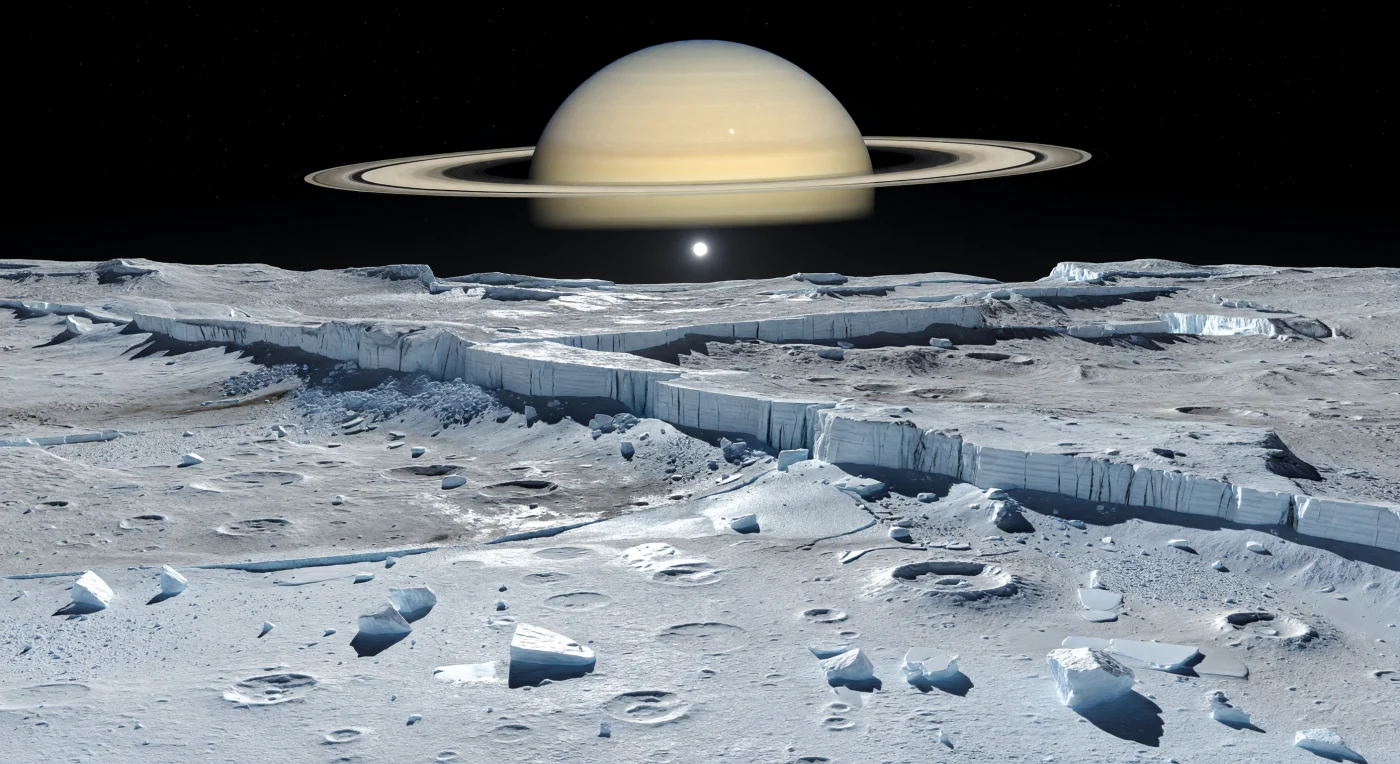
Under a sky of absolute black, the surface stretches away in cold gray-white cratered plains littered with shattered ice blocks, frost-bright boulders, and thin smudges of darker, radiation-processed material, while towering bluish-white scarps and fractured bands slash diagonally across the landscape like frozen lightning. These famous wispy terrains are not deposits of vapor but immense tectonic fault cliffs and chasm-like fractures, where cleaner water ice has been exposed through ancient crust, gleaming far more brightly than the older, crater-saturated ground around them. In the moon’s feeble gravity, the relief looks improbably sharp and steep, with blocky talus piled below crisp escarpments and impact craters overlapping across a surface shaped by both bombardment and episodes of icy resurfacing. Above it all hangs Saturn, enormous and nearly unmoving, its cream-and-tan globe and knife-thin rings casting a faint secondary glow, while the distant Sun—tiny yet fierce—throws hard-edged shadows across this silent, airless world that may conceal a deep ocean far beneath its frozen shell.

From this ground-level vantage, the highlands stretch away as a frozen labyrinth of overlapping craters, their softened rims and degraded bowls packed so tightly across the pale ash-gray and ivory water-ice bedrock that the landscape reads like a battered record of billions of years of impacts. The surface is bright but not pristine, dusted with faint brown-gray and tan contaminants mixed into the ice, while the foreground is littered with angular fractured blocks, brecciated ejecta, and brittle rubble ridges formed in a cryogenic crust shattered by repeated collisions. In the weak yet hard-edged sunlight of the outer Solar System, shadows fall as perfectly black wells under a sky with no air, haze, or cloud to soften the view, and the low gravity preserves steep crater walls and sharp relief all the way to a horizon crowded with layered rims and uplifted icy uplands tens of kilometers away. Over it all hangs an enormous cream-gold Saturn with its rings etched in stunning clarity, making the ancient, silent terrain feel both scientifically legible and profoundly alien.

A broad, low-lying plain of fine-grained water-ice regolith stretches outward in pale gray-white silence, so smooth and gently undulating that only a few tiny impact pits, shallow bowl-shaped craters, and faint wrinkle-like ridges interrupt the frozen surface before it curves away at the horizon. In the hard, distant sunlight, clean ice grains flash with cold highlights while sparse darker contaminants lightly pepper the otherwise bright terrain, revealing a resurfaced landscape shaped by ancient tectonic adjustment and the slow reworking of icy debris in an airless vacuum. The black sky offers no haze or softness—only sharp shadows, distant stars, and, if this face is turned the right way, the immense cream-colored disk and rings of the parent giant hanging over the plain with overwhelming scale. Standing here, you would feel the stillness of a world built mostly of water ice and rock, where weak sunlight, low gravity, and eons of impact and faulting have left a frozen lowland both starkly simple and profoundly alien.

At the edge of day and night, the frozen ground becomes a gallery of ice-carved relief: shattered water-ice rubble, frost-bright ejecta, and angular blocks stretch across cratered plains where rims and fault scarps flare in grazing sunlight while their walls fall instantly into abyssal blue-black shadow. The landscape’s brilliant wisps are not clouds but immense tectonic cliffs and parallel fractures, exposed where ancient crust was pulled apart and resurfaced, their icy faces reflecting the harsh, nearly white light with only faint traces of darker non-ice material mixed into older terrain. In the weak gravity and near-perfect vacuum, every edge looks unnervingly crisp—talus slopes, breccia ridges, and towering scarps stand out with sculptural sharpness beneath a black sky where stars persist and shadows remain absolute. Above the razor-clean horizon, Saturn hangs enormous and exquisitely detailed, its pale bands and sweeping rings dominating the sky and making the silent, frozen terrain feel at once intimate underfoot and vast beyond comprehension.
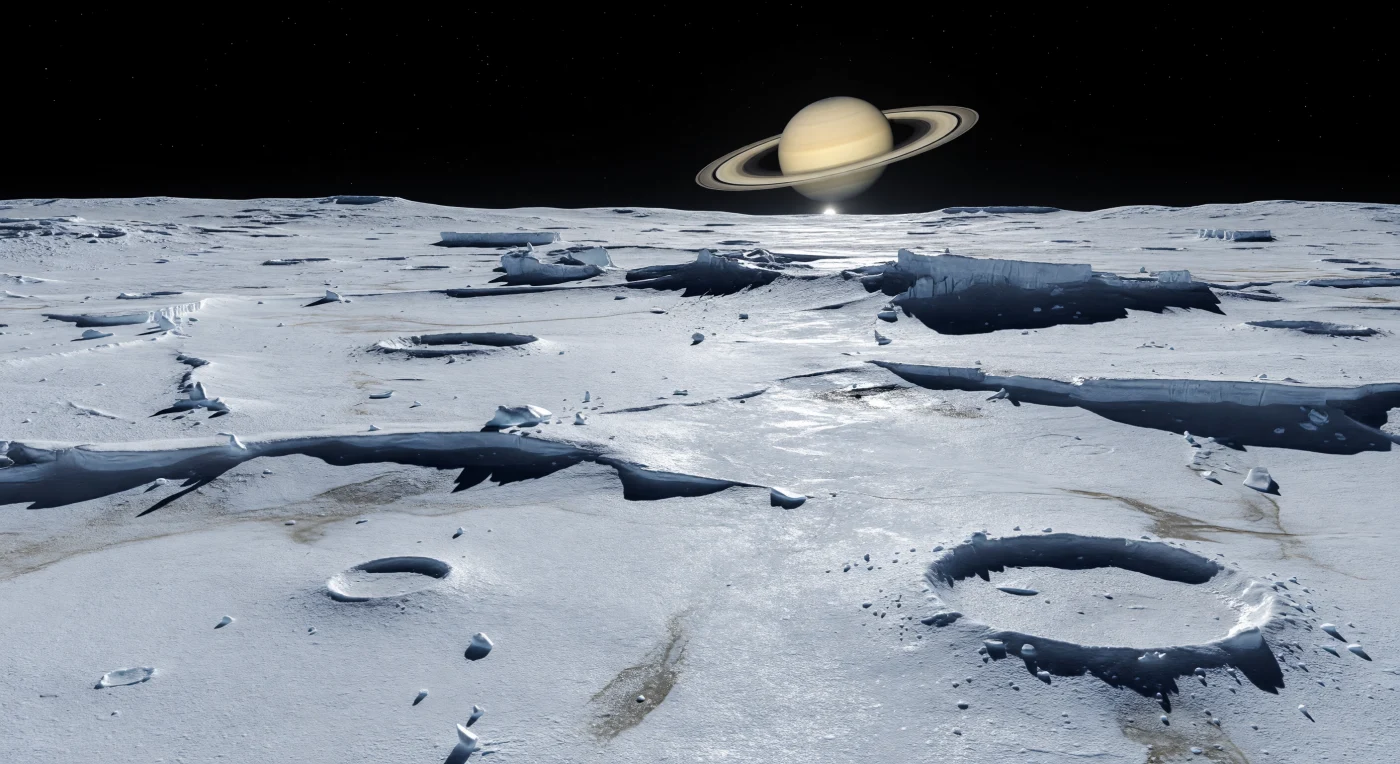
Under a tiny Sun skimming the horizon, an intensely bright plain of water ice stretches outward in bluish-white silence, its granular frost crust broken by scattered angular blocks, shallow tectonic troughs, and crisp-rimmed ancient craters whose interiors fade into jet-black shadow. With almost no atmosphere beyond a vanishingly thin exosphere, the sky is pure black and the low-angle sunlight remains harsh and unfiltered, throwing kilometer-long shadows from fault scarps, fractured ridges, and cliff-like icy uplifts that rise with exaggerated sharpness in the weak gravity. Subtle gray-brown contaminants stain parts of the otherwise snow-bright surface, recording the mixing of non-ice material into a crust dominated by frozen water, while broad cratered highlands on the far horizon remain razor-clear because no haze softens the view. If Saturn hangs above the landscape, pale and enormous with its rings etched across space, it deepens the uncanny sense of standing on a frozen, airless world shaped by impact, tectonic fracturing, and deep time.

At the foot of a towering fault scarp, you would see a frozen landslide plain of pale, angular ice blocks and powdery regolith spread beneath a gleaming wall of fractured bedrock, its terraces and vertical cracks rising far higher than the foreground debris. In the airless vacuum, water ice behaves as hard rock, and the moon’s extremely weak gravity allows unusually steep, sharp-edged escarpments and precariously stacked talus to persist, preserving the signature of ancient tectonic stretching that ripped open the bright crust. Side lighting from the distant Sun turns fresh cliff faces brilliant white while shadowed fissures fall into absolute black, revealing every razor-crisp texture with no haze to soften the view. Beyond the broken icy plain, subtle lineations and scattered small craters run toward a far horizon under a pure black sky, where Saturn looms immense, its rings casting a faint ghostly glow over the cold, silent landscape.
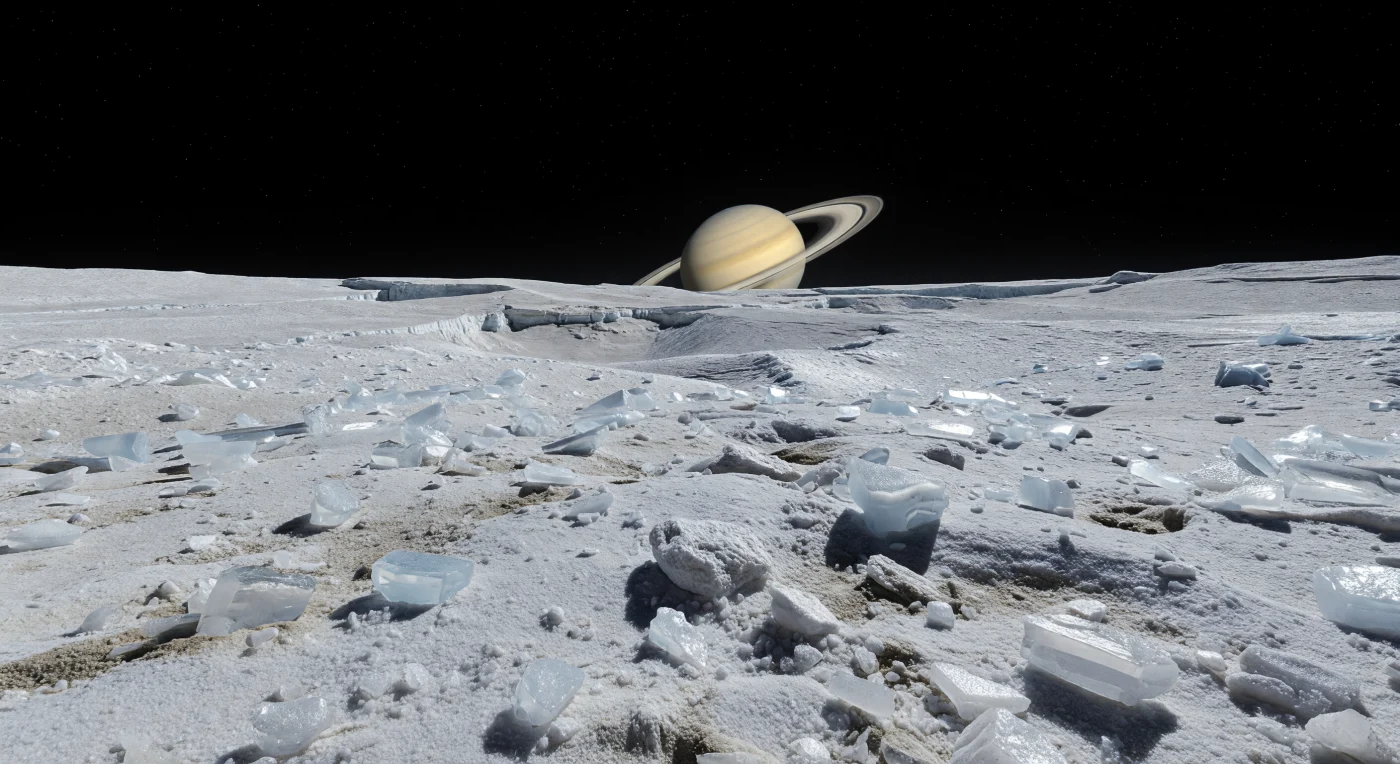
Underfoot, the ground is a compact pavement of pale gray-white water-ice regolith, where frost-like grains and shattered angular blocks lie frozen in place so perfectly that every pebble throws a knife-edged shadow into the black vacuum. Freshly fractured ice faces flash with bluish-white glints in the distant Sun, while darker dust and non-ice contaminants collect in protected cracks and tiny hollows, hinting at the slow space-weathering of an ancient cratered plain. Beyond the close rubble, the landscape broadens into gently rolling icy lowlands, crisp crater rims, fault-bounded ridges, and faint bright scarps—the exposed tectonic fractures of a once-active shell shaped by impacts, extension, and resurfacing above a differentiated interior that may still conceal a deep ocean far below. Hanging over the horizon, Saturn’s softly banded globe and tilted rings dwarf the scene, making the silence, the low gravity, and the pristine sharpness of this frozen terrain feel both immense and unnervingly close.

Under a perfectly black, airless sky crowded with sharp stars, an ancient plain of water ice stretches to a knife-edged horizon, its cratered surface barely revealed by distant starlight and faint light reflected through the surrounding planetary system. The ground is a muted silver gray, textured with granular frost, darker non-ice impurities, car-sized impact blocks, and overlapping crater rims whose steep walls and frozen ejecta remain crisp in the moon’s weak gravity and total lack of weather. Farther out, broad degraded basins and broken rim segments rise as hard silhouettes, their forms fading only into darkness rather than haze because no atmosphere softens or scatters the view. In this deep vacuum night, the landscape feels both silent and immense: a frozen record of billions of years of impacts, gleaming with a cold metallic sheen from a world built largely of bright water ice over a rock-rich interior.
