
You stand beneath a towering rainforest vault where buttressed trunks rise like living columns, their bark draped in moss, lichens, and vines, while layer upon layer of leaves merge into a dense green ceiling more than 55 meters overhead. Late-afternoon sunlight, filtered through water-saturated air, turns into a warm golden glow that softens shadows and hangs as luminous haze, a reminder that intense evaporation and transpiration keep tropical forests humid enough to blur the view after only a hundred meters or so. Through gaps in the canopy, brilliant white cumulus clouds drift above the treetops, and the Sun appears as a softened yellow-white disk about half a degree wide, its light scattered by water vapor and aerosols so that the sky fades from milky blue near the horizon to deeper azure overhead. Dark wet soil, tangled roots, and decomposing leaves underfoot reveal a landscape where heat, rainfall, rapid biological turnover, and relentless chemical weathering work together to build one of the planet’s most productive and immersive ecosystems.
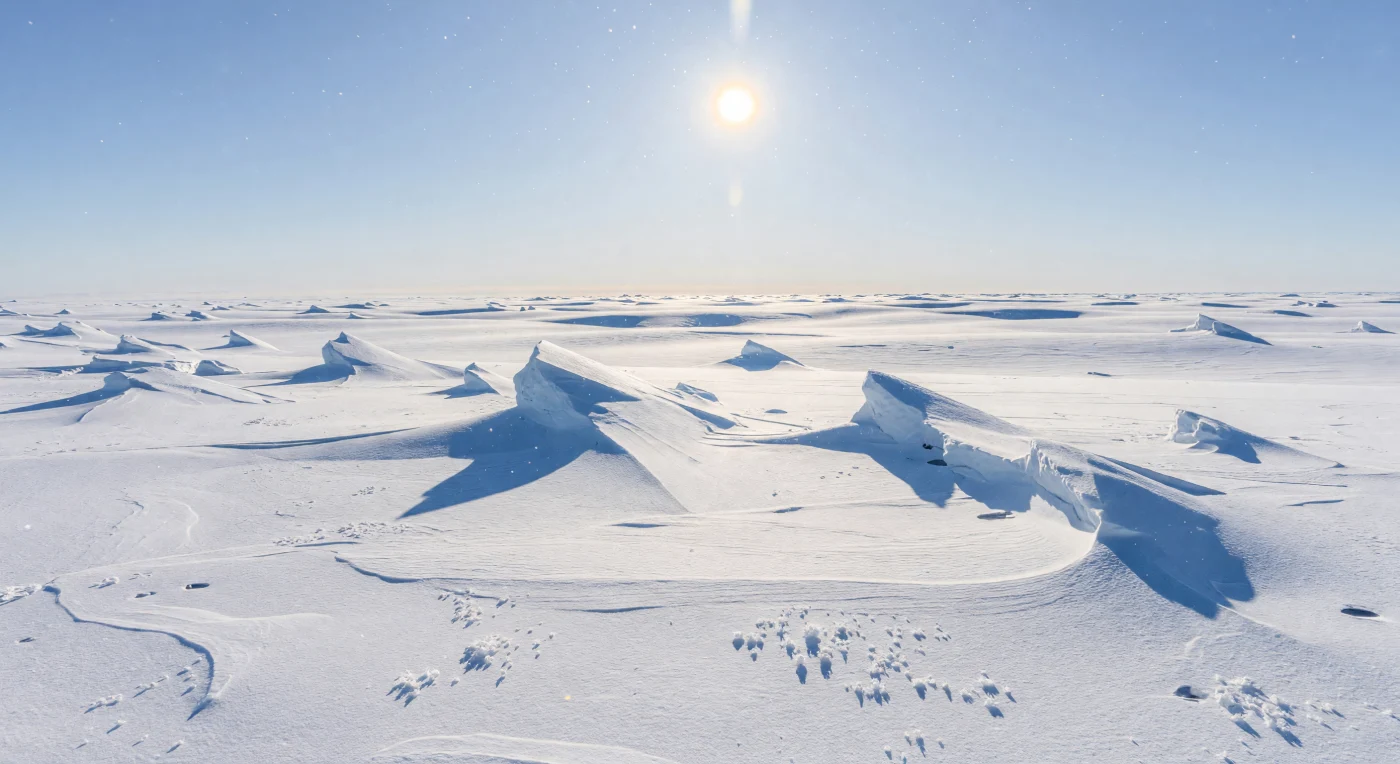
An immense white plain of compacted glacial ice stretches to a horizon so distant it seems to dissolve into the sky, its surface chiseled into sharp sastrugi by relentless katabatic winds and broken by pressure ridges whose blue shadows cut across the snow like frozen waves. At this elevation and in temperatures cold enough for diamond dust to remain suspended in the air, sunlight glints from hoarfrost and tiny ice crystals, producing faint iridescence and a constant crystalline shimmer in the otherwise austere scene. The pale midday sky, washed with fine ice haze, filters the Sun into a hard, brilliant disk while the dense, nearly bubble-free ice below absorbs red light and reflects luminous cyan from within the shadowed faces. Standing here, you would feel surrounded by a landscape both exquisitely detailed and almost incomprehensibly vast—a polar desert where wind, light, and frozen water have sculpted one of the most extreme environments on the planet.

From this terrace inside the canyon, you are surrounded by a colossal chasm whose walls step downward through bands of rust red, orange buff, chocolate brown, and muted purple, each layer recording ancient deserts, coastal plains, muds, and shallow seas laid down over hundreds of millions of years. The low sunrise, only about 15 degrees above the rim, strikes the Coconino Sandstone and higher cliffs in molten gold while casting extraordinarily long shadows that turn recesses nearly black and tint shaded slopes deep maroon and violet. Fine sand, siltstone, scattered shrubs, and bleached wood in the foreground sharpen the sense of scale, while far-off walls fade to bluish haze as sunlight scatters through the atmosphere, making the canyon seem to recede for impossible distances. Beneath a sky that shifts from fiery orange at the horizon to pale blue overhead, the scene feels both intimate and immense—a living cross section of continental geology illuminated at the brief, dramatic moment when night yields to day.
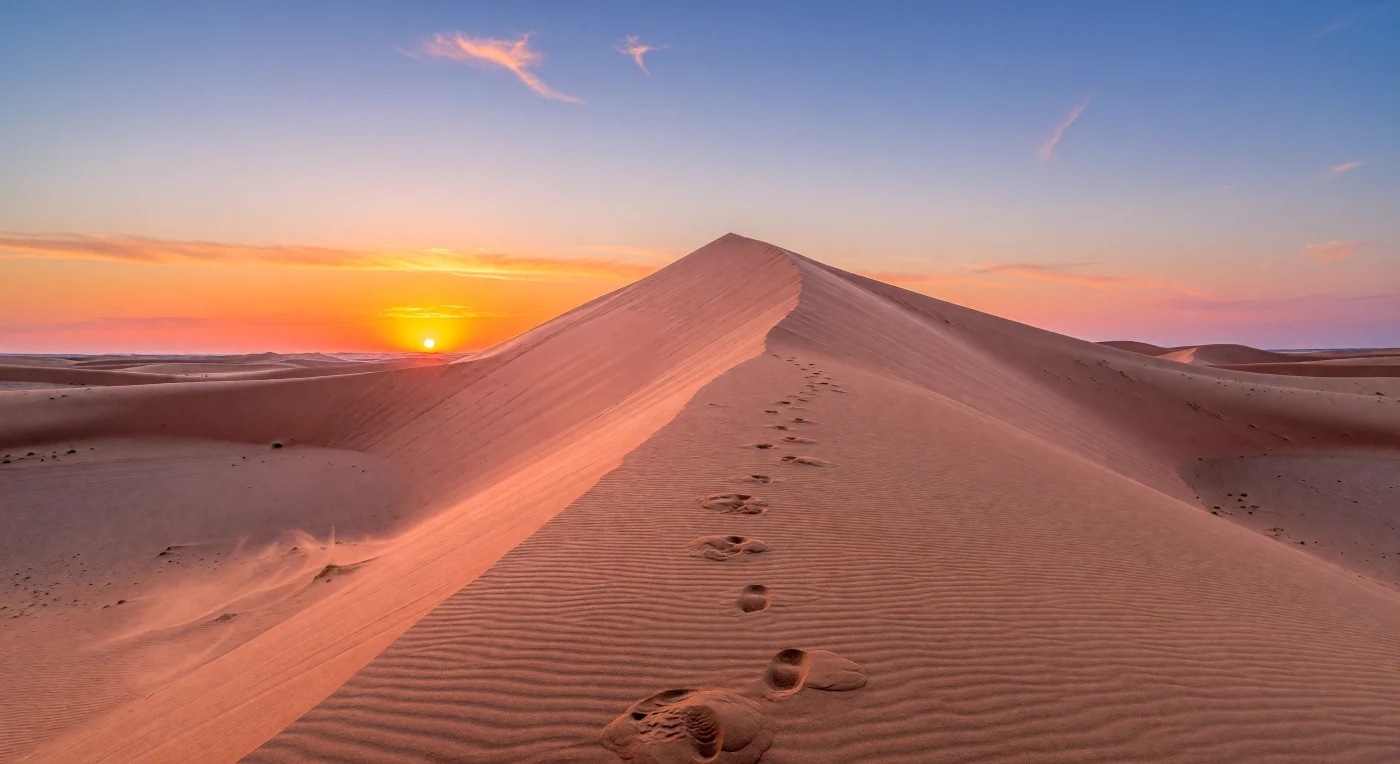
From the lower flank of a towering dune, you look up a 200-meter wall of quartz-rich sand whose knife-edge crest cuts cleanly across a glowing evening sky, while tight wind ripples, faint miniature avalanche streaks, and scattered footprints reveal the constant work of desert winds on loose, well-sorted grains. Low-angle sunlight transforms the slope into bands of pink, apricot, and fiery orange that fade into a deep red-purple shadow at the base, an effect created by iron-oxide staining in the sand and warm reflected light within the dense lower atmosphere. On the horizon, the Sun hangs as a brilliant golden disk, slightly flattened by atmospheric refraction, while dust and haze near the ground intensify the vivid orange, magenta, and lavender twilight before it deepens to blue overhead. Beyond the foreground, subdued dune fields roll away into the distance with no water or vegetation to interrupt the mineral expanse, making the scene feel immense, silent, and sculpted almost entirely by air, light, and time.

From the wet tan quartz sand, scattered with shell fragments, driftwood, and shallow mirror-like tide pools, you stand in the uncanny calm of a hurricane’s eye while a colossal ring of storm towers wraps the horizon almost unbroken, dwarfing the low dunes and tiny shoreline vegetation. The ocean ahead is no refuge: steel-blue to green-gray water heaves with confused cross-swells and torn spindrift, evidence of the cyclone’s rotating wind field still raging in the surrounding eyewall. That wall is built from towering cumulonimbus clouds rising more than 15 kilometers into the atmosphere, with dark, rain-heavy bases, rotating convective cores, and brilliant anvil tops where moist air has surged upward, cooled, condensed, and spread outward near the tropopause. Overhead, the roughly 50-kilometer-wide eye opens in muted blue patches around a pale, diffused Sun, while greenish-gray light filtered through dense cloud and salt-heavy haze gives the scene an eerie, almost unreal stillness that makes the storm’s vast scale feel mountain-like and immediate.

At ground level, the geothermal pool spreads out like a vast living eye, its nearly 110-meter-wide center glowing an intense cobalt and sapphire blue where the water remains hot enough to approach 188°F (87°C). Around that clear core, sharply defined rings of green, yellow, orange, and rusty brown mark communities of heat-loving microorganisms, each band tracing a narrow temperature zone where cyanobacteria and other thermophiles thrive with different photosynthetic and carotenoid pigments. Thin white steam rises in drifting veils above the surface, while bright midday sunlight glints off wet runoff channels, pale silica sinter, and mineral crusts that frame the spring in white and beige, emphasizing the chemistry of silica-rich hydrothermal waters as they cool and precipitate. Beyond the basin’s mineral flats and faint geothermal haze, sparse lodgepole pines and tiny human figures at the edge make the scale unmistakable, turning the scene into a rare meeting point of geology, heat, water, and life.

From the ocean surface, you face a vast monsoon thunderstorm rearing up like a mountain of vapor, its cumulonimbus tower rising to roughly 15 kilometers as a dark graphite base sweeps low over the horizon and sunlit upper domes blaze brilliant white against the humid blue sky. Diffuse yellow-white flashes pulse within the cloud’s interior, evidence of intense charge separation inside the deep convective column, while multiple updraft towers reveal the powerful vertical transport of warm, moisture-laden air that drives monsoon storms. Below, the sea is split by light and shadow: grey-green and slate-blue beneath the storm, cobalt where sunlight still reaches through, with steep white-capped waves and low skimming spray showing the force of the gust front spreading ahead of the rain. Crepuscular rays slant down from gaps under the cloud deck, but the distance is already fading into haze and precipitation, making the storm feel immense, dynamic, and close enough to swallow the horizon.

From the floor of a high-latitude alpine valley, jagged snow-loaded peaks rise in dark tiers beneath a sky alive with auroral curtains, their vivid green glow produced as charged particles guided by the planet’s magnetic field excite oxygen atoms high in the atmosphere to emit light at 557.7 nanometers, with faint crimson fringes marking rarer oxygen emission near 630 nanometers at greater altitudes. The aurora becomes the landscape’s primary illumination, washing snowfields, glacier ice, and corniced ridgelines in a pale green light that reveals arêtes, cirques, avalanche chutes, and frost-rimmed rock faces, while blue-toned shadows linger in the hollows and among wind-sculpted sastrugi. Through thinner folds of the luminous veil, stars remain visible in the dry, crystal-clear night air, emphasizing that these shimmering structures are not clouds but vast, semi-transparent displays unfolding far above the mountains. Standing here, surrounded by hoarfrosted boulders and the immense silence of winter stone and ice, the scene feels both intimately terrestrial and astonishingly alien in scale.

From the forest floor, you stand beneath a high canopy blazing with autumn chemistry: scarlet and crimson leaves rich in anthocyanins, golden crowns colored by carotenoids, and pockets of dark conifer green that have resisted seasonal change. Warm sunlight slants in from mid-sky, catching waxy leaf surfaces and casting crisp, dappled shadows across dark loam, exposed roots, moss, weathered stones, and a thick litter of freshly fallen oak, maple, and beech leaves already curling toward decay. The trunks around you—furrowed oak, smooth pale beech, darker maple—rise through cool, clear air into branches that are just beginning to open, revealing patches of pale blue sky and soft white cloud. This is a biologically rich woodland in transition, where undergrowth senesces, insect activity has fallen silent in the chill, and the ground is being steadily transformed into the organic layer that will feed the forest through another cycle of growth.
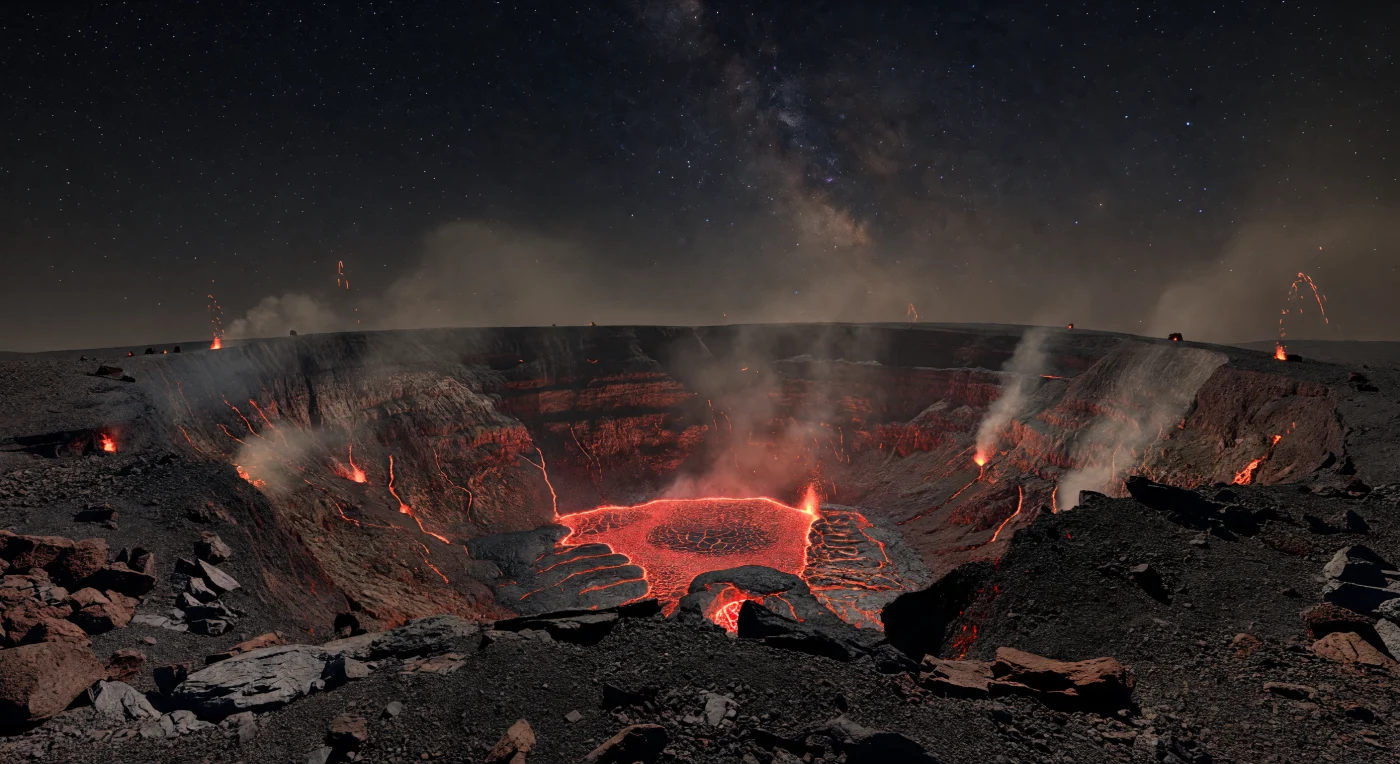
From the crater rim, you look down nearly 400 meters into a molten basaltic lava lake, its surface glowing cherry-red to orange where temperatures exceed about 700°C, while darker crimson crust plates and blackened margins show where the melt is cooling and rafts slowly across the vent. Jagged basalt blocks, scoriaceous rubble, ash-coated ground, and fractured clinker lie in the foreground, their sharp textures lit from below by the lava’s fierce incandescence, while the inner walls reveal welded spatter, oxidized red-brown streaks, talus slopes, and thin fumaroles venting hot volcanic gas through fractures. Rising heat and mineral-rich gases shimmer upward in translucent columns that warp the Milky Way overhead, and with no moonlight the stars burn sharply above—though ash and aerosols mute them near the horizon—until brief Strombolian bursts hurl incandescent spatter skyward and flash against a low ash plume. The only true light comes from the crater itself, casting hard black shadows and glossy red reflections across the dark volcanic landscape, making the vast rimline and tiny silhouetted boulders feel both immediate and immense in the furnace-like night.

From this shallow, sunlit vantage beneath the sea, a dense city of coral rises from pale carbonate sand—branching staghorn and table corals, rounded boulders, maze-patterned brain corals, and encrusting sponges glowing in reds, oranges, yellows, purples, and pinks. These vivid hues come from living coral tissue, where symbiotic algae and fluorescent proteins thrive in the strong tropical light, while the clear water filters out red wavelengths and turns the world above into a luminous blue ceiling streaked with sharp sunbeams. Caustic bands of light ripple across the seabed, coral rubble, and waving sea grass, and schools of silver-blue fish flash through the reef as distant forms fade into a soft blue haze at the edge of visibility. Standing here at 10 to 15 meters depth, with the Sun reduced to a brilliant refracted spark beyond the gently rippled surface, you feel both the intimacy of a living ecosystem and the vast architecture of a reef built grain by grain from calcium carbonate over thousands of years.

From the rocky shore of this high alpine lake, the world appears suspended in a breathless pause before sunrise: a glass-still surface mirrors serrated, snow-laden summits soaring above 4,000 meters, their highest ridges catching the first pale gold light while the cirques, forests, and boulder-strewn valleys below remain submerged in blue-violet shadow. The mountains reveal a landscape carved by ice and uplift, with hard granite and metamorphic walls, talus fans, narrow snow gullies, and moraines recording the long work of glaciers in thin, exceptionally clear air. Along the frost-rimmed shoreline, thin ice, granite cobbles, and low alpine plants emphasize the cold, while faint mist rising from the darker water marks warmer lake moisture meeting the predawn chill. Overhead, sunlight filtering through a clear nitrogen-oxygen atmosphere paints a natural dawn spectrum from orange and gold at the horizon through yellow, greenish tones, and cyan into deep blue, giving the entire basin an immense, quiet grandeur that makes you feel both tiny and vividly present.

At ground level, the scene is an almost impossibly flat sheet of brilliant white halite stretching across roughly 30,000 acres, its polygonal crust broken into brittle plates, hairline fractures, and faint beige-gray mineral stains left behind by repeated cycles of shallow brine evaporation. Under a near-overhead Sun, the salt’s high albedo floods the basin with reflected light, erasing most shadows and washing the horizon into a glowing band where intense glare and atmospheric refraction produce wavering superior mirages. The air is so clear and dry that visibility extends for many kilometers, with only the thinnest blue-gray mountain silhouettes at the basin margins and even a subtle hint of Earth’s curvature reinforcing the immense scale. Standing here feels like occupying a natural evaporite plain stripped to its essentials—no vegetation, no standing water, only crystalline salt, radiant heat, and a silence so complete the landscape seems to blur into the sky.
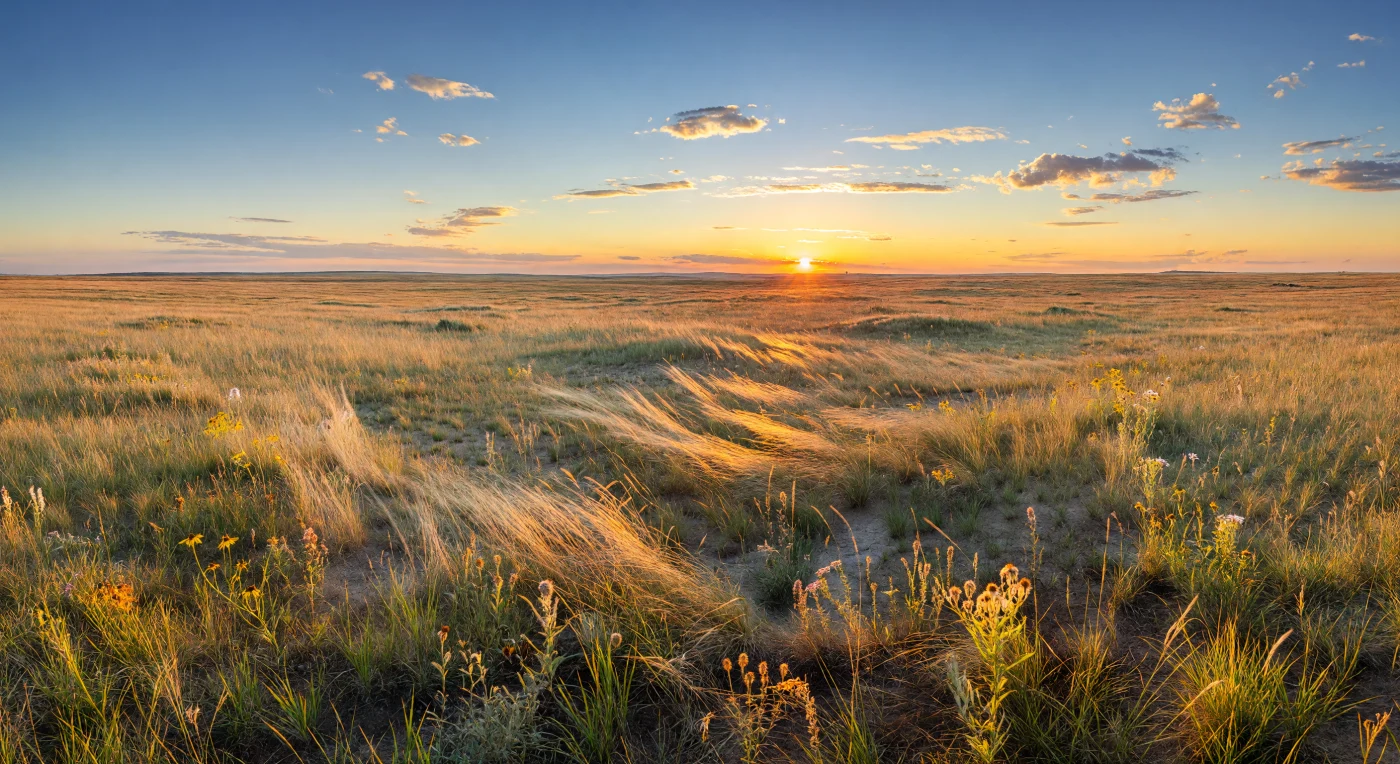
Under a low, blazing Sun, the prairie opens in every direction as a sea of tall grasses, their late-season blades and seed heads glowing honey-gold while wind drives shifting ripples across the plain like waves on water. From this ground-level view, wildflowers and fine stems stand sharp in the foreground, some lit along their edges, others thrown into silhouette by the intensely lateral light that casts extraordinarily long shadows over gently undulating, loamy ground. The sky records the physics of a dense atmosphere in real time: blue overhead, warming through yellow into orange and pink near the horizon, with small clouds edged in gold and rose and the distant plain fading to a purple-blue haze from scattering through tens of kilometers of clear air. With no mountains or exposed rock to interrupt it, the landscape feels immense and elemental—a living grassland shaped by wind, sunlight, seasonal drying, and deep soils that sustain one of the world’s great continental ecosystems.

From the shoreline, you look into a vast U-shaped fjord where dark seawater is walled in by cliffs that rise almost vertically for more than a kilometer, their banded gray and black rock polished and striated by the passage of ancient ice. At the head of the valley, a bright glacier descends between steep mountains, its crevasses and blue seracs feeding a broad plume of sediment-rich meltwater that turns the surface brilliant turquoise and milky blue; this color comes from suspended glacial flour, rock ground to powder beneath moving ice and carried far into the fjord before settling. Waterfalls spill from hanging tributary valleys high above, throwing mist into the cold air and revealing how deeply the main glacier carved the landscape compared with smaller side valleys. Under cool northern sunlight and drifting cloud shadow, the scene feels immense and freshly made, a place where ice, rock, and water are still actively reshaping the land.

At ground level, you stand at the edge of a spring-fed pool so clear and intensely turquoise that it seems almost unreal, ringed by tall date palms whose fibrous brown-gray trunks and dense green crowns cast sharp shadows across damp sediment, salt crusts, and the glassy water. Only a few meters away, the oasis gives way abruptly to bright quartz-rich sand dunes stained tan, ochre, and reddish brown by iron-bearing grains, their ripple marks and slip faces sculpted by persistent wind under a harsh white Sun in a pale blue, nearly cloudless sky. The pool is shallow and transparent at the margins, darkening toward the center where dissolved minerals, depth, and sky reflection enrich its blue-green color, while faint spring ripples disturb mirrored fronds and hints of reeds at the wettest edge. The result is a striking lesson in desert hydrology and surface processes: life clustered tightly around groundwater reaching the surface, surrounded by heat-shimmering emptiness where exposed sand, dry air, and the complete absence of moisture beyond the oasis make the contrast feel immense and profoundly otherworldly.

From this wave-battered shoreline, immense walls of basalt rise 200 to 300 meters overhead, their dark volcanic faces split into striking columnar joints—hexagonal and irregular pillars formed as ancient lava cooled and contracted, now slick with rain, silvered by weathering, and mottled with pale lichen and tide-darkened algae. Below them, a cold grey-green ocean hammers the cliff base with relentless force, blasting white surf and spray more than 50 meters into the air, while fresh rockfall, erosional notches, and detached spires reveal how waves and gravity steadily dismantle the coast. Under a low ceiling of stratocumulus cloud, the light is flat and shadowless, reduced to charcoal, slate, wet silver, and foam-white, with wind-driven rain slanting across the scene and distant headlands dissolving into mist. Standing among polished black boulders and draining tide pools, you feel the scale of an active shoreline shaped by volcanic history and ongoing marine erosion, where every surface glistens and every crash of water makes the land seem both ancient and violently alive.

At ground level in this winter boreal forest, tall spruce and pine rise as black, sharply etched silhouettes from a bright snowfield, their snow-laden branches standing over a gently rolling plain of glacially shaped drifts, frost-crusted shrubs, and occasional dark granitic and metamorphic stones breaking through the surface. The sky records the physics of deep twilight in layers: a warm orange-red band of sunlight scattered through the thick lower atmosphere along the western horizon fades upward through violet into dark blue, where the first stars and a faint wash of the Milky Way emerge. To the north, Earth’s magnetic field is revealing itself as soft green auroral arcs and delicate vertical curtains, produced when charged particles from space excite oxygen high in the upper atmosphere, casting a subtle emerald sheen across the snow and the edges of tree trunks. In the still, subfreezing air, with ice crystals suspended almost invisibly and the endless tree line dissolving into atmospheric haze, the forest feels immense, silent, and uncannily alive beneath two kinds of light: the last glow of the Sun and the first whisper of the aurora.

At high tide, the mangrove forest becomes a flooded maze: arching prop roots and stilted trunks rise from black, oxygen-poor mud while thousands of pencil-like pneumatophores poke through the dark, tea-brown water, their reflections broken by only the faintest tidal current. The water’s color comes from tannins leached from decaying leaves and from suspended silt, revealing a nutrient-rich but low-oxygen environment where salt-tolerant trees have evolved elaborate aboveground root systems to anchor themselves, breathe, and withstand shifting coastal sediments. Overhead, a dense canopy of glossy green leaves filters bright sunlight into scattered beams, casting sharp shadows across wet bark, exposed roots, and the occasional bird or cloud of insects moving through the humid air. With visibility closing in to just a few meters between tangled trunks and a narrow tidal creek vanishing into the vegetation, the swamp feels both intimate and immense—a living shoreline engineered by biology to trap sediment, buffer storms, and shelter countless species.

From this exposed crest more than 6,000 meters above sea level, you stand on a barren crown of frost-shattered rock—grey and brown layers of metamorphic and sedimentary stone stained with rusty minerals, broken into sharp ledges and talus, with old snow and blue-white ice lingering in wind-sheltered cracks. Far below, a continuous white undercast fills the valleys like an ocean of cloud, while serrated summits rise through it and the dry, exceptionally thin air allows visibility for more than 100 kilometers to distant mountain chains and a subtly curved horizon. Overhead, the sky deepens to a saturated cobalt because there is less atmosphere to scatter sunlight, and the Sun burns small, white, and fierce, casting harsh, crisp shadows that take on a cool blue tint from Rayleigh-scattered skylight. The absence of vegetation, liquid water, and any sign of life reflects the severe cold, low pressure, and intense exposure of this extreme alpine environment, where local rock weathering is driven by freeze-thaw fracturing and the immense scale of the planet becomes almost tangible.
