
At ground level, the landscape is a striking collision of colors and textures: crescent-shaped dunes of charcoal-black basaltic sand rise sharply from patches of rust-red dust, their steep slip faces and fine ripples etched by persistent winds in the planet’s thin, cold atmosphere. Low dawn light casts long, knife-edged shadows across the dune field, while iron-oxide dust gathers in troughs and along windward slopes, revealing how dark volcanic grains and brighter oxidized regolith are constantly sorted and reworked by aeolian processes. Scattered angular rocks, ventifact-sculpted stones, and pebble-armored deflation surfaces lead the eye toward distant crater rims and worn volcanic outcrops, pointing to a basaltic source terrain that feeds this vast sea of mobile sand. Above it all, a muted salmon sky deepens to tan and bluish gray, with a faint cool halo around the small rising Sun—an effect of sunlight scattering through suspended dust—giving the immense plain an austere, alien stillness.
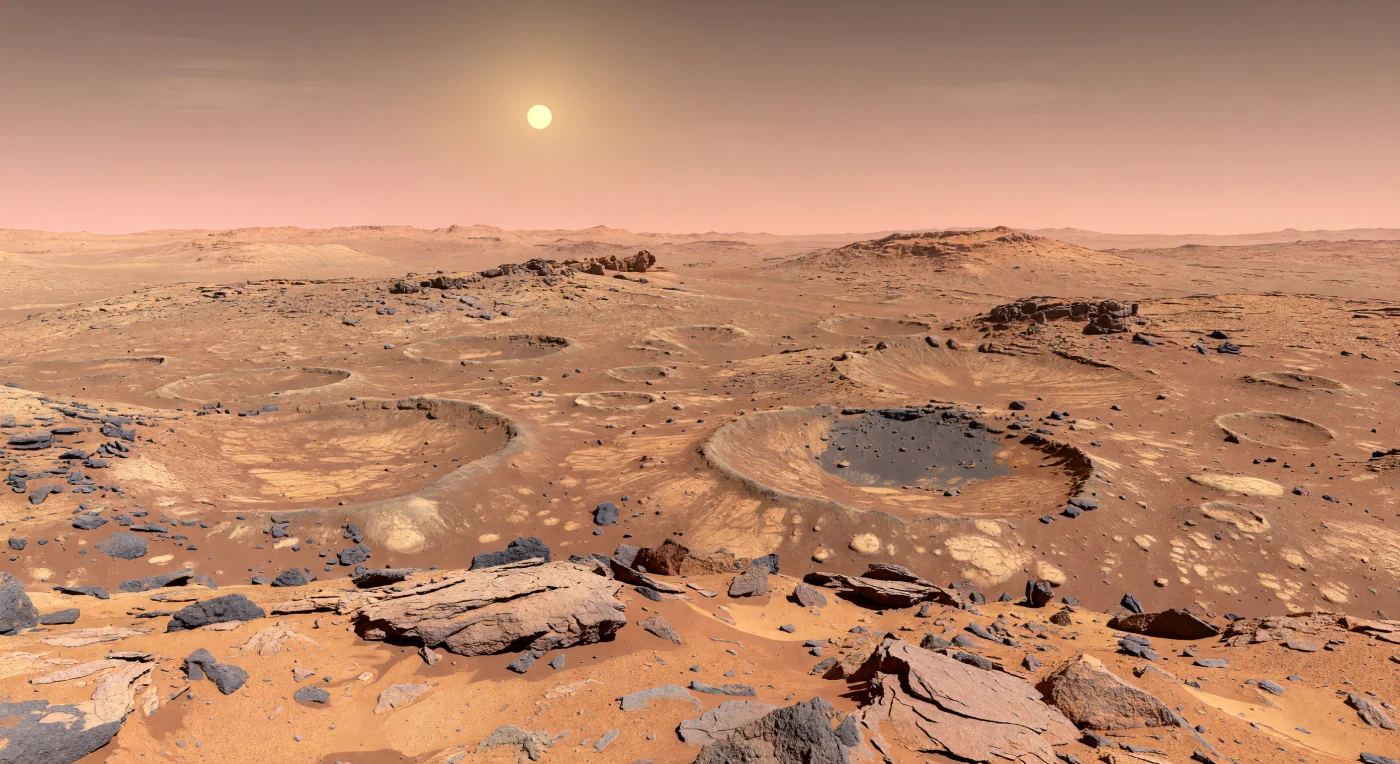
From this rocky ridge, the eye travels across an immense field of ancient, overlapping craters—kilometers wide, softened and subdued by billions of years of impacts, dust deposition, and slow mechanical weathering under a thin carbon-dioxide atmosphere. At your feet lie angular basaltic stones, impact-breccia blocks, fractured bedrock, and drifts of red-orange iron-oxide dust, while darker basaltic sands collect in crater floors and hollows between worn ejecta ridges. In the cold, low-gravity afternoon light, crater rims and scattered boulders cast sharp shadows that make the terrain appear both stark and vast, each distant rise fading into a faint rose haze beneath a pink-tan sky and a Sun noticeably smaller than Earth’s. It feels like standing on the exposed memory of a primordial surface, where the highlands preserve one of the oldest cratered landscapes in the Solar System.

From the floor of a young impact crater, meter-scale rocks and jagged boulders lead the eye up steep inner walls where fractured basaltic bedrock, impact-brecciated rubble, and thin coatings of red iron-oxide dust are cut by scree channels and gullied mass-wasting scars. House-sized blocks with freshly exposed dark gray faces lie among shattered ejecta and narrow drifts of charcoal basaltic sand, their rippled dunelets trapped in hollows by winds moving through the crater’s bowl, while crisp layered outcrops revealed by the impact hint at the subsurface structure below. In the thin, cold carbon-dioxide atmosphere, the morning Sun hangs small and low near the rim, casting brilliant edge light on dust-coated ledges and plunging walls hundreds of meters high into hard blue-gray shadow softened only slightly by suspended haze. Beneath a butterscotch sky fading upward into muted salmon-brown, the far rim recedes through dusty perspective, and the reduced gravity makes the crater feel improbably steep and immense—as if you are standing inside a freshly torn wound in the planet’s basaltic crust.

Rust-colored dust lies like a thin veil across a vast dark basalt plain, where angular volcanic stones, vesicular fragments, and impact-shattered cobbles rest among low ripples sculpted by persistent winds. Beneath a pale butterscotch sky, the thin carbon-dioxide atmosphere filters the midday Sun into a compact white-yellow disk, softening the light just enough to cast gentle but distinct shadows across the iron-oxide regolith and exposed black bedrock. The scene is intensely dry and mineral-rich: a surface built from ancient lava flows, battered by impacts, ground by dust, and slowly mantled by fine oxidized particles that give the landscape its characteristic rusty tones. From the detailed rocks at your feet to the faint crater rims dissolving into tan haze at the horizon, the plain feels immense, cold, and silent, an open world shaped by volcanism, wind, and deep time.

From the fractured basaltic rim, the ground falls away abruptly into an abyss so vast that its far walls dissolve into reddish haze, their kilometer-high faces striped with dark volcanic rock and pale sulfate-rich layers laid down long after the lava cooled. Oblique sunlight from the small distant Sun rakes across terraces and immense landslide scars, making cream-colored hydrated mineral bands glow against charcoal cliffs while dust-softened shadows sink into the canyon’s depth. Below, through the thin carbon dioxide atmosphere, dark dunes, talus fans, and faint dry channel-like traces emerge and fade in the murk, recording a history of collapse, sediment transport, and ancient water-related alteration in a landscape now utterly arid. Standing here, amid iron-oxide dust and vesicular lava broken under a butterscotch sky, the scale feels almost impossible: a wound in the crust large enough to swallow mountains.

At ground level, the plain is littered with angular basaltic stones, wind-carved ventifacts, and dark ripple patches of sand dusted by a thin veil of red-orange iron oxide, while beyond them towering mesas and isolated buttes rise in stacked bands of tan, cream, ochre, and rusty red. These exquisitely layered cliffs expose sedimentary deposits likely laid down over immense spans of time, then stripped back by wind-driven erosion, collapse, and dry mass wasting into scarps, talus slopes, and narrow gullies under the planet’s cold, thin atmosphere and weak gravity. In the low evening Sun, west-facing strata glow gold as bluish-gray shadow pools gather between the mesas, emphasizing landforms hundreds of meters tall that keep crisp, austere profiles into the hazy distance. Overhead, the sky is unmistakably alien: butterscotch and reddish-brown away from the Sun, yet encircling the small dim solar disk is a cool blue halo created by fine suspended dust scattering light in the opposite way from Earth’s sunsets.

At rover scale, you stand over a pavement of ancient lakebed mudstone, its gray-beige surface split into desiccation-like polygons and stitched with thin, chalky white mineral veins that thread across the rock like healed fractures. Low morning sunlight falls at a sharp angle, casting crisp shadows into each crack and revealing delicate sedimentary laminations, tiny ridges, wind-scoured pits, and scattered dark basaltic grains trapped along the margins, while rusty iron-oxide dust lightly powders the veins and stone. These bright veins were likely deposited by mineral-rich groundwater moving through fractures long after the mud first dried and lithified, preserving evidence that this now frigid, arid crater-basin plain once hosted persistent water. Beyond the centimeter-scale textures, the land opens into a nearly barren expanse of low bedrock plates, softened crater rims, and distant mesas under a thin carbon-dioxide sky, where a small pale Sun glows through muted tan haze and makes the scene feel both intimate and immense.

At ground level, the ancient delta front rises in sinuous, branching ridges where former river channels have been turned inside out by erosion, leaving pebble-rich conglomerates and sandstone standing above the surrounding plain. Tan and brown outcrops, packed with rounded cobbles, step downward in tilted sedimentary benches that expose finely layered deposits laid down when water once entered a long-vanished crater lake, while dark basaltic fragments and patches of volcanic sand punctuate the iron-oxide dust gathered in sheltered hollows. In the low morning Sun, the thin carbon-dioxide air casts long, crisp shadows softened by suspended dust, and a faint basin haze washes the distant crater wall into muted relief beneath a salmon-butterscotch sky. The scene feels both desolate and monumental: a dry, wind-shaped basin where no liquid water survives today, yet every ridge and ledge preserves the fossil geometry of flowing streams and sediment settling billions of years ago.

At ground level, the lower flank of this giant shield volcano reads not as a mountain but as an almost level, dark basaltic plain stretching to a horizon so distant the volcano’s rise is sensed only as a subtle tilt beneath your feet. Rough clinker-like lava, smoother weathered slabs, angular vesicular rocks, low pressure ridges, and a few sharp-edged collapse pits are dusted with rust-red and cinnamon iron-oxide fines, while gently sinuous wrinkle ridges fade into the haze over tens of kilometers. Above, a pale butterscotch sky deepens to muted tan-brown in the thin carbon-dioxide atmosphere, with a small Sun shining through suspended dust and a delicate white water-ice cloud hanging far upslope in the cold morning air. In the weak gravity and arid stillness, volcanic textures remain strikingly crisp, making the scene feel immense, austere, and unmistakably otherworldly.

You stand on the floor of a vast dry outflow channel where ancient catastrophic floods once tore through the crust, leaving behind streamlined bedrock islands, gravelly bars, and dark scour grooves that still point in the direction of vanished torrents. Reddish iron-oxide dust lies thinly across polished basaltic and sedimentary rock, but the low Sun picks out stripped patches of darker stone, crisp shadows, and the tapered tails of flood-carved forms on a scale that stretches for kilometers toward hazy cratered uplands. Pebble bars, angular cobbles, and layered outcrops near your feet hint at powerful past transport, while today only faint wind-driven dust streaks skim the trough under a cold, thin carbon-dioxide atmosphere and a small distant Sun. The butterscotch sky, subtle haze, and immense, silent corridor make the landscape feel both desolate and dynamic—a fossil river of rock recording water’s former power on a planet now almost entirely dry.

From the rim of the summit caldera, the ground falls away into a colossal set of nested collapse pits, their terraced walls broken into dark basaltic ledges, angular talus, and blocky lava fragments lightly powdered with red-orange iron-oxide dust. In the thin, exceptionally clear air, a small morning Sun hangs low and casts razor-sharp shadows that pool blue-gray inside the deepest chasms, while the broad caldera floor reveals old lava textures, black volcanic rubble, and wind-rippled basaltic sand gathered with ochre dust in sheltered hollows. These pits were carved not by impact, but by the volcano’s summit collapsing as subsurface magma reservoirs drained, leaving kilometer-wide voids ringed by fractured bedrock and escarpments that appear startlingly tall under lower gravity. Beyond the caldera, the immense shield slopes fade only slightly into a butterscotch and muted tan sky, and the uninterrupted horizon feels almost unreal—cold, dry, silent, and vast enough to make the foreground boulders seem like grains at the edge of a planetary wound.

Across the floor of the chasm, immense tilted blocks of shattered basalt and layered canyon rock lie strewn like toppled buildings, their angular faces and hummocky debris tongues casting long, knife-edged shadows through a faint haze pooled low in the basin. The scene records catastrophic mass wasting in a cold, dry world: cliffs collapsed in giant landslides, leaving brecciated boulder fields, talus aprons, detached slump blocks, and dark basaltic sand trapped in hollows, all lightly mantled by iron-oxide dust that paints the ground in rusty reds and ochres. Above, colossal stratified escarpments rise into a butterscotch sky that darkens upward, while the small late-afternoon Sun glows through the thin carbon-dioxide atmosphere and a slight veil of suspended dust, with distant terraces softened by scattering in the canyon air. Standing here, you would feel the scale immediately—foreground rocks as large as vehicles, background megablocks the size of buildings, and everywhere the stark, sharp-edged forms of collapse preserved by low gravity, aridity, and the near absence of liquid water.

From ground level, the landscape resolves into long, parallel yardangs—buff-tan ridges of layered sedimentary rock—streamlined by relentless wind into steep upwind faces and tapered tails, with red-orange dust and darker basaltic sand pooled in the shallow troughs between them. Thin sheets of sand race just above the surface in the crosswind, a visible reminder that even under a thin carbon-dioxide atmosphere, abrasion can slowly sculpt remarkably sharp landforms that persist for ages in the cold, dry climate and lower gravity. Side-lit by a small pale Sun, the ridges cast long, crisp shadows across ventifact-scarred rock, fractured ledges, pebble lag, and delicate ripples, while suspended dust turns the sky a hazy butterscotch-pink near the horizon. In the distance, a low crater rim and subdued mesas fade into the haze, making the plain feel immense, silent, and almost oceanic—an alien desert carved not by water, but by wind alone.

At dawn, the frozen plain is quilted into irregular polygons a few to tens of meters across, their dusty red-orange centers bordered by shallow gray troughs where pale frost and ice-rich soil catch the weak sunlight in bluish-white flashes. These patterns form as buried ice and cemented regolith contract in the intense cold, cracking the ground into geometric cells that slowly evolve through repeated freeze-thaw-freezing cycles in a world where liquid water cannot persist at the surface. Angular basaltic stones and dark vesicular rocks lie scattered across the butterscotch dust, while a thin mist clings low to the ground beneath a light tan sky and a small, distant Sun casts long, razor-sharp shadows through the thin carbon-dioxide air. From this low vantage, every crusted grain and frosted rim feels close enough to touch, yet beyond them the permafrost plain runs outward toward faint crater rims and isolated mesas, making the landscape feel both intimate and immense.
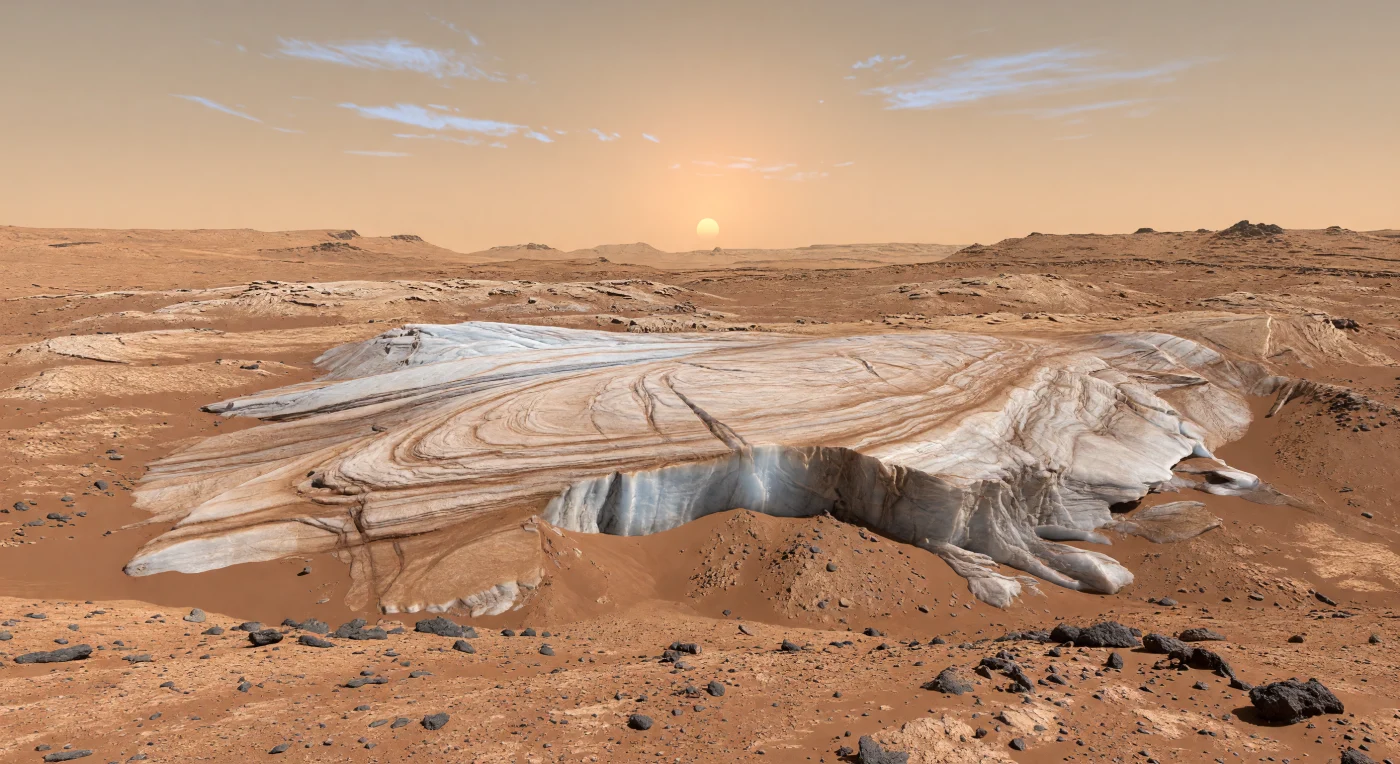
At the foot of a worn escarpment, a broad tongue of debris-covered ice spills onto the rust-colored plain, its surface etched with sweeping crescent ridges, stony stripes, and polygonal cracks that record the slow creep and wasting of a once more vigorous glacier. A fresh scarp slices into the lobe, exposing pale bluish-white water ice beneath only a thin mantle of ochre dust and rock—a vivid reminder that in this intensely cold, arid climate, ice can survive for long periods when shielded from direct sublimation by debris. Angular basaltic stones, brecciated cobbles, and wind-sorted gravel litter the foreground, while shallow pits, hummocky moraines, and fading lobate aprons stretch toward distant crater rims and isolated mesas, their scale exaggerated by low gravity and the immense openness of the terrain. Under a butterscotch sky and a small low Sun, the thin atmosphere casts long, razor-sharp shadows across the frozen flow, making the landscape feel both geologically active and eerily still, as if you are standing beside the exposed edge of a buried ice age.

A dazzling plain of water ice stretches to every horizon, its surface broken by immense spiral troughs and crisp stepped scarps that expose stacks of bright ice interleaved with thin tan and rusty dust bands—layer upon layer recording shifts in wind, frost deposition, and climate over long spans of Martian history. In the foreground, polygonal frost-hardened ground, scattered dark basaltic pebbles, and patches of red-orange dust sit motionless in air so thin and cold that the landscape feels almost vacuum-sharp, while the trough floors fall away into blue-shadowed hollows and ledges of exposed ice. Under a small low Sun, the white plateau gleams with a hard, oblique light, and the broad arcs of the troughs repeat into the distance with a scale that feels planetary rather than terrestrial. Above, a butterscotch horizon fades into a darker sky where a few delicate water-ice clouds hang nearly still, completing a scene shaped not by flowing water, but by frozen deposits, dust, and persistent polar winds.

At ground level, the northern lowlands stretch away as a nearly featureless basaltic sediment plain, its dark volcanic stones, ventifacted cobbles, and low sand ripples half-buried beneath rusty iron-oxide dust and soft ochre drifts. A planet-wide dust storm has turned noon into a dim butterscotch twilight: the thin carbon-dioxide air is so choked with fine suspended particles that the Sun survives only as a weak, pale disk, shadows are barely present, and rocks fade into haze within a few hundred meters. Subtle details—shallow deflation hollows, degraded micro-crater rims, and the ghost of a distant escarpment—hint at a broad, low-relief basin almost erased by airborne dust. Standing here would feel like being engulfed inside the atmosphere itself, in a cold, dry world where iron-rich fines lifted by global winds can swallow an entire landscape whole.

A slender tan dust devil twists across the flat volcanic plain like a living column of air, lifting fine iron-rich dust from a surface where red-orange coatings lie thinly over dark basaltic rock and black-brown sand. In its wake, a sinuous darker track marks where the vortex has stripped away the bright dust veneer, exposing the underlying basalt and revealing how active winds continually rearrange this cold, arid landscape. Around you, scattered angular stones, ventifact-shaped rocks, shallow hollows, and softened craters sit beneath a muted butterscotch sky, where a small pale Sun shines through the thin carbon-dioxide atmosphere and suspended haze. The scene feels immense and austere: a world of weak air and low gravity, where even a narrow whirlwind can write a visible path across kilometers of ancient volcanic ground.

Across the broad basaltic plain, angular black volcanic rocks and vesicular fragments lie half-draped in rust-red dust, while low ripple fields and wind-shaped bedforms stretch toward hazy mesas and softened crater rims on the far horizon. Above this cold, desiccated regolith, the thin carbon-dioxide atmosphere turns the twilight sky from salmon near the ground to violet-brown and almost black overhead, with suspended fine dust muting the distance but leaving nearby textures razor sharp. Near the horizon, the Sun appears distinctly small and haloed in an eerie blue glow created by forward scattering through airborne dust, just as the lumpy, irregular silhouette of rapidly orbiting Phobos bites into its disk for a fleeting eclipse; higher up, Deimos hangs as a faint, star-like point. In the weak, filtered light, elongated shadows spill across the plain and the world feels immense, silent, and momentarily stranger still, as if dusk itself has been briefly interrupted by a passing stone.

You are standing on a vast springtime polar plain where bright white to faintly pink carbon-dioxide ice stretches for kilometers, its smooth slabs fractured into subtle polygons and punctuated by dense fields of dark, spider-like araneiform channels radiating from central vents beneath your feet. Across this frozen surface, sharply defined fans of black to dark brown sand and dust spread downwind like ink flung over snow, created when sunlight penetrates the translucent CO2 ice, sublimates it from below, and forces pressurized gas to burst upward through cracks, carrying basaltic sediment in seasonal jets. In the cold, hard light of a noticeably small Sun, every trough, pit, and scalloped hollow casts razor-edged shadows, while faint bluish translucence glows through thicker ice and rusty dust gathers in low wind-worked ripples. Above it all hangs a pale salmon sky deepening toward butterscotch overhead, so clear and thin that the repeating fan fields and fracture networks seem to recede forever into the low horizon, making the landscape feel both exquisitely detailed and immense beyond intuition.
