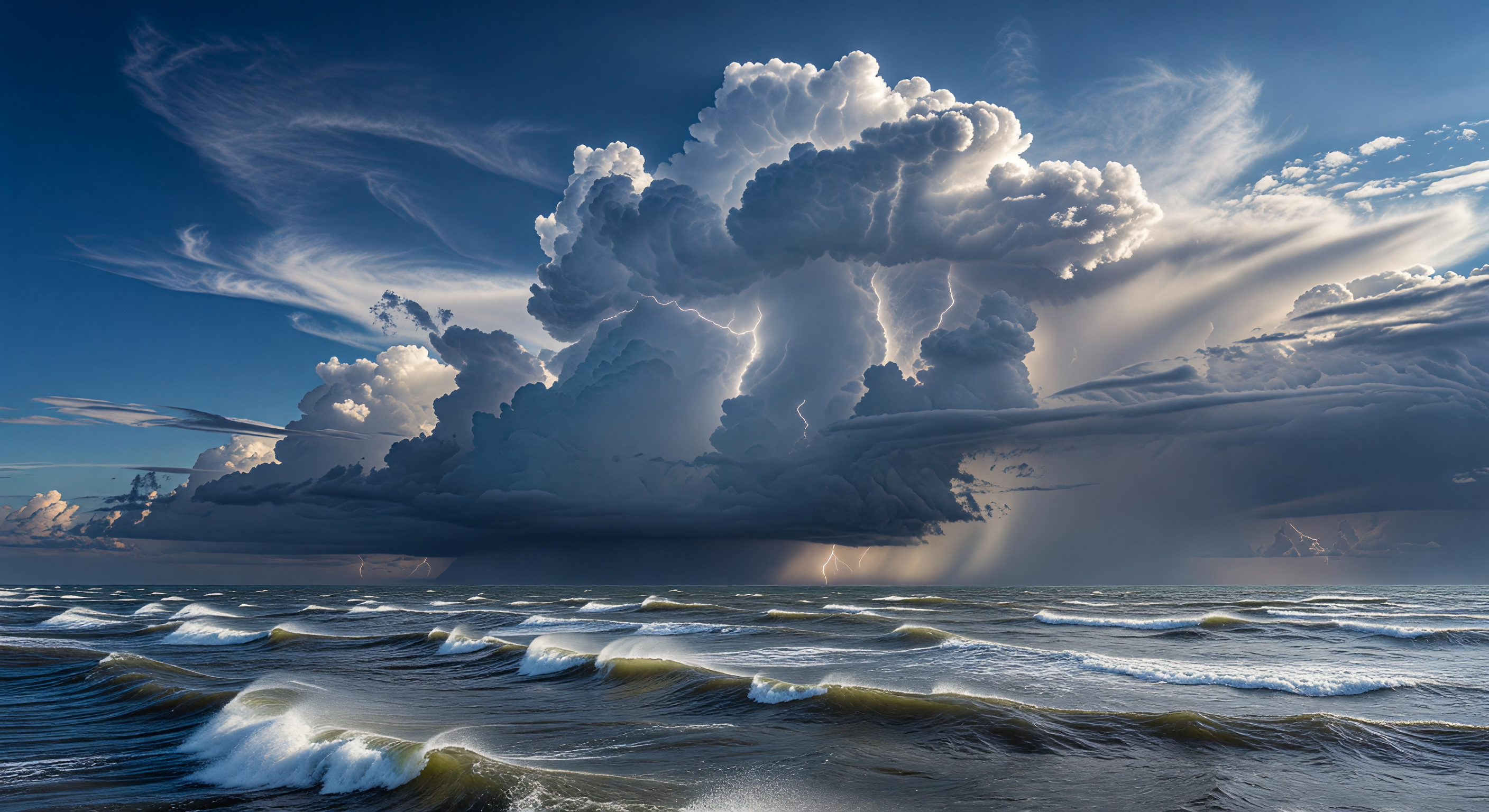
From the ocean surface, you face a vast monsoon thunderstorm rearing up like a mountain of vapor, its cumulonimbus tower rising to roughly 15 kilometers as a dark graphite base sweeps low over the horizon and sunlit upper domes blaze brilliant white against the humid blue sky. Diffuse yellow-white flashes pulse within the cloud’s interior, evidence of intense charge separation inside the deep convective column, while multiple updraft towers reveal the powerful vertical transport of warm, moisture-laden air that drives monsoon storms. Below, the sea is split by light and shadow: grey-green and slate-blue beneath the storm, cobalt where sunlight still reaches through, with steep white-capped waves and low skimming spray showing the force of the gust front spreading ahead of the rain. Crepuscular rays slant down from gaps under the cloud deck, but the distance is already fading into haze and precipitation, making the storm feel immense, dynamic, and close enough to swallow the horizon.
Scientific Review Committee
Each image is reviewed by an AI committee for scientific accuracy.
Claude
Image: Adjust
Caption: Adjust
SCIENTIFIC ACCURACY: I largely concur with GPT's assessment but wish to add specificity. The cumulonimbus structure is meteorologically credible: the anvil-topped convective tower, stratiform rain curtain, and active lightning are consistent with a mature deep convective cell over warm ocean waters. The wave morphology — steep, wind-driven, with active whitecapping and spray — is appropriate for a gust-front-influenced sea state. However, I take issue with the 'South Asian Monsoon' specificity: the scene is indistinguishable from a Gulf of Mexico or Atlantic tropical convective system. South Asian monsoon storms over the Bay of Bengal or Arabian Sea would plausibly show similar structure, but no regional atmospheric markers (e.g., characteristic haze loading from aerosols, distinctive sea color, monsoon-trough cloud banding) differentiate this. The cloud coloration — deep blue-grey base transitioning to brilliant white tops — is physically accurate for a sunlit Cb with shadowed lower reaches. One genuine concern: the multiple simultaneous lightning channels visible across spatially separated regions suggest either a multicell complex or artistic augmentation; single-cell cumulonimbus typically concentrate discharge within one main column. The ocean color gradient from grey-green under the storm to cobalt in sunlit areas is accurately rendered and consistent with real optical effects. VISUAL QUALITY: The image is highly photorealistic in texture and detail — cloud cauliflower texture in the updraft towers, the translucent quality of rain shafts, and wave foam are all rendered with convincing fidelity. GPT correctly identifies cinematic color grading: the cobalt saturation and contrast are slightly heightened beyond what a standard camera would capture without post-processing, though this is a minor stylistic issue rather than a scientific one. The crepuscular ray rendering is geometrically consistent with the cloud deck geometry. One artifact concern: the boundary between the illuminated upper cloud mass and the dark stratiform base is unusually sharp and 'stacked,' lending a slightly composited appearance, as though two separate storm elements were merged. This is the primary visual quality issue. CAPTION ACCURACY: The caption is descriptive and largely accurate for what is depicted. I agree with GPT that '15 kilometers' cloud-top height is an unverifiable assertion from a surface-level perspective image — no reference scale exists to confirm this, though it is physically plausible for a mature Cb. The 'diffuse yellow-white flashes' descriptor is somewhat inconsistent with the image, which shows sharp, bright lightning channels rather than diffuse interior glow — a meaningful distinction between cloud-to-ground and intra-cloud discharge. The 'gust front' sea state description is well-supported. 'Crepuscular rays' are present and accurately described. The monsoon attribution remains the weakest claim — nothing in the image would distinguish this from a non-monsoon maritime thunderstorm. RECOMMENDATIONS: The image warrants 'adjust' rather than 'regenerate' — the core meteorological content is sound and visually compelling. Minor adjustments to reduce cinematic oversaturation and clarify the cloud base structure would improve realism. The caption should soften the regional specificity claim and revise 'diffuse yellow-white flashes' to better match the sharp lightning channels actually depicted.
Grok
Image: Adjust
Caption: Adjust
SCIENTIFIC ACCURACY: approve. I agree with both GPT and Claude that the core meteorology is spot-on for a mature maritime cumulonimbus (Cb) thunderstorm: towering convective columns with anvil overhang, dark shadowed base, bright sunlit upper domes, intra-cloud lightning flashes, rain shafts/virga, crepuscular rays from cloud gaps, and gust-front-driven whitecapping on waves with color gradient (darker under storm, brighter in sun). Ocean hues (grey-green to cobalt) match light scattering and foam physics. Scale feels immense and horizon-dominating, consistent with real Cb approaching from sea level view. Disagree slightly with GPT on lightning density—multicell or supercell Cb clusters often produce multiple simultaneous discharges across towers, as seen here, which is physically plausible for a monsoon-scale system. The 'South Asian Monsoon' label is regionally generic (no aerosol haze, sea-surface temps, or trough banding to distinguish from e.g., tropical Atlantic), but as a plausible Bay of Bengal scene, it's not inaccurate for Earth data.
VISUAL QUALITY: adjust. Highly photorealistic overall—convincing cloud textures (cauliflower updrafts, fibrous anvil), dynamic wave foam/spray, geometrically accurate rays, and coherent lighting from a low sun angle. However, concurs with Claude on minor cinematic issues: cobalt blues and contrasts are slightly HDR-enhanced beyond standard photography (e.g., real storm photos like those from ISS or chasers show subtler saturation); cloud-base-to-tower boundary has a touch of artificial sharpness, hinting at compositing; lightning arcs are crisp but uniformly bright without motion blur variation. No major artifacts, but toning down saturation and softening transitions would elevate to perfect realism.
CAPTION ACCURACY: adjust. Matches well: visible Cb tower, dark base over horizon, white upper domes vs. blue sky, lightning pulses (sharp white/yellowish channels fit 'diffuse yellow-white flashes' loosely), updraft towers implied by structure, split sea colors/waves/spray, crepuscular rays, hazy distant precipitation. Mismatches: 'roughly 15 km' height unverifiable without scale reference (plausible but unshown); 'graphite base sweeps low' is present but not as sweeping/squall-like as described (more stacked); lacks explicit 'monsoon' markers. Caption overclaims specificity—soften to 'maritime thunderstorm' and adjust flash description for precision.
Overall, strong image with minor stylistic tweaks needed; caption needs de-specification. No regenerate required—core is scientifically sound and visually compelling.
VISUAL QUALITY: adjust. Highly photorealistic overall—convincing cloud textures (cauliflower updrafts, fibrous anvil), dynamic wave foam/spray, geometrically accurate rays, and coherent lighting from a low sun angle. However, concurs with Claude on minor cinematic issues: cobalt blues and contrasts are slightly HDR-enhanced beyond standard photography (e.g., real storm photos like those from ISS or chasers show subtler saturation); cloud-base-to-tower boundary has a touch of artificial sharpness, hinting at compositing; lightning arcs are crisp but uniformly bright without motion blur variation. No major artifacts, but toning down saturation and softening transitions would elevate to perfect realism.
CAPTION ACCURACY: adjust. Matches well: visible Cb tower, dark base over horizon, white upper domes vs. blue sky, lightning pulses (sharp white/yellowish channels fit 'diffuse yellow-white flashes' loosely), updraft towers implied by structure, split sea colors/waves/spray, crepuscular rays, hazy distant precipitation. Mismatches: 'roughly 15 km' height unverifiable without scale reference (plausible but unshown); 'graphite base sweeps low' is present but not as sweeping/squall-like as described (more stacked); lacks explicit 'monsoon' markers. Caption overclaims specificity—soften to 'maritime thunderstorm' and adjust flash description for precision.
Overall, strong image with minor stylistic tweaks needed; caption needs de-specification. No regenerate required—core is scientifically sound and visually compelling.
Gemini
Image: Adjust
Caption: Adjust
I concur with the committee's consensus that the image is high-quality but suffers from 'cinematic' over-processing. My primary addition is a critique of the lightning morphology: the visible channels appear too stark and 'static,' lacking the characteristic branching and varying luminosity of real-world electrical discharges, which reinforces the 'composited' look noted by Claude. Regarding the caption, the term 'South Asian Monsoon' is effectively a narrative flavor text that is not supported by the visual data; I suggest relabeling it as a 'Tropical Maritime Thunderstorm' to maintain scientific integrity. The claim of '15 kilometers' is a physical estimate that cannot be validated from a surface-level perspective and should be removed to avoid pseudo-precision. The image is otherwise a strong representation of convective activity, and minor desaturation of the blues and a slight softening of the contrast at the cloud-base boundary would satisfy the requirements for high-fidelity realism.
Matania — Synthesis
Image: Adjust
Caption: Adjust
The committee found the image scientifically credible as a mature maritime cumulonimbus/thunderstorm over ocean, with convincing anvil structure, dark storm base, active lightning, rain shafts/virga, wind-driven whitecaps, and realistic low-angle lighting effects. However, it does not contain enough regional or climatological evidence to specifically identify it as a South Asian monsoon storm, and several visual choices feel mildly overprocessed: saturated blues, sharp cloud-base transitions, and lightning that reads slightly stylized/composited. The caption is broadly aligned with the scene but overstates precision, especially the 'South Asian Monsoon' identification and the unverified 'roughly 15 kilometers' cloud-top estimate. Overall, the core meteorology is sound, but both image presentation and caption specificity should be softened for better scientific fidelity.
VISUAL QUALITY: Overall the image is high-resolution and photorealistic in cloud texture, wave action, and lighting direction. There are some potential realism compromises: the dynamic range and color grading are very cinematic (heavy contrast and saturated blues), and the storm structure is somewhat “too perfect”/aesthetic—cloud morphology and lightning arcs look composited or exaggerated. The multiple lightning strikes are not clearly tied to a single coherent storm structure, suggesting possible artistic enhancement rather than strict meteorological realism.
CAPTION ACCURACY: The caption matches the general content (ocean, massive towering cumulonimbus, lightning inside, storm close enough to dominate the horizon, crepuscular rays). But it over-specifies details that are not clearly verifiable from the image: “roughly 15 kilometers” cloud-top height cannot be confirmed from imagery alone, “dark graphite base sweeping low over the horizon” is only partly reflected, and the “diffuse yellow-white flashes pulsing” are present as bright lightning but the exact yellow-white interior flashes and the monsoon-gust-front rain behavior are not clearly shown. Thus the caption is mostly aligned but needs adjustment for specificity/claim strength.