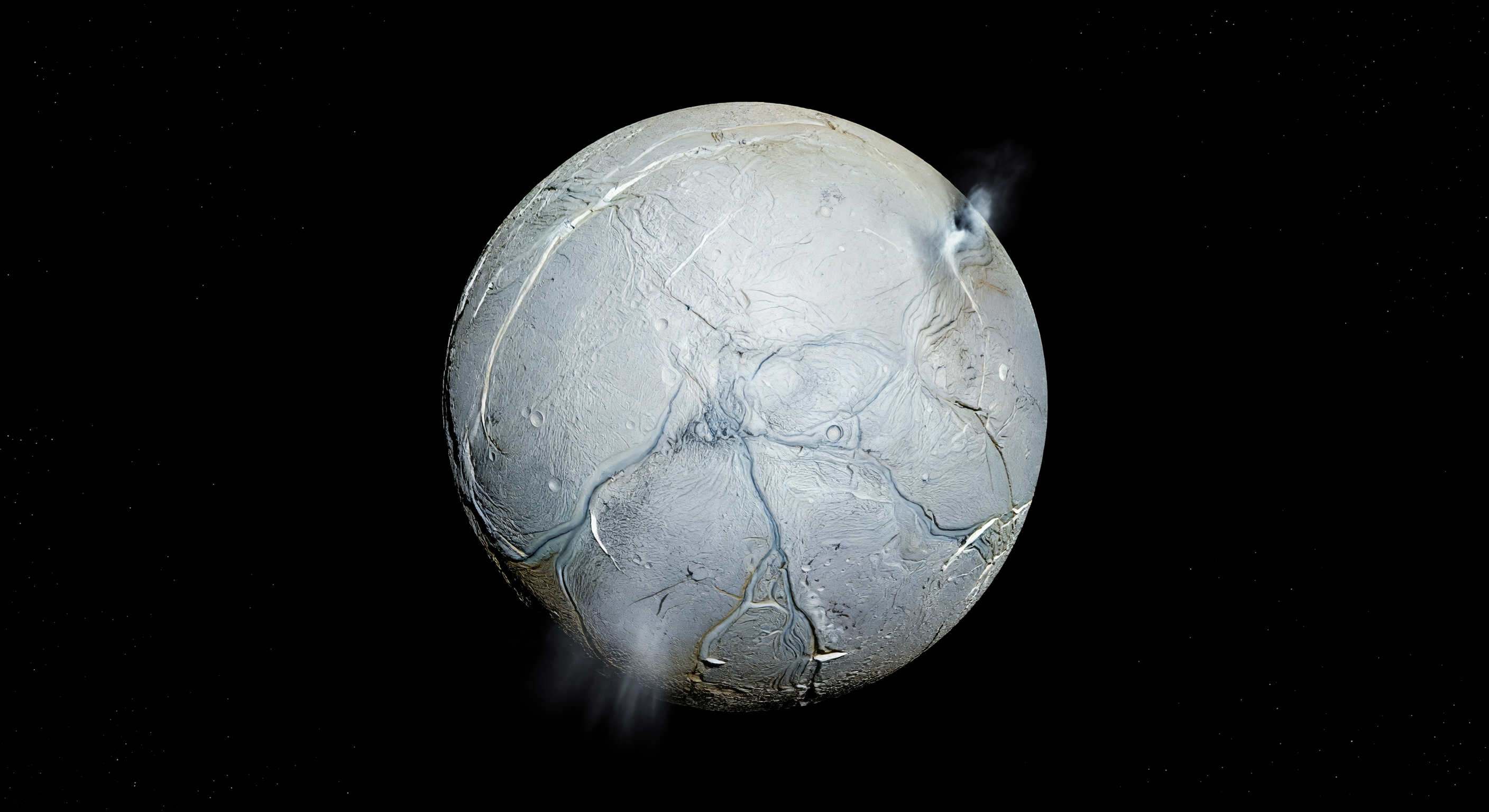
Scientific confidence: High
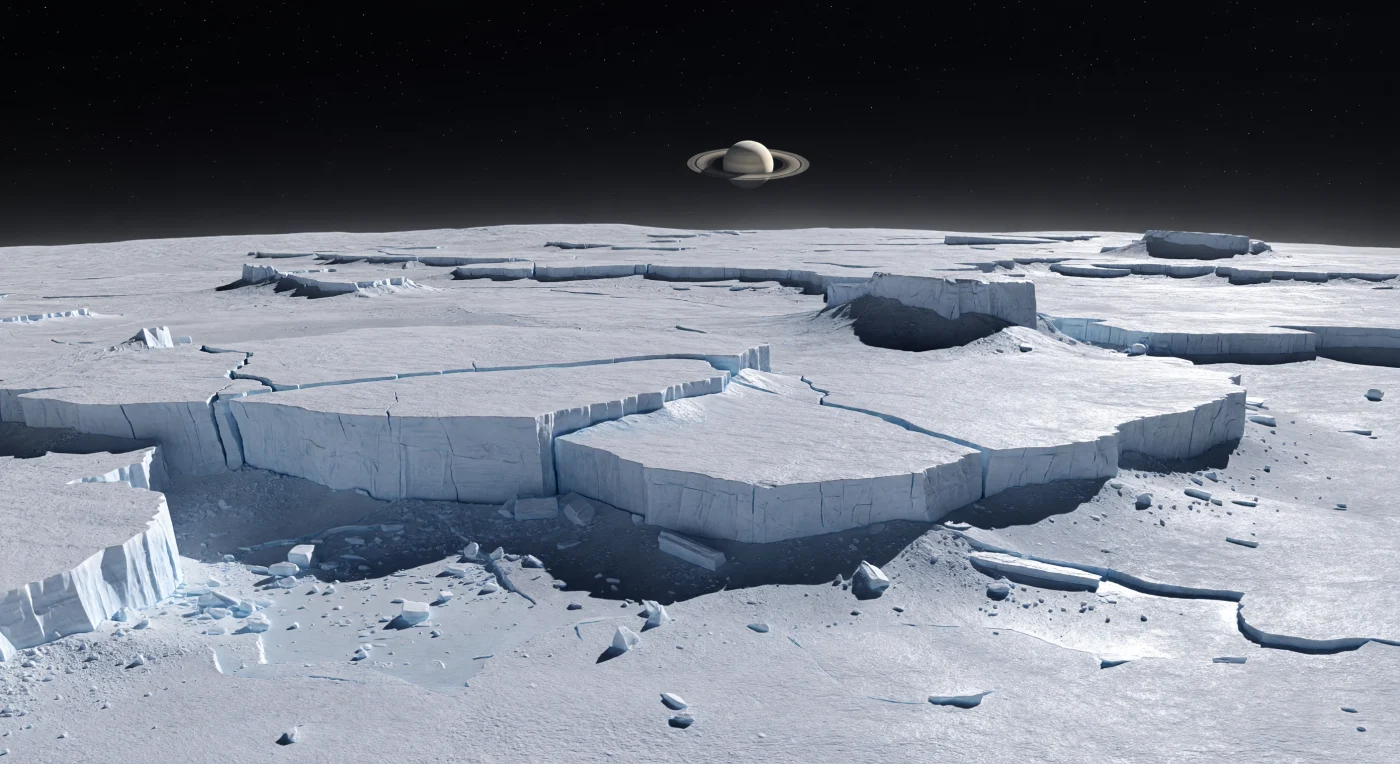
Across a hard plain of compacted frost and water-ice regolith, stepped fault blocks rise in abrupt terraces, their sunlit tops blazing almost pure white while steep cliff faces glow with faint cyan-blue tones and cast long, knife-edged black shadows across the lowland. The scarps are built of clean, fractured water ice, their razor-sharp edges preserved by airless vacuum, weak gravity, and the geologic youth of this tectonically disrupted crust, with only sparse talus and glittering dust gathered at their bases. The horizon curves surprisingly close on this tiny world, making the stacked escarpments and isolated pinnacles feel oversized, as if the landscape has been pulled upward and frozen mid-rupture. Above it all hangs a black sky with no atmospheric haze to soften the view—only a small, distant Sun, visible stars, and, in some places, a vast pale Saturn and its tilted rings suspended beyond the brilliant frozen silence.
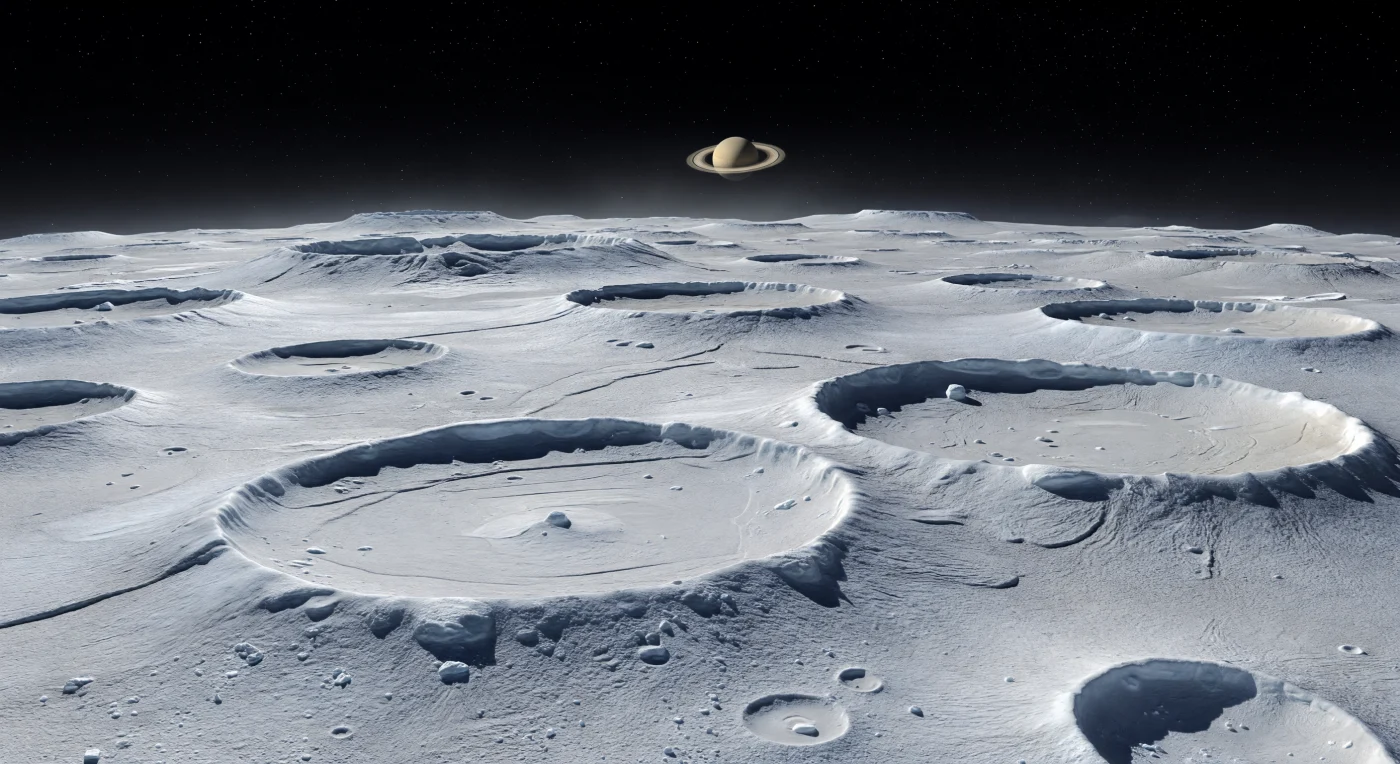
From a low icy ridge, you look out across an ancient quilt of overlapping impact craters, their once-sharp edges softened by the slow viscous flow of frigid water-ice into rounded, brilliant-white rims and pale gray-blue floors. Between them lie gently rolling frozen plains, narrow tectonic grooves, scattered secondary pits, and occasional scarps that remain improbably steep in the moon’s feeble gravity, while frost crystals and granular ice rubble glitter in the foreground with hard, glassy highlights. The horizon curves away startlingly close under a pure black sky, a reminder of this world’s tiny size and near-total lack of atmosphere, as the distant Sun—small and fierce—casts razor-edged navy shadows into crater interiors and reveals every fracture, slump terrace, and hummock of ancient ejecta with vacuum-sharp clarity. Nothing moves, nothing melts: only bedrock ice, irradiated frost, and bright regolith stretch outward in cold silence, making the landscape feel both pristine and geologically alive.
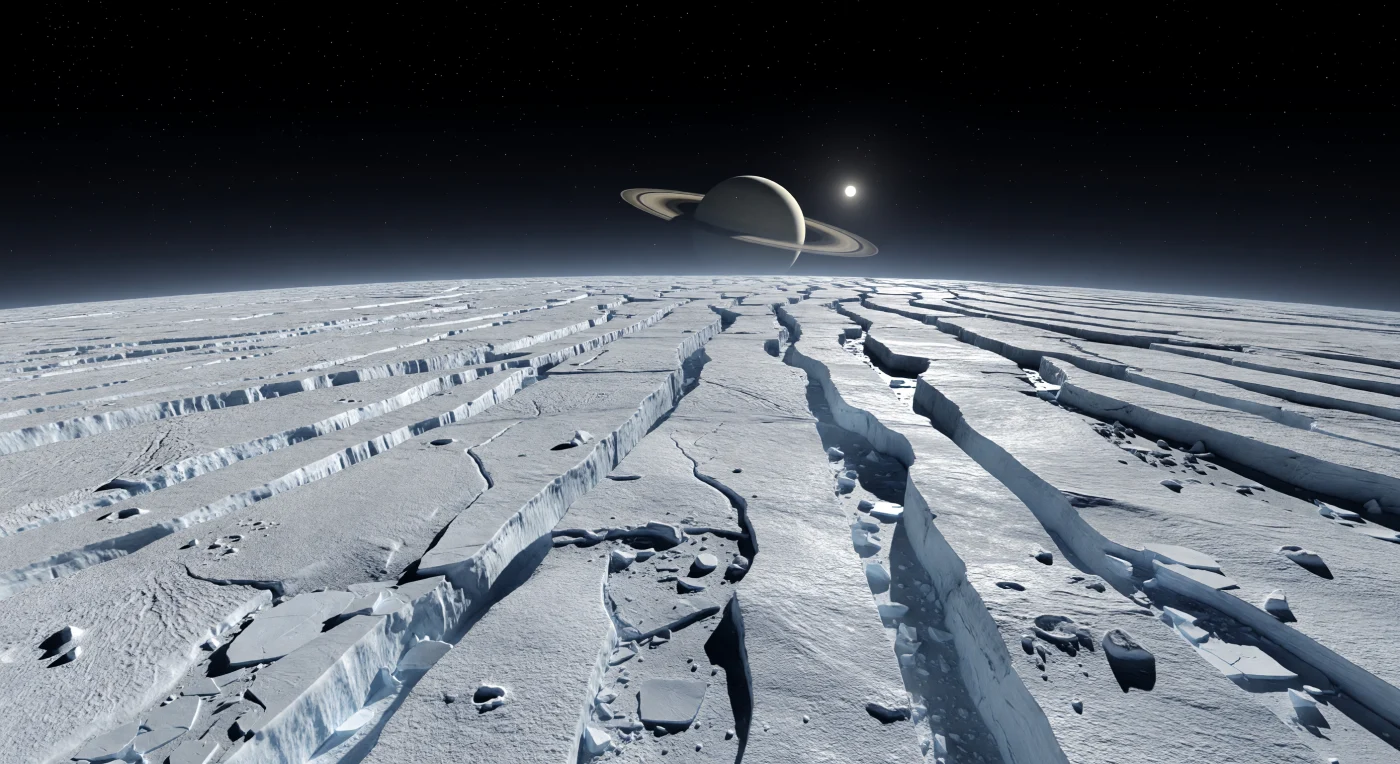
The ground is a frozen tectonic battlefield: long, parallel ridges and steep-sided troughs of shattered water ice run to the sharply curved horizon like the ribs of a tiny world, their chalk-white crests blazing in the Sun while pale cyan fracture walls sink into ink-black shadow. Between them lie brittle slabs, coarse frost, and fields of angular ice blocks, all preserved with extraordinary crispness because there is no air, no weather, and almost no gravity to soften the relief or blur the view. These grooved belts record a youthful, stressed ice shell pulled apart and faulted by tidal forces, exposing cleaner crystalline ice along scarps and grabens while occasional impact debris sits starkly atop the bright regolith. Above the silent landscape, the sky is pure black, the sunlight cold and hard, and a giant banded world may hang overhead with its rings as a thin luminous line, making the scene feel both intimate in scale and vast beyond comprehension.
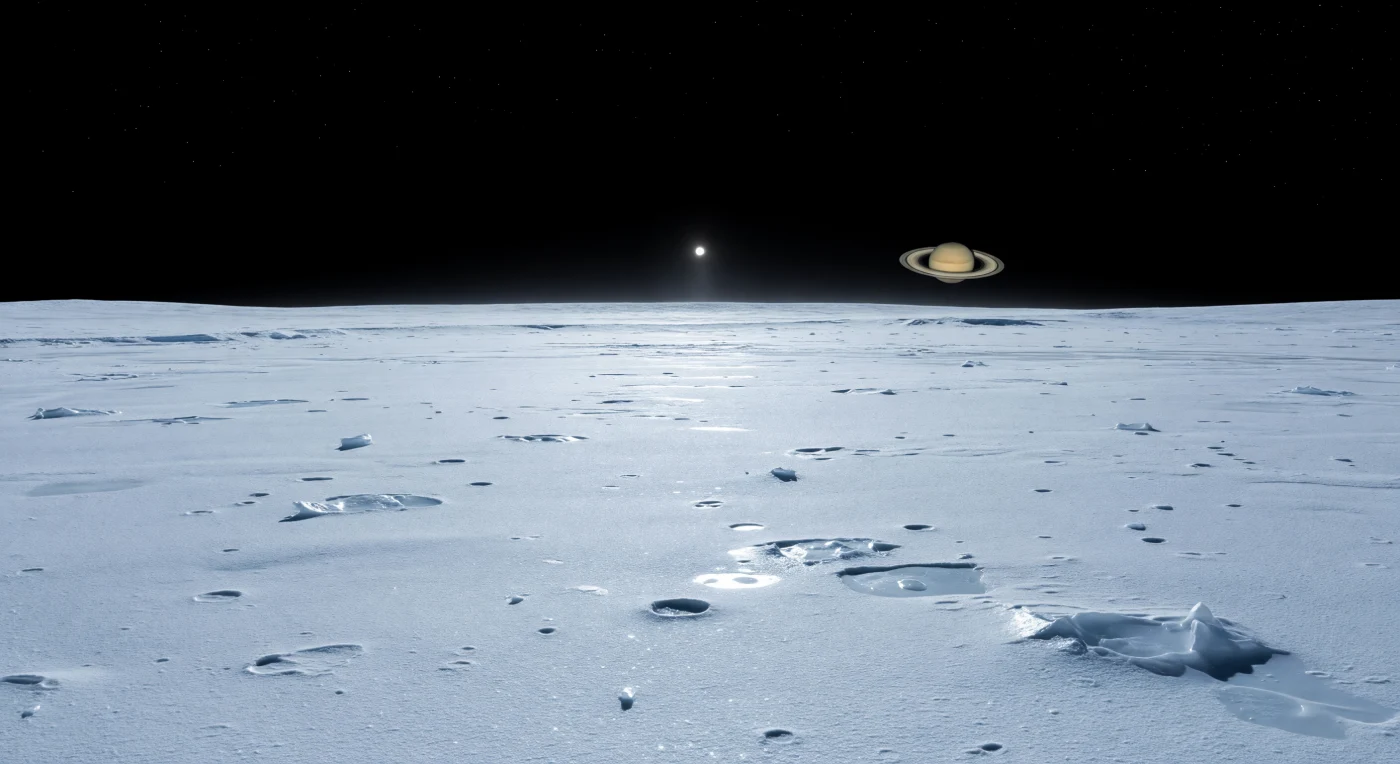
A blinding expanse of blue-white frost stretches away in every direction, so bright it seems to glow against the absolute black of the airless sky, while the horizon curves up alarmingly close, revealing the tiny scale of this frozen world. Under the small, distant Sun, subtle hummocks, crisp-rimmed microcraters, and faint fracture-bounded rises interrupt the plain, their sharp relief preserved by vacuum, weak gravity, and the near absence of erosion. The surface is almost pure water ice—freshly resurfaced, dusted with glittering frost grains, with occasional harder translucent ice and compacted icy regolith exposed between the brightest patches—its extreme reflectivity sending cold bluish highlights across the ground and deep black shadows into every hollow. In the far distance, a barely perceptible veil of suspended ice grains may hang above the plain, a delicate sign of active cryovolcanism, making the stillness feel not dead but quietly, geologically alive.
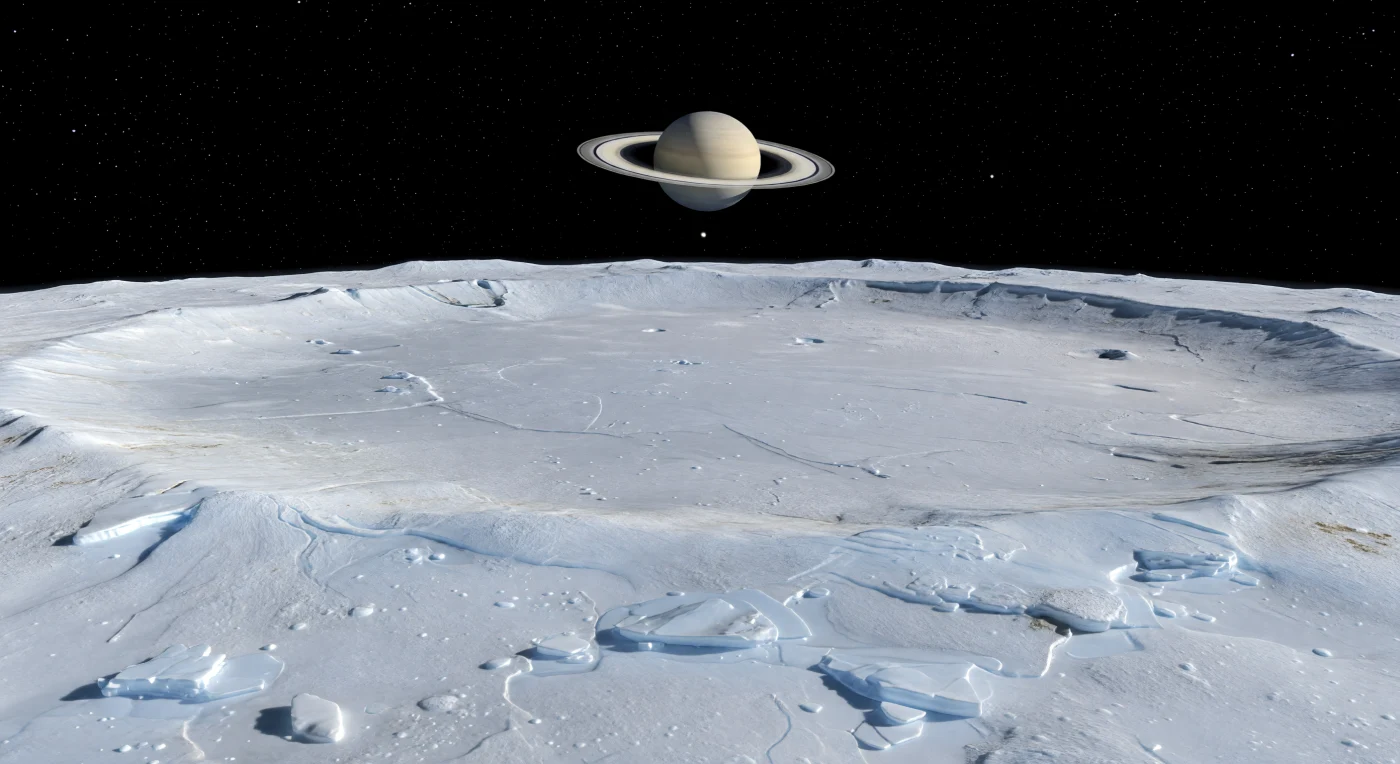
You stand within an ancient impact basin several kilometers wide, where the crater’s once-steep walls have relaxed into pale, ghostly arcs by the slow viscous flow of water ice, leaving a broad floor of dazzling bluish-white frost and clean ice that gleams under a small, distant Sun. Narrow fractures, shallow troughs, wrinkle-like lineations, and scattered broken slabs cut across the otherwise smooth surface, while occasional darker bluish-gray patches hint at contaminant-rich ice or rocky debris mixed into the moon’s extraordinarily reflective crust. In this near-vacuum, the sky is perfectly black and sharp with stars, and the low sunlight draws out every subtle rise and sag in the basin, revealing how impact scars here can gradually soften as the icy shell deforms over geologic time under internal tidal heating. The close curved horizon and the enormous stillness make the landscape feel both compact and immense, a frozen world where even old craters slowly flow.
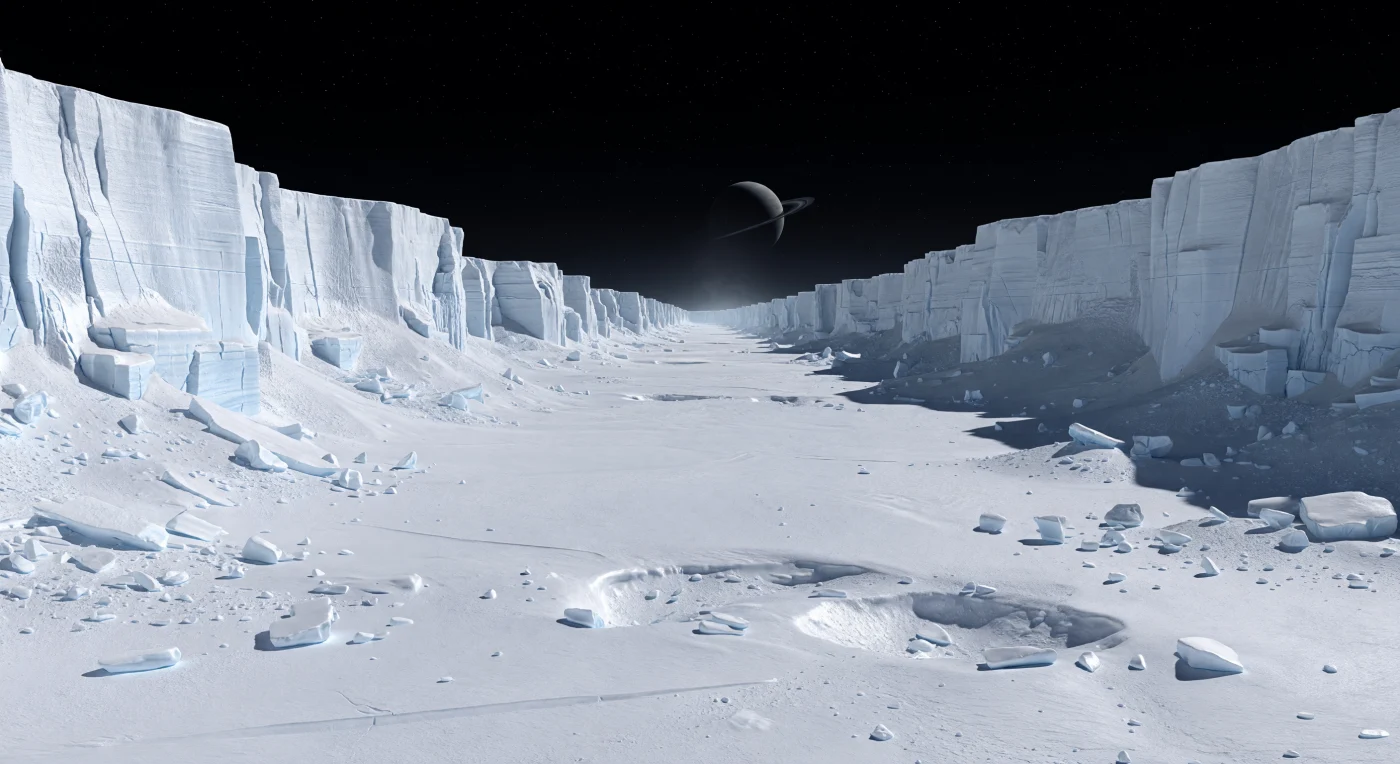
A vast white corridor of compacted frost and water-ice regolith stretches away beneath a pure black sky, its horizon curving startlingly close on this tiny world as sheer walls of brilliant fractured ice tower to either side. Low, cold sunlight rakes across the trough, carving every scarp, ledge, crevasse, and debris apron into razor-sharp relief, while the vacuum and feeble gravity preserve the cliffs in crisp, angular forms that on Earth would quickly soften or collapse. The pale rubble at the base of the walls—broken slabs, icy boulders, and snow-like grains—records repeated tectonic faulting in a young, active ice shell shaped by tidal stresses and internal heat. Overhead, Saturn hangs immense and softly banded with its thin rings tipped across the darkness, making the frozen silence feel at once intimate and cosmic.
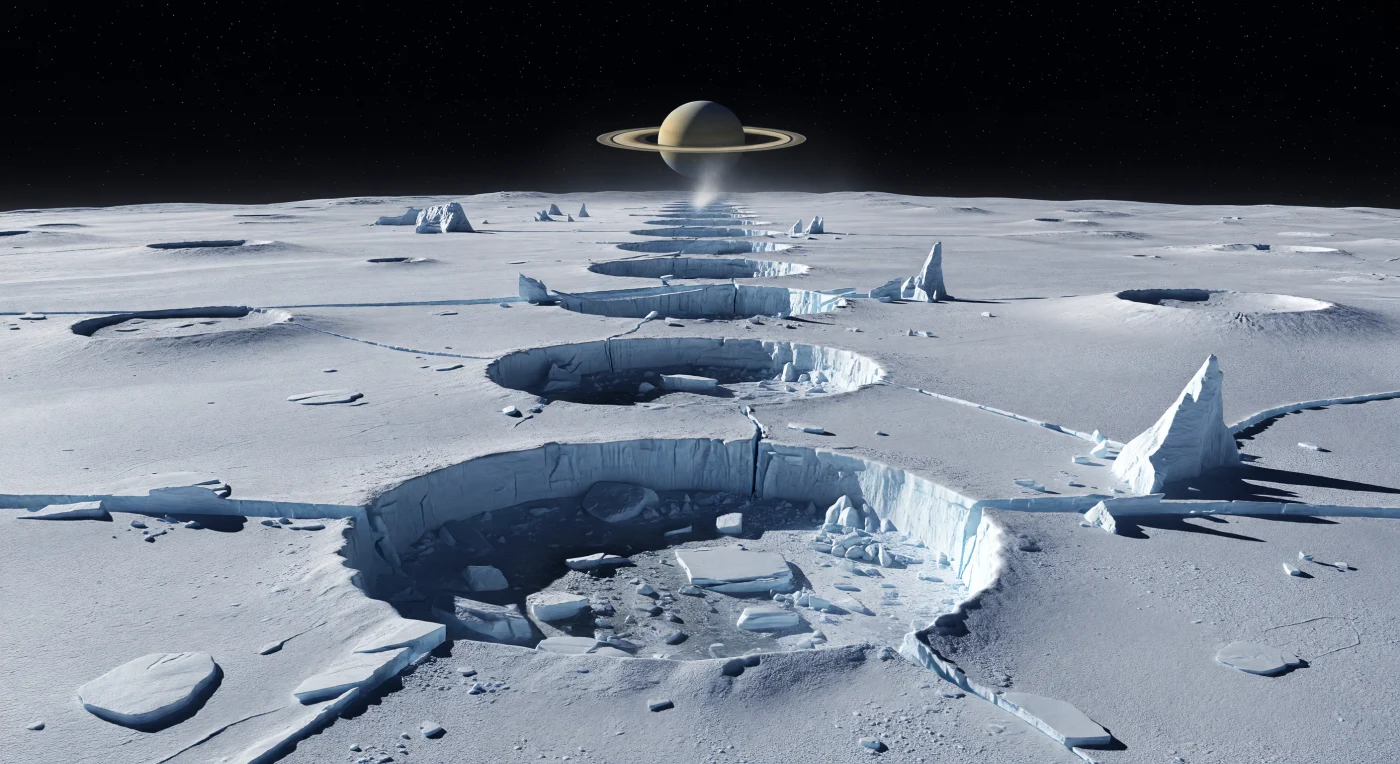
A chain of circular and elliptical collapse pits slices across the fractured ice plain, each hollow rimmed with brilliant fresh frost and plunging into blue-black shadow where shattered slabs, angular ice blocks, and brecciated rubble lie piled against steep frozen walls. Between the pits, narrow broken ridges and fragile-looking icy bridges span the gaps, while sharp buttresses, low fault scarps, and jumbled cryotectonic plates stand starkly preserved by the moon’s feeble gravity and airless stillness. The ground is almost pure water ice, gleaming in pale cyan and bluish-white tones under a small distant Sun, with hard-edged shadows and mirror-like glints that emphasize the brittle texture of a surface pulled apart by tidal stresses and collapse above hidden voids or weakened subsurface zones. Over the low, sharply curved horizon, a delicate white plume rises from active fractures and an enormous banded Saturn hangs in the black sky, making the scene feel both silent and dynamic—a frozen crust still very much alive.
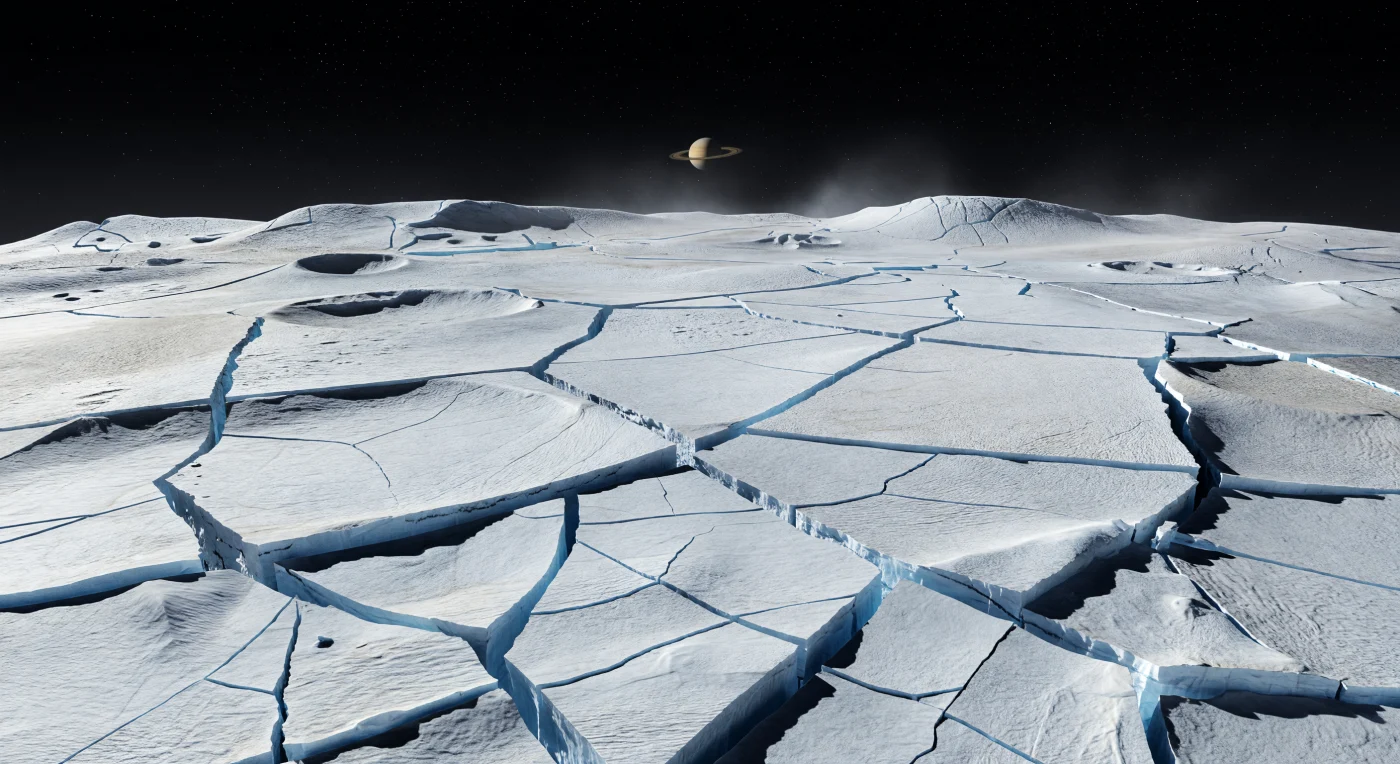
At this tectonic crossroads, the ground looks like shattered porcelain: bright polygonal plates of water ice split by intersecting fractures, their freshly broken edges glowing faint blue while narrow chasms fall into ink-black shadow. Offset ridges, fault scarps, and zigzag troughs crisscross the plain in a dense geometric pattern, revealing a young, continually reworked icy crust shaped by tidal stresses that flex and crack the surface rather than by impacts or flowing liquid. Under the tiny, distant Sun, the hard light is merciless—casting razor-sharp shadows, igniting mirrorlike flashes on smooth ice faces, and emphasizing how the near-vacuum leaves the sky black and star-filled even in daylight. Beyond the fractured foreground, scarps and hummocks rise above a strongly curved horizon, making the landscape feel both miniature and immense, a frozen shell of solid water ice and sparse plume-fall dust stretched over hidden internal activity.
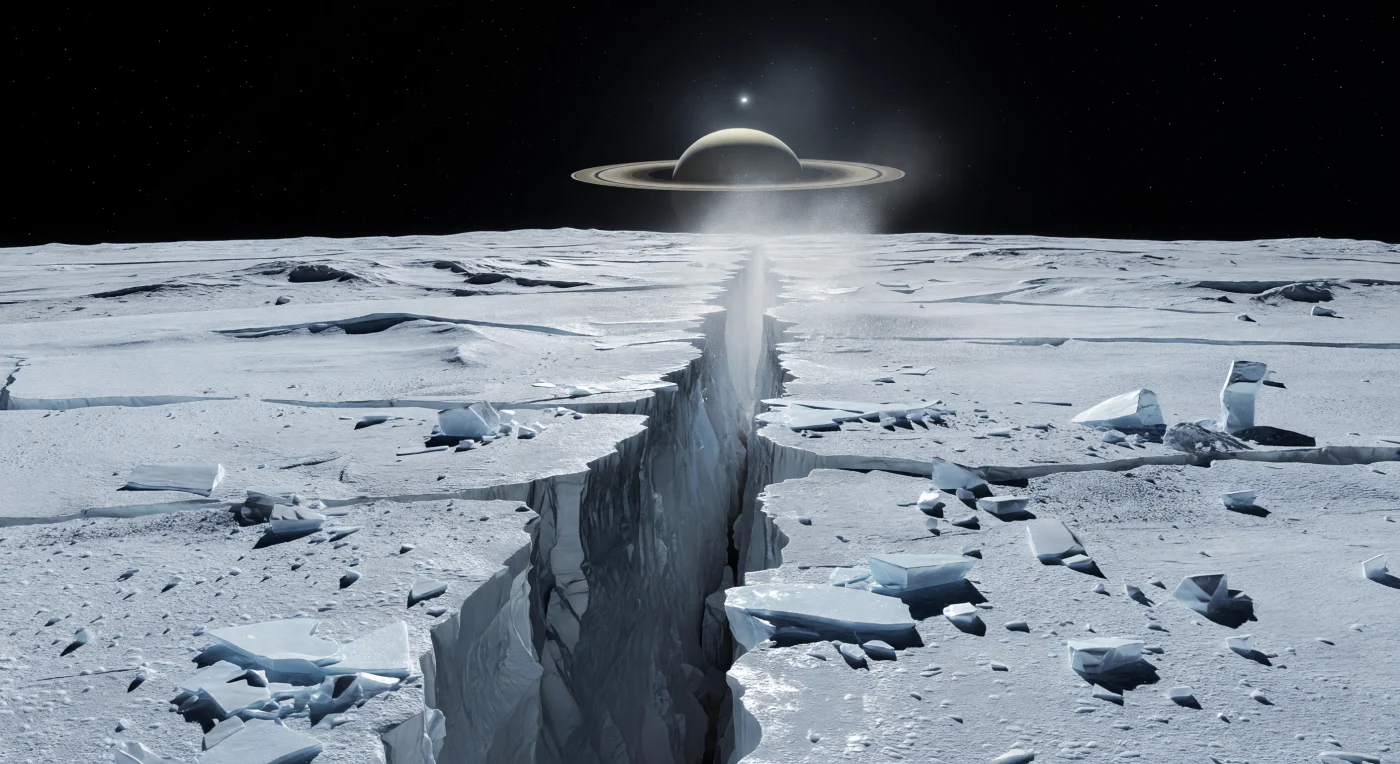
You stand on a razor-edged rim of shattered water ice, where sintered crust and brittle frost plates break away into a narrow, abyssal trench whose gray-blue walls gleam with cleaner, newly condensed ice. These south polar fractures are active tectonic and cryovolcanic vents, opened and flexed by tidal stresses, and their fresh frost, scalloped ledges, and collapsed overhangs record continual resurfacing as water vapor and ice grains escape from the hidden ocean below. In the hard, airless light, every pinnacle throws an ink-black shadow, while the extraordinarily reflective ground flashes white and pale cyan; a sparse veil of vent particles drifts overhead, scattering sunlight into a ghostly silver glow around the fracture. Beyond the broken plain, other tiger-stripe lineaments fade toward a sharply curved horizon, making the landscape feel at once intimate in its crystal-sharp textures and immense in the depth of the chasm and the small world’s stark, frozen scale.
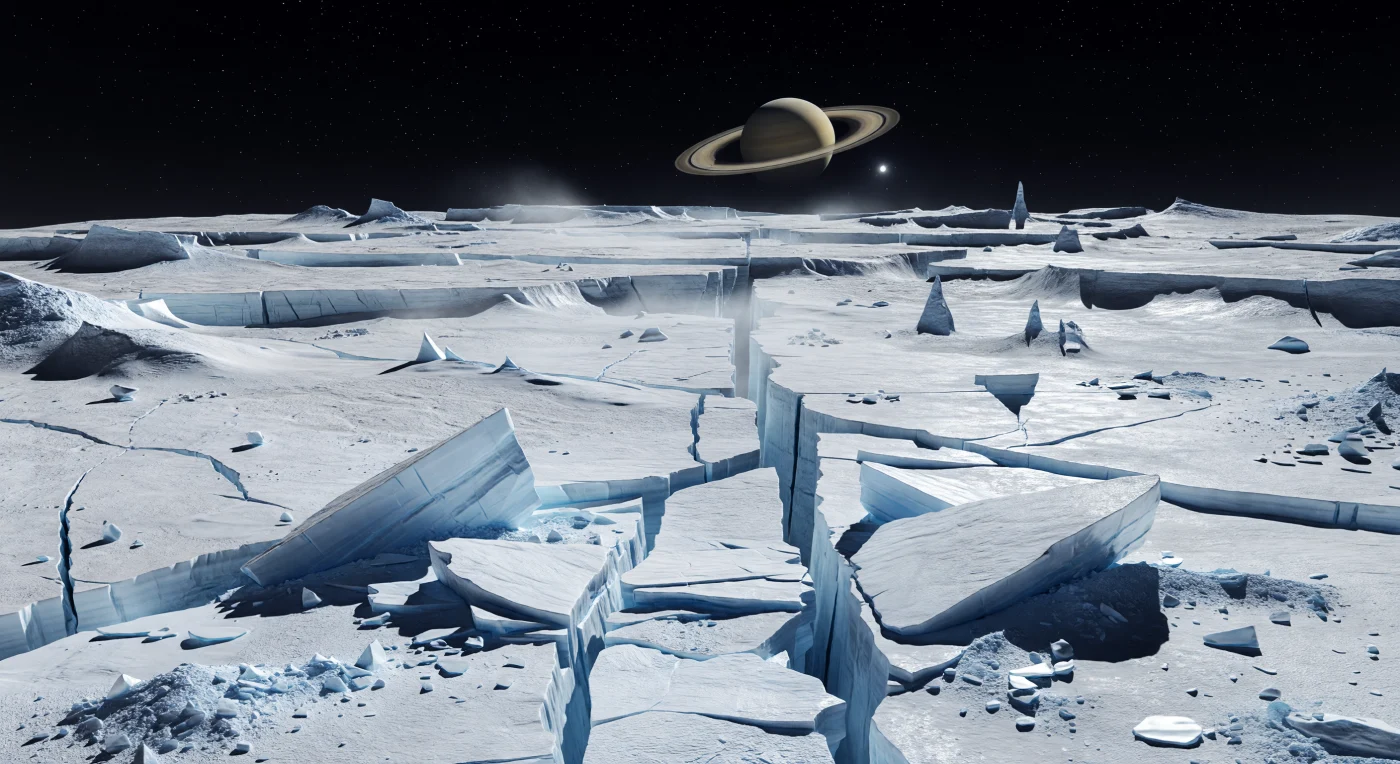
A frozen wilderness of shattered brilliance stretches in every direction: towering slabs of water ice lean at precarious angles, knife-thin crevasses split the ground, and rubble of brecciated frost glitters under hard, distant sunlight. These south polar fractures are the surface expression of intense tidal flexing, where internal heat has cracked and resurfaced the ice shell, while fallout from active plumes dusts the terrain with exceptionally fresh, bright grains from below. In the moon’s feeble gravity, pinnacles and scarps look unnaturally tall, the horizon curves close and sharply, and even far-off chasms stand out against the black sky with startling clarity. Only the faintest pearly haze of suspended ice softens the most distant breaks, giving this near-airless cryovolcanic landscape an eerie stillness, as if you are standing at the edge of an active frozen world caught between fracture and eruption.
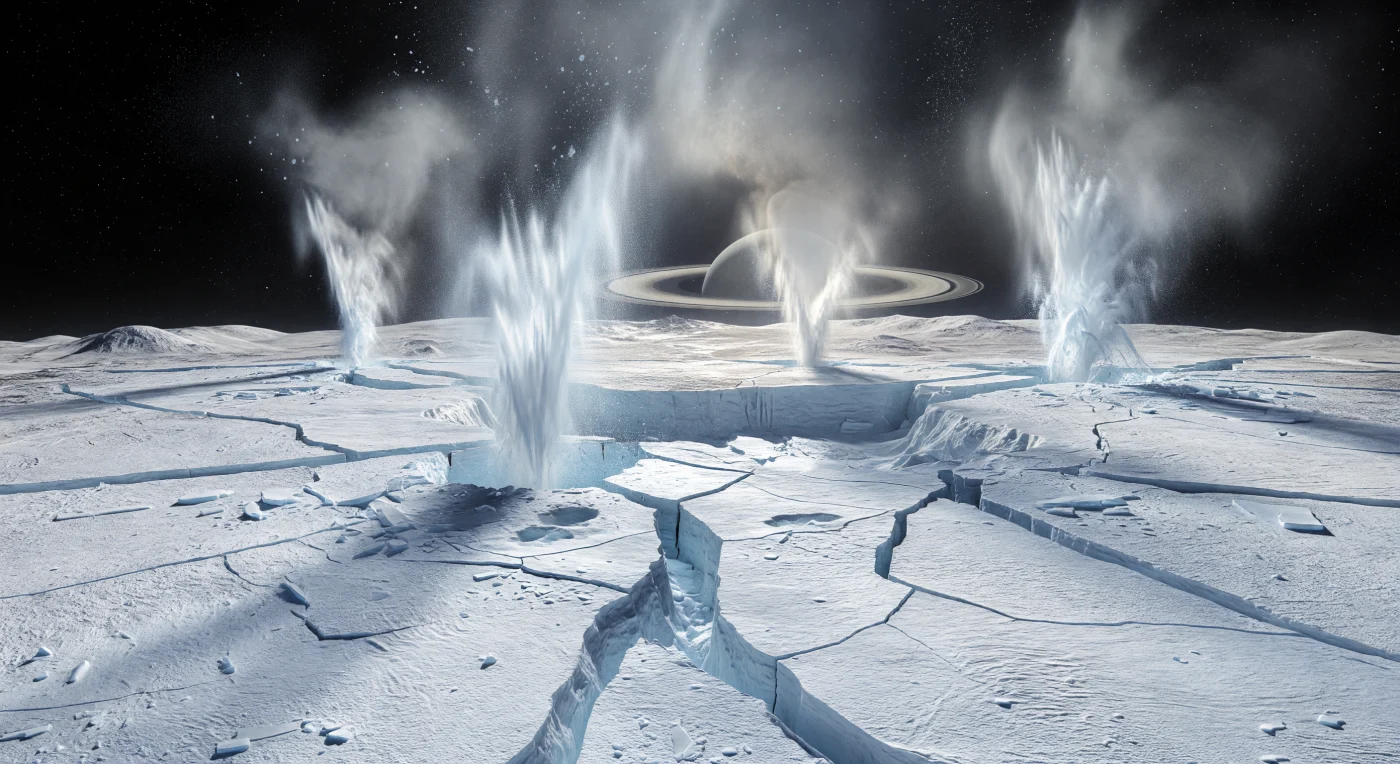
Across the south polar fractures, intensely bright blue-white ice is split into long parallel chasms, sharp scarps, collapsed pits, and ridged bands, while the foreground is littered with crusted frost, angular blocks, shattered plates, and a powdering of snowlike fallout from the plumes. From the “tiger stripe” vents, cryovolcanic jets surge upward as radiant white columns and fan-shaped curtains of water vapor and ice grains, backlit so strongly by the distant Sun that the black, airless sky near them turns pearly with forward-scattered light. In this feeble gravity, the spray rises far above cliffs tens of meters high and drifts in graceful ballistic arcs, then settles back as fresh frost—evidence of a restless ice shell flexed and heated by tides over a hidden subsurface ocean. Standing here, you would see no liquid at all, only vapor, glittering grains, and clean water ice flashing silver along every fracture edge beneath a horizon so sharply curved it makes the landscape feel both tiny and immense.
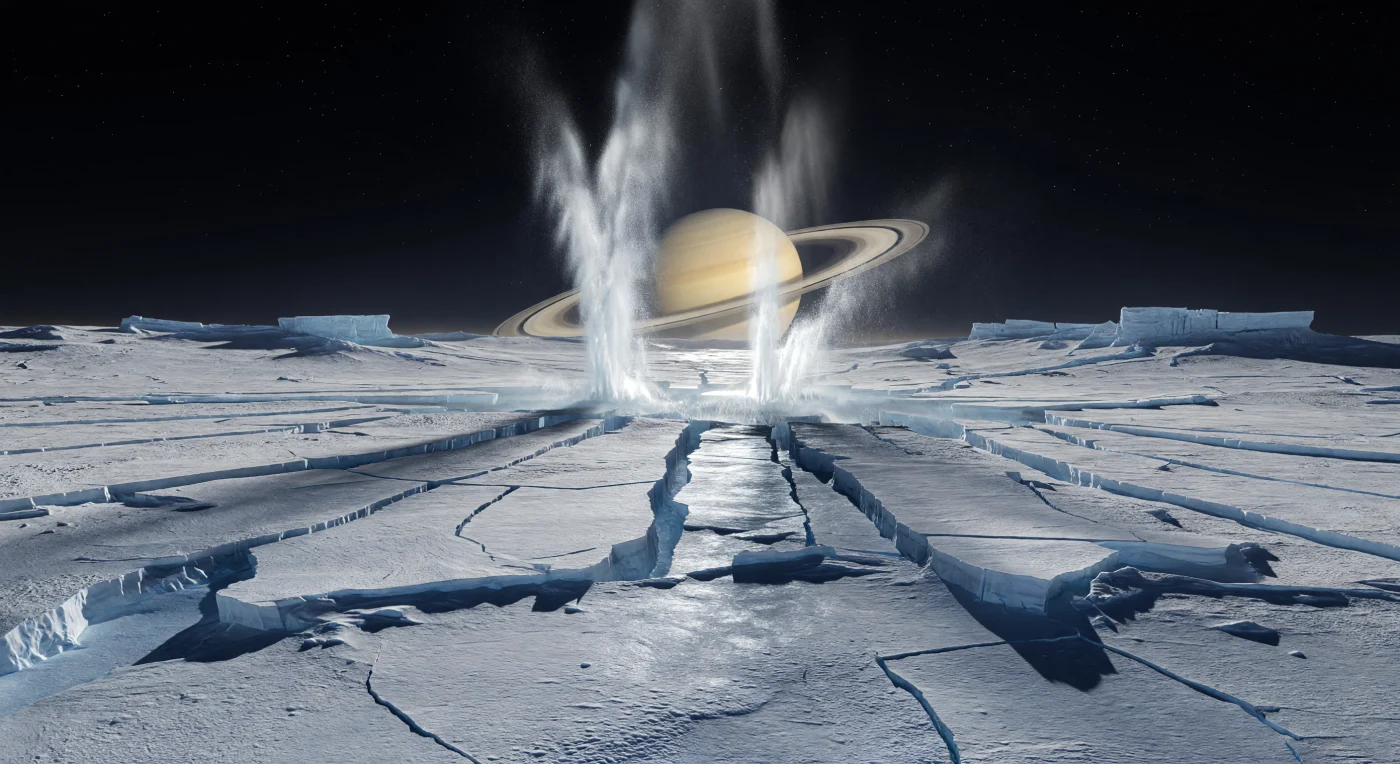
In the deep twilight of the south polar terrain, the ground is a frozen maze of brilliant water-ice slabs, brittle frost, and dark parallel fractures—the tiger stripes—whose steep walls, collapsed pits, and knife-edged ridges look starkly preserved by extraordinarily weak gravity. Above this shattered crust, active vents hurl water vapor and icy grains into space as towering plume curtains, their silver-white columns and arcing sprays blazing in backlight while the surface below remains blue-black and silent in shadow. The ice here is geologically young and remarkably clean, continually renewed by cryovolcanic fallout from a subsurface ocean driven by tidal heating, with fresh frost brightening the vent margins and a faint local haze catching the distant sunlight. The horizon curves nearby, emphasizing the tiny world beneath your feet, while a giant ringed planet hangs low and immense in the black, star-filled sky, making the whole scene feel at once intimate, frigid, and vast beyond measure.
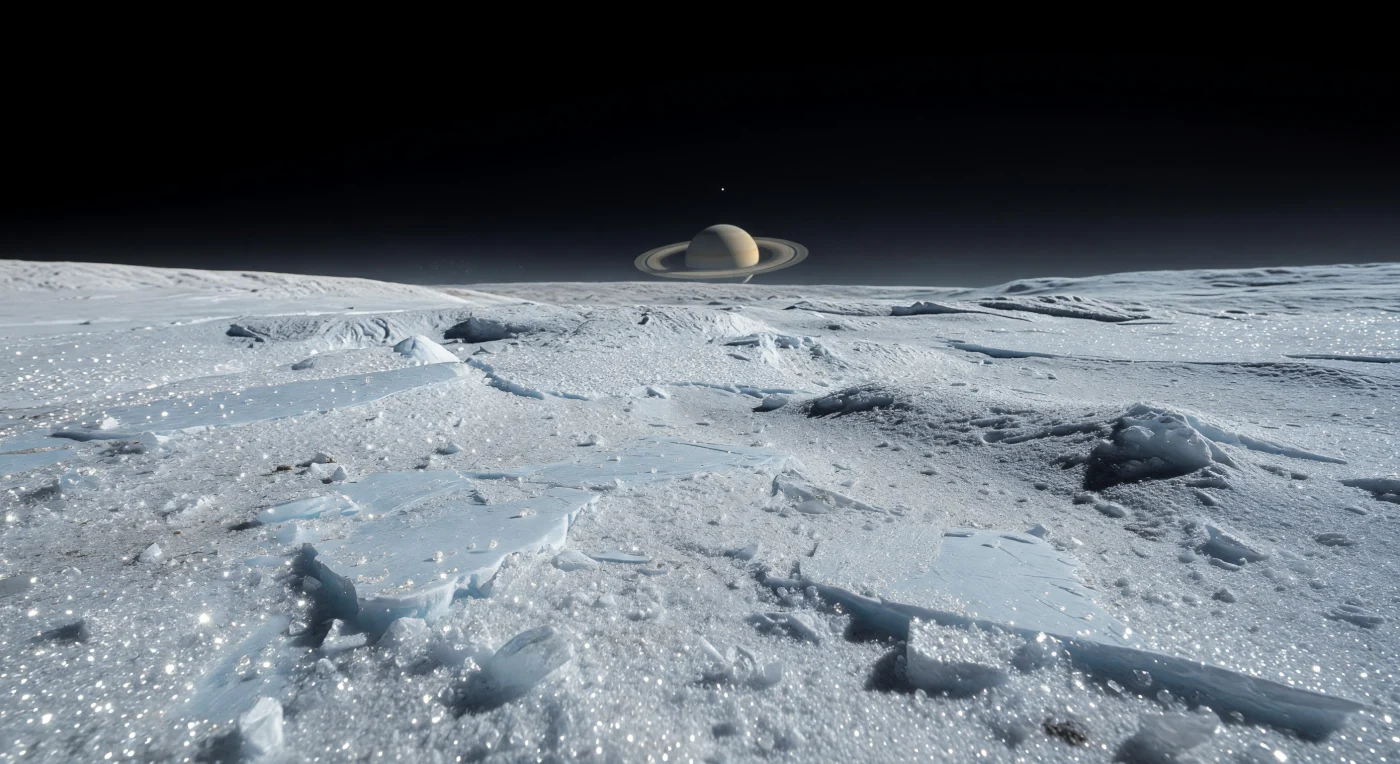
At this scale, the ground is a glittering pavement of water ice: angular frost grains, sharp translucent clasts, and thin sintered crust plates packed so tightly they resemble spilled diamond dust under a black, airless sky. Hard sunlight from far away strikes the brilliant regolith with icy-white flashes, while every tiny ridge, pit, and fracture casts razor-edged shadows that reveal a surface shaped by vacuum processing, brittle tectonic stress, and continual resurfacing by fresh frost. Occasional dark specks of rocky or radiation-altered material are trapped between the bluish-white crystals, hinting that this seemingly pristine crust is part of a dynamic outer shell above a much more active interior. The low hummocks and close, gently curving horizon make the landscape feel both miniature and immense, as if you are standing inside a frozen field of gemstones on a world where cold, darkness, and geology work on exquisitely delicate scales.
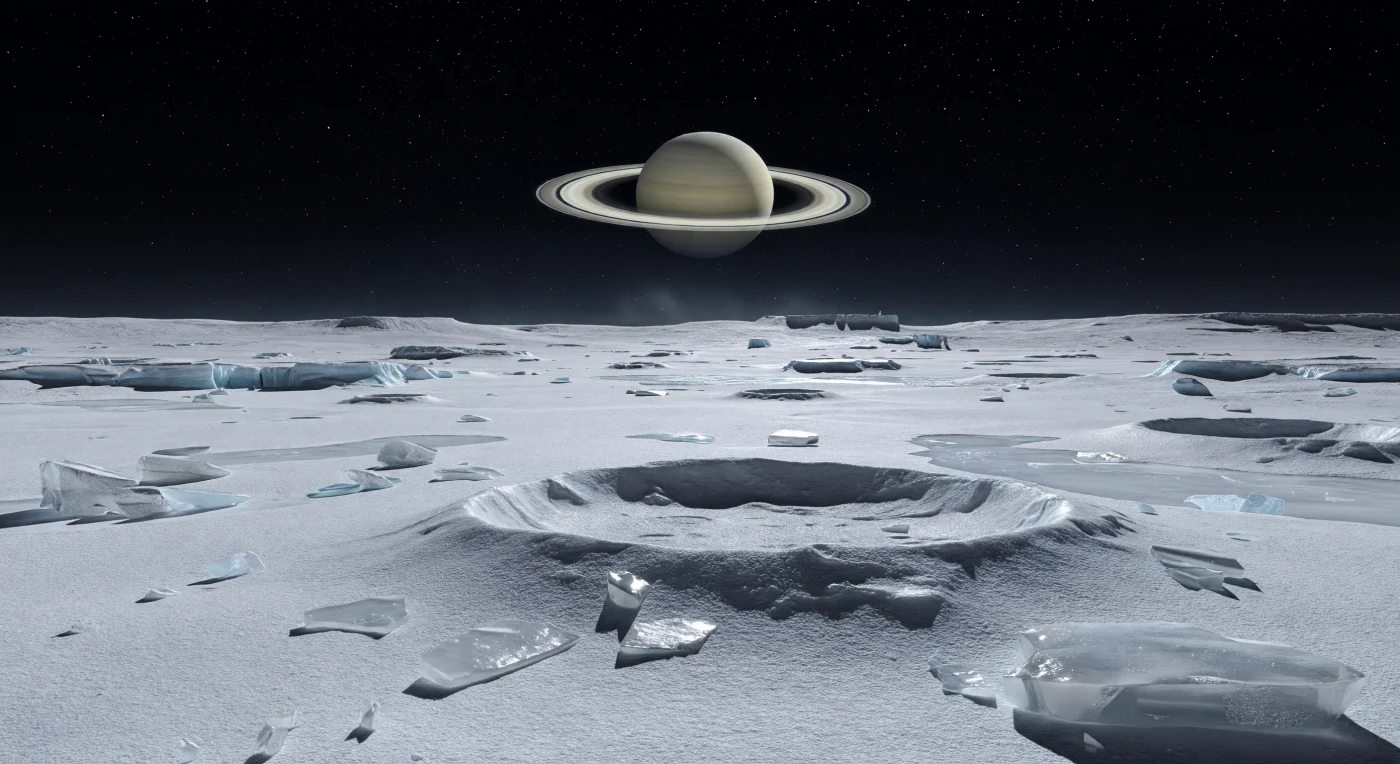
Under a perfectly black, airless sky, the frozen plain gleams in faint Saturnshine: crater rims, frost-crusted hummocks, and scattered angular blocks of water ice glow silver-blue, while polished patches and sintered snow-like deposits catch a cold, metallic sheen. A nearby impact rim preserves razor-sharp ejecta textures in the vacuum, and beyond the unusually close, curved horizon, fracture-bounded scarps and icy ridges rise starkly, their scale exaggerated by the moon’s tiny size and weak gravity. Overhead, Saturn hangs immense and nearly motionless, its pale banded disk and thin luminous rings casting the only light, producing delicate, low-contrast shadows across bluish-white bedrock and undisturbed dustings of fine ice grains. The stillness feels absolute—no wind, no liquid, no atmospheric glow—only pristine frozen geology shaped by impacts, tectonic fracturing, and continual resurfacing of extraordinarily reflective water ice.
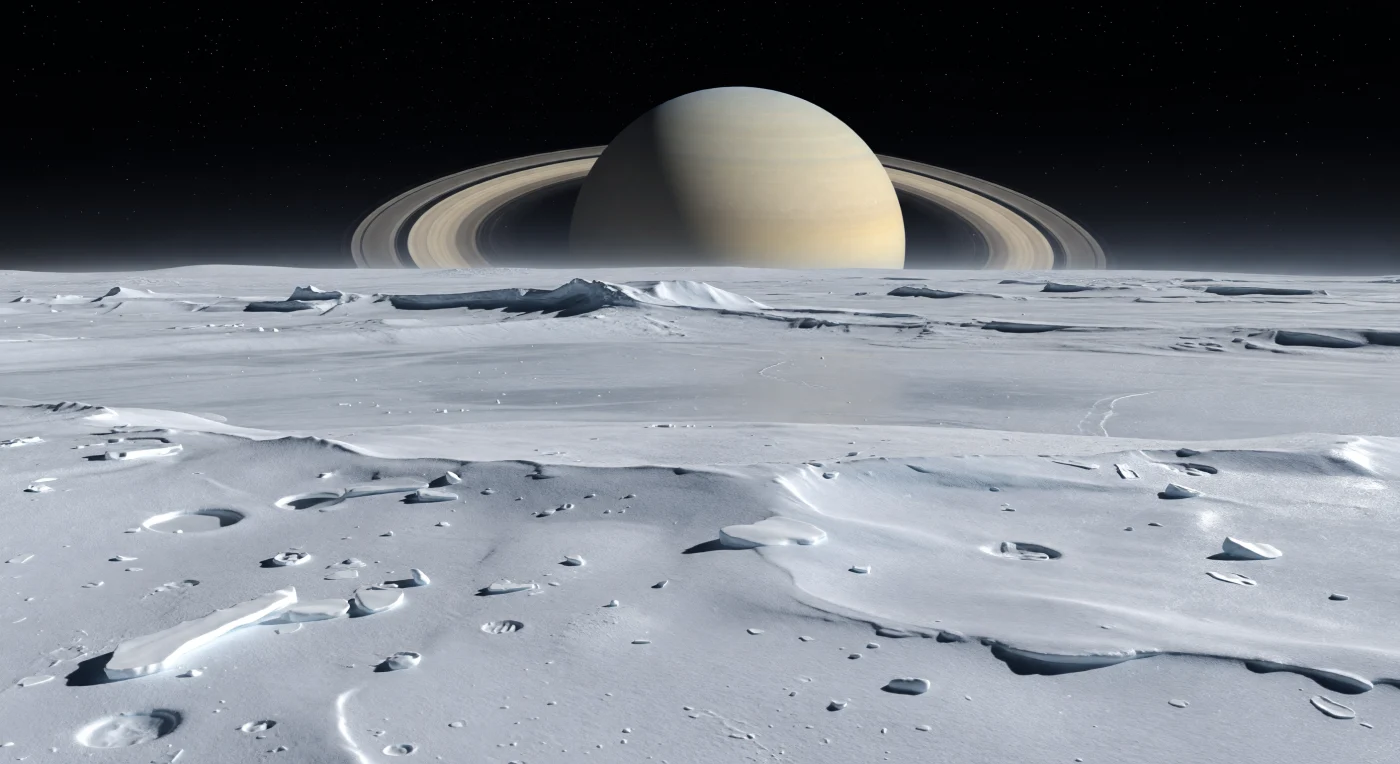
A blinding plain of clean water ice stretches away under a black, airless sky, its close, strongly curved horizon revealing the tiny scale of this moon while long blue-gray shadows rake across micro-rippled frost, brittle pressure ridges, shallow troughs, and scattered angular blocks of fractured ice. The surface is dry and frozen solid—hard icy regolith and sintered frost shaped not by wind or rain but by impacts, tectonic cracking, and slow deformation of the ice shell, with faint darker seams hinting at trace non-ice contaminants mixed into space-weathered fractures. Near the horizon, subdued scarps and ridgelines stand out sharply in the weak gravity, while above them Saturn hangs almost motionless and enormous, its pale cloud bands and razor-thin luminous rings spanning the sky on a scale no Earthly moonrise could match. In the dim, distant sunlight, the ice flashes silver and bluish white with mirror-bright highlights, making the scene feel both pristine and severe—a frozen world where tidal forces still work beneath the crust, even as the surface lies silent in vacuum.