Scientific confidence: High

At the rim of the abyss, the ground is a blinding pavement of water ice and icy regolith, shattered into angular plates, frost-rimmed boulders, and brittle fracture webs that gleam blue-white in the Sun’s hard light. Beyond your feet, fault-generated cliffs drop for kilometers into a vast tectonic trough where rotated crustal slabs, avalanche debris, and giant slump blocks record the rifting and collapse of an ancient, rigid ice shell on a world with barely more than a whisper of gravity. With no atmosphere to soften the view, every escarpment casts a knife-edged shadow into the canyon, and the clean, stratified ice walls stand out in stark whites, pale grays, and faint beige streaks left by radiation weathering and dustlike contamination. Over this silent frozen chasm hangs an immense Saturn, almost motionless in the black sky, its pale-gold disk and luminous rings emphasizing both the moon’s synchronous orbit and the overwhelming scale of the rift stretching away across the horizon.

You stand in a frozen jumble of shattered water-ice bedrock at the foot of the central uplift, where blocky ridges rise in broken tiers and fields of angular boulders sprawl across the crater floor like the wreckage of a world struck and lifted by an immense impact. In the harsh, unfiltered sunlight of an airless moon, the ancient ice blazes silver-white, while fresh fracture faces glow faint blue and every scarp, crevasse, and fault-stepped ledge throws a razor-black shadow across the regolith-dusted surface. The terrain’s steep, collapsed blocks and precarious hummocks survive because gravity here is extraordinarily weak, preserving sharp relief that on a larger world would slump and soften. Above this silent landscape, the sky is perfectly black, and the vast basin beyond the ridges hints at a collision so colossal it nearly reshaped the entire icy crust.

At dawn on the softened rim of an immense impact basin, you look out across a shallow, continent-scale depression so vast that the moon’s curvature lifts the far horizon, turning the landscape into a gleaming arc of pale ice beneath a black, airless sky. The ground at your feet is a jumble of brilliant white to gray-white water-ice regolith and brecciated impact debris—fractured blocks, low scarps, frost-bright rubble, and fine granular dust—while the basin floor beyond is smoothed into broad undulations, faint concentric ridges, and subdued craterlets by the slow viscous relaxation of an ancient icy shell in weak gravity. Far off, a massive central uplift of ice rises from the basin interior, casting a long, razor-edged black shadow across the luminous plain under the hard, distant sunlight. Over everything hangs the stark stillness of an atmosphere-free world: no wind, no haze, only high-albedo ice, subtle streaks of darker contamination, a tiny Sun low on the horizon, and Saturn suspended enormous above the scene with its rings tilted in silent grandeur.
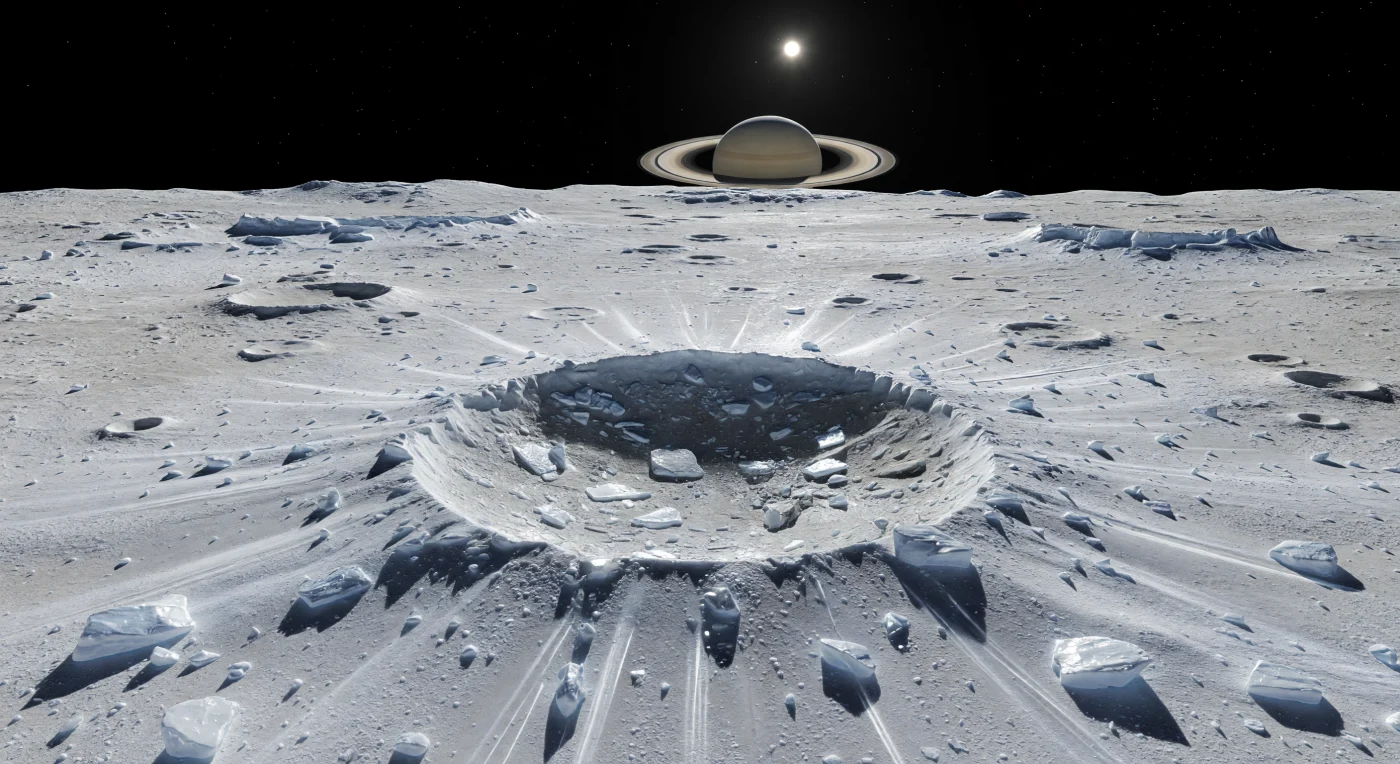
A small, razor-sharp impact crater interrupts the ancient icy plain, its raised rim of shattered water-ice bedrock standing crisp and bright under hard midday sunlight, while a dark bowl drops away inside to steeper walls littered with broken slabs and refrozen icy rubble. Around it, a radiant ejecta blanket fans outward in thin white rays, strewn with powdery frost-like debris, coarse ice fragments, and bluish-white boulders whose fresh faces flash with glassy reflections—evidence that this is a geologically young scar excavated from an older, more weathered regolith. Beyond the crater, softened ancient impacts, low hummocky ridges, fractures, and degraded scarps reveal a long history of bombardment and cracking in a rigid, water-ice crust shaped under gravity so weak that collapse blocks and slumps settle gently rather than violently. Above the gently curving horizon the sky is utterly black, with no air to soften the light or hide the distance, so every shadow is ink-dark, every ridge edge knife-clear, and the frozen landscape feels both dazzlingly pristine and immense in the silent cold.

You stand amid a frozen tectonic province where the brilliant water-ice crust has been torn into long, parallel grabens, their step-like normal fault scarps and sunken troughs marching toward a low, gently curving horizon. In the hard, unfiltered sunlight of an airless world, fresh fracture faces gleam bluish-white while older icy surfaces look chalkier and faintly weathered, and the trough floors plunge into black shadow so deep they seem cut from the landscape entirely. Angular slabs, frost-bright boulders, and drifts of fine icy regolith litter the foreground, showing how an ancient, rigid ice shell has cracked and dropped along faults under extremely low gravity, preserving unusually sharp edges and steep scarps. Above it all hangs a perfectly black vacuum sky, and the immense open silence—sometimes framed by the distant pale arc of a ringed giant—makes the frozen terrain feel both scientifically legible and utterly otherworldly.

A dazzling plain of fine, frostlike water-ice regolith stretches almost featurelessly to a surprisingly close, curved horizon, its pale white and bluish tones broken only by gentle swells, a scatter of small impact craters, and a few softened rims worn down by eons of impact gardening. In the airless vacuum, there is no haze to soften distance, so every ripple and craterlet remains razor-sharp under hard sunlight, while the moon’s low gravity and small size make the landscape feel both intimate and immense. The surface is composed overwhelmingly of ancient water ice, with only faint gray variations and rare darker specks hinting at minor non-ice contamination mixed into the regolith. Above this frozen silence, Saturn hangs enormous in a black sky, its muted globe and luminous rings arching across space as compact black shadows and glittering ice reflections make the scene feel stark, pristine, and profoundly alien.

From this upland vantage, the landscape is a near-continuous maze of ancient craters, their pale rims overlapping and softening into one another until the ground becomes a frozen, impact-gardened wilderness of broken ice blocks, hummocky ejecta, and scalloped hollows stretching to the curved horizon. The surface is built mostly of water-ice bedrock mantled by thick icy regolith, its brilliant white, cream, and faintly gray tones reflecting the weak, distant sunlight with harsh contrast and black-edged shadows in the absolute clarity of vacuum. In this airless stillness, nothing blurs the view: far-off ridges and crater crests remain unnaturally sharp, revealing how billions of years of impacts, slumping, and slow relaxation in very low gravity have reshaped old basins without erasing them. Under the pure black sky, with the Sun reduced to a small, fierce point and perhaps Saturn hanging immense above the horizon, the scene feels both silent and immense—a luminous fossil record of collisions preserved in ice.

Under a pitch-black sky, a small distant Sun skims the polar horizon, turning the frozen ground into a stark field of silver-white brilliance and abyssal shadow, where crater rims, fault scarps, and shattered ice ridges cast black bands that stretch across multiple basins. The surface is almost entirely water ice—bright regolith, granular frost, coarse rubble, and hard sintered bedrock—its high reflectivity broken only by faint tan-gray contaminant patches, sparkling crystalline highlights, and the deep hollows of terraced craters and chasm-like fractures left by ancient impacts and brittle tectonic failure. In the weak gravity, the landscape looks unnervingly crisp and steep: angular ice boulders sit tiny in the foreground while kilometer-wide rims and broken uplands recede into darkness, preserved by a dry vacuum with no air, no haze, no weather, and no twilight to soften the view. Near the horizon, Saturn hangs immense, its pale rings arcing above the icy plain and casting a ghostly reflected glow onto some shadowed slopes, heightening the sense of standing on a silent, ancient world of frozen stone and light.

At eye level inside the crater, the view is all shattered brightness and abyssal shadow: angular ice-rich boulders and powdery regolith lie at your feet, while towering stepped terraces climb upward in sharp ledges, fractured scarps, and slump benches carved into ancient water-ice bedrock. The brilliant white to pale gray walls, lightly stained with faint dirty-ice beige, preserve crisp fracture networks and fresh break surfaces that speak to a rigid, cryogenic crust fractured by a colossal impact and then slowly modified by downslope collapse in gravity barely more than a whisper. In the airless black, sunlight arrives harsh and unfiltered, igniting the high-albedo ice into hard glare and leaving recessed ledges and crevices in perfectly black cold, with no wind, haze, or weather to soften any edge. The curving wall beyond hints that this intimate scene is only a small piece of a vastly larger basin, where terraces tens to hundreds of meters high remain improbably steep and sharp because this frozen landscape is built almost entirely from ancient, brittle water ice.
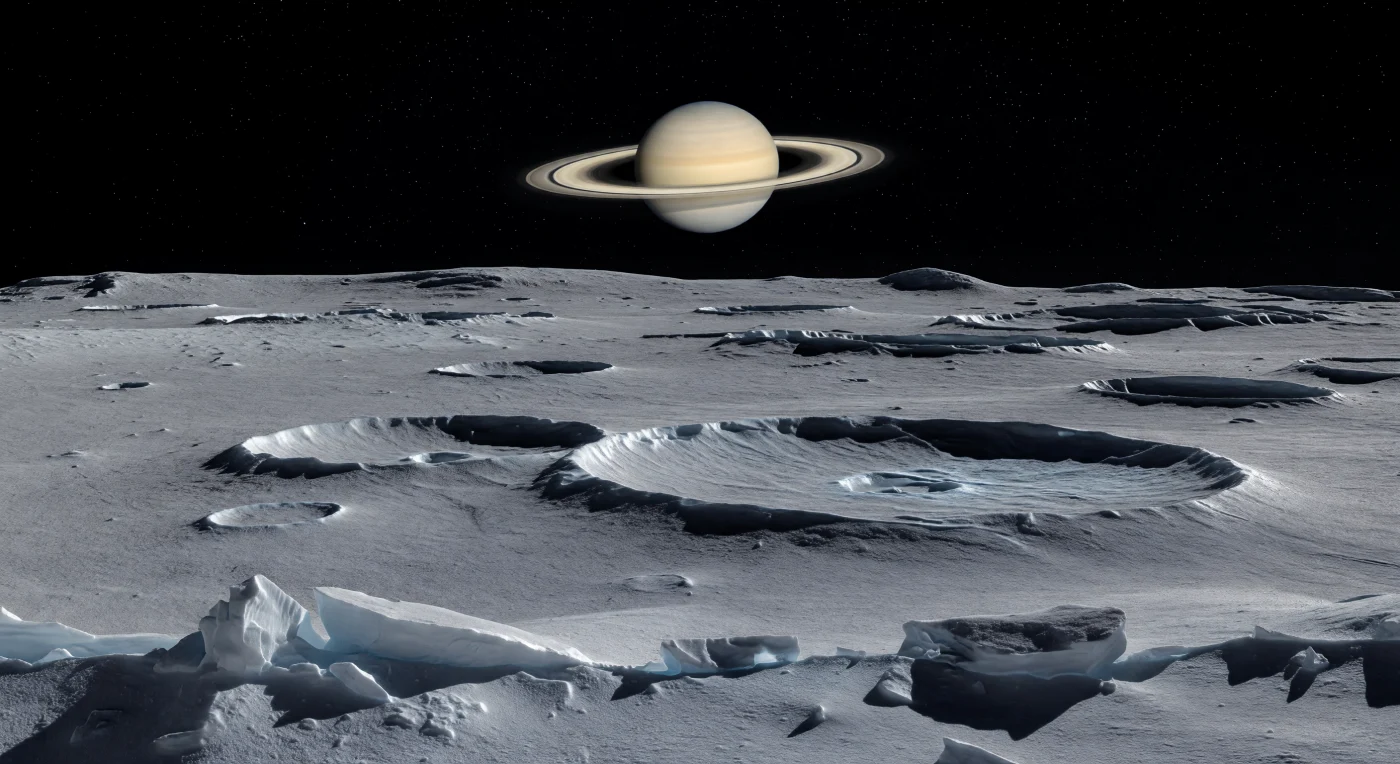
Under the cold glow of Saturn and its brilliant rings, the nightside plain stretches away in muted silver-gray, a frozen expanse of water-ice bedrock mantled by fine icy regolith and littered with angular frost-shattered blocks. Overlapping impact craters carve the middle distance with razor-sharp rims, shallow black interiors, and exposed bands of clean ice interrupted by darker contaminant-rich patches and faint tectonic lineations, while low ridges and gentle scarps hint at an ancient, rigid ice shell that has fractured and shifted over time. In the moon’s feeble gravity and airless vacuum, every edge appears unnaturally crisp: shadows fall ink-black, the horizon curves close, and dense stars remain visible in a perfectly lightless sky beyond the immense banded disk of Saturn hanging motionless overhead. Standing here would feel like standing on a silent shard of frozen history, where reflected ringlight reveals both the beauty and the stark permanence of an old, battered icy world.
