Scientific confidence: Low
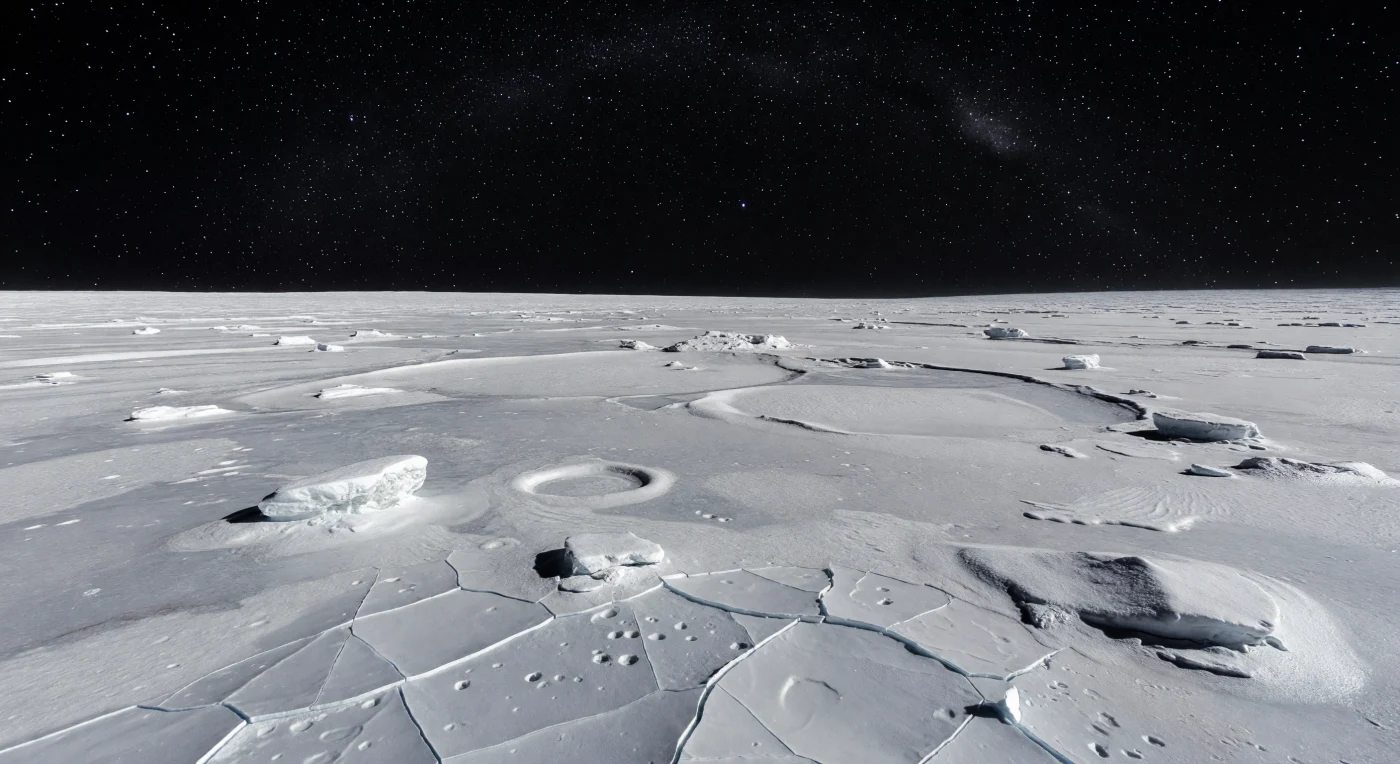
An immense plain of nitrogen frost stretches in every direction, so level and bright that the horizon curves upward surprisingly close, revealing the small scale of this frozen world. At your feet, the surface breaks into crisp polygonal plates, narrow troughs, scalloped pits, and low ridges where nitrogen ice and a thin glaze of methane frost have been reshaped by slow sublimation and redeposition in temperatures near 40 K, while a few angular blocks of harder water ice protrude through the volatile veneer. The sunlight here is astonishingly weak yet unforgiving, arriving from a tiny brilliant Sun that casts razor-sharp black shadows across silver-white crust and glassy highlights across the frost. Above, with no real atmosphere to soften anything, the sky is pure vacuum-black and crowded with stars, making the landscape feel silent, pristine, and cryogenically preserved at the edge of sunlight itself.

You stand amid tightly packed ridges of methane-rich frost, their pale cream and ivory crests rising in sharp, brittle waves above a harder foundation of brilliant nitrogen ice, with narrow troughs of compressed grey-white ice and faint reddish-brown tholin dust threading the gaps. In this extreme cold, volatile ices that would vanish closer to the Sun remain stable as glittering crystalline coatings, and the weak gravity helps preserve unusually steep, delicate ridge forms marked only by fracture patterns and subtle sublimation pits, untouched by any wind-driven erosion. The light is astonishingly faint yet brutally crisp: a tiny, star-like Sun throws knife-edged shadows across the frozen ground while the frost flashes like shattered glass, and beyond the low-curving horizon the ridge field opens into broad, silent plains scattered with ice blocks and impact-scalloped hollows. Overhead, a perfectly black sky crowded with unwavering stars and the luminous band of the Milky Way makes the landscape feel both exquisitely pristine and almost impossibly remote.

At the foot of this frozen escarpment, the ground is strewn with angular shards and toppled blocks of water-ice bedrock, while above, a towering massif of bluish-white cliffs rises in fractured walls, sharp joints, and overhanging terraces preserved by intense cold and weak gravity. Thin veneers of nitrogen and methane frost brighten ledges and shadowed cracks to a near-metallic brilliance, interrupted here and there by faint reddish-brown tholin stains that mark older, radiation-processed surfaces. With no atmosphere to soften the view, every edge is cut with startling clarity: sunlit faces flare with hard reflections, crevices fall to absolute black, and the horizon feels unnervingly close against the body’s small scale. Overhead, the sky is a perfect vacuum black filled with sharp stars, and the distant Sun hangs only as a tiny, piercing point of light, making the landscape feel silent, airless, and almost impossibly remote.
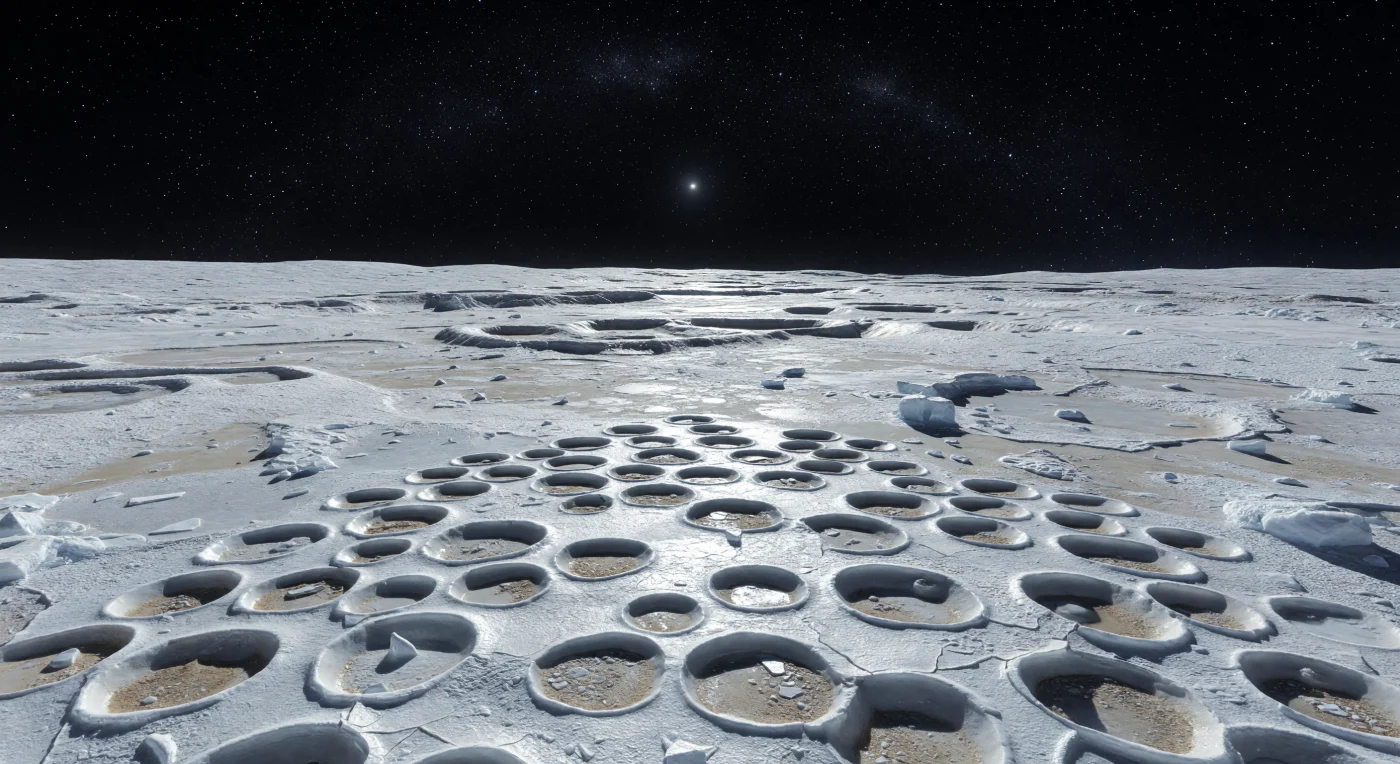
At ground level, the plain resolves into a tight mosaic of scalloped pits, as if the brilliant frost has been eaten away cell by cell, leaving sharp polygonal rims, undercut ledges, and steep pale walls that fall into darker hollows. This terrain is carved by sublimation: over immense spans of time, ultra-cold nitrogen and methane ices retreat directly from solid to gas in the near-perfect vacuum, while faint tan-brown residues of tholin-rich dust and other nonvolatile material collect in the pit bottoms as a lag deposit. The surface between the depressions is crusted and fractured, with glassy patches, brittle plates, and scattered angular ice blocks preserved by the deep freeze, while the close, subtly curved horizon hints at a small world under weak gravity. Above it all hangs an abyssal black sky crowded with sharp stars, where the far-off Sun shines only as a piercing point, casting hard-edged shadows that make the white and silver-gray frost feel at once pristine, fragile, and profoundly alien.

From the crater floor, you stand on a dazzling plain of nitrogen and methane frost, so bright it seems to glow against the pure black sky, its surface broken only by faint polygonal cracks, low icy hummocks, and scattered angular blocks thrown out by the ancient impact. Around you, terraced walls of bluish-gray water-ice bedrock rise in steep rings, their ledges and scarps shaped by collapse after the collision, not by flowing liquid, while isolated sheltered patches hint at darker tholin staining beneath the frost. At nearly 40 K and almost 96 times farther from the Sun than Earth, the landscape is locked in deep cryogenic stillness: sunlight arrives as a hard, star-like point, weak yet intensely directional, making the crater rim blaze silver-white while boulders and recesses fall into razor-edged, absolute darkness. The horizon feels strangely close on this small world, and in the airless silence of a surface preserved for billions of years, every bright frost crystal and black shadow heightens the sense of standing inside a frozen impact scar at the edge of the Solar System.

You stand on a dazzling equatorial plain where brilliant nitrogen and methane frost lies like polished snow, split apart by ruler-straight graben and narrow blue-gray fissures that run to the tight horizon in immense, almost unnatural lines. Along these faults, cryotectonic forces have heaved up icy ridges, dropped sharp-walled troughs, and scattered angular blocks of tougher water-ice bedrock through the volatile veneer, while faint reddish-brown tholin dust gathers in protected cracks and on crest tops. Some fractures reveal darker, cleaner ice below the frost mantle, hinting at dense layered material beneath a surface that has remained frozen and nearly unchanged for billions of years in the deep outer Solar System. Overhead, the sky is utterly black and crowded with hard stars, and the Sun is only a piercing white point whose weak but razor-sharp light makes the frost gleam silver-white and fills the chasms with ink-dark shadow.

From the ground, the landscape is a frozen avalanche of impact debris: house-sized angular blocks of water ice and shattered ice-rock clasts strewn across a hummocky apron, their fractured faces dusted with a thin silver sheen of fresh nitrogen and methane frost. The surface blazes white under extraordinarily distant sunlight, yet every boulder, pebble, and ridge throws a razor-sharp black shadow into the airless vacuum, while older exposed faces show faint rusty-brown tholin staining trapped within brittle, granular ice. Shallow troughs, secondary pits, and low scarps lead the eye toward ridgelines that drop quickly below the close horizon, a subtle reminder of the world’s small size and weak gravity, where massive blocks can remain improbably perched for eons. Above it all hangs a pure black sky crowded with stars and the Milky Way, with the Sun reduced to an intensely bright point, making the scene feel both brilliantly illuminated and profoundly remote at roughly 40 K.

A rare defrosted opening interrupts the dazzling volatile plain, where fractured nitrogen and methane frost forms crisp white crusts, bluish ice plates, and polygonal sublimation textures around a broad exposure of dark, crusty lag. In that revealed patch, brownish-red to muted maroon irradiated organic material—tholins mixed with fine granular regolith and frost-cemented debris—lies matte and stark against the surrounding reflective ice, while sheltered hollows, craterlet rims, and the lee of angular water-ice blocks still hold bright condensate. Under sunlight so weak that the Sun is only a hard white spark in a black, star-crowded sky, the low ridges and scarps cast razor-sharp shadows, their preserved steep faces and the close, compact horizon hinting at the body’s small size and low gravity. The scene feels frozen beyond weather and beyond time: an airless, cryogenic landscape where retreating frost briefly exposes the chemistry of radiation-darkened organics beneath one of the Solar System’s brightest icy surfaces.

At ground level, the polar plain appears as a blinding, smooth sheet of nitrogen and methane frost stretching to a tight, gently curving horizon, its brilliance broken only by faint polygonal cracks, low hummocks, shallow sublimation pits, and a few angular blocks of harder water ice glazed in sparkling white. Under temperatures near 40 K and the near-total vacuum of this distant world, these volatile ices can remain stable for immense spans of time, preserving razor-sharp textures and trapping delicate reddish tholin stains within older layers of frost. The tiny Sun shines only as an intense star-like point in an absolute black sky crowded with hard, unmoving stars and the pale river of the Milky Way, while the frost’s exceptional reflectivity throws a cold secondary glow back into nearby shadows. Standing here, you would feel the strange intimacy of a small world and the enormity of deep space at once: an ancient, luminous ice cap lying silent beneath a sky with no air, no haze, and no softness at all.

From the stepped rim of an enormous impact basin, terraces of brilliant nitrogen frost and faintly blue methane-rich ice plunge downward in crisp, fractured scarps toward a broad silver floor glazed with frozen sublimation deposits. In the extreme cold and weak gravity, cliffs stand unusually tall and sharp, angular slump blocks and ice boulders remain precariously perched, and even tiny later craters and narrow crevasses are preserved with startling clarity beneath hard-edged shadows. Sparse reddish-brown tholin dust stains cracks and sheltered ledges, hinting at irradiated organic chemistry on a surface otherwise dominated by some of the most reflective volatile ices in the Solar System. Above the close, subtly curved horizon, the moon Dysnomia hangs as a small pale point against a sky of perfect black, where the Sun is only a fierce star and the Milky Way blazes undimmed in the total absence of atmospheric haze.
