Scientific confidence: Low

From this low vantage, the uplands stretch away as a labyrinth of overlapping ancient craters, their jagged rims and brittle scarps rising above a frozen plain of dark burgundy regolith littered with sharp-edged blocks and fractured slabs. The deep red-brown color likely comes from tholins—complex organic compounds altered by radiation over immense spans of time—while the thin pale streaks exposed on fresh crater walls hint at cleaner subsurface ice beneath the irradiated surface skin. In the feeble sunlight, reduced here to a brilliant star, every stone throws a razor-black shadow across ground locked near 40 K, with no air, water, or weather to soften the terrain that impacts sculpted billions of years ago. The horizon feels uncannily close and gently curved on this small world, and above it hangs a perfectly black sky dense with stars, making the silent cratered expanse feel both intimate underfoot and vast beyond imagining.

You stand within a broad, shallow frost trap where the basin floor stretches away as a hard, ancient crust of methane-rich and likely nitrogen-bearing ice, glowing in muted pink-white and salmon tones beneath a sky as black as interstellar space. Deep red tholin dust—complex organic material altered by radiation over immense spans of time—has settled into polygonal contraction cracks and hollows, while scattered dark blocks of mixed ice and rock jut from the frozen plain, their long, knife-edged shadows revealing the feeble but unsoftened light of a Sun reduced to a brilliant star. Around the margins, low scarps and hummocky rims of darker, organic-rich regolith rise above brighter fractured ice exposures and small impact scars preserved by the near-total absence of erosion. In airless cold near 40 K, with no haze, no wind, and no liquid ever moving across the ground, every glittering frost grain and crimson-stained seam appears unnervingly still, as if the landscape has been locked unchanged for ages beyond human history.

A dark, wine-red plain of compacted tholin-rich regolith stretches outward to a surprisingly near, gently curved horizon, its crusted surface scattered with angular gravel, frost-bound clasts, low brittle boulders, and faint polygonal cracks etched by extreme cold. Subtle hummocks and shallow sublimation pits interrupt the otherwise immense equatorial flatness, and in a few fresh scars the reddish organic mantle gives way to brighter grey-white ice beneath, revealing a layered surface shaped more by irradiation, slow volatile loss, and ancient impacts than by any wind or flowing liquid. Under an airless black sky crowded with sharp stars and a luminous Milky Way, the Sun appears only as an intensely bright point, casting dim, hard light that makes every pebble throw a razor-edged black shadow across the frozen ground. The scene feels ancient and almost motionless: a chemically altered crust of complex organics preserved for eons in deep cold, on a small world where low gravity and absolute vacuum leave the landscape stark, pristine, and profoundly alien.
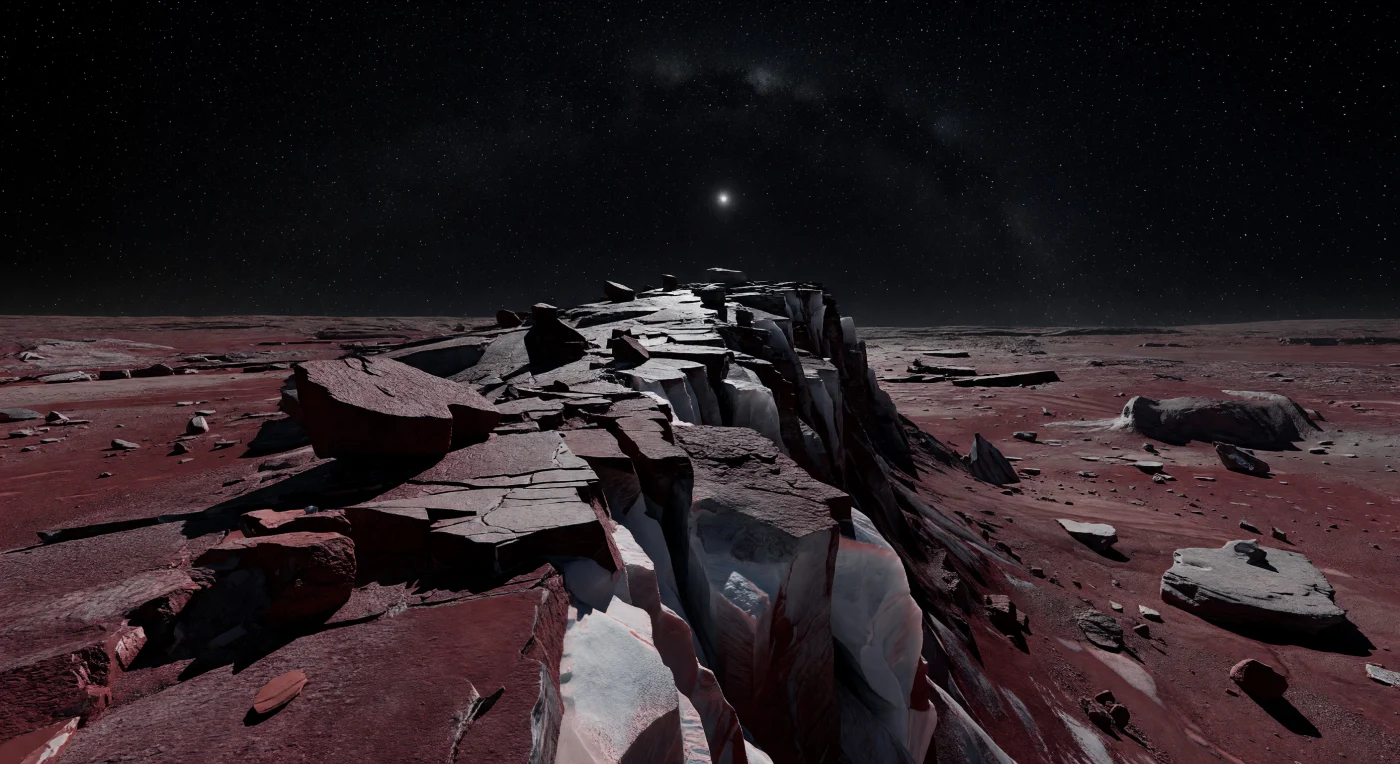
You stand on a knife-thin crest of ancient ice-rock crust, where splintered slabs and shattered polygonal plates jut upward in deep maroon and reddish-brown tones, their surfaces stained by tholin-rich organic material darkened by eons of radiation. Freshly broken scarps and fractured boulders expose paler grey-white and faint pink ice beneath this weathered skin, while enormous house-sized blocks cling improbably to the ridge, preserved in steep, brittle relief by gravity barely a few percent of Earth’s and temperatures near 40 K. Below, a broad plain of muted red regolith and frozen granular deposits stretches outward, scattered with ejecta, hummocks, and ancient secondary craters left almost perfectly intact in the airless vacuum, untouched by wind, water, or thaw. Overhead, the sky is a pure black vault crowded with sharp stars and the luminous sweep of the Milky Way, while the Sun appears only as an intensely bright point, casting faint, cold light that carves every crack into razor-edged shadow and makes the frozen landscape feel vast, silent, and profoundly remote.

From the fractured rim of this young crater, the ground breaks open like a wound in the dark red surface, revealing brilliant gray-white water ice and cleaner, volatile-rich layers beneath a thin crust of radiation-processed organic material. The crater’s steep walls drop into a vast bowl lined with sharp terraces, frozen debris chutes, and scattered angular boulders that look tiny against the immense scale, while long pale ejecta streaks sweep across the surrounding maroon plain in the weak grip of gravity. Under an airless black sky crowded with stars, the Sun is reduced to a fierce point of light, casting faint but razor-edged shadows and making fresh ice faces glint with a cold bluish sheen. In this extreme deep-freeze, where there is no wind, no liquid, and almost no erosion, the impact’s violence remains preserved with extraordinary clarity, exposing both ancient irradiated tholins at the surface and the cleaner icy materials hidden below.

At your feet, the frozen ground is broken into irregular polygons meters to tens of meters across, their brittle plates colored deep pink, maroon, and rusty red by tholin-rich organic material irradiated over eons atop a hard volatile-ice crust. Between them, narrow thermal-contraction cracks split the plain into black wedges and slots, some edged with a delicate trace of fresh white frost where cleaner ice has been exposed, while the tiny distant Sun throws impossibly long, knife-sharp shadows across every raised rim and granular surface. In this airless cold of roughly 40 K, with gravity only a small fraction of Earth’s, even subtle hummocks, micro-scarps, and scattered icy blocks can remain crisp for billions of years, preserving a landscape shaped by deep freezing, ancient impacts, and almost no erosion at all. Beyond the patterned foreground, the polygon network stretches toward low ridges and an old crater rim under a pure black sky crowded with stars and the Milky Way, making the stillness feel immense, pristine, and profoundly otherworldly.

Inside this immense polar hollow, the floor lies in near-eternal darkness, glazed with an intensely bright bluish-white frost that sparkles faintly where weak light ricochets down from the sunlit rim. The surface is a cryogenic mosaic of polygonal cracks, brittle sintered ice plates, shallow troughs, and sharp scarps, interrupted by scattered angular boulders whose dark reddish tholin coatings stand out against the nearly monochrome frost. Along the basin walls, steep low-gravity cliffs expose bands of deep crimson organic-rich mantle over cleaner methane-, nitrogen-, and water-ice-rich layers, while the distant rim towers hundreds of meters above, casting razor-edged shadows through the airless void. Overhead, a perfectly black sky crowded with stars and crossed by the Milky Way deepens the silence, and the Sun itself is only a brilliant point—so remote that this frozen landscape is illuminated less by direct daylight than by ghostly reflected glints from the ice.

You stand on a vast cryovolcanic plain where ancient, overlapping lobes of frozen water-ammonia slurry spread outward in broad, low swells, their gently convex fronts, embayed margins, shallow collapse hollows, and wrinkle-like ridges still preserved in exquisite detail by the airless cold. The surface is smooth but mottled—pale gray and faint pink ice deposits thinly dusted with reddish-brown tholins and granular frost—so that fresh white exposures, darker organic crusts, fractured icy plates, and scattered sharp-edged impact pits create a subtle tapestry of frozen geology underfoot. At roughly 40 K, with no atmosphere, no liquid flow, and almost no erosion beyond slow impact gardening, these cryovolcanic materials may have remained largely unchanged for billions of years, recording an ancient episode when subsurface volatile-rich slurries once welled up and froze solid. Overhead, the sky is a black vacuum crowded with stars and crossed by a brilliant Milky Way, while the Sun appears only as an intensely bright point, casting feeble but razor-sharp light across a horizon of low frozen flow fields and distant crater rims that feels both immense and eerily still.

You stand among a frozen avalanche of impact debris, where house- to cliff-sized angular blocks of bright fractured ice and dark maroon organic-coated crust lie strewn across a plain of crimson granular regolith, many improbably perched on tiny contact points in the feeble gravity. The scene is the preserved apron of an ancient impact ejecta field: sharp shards, shallow ballistic skid marks, half-buried slabs, and hummocky ridges remain almost untouched because there is no atmosphere, no flowing liquid, and virtually no erosion at temperatures near 40 K. Under the dim light of a Sun reduced to a brilliant star, every boulder throws a razor-black shadow across the tholin-rich surface, while fresh icy faces catch faint cold glints against the deep red terrain. Beyond the chaotic foreground, dark undulating plains and low cratered rises fade into immense stillness beneath a perfectly black sky crowded with stars, making the landscape feel both geologically violent and eerily eternal.
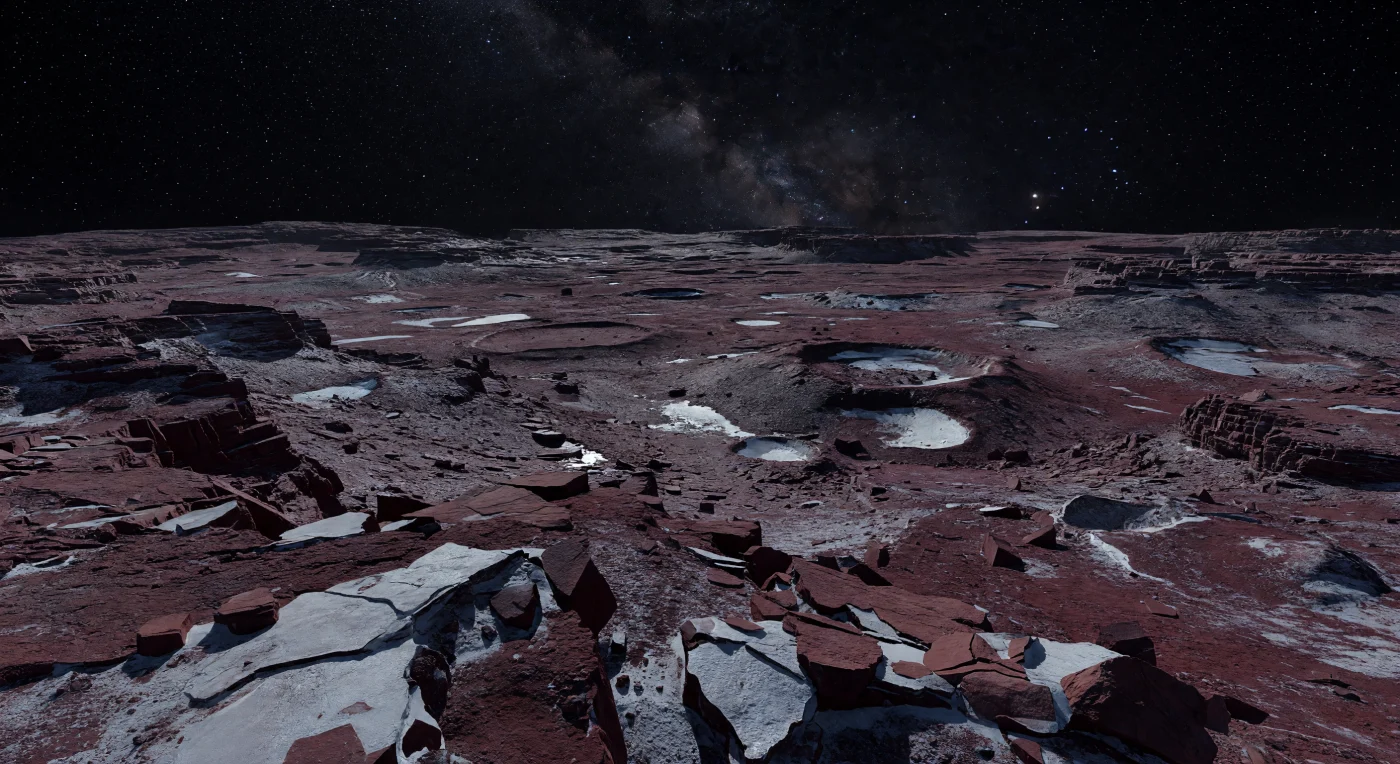
From this high, jagged ridge, the ground is a dark tapestry of maroon and reddish-brown tholin-rich crust, fractured into brittle slabs and sharp boulders, with pale frost of methane and water ice gathered in the coldest cracks like scattered ash. Below, the ridge falls abruptly into cratered plains and steep scarps whose unusually crisp cliffs, blocky debris aprons, and undisturbed ejecta record billions of years in an airless deep freeze, with no wind, liquid, or weather to soften them. The horizon curves noticeably over this small world, and the red-and-white basin seems to drop away into blackness under lighting so faint and hard that every shadow is razor-dark, every icy patch glints coldly, and the temperature hovers near a numbing 40 kelvin. Overhead, the sky is not merely dark but pure vacuum-black: the Milky Way burns bright and crowded across it while the Sun, reduced by vast distance to a piercing white star, casts its dim illumination on one of the most isolated landscapes in the Solar System.
