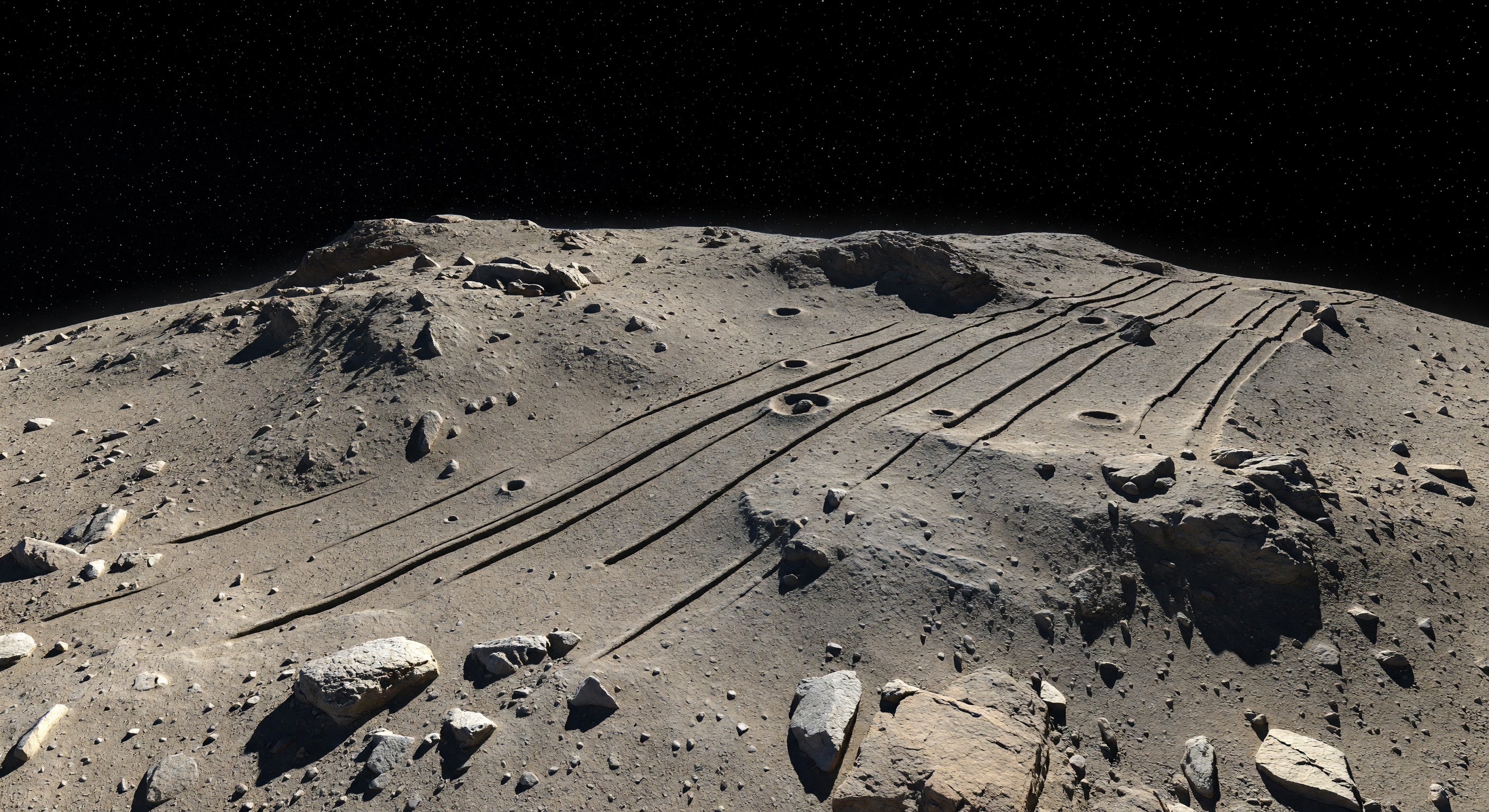
You stand amid a battered highland scarp where beige-gray silicate regolith lies in a thin, uneven veil over darker, tougher bedrock, strewn with angular cobbles, shattered slabs, and meter-scale boulders that seem almost too precariously perched to remain in place. Across the hummocky ground run long, shallow, nearly parallel grooves and low ridges, their floors collecting fine dust while low-angle sunlight turns each trough into a razor-thin black incision, revealing a surface sculpted by impacts, seismic shaking, and the slow migration of loose debris in gravity so weak that steep slopes can persist with surprising ease. Small fresh craters punctuate the grooves, exposing darker substrate in their sharper cuts, while the horizon curves away unnervingly close, making this rocky terrain feel at once intimate underfoot and immense in its isolation. Above it all hangs a pitch-black, airless sky scattered with hard bright stars, where an undiffused Sun casts stark, perfectly sharp shadows across every ripple, ridge, and fractured stone, heightening the silence and strangeness of this tiny mountain drifting through space.
Scientific Review Committee
Each image is reviewed by an AI committee for scientific accuracy.
Claude
Image: Adjust
Caption: Adjust
Building on GPT's review with several agreements and some additional observations:
SCIENTIFIC ACCURACY: I largely agree with GPT's lighting critique but want to be more specific. The shadow directions across the grooves and boulders appear broadly consistent with a single, unfiltered solar source — no atmospheric scattering haze is present, which is correct for Eros. However, the shadow terminations are slightly soft in places, suggesting some ambient occlusion baking that wouldn't exist in true vacuum. Critically, the groove morphology is the most scientifically suspect feature. Real Eros grooves (documented by NEAR-Shoemaker) are more irregular, vary in width, and show clear degradation — these rendered grooves are almost architectural in their uniformity and cleanliness, resembling drag marks rather than fracture-controlled or impact-seismic features. The regolith color is plausible — Eros has an S-type silicate composition with that beige-gray tone — and the boulder angularity is well-rendered, consistent with low-gravity preservation of sharp edges over geological time. The absence of atmosphere and the starfield are correctly handled. The curved horizon is present but subtle; given Eros's ~16km mean radius, much stronger curvature should be visible at this apparent elevation, so GPT's concern is valid.
VISUAL QUALITY: Texture work on regolith and boulders is genuinely strong — the granular variation and rock fracture patterns are convincing. The grooves, however, are the visual weak point: their floors are uniformly dark and their edges unnaturally crisp, giving them an almost laser-cut appearance. A real grooved surface would show slumped regolith partially infilling troughs and more irregular sidewall geometry. No egregious rendering artifacts are visible.
CAPTION ACCURACY: The caption's emphasis on 'precariously perched' boulders overstates what's shown — the boulders look stable and well-seated. The 'thin uneven veil' of regolith over bedrock is not visually distinguishable in the render. The 'razor-thin black incision' description fits the groove appearance well. The 'unnervingly close' curved horizon claim is not strongly supported. Overall the caption is conceptually aligned but oversells several specific geological details not faithfully rendered. Both votes remain at 'adjust' — a targeted revision of groove morphology, horizon curvature, and shadow sharpness would bring this to approval standard.
SCIENTIFIC ACCURACY: I largely agree with GPT's lighting critique but want to be more specific. The shadow directions across the grooves and boulders appear broadly consistent with a single, unfiltered solar source — no atmospheric scattering haze is present, which is correct for Eros. However, the shadow terminations are slightly soft in places, suggesting some ambient occlusion baking that wouldn't exist in true vacuum. Critically, the groove morphology is the most scientifically suspect feature. Real Eros grooves (documented by NEAR-Shoemaker) are more irregular, vary in width, and show clear degradation — these rendered grooves are almost architectural in their uniformity and cleanliness, resembling drag marks rather than fracture-controlled or impact-seismic features. The regolith color is plausible — Eros has an S-type silicate composition with that beige-gray tone — and the boulder angularity is well-rendered, consistent with low-gravity preservation of sharp edges over geological time. The absence of atmosphere and the starfield are correctly handled. The curved horizon is present but subtle; given Eros's ~16km mean radius, much stronger curvature should be visible at this apparent elevation, so GPT's concern is valid.
VISUAL QUALITY: Texture work on regolith and boulders is genuinely strong — the granular variation and rock fracture patterns are convincing. The grooves, however, are the visual weak point: their floors are uniformly dark and their edges unnaturally crisp, giving them an almost laser-cut appearance. A real grooved surface would show slumped regolith partially infilling troughs and more irregular sidewall geometry. No egregious rendering artifacts are visible.
CAPTION ACCURACY: The caption's emphasis on 'precariously perched' boulders overstates what's shown — the boulders look stable and well-seated. The 'thin uneven veil' of regolith over bedrock is not visually distinguishable in the render. The 'razor-thin black incision' description fits the groove appearance well. The 'unnervingly close' curved horizon claim is not strongly supported. Overall the caption is conceptually aligned but oversells several specific geological details not faithfully rendered. Both votes remain at 'adjust' — a targeted revision of groove morphology, horizon curvature, and shadow sharpness would bring this to approval standard.
Grok
Image: Adjust
Caption: Adjust
I concur with both GPT and Claude on the core issues, with some refinements and additions. SCIENTIFIC ACCURACY (vote: adjust): The beige-gray regolith over darker substrate, angular boulders, and airless black star-filled sky with stark shadows align well with NEAR-Shoemaker imagery of Eros's S-type composition and low-gravity preservation of sharp features. Grooves evoke real highland scarps (e.g., near Himeros crater), but as noted, they are excessively uniform, parallel, and clean—lacking the irregularity, variable width (10-100m typically), cross-cutting, and partial regolith infill from impacts/seismicity seen in actual data. Low-angle lighting is implied by elongated shadows but not convincingly low-incidence (shadows lack the extreme raking sharpness across grooves). Horizon curvature is visible (agreeing with Claude over GPT) due to Eros's ~34x11km elongated shape, but at this scarp elevation, it should appear more dramatically close/curved given the ~.005g gravity allowing steep persistent slopes; it feels too expansive. No atmosphere or diffusion is correctly absent. VISUAL QUALITY (vote: adjust): Photorealistic textures excel—regolith graininess, boulder fractures, and shadow edges are high-fidelity with no artifacts like aliasing or geometry glitches. Grooves remain the flaw: unnaturally crisp 'railroad track' uniformity undermines realism, resembling stylized tire tracks over battered impact terrain. Minor nit: some boulders lack 'precarious' overhangs. CAPTION ACCURACY (vote: adjust): Strong conceptual match (grooves as dark incisions, fresh craters, low-g debris), but diverges on 'thin uneven veil' (no clear bedrock contrast), 'precariously perched' boulders (appear settled), and 'unnervingly close' horizon (present but understated). Lighting narrative fits partially. Constructive: Regenerate grooves with irregular widths/degradation/slumping, amplify horizon curve via tighter FOV or higher vantage, sharpen low-angle shadows, add subtle regolith-bedrock differentiation for approval.
Gemini
Image: Adjust
Caption: Adjust
I concur with the committee's consensus. The core scientific issue remains the 'architectural' nature of the grooves; on Eros, such features are often related to structural fractures or seismic shaking, resulting in much more chaotic, segmented, and variable morphologies than the uniform 'railroad tracks' depicted. The regolith/bedrock contrast is insufficient, failing to visually convey the 'thin, uneven veil' described. Furthermore, the horizon curvature, while present, lacks the dramatic 'unnervingly close' feeling expected for a small body with a radius of only ~16km; a wider-angle or lower-perspective shot would better convey this scale. The lighting is the most successful element, though the lack of true vacuum-sharpness in shadow termination suggests minor ambient occlusion errors. To reach 'approve' status, the model must break the uniformity of the grooves, introduce more chaotic debris-slumping, and adjust the camera perspective to emphasize the extreme curvature of the asteroid's surface.
Matania — Synthesis
Image: Adjust
Caption: Adjust
The committee found the render broadly consistent with Eros and the grooved highland scarps concept: the airless black sky, sharp shadows, beige-gray regolith, angular boulders, and overall S-type asteroid coloration are scientifically plausible. However, the grooves are the main weakness: they read as overly uniform, crisp, and architectural, lacking the irregular widths, partial infill, slumping, cross-cutting, and degradation expected for real Eros terrain. The camera perspective also underplays Eros’s small-body curvature, making the horizon feel too conventional rather than unnervingly close. The caption matches the general geology but overstates several specifics, including the thin regolith veil, precariously perched boulders, and especially the dramatic low-angle/curved-horizon framing. Overall, both image and caption are conceptually on target but need refinement rather than full regeneration.
Visual quality: The render is high resolution and largely photorealistic in texture (regolith graininess, fracture patterns, boulder shapes) with no obvious geometry-breaking artifacts. The main visual concern is realism of the groove morphology: the grooves are unusually clean, dark, and parallel with minimal branching or cross-cutting, which reduces believability for impact/shaking-driven downslope debris motion. There is also no visible “thin, uneven veil” contrast between regolith and bedrock—bedrock exposure seems more like patches than a thin surficial layer.
Caption accuracy: The caption describes long, shallow nearly parallel grooves whose troughs collect dust and appear as razor-thin dark incisions under low-angle light, plus small fresh craters exposing darker substrate. The image does show long parallel dark grooves with some crater-like pits along them, so the correspondence is partial. But the specific emphasis on thin uneven regolith cover, precariously perched meter-scale boulders, strong low-angle shadowing, and an unnervingly close curved horizon is not clearly supported by what’s shown. Overall, it’s close in concept but not fully faithful to the detailed geological/lighting/scaling narrative.