Scientific confidence: High

At ground level, the scene is a broad plain of pale gray-beige silicate dust and crushed gravel, littered with angular charcoal-gray boulders, shattered rock fragments, and a few flat slabs of exposed bedrock emerging from the regolith. Tiny impact pits, faint grooves, and shallow troughs score the surface, recording countless collisions that have broken, churned, and redistributed this stony S-type crust over immense spans of time. The horizon falls away abruptly and curves just beyond the plain, with only low rises and crater rims interrupting the view, making the landscape feel less like a world and more like the skin of a small mountain drifting in space. Above it all, a pure black, star-pricked sky and a hard white Sun cast perfectly razor-edged shadows behind every pebble, underscoring the airless vacuum, the slightly diminished sunlight, and the eerie fragility of terrain held down by almost no gravity at all.

At the center of this shallow hollow lies an uncanny pond of dust: a pale, almost perfectly level sheet of fine regolith so smooth and featureless that it looks settled by some invisible hand, sharply set against a rough rim of fractured tan-gray silicate rock, angular boulders, and scattered cobbles. These “ponds” are a distinctive feature of tiny airless asteroids, where impacts grind ordinary-chondrite-like stone into powder and the feeblest gravity, combined with seismic shaking from later impacts, can let the finest grains migrate into low spots and collect into remarkably flat deposits. Under direct, unfiltered sunlight, every edge is mercilessly crisp—the shadows are pure black, the dust reflects only as matte powder, and the close, strongly curved horizon makes ridges only a few meters high feel like the walls of a miniature mountain range. Above it all hangs a pitch-black sky pricked with steady stars, and in the absolute stillness, with no air, no haze, and no motion, the landscape feels less like a world than a fragment of broken stone suspended in space.

A ground-level view here is a study in instability: meter-scale angular blocks of silicate-rich rock lie scattered across tan-gray, muted brown regolith, some delicately balanced on tiny contact points, others stretched out in sparse, ballistic-looking trails from a sharp-rimmed crater nearby. Fine dust has settled into shallow hollows between fractured slabs and gravelly rubble, while fresh breaks gleam slightly brighter against darker, space-weathered stone, revealing a surface shaped almost entirely by impacts on an airless S-type body. In the fierce, unfiltered sunlight, every edge throws a razor-black shadow, and beyond the low hummocks and crater rims the land drops quickly toward an unnervingly close, strongly curved horizon, hinting at a world so small that even modest rises feel like the crest of a drifting mountain. Above it all hangs a pitch-black sky pricked with steady stars, making the whole ejecta field seem barely held down, as if one careful step could disturb a landscape suspended between rockfall and orbit.
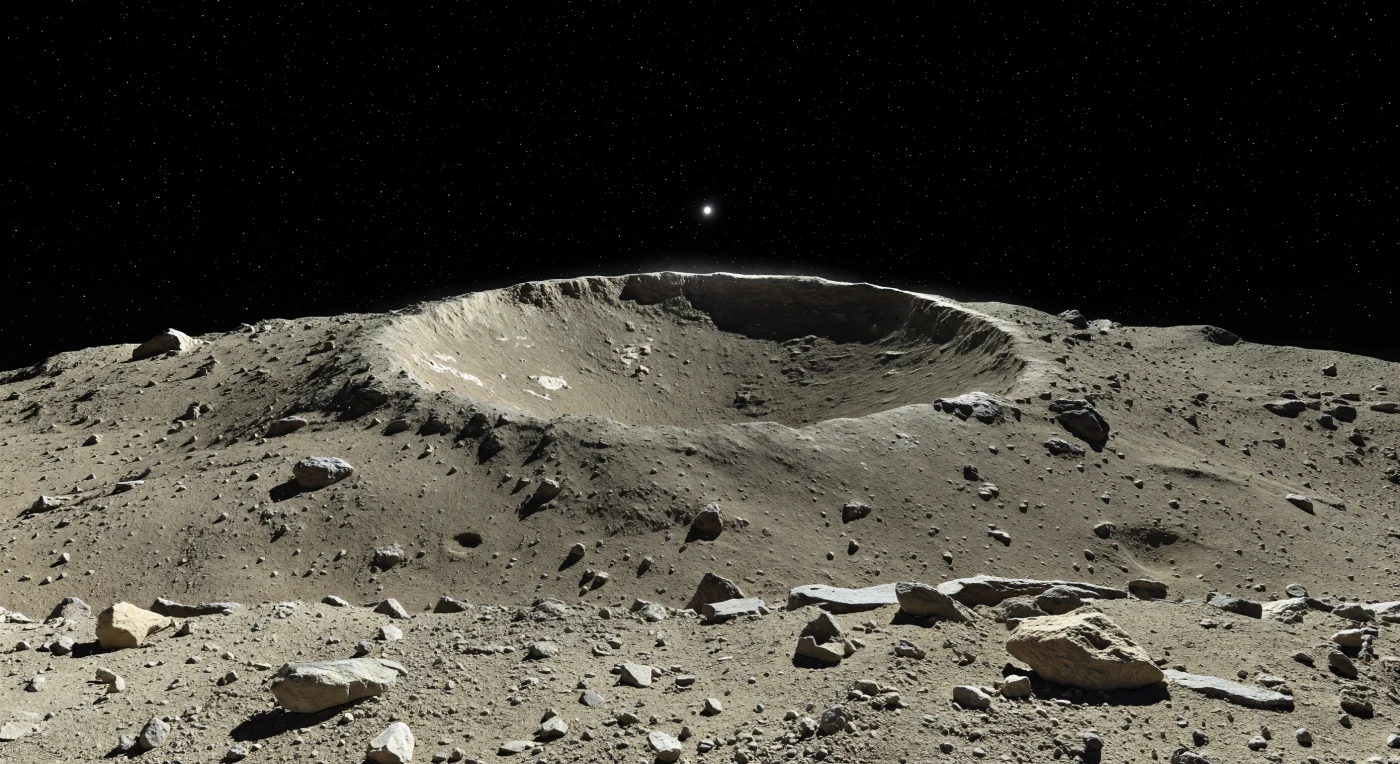
You stand on a fragile rim of pale, dusty gravel and shattered chondritic blocks, looking across a modest impact crater whose bright, blocky crest drops almost immediately into a wall of absolute blackness, where the shadowed interior vanishes because there is no air to soften or scatter the sunlight. Every pebble casts a knife-edge shadow on the muted beige and warm-gray regolith, and the ground itself seems to curve away unnervingly fast, revealing the tiny scale of this elongated, rocky world. The surface is that of an S-type asteroid: silicate-rich dust, fractured bedrock, scattered boulders, subtle grooves, and downslope streaks left by migrating regolith in gravity so weak that rocks appear barely anchored to the slope. Beneath a pitch-black sky pricked with steady stars, the stark contrast, close horizon, and crater walls only tens of meters high make the landscape feel less like a planet and more like a sunlit mountainside adrift in vacuum.

From the floor of this broad impact hollow, you would be surrounded by a rough blanket of ochre-gray and beige-brown regolith littered with darker pebbles, jagged shattered stones, and precariously balanced ejecta blocks, with fractured silicate bedrock poking through in places like broken pavement. The steep crater walls rise only tens of meters yet feel dramatic on such a tiny world: one side blazes under hard white sunlight, revealing ledges, grooves, slabs, and draped dust, while the opposite wall disappears into perfectly black shadow, unsoftened by any air. These rocks are ordinary-chondrite-like silicate materials typical of an S-type asteroid, ground and redistributed by countless impacts into a surface where even delicate rubble piles can survive in gravity so weak that the nearby horizon looks unnervingly close and distinctly curved. Above it all hangs a pitch-black sky, stars sharp even in daylight, making the scene feel less like a landscape on a planet than a stony mountain afloat in open space.

You stand amid a battered highland scarp where beige-gray silicate regolith lies in a thin, uneven veil over darker, tougher bedrock, strewn with angular cobbles, shattered slabs, and meter-scale boulders that seem almost too precariously perched to remain in place. Across the hummocky ground run long, shallow, nearly parallel grooves and low ridges, their floors collecting fine dust while low-angle sunlight turns each trough into a razor-thin black incision, revealing a surface sculpted by impacts, seismic shaking, and the slow migration of loose debris in gravity so weak that steep slopes can persist with surprising ease. Small fresh craters punctuate the grooves, exposing darker substrate in their sharper cuts, while the horizon curves away unnervingly close, making this rocky terrain feel at once intimate underfoot and immense in its isolation. Above it all hangs a pitch-black, airless sky scattered with hard bright stars, where an undiffused Sun casts stark, perfectly sharp shadows across every ripple, ridge, and fractured stone, heightening the silence and strangeness of this tiny mountain drifting through space.

At descent scale, the surface appears as a tightly packed mosaic of beige-gray dust, crushed gravel, and centimeter-sized pebbles, punctuated by darker angular stones half-sunk into a dry silicate regolith. In the airless vacuum, sunlight falls unsoftened across every grain, carving razor-black micro-shadows that make the texture look almost tactile, while the ground rises gently and then drops away into a surprisingly near, curved horizon. This is an impact-worked landscape of ordinary-chondrite-like rocky material, where fines have sifted into smoother pockets between fractured clasts, shallow pits and short grooves record repeated collisions, and a few delicately perched rocks reveal how feeble gravity is on such a small body. With no atmosphere to blur the view, the black sky and unwavering stars make the scene feel less like a desert and more like standing on a tiny mountain of stone adrift in space.

Below the ridge, pale gray-tan regolith lies draped across a remarkably steep slope in silky streaks, smooth pockets, and thin aprons, threaded between darker slabs of exposed rock, angular chondritic boulders, and a few precariously perched stones that seem almost too lightly held to stay put. This is an airless silicaceous surface shaped by countless impacts and by the slow downslope migration of loose grains in extremely weak gravity, where subtle grooves, pebble clusters, fractured faces, and shallow pitting remain etched with extraordinary crispness under low, grazing sunlight. The land falls away so quickly that the horizon appears unnervingly close and strongly curved, making nearby ridge crests, crater rims, and boulder fields feel like features of a tiny mountain rather than a world. In the black vacuum above, with no atmosphere to soften light or shadow, every pebble casts a razor-edged darkness, and the whole slope rests in a stillness so complete it feels as if you are standing on a fragile, dusty mountainside suspended in open space.

At this narrow saddle, the ground feels like the pinched spine of a tiny stone world: pale tan and gray dust lies in thin, patchy veneers over darker silicate bedrock, strewn with angular rubble, shattered chondritic-looking fragments, and boulders that seem only barely anchored by the asteroid’s feeble gravity. Intersecting slopes rise away into low knobby masses on either side, while shallow troughs, small fresh craters, linear grooves, and subtle regolith ponds reveal a surface shaped by incessant impacts, seismic shaking, and the slow downslope migration of loose material on an airless S-type body. The horizon sits unnervingly close and curves away in several directions at once, making nearby scarps only tens of meters high feel like the edges of a drifting mountain in space. Overhead, a pure black sky and a hard white Sun produce brutal, unsoftened light: sun-struck facets glare warmly in beige and ochre tones, while every hollow and rock-shadow drops instantly into absolute black.

At sunrise on this tiny airless world, the Sun lifts just above a broken, sharply curved horizon, its disk slightly smaller than seen from Earth, while brilliant stars still burn in a sky that remains perfectly black with no twilight at all. Around you, gray-beige and ochre-brown regolith, fractured bedrock slabs, crisp-rimmed craters, and scattered chondritic boulders record a long history of impacts on a silicaceous S-type asteroid, with subtle grooves and troughs slicing across the terrain. In the brutal, undiffused sunlight, every pebble and ridge throws an impossibly long, knife-edged shadow, and shadowed hollows plunge into near-total darkness, emphasizing the vacuum, the weak gravity, and the absence of any atmosphere to soften the scene. The close horizon and low hummocky ridges make the landscape feel intimate yet uncanny, as if you are standing on a stony mountain only loosely held together, drifting through space under the hard white glare of the distant Sun.
