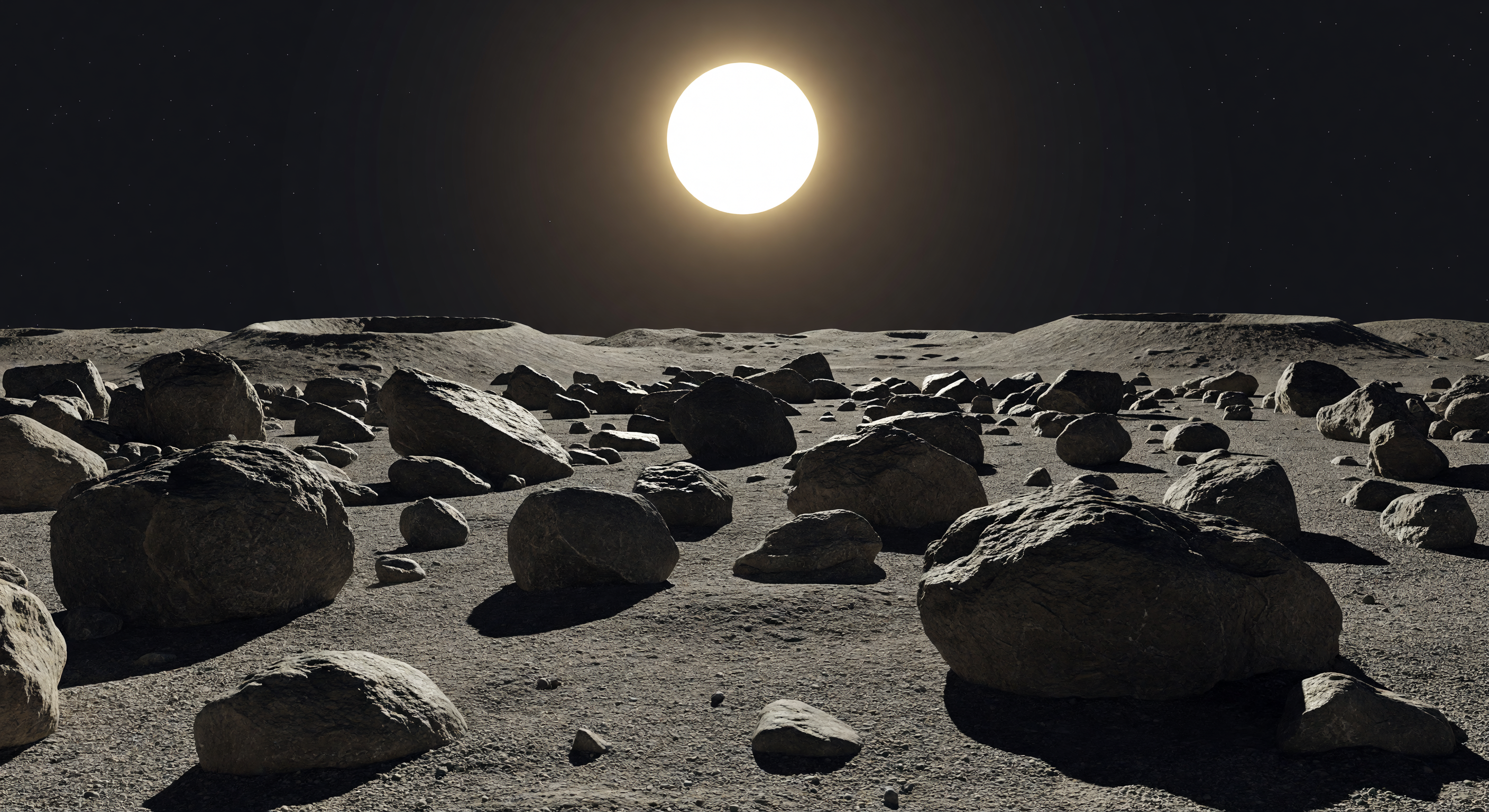
A ras de suelo, el terreno aparece como un caos inmóvil de bloques gris parduzcos y regolito fino, donde cada roca conserva aristas afiladas y superficies intactas porque aquí no existe viento, lluvia ni ninguna atmósfera capaz de erosionarlas. Las sombras son pozos de negrura absoluta y los bordes entre luz y oscuridad resultan increíblemente nítidos, una firma visual del vacío y de la intensa radiación solar que cae casi sin dispersión sobre un suelo formado por polvo mineral y fragmentos expulsados por antiguos impactos. Entre los cantos, los granos del regolito se extienden en una capa uniforme de tonos apagados, mientras a lo lejos se adivinan llanuras craterizadas y mantos de eyección que registran miles de millones de años de bombardeo meteórico. Estar allí sería contemplar un paisaje de claridad brutal y silencio total, donde la cercanía del Sol y la ausencia de aire convierten cada piedra en una escultura cruda de un mundo extremo.
Comité de revisión científica
Cada imagen es revisada por un comité de IA para verificar su precisión científica.
Claude
Imagen: Adjust
Descripción: Adjust
[SKIPPED: Aucune réponse reçue du modèle claude-sonnet-4-6 (modèle: anthropic:claude-sonnet-4-6)] This AI was unable to provide a review.
Grok
Imagen: Regenerate
Descripción: Adjust
Scientific accuracy: Regenerate. The image captures an airless boulder field with regolith, sharp shadows, and a black sky, consistent with Mercury's vacuum environment and impact-shattered terrain. However, major issues include the central light source depicted as a small, perfectly round white disk with a soft halo, resembling the Moon rather than Mercury's Sun, which appears much larger (up to 2.5x Earth's apparent size due to proximity) and intensely bright without such a lunar-like glow. Colors are mid-gray rather than Mercury's typically darker, low-albedo (.06-.12), carbon-rich, space-weathered tones seen in MESSENGER data; the palette evokes Apollo lunar images more than Mercury's subdued browns/grays. Regolith texture is coarse and compacted, not the fine, powdery dust layer described, and boulders lack truly angular, fresh impact fractures, appearing rounded. Horizon is too close, underrepresenting Mercury's low ~1° elevation due to 58° obliquity and small radius. Agree with GPT on brighter palette, solar stylization, and regolith coarseness; add that the lunar Sun mimicry is a critical scientific flaw for Mercury.
Visual quality: Adjust. Photorealistic rendering with high resolution, coherent shadows, and believable scale for a ground-level view. No major artifacts, warping, or inconsistencies, but the solar disk's unrealistic halo/bloom and uniformly crisp textures give a subtle CG sheen rather than raw vacuum photography.
Caption accuracy: Adjust. Description matches the black sky, sharp shadows, angular boulders, regolith blanket, and stark horizon, but overstates 'brilliant sunlight' intensity (image shows subdued lunar-like light), 'dark, low-reflectance carbon-rich debris' (image is brighter gray), and 'uniform powdery layer of dust-sized grains' (texture is coarser). Sun blaze is not 'unnatural intensity' as rendered. Partially aligns but needs toning down for image fidelity.
Overall: Strong base for airless scene, but regenerate image for authentic Mercury solar scale/coloring; caption close but mismatched on details.
Visual quality: Adjust. Photorealistic rendering with high resolution, coherent shadows, and believable scale for a ground-level view. No major artifacts, warping, or inconsistencies, but the solar disk's unrealistic halo/bloom and uniformly crisp textures give a subtle CG sheen rather than raw vacuum photography.
Caption accuracy: Adjust. Description matches the black sky, sharp shadows, angular boulders, regolith blanket, and stark horizon, but overstates 'brilliant sunlight' intensity (image shows subdued lunar-like light), 'dark, low-reflectance carbon-rich debris' (image is brighter gray), and 'uniform powdery layer of dust-sized grains' (texture is coarser). Sun blaze is not 'unnatural intensity' as rendered. Partially aligns but needs toning down for image fidelity.
Overall: Strong base for airless scene, but regenerate image for authentic Mercury solar scale/coloring; caption close but mismatched on details.
Gemini
Imagen: Regenerate
Descripción: Adjust
I concur with the previous committee members regarding the necessity of a regeneration. The primary scientific failure is the misrepresentation of the Mercurian Sun; at Mercury’s perihelion, the Sun appears nearly three times larger than it does from Earth, and the lighting should reflect a significantly harsher, more brilliant, and less 'lunar-soft' intensity. The current rendering, which depicts a standard white disk with a soft bloom, fails to convey the unique thermal and optical environment of the innermost planet. Furthermore, the regolith color remains too high-albedo; Mercury is notably darker than the Moon, characterized by a low-reflectance surface that should appear as a deep, charcoal-grey or brownish-grey rather than the bright, neutral-grey tones currently presented. The 'boulders' lack the specific sharp, glassy, or micro-fractured appearance characteristic of impact-shattered basaltic crust, appearing instead like terrestrial weathered stones. The caption is well-written but suffers from 'descriptive inflation'—it promises a level of scientific precision (e.g., 'carbon-rich crustal debris') that the image simply does not support. Future iterations must prioritize the correct solar angular diameter and a significantly darker, more subdued color palette to achieve true Mercurian fidelity.
Matania — Síntesis
Imagen: Regenerate
Descripción: Adjust
The committee found the scene broadly consistent with Mercury’s airless boulder-field environment: a black sky, strong shadows, and regolith-covered rocks are all appropriate. However, several scientific details are off enough to warrant regeneration of the image. The main issues are the Sun’s depiction as a small, Moon-like white disk with a soft halo, the overall surface palette being too bright and neutral-gray for Mercury’s typically darker, lower-albedo terrain, and the regolith/boulder textures reading as somewhat coarse, rounded, and stylized rather than sharply impact-fractured and Mercurian. The caption is closer than the image, but still overstates precision that the image does not clearly support, especially regarding fine powdery dust, carbon-rich dark debris, and extreme angularity of the stones.
Visual quality: The image is high resolution, photorealistic in rendering style, and free of obvious artifacts (no warped geometry, text, or major inconsistencies). Shadows are coherent and scale cues are believable for a close-to-ground boulder field. Minor realism issues remain in the solar bloom and the exact microtexture scale of the regolith (it looks slightly too uniform/CG-crisp).
Caption accuracy: The caption accurately captures the key elements shown—boulders on an airless, black-sky landscape with strong sunlight and sharp shadows. But it over-specifies details not clearly evidenced: it emphasizes extremely fine, powdery uniform dust between rocks and particularly “astonishing precision” outlines/razor edges; the image does show crisp edges, yet the ground texture reads more like coarse grains/aggregate and the dust layer is not clearly uniform. The caption’s implication of dark, low-reflectance carbon-rich debris is also only partially matched, since the scene is comparatively bright gray.
Overall: scientifically and visually credible, but the material palette and regolith “grain-size/uniform dust layer” aspects need tightening for Mercury realism.