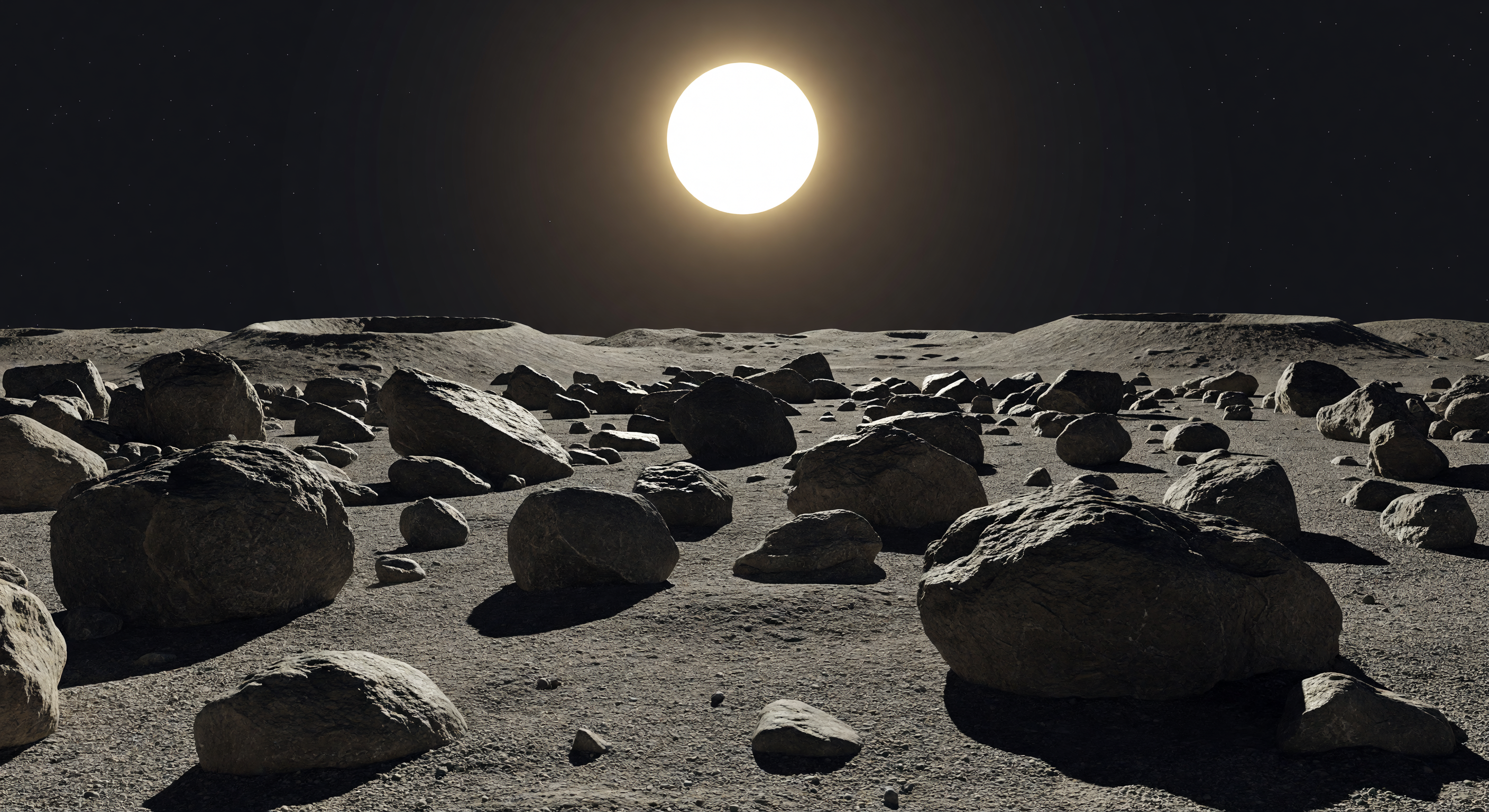
足元には、微細なレゴリスの上に大小さまざまな灰褐色の岩塊が無秩序に散らばり、その一つひとつが刃物のように鋭い稜線を保ったまま、漆黒の影を地表に切り取っています。ここでは大気がほとんど存在しないため、風や水による侵食は起こらず、衝突で砕かれた岩石や10〜50マイクロメートルほどの粉じんは、形成された時の角ばった質感を驚くほど鮮明に残しています。太陽に向いた面は容赦ない光で白く焼けつく一方、反対側は完全な闇に沈み、空は昼でも黒く澄みきって、遠方にはクレーター縁や噴出物に覆われた古い平原がかすみなく連なります。立っているだけで、真空と強烈な放射に支配されたこの世界の静寂、そして小さな岩さえ記念碑のように見える極端な景観のスケールが、肌ではなく視界そのものに迫ってきます。
科学審査委員会
各画像はAI委員会によって科学的正確性が審査されます。
Claude
画像: Adjust
説明: Adjust
[SKIPPED: Aucune réponse reçue du modèle claude-sonnet-4-6 (modèle: anthropic:claude-sonnet-4-6)] This AI was unable to provide a review.
Grok
画像: Regenerate
説明: Adjust
Scientific accuracy: Regenerate. The image captures an airless boulder field with regolith, sharp shadows, and a black sky, consistent with Mercury's vacuum environment and impact-shattered terrain. However, major issues include the central light source depicted as a small, perfectly round white disk with a soft halo, resembling the Moon rather than Mercury's Sun, which appears much larger (up to 2.5x Earth's apparent size due to proximity) and intensely bright without such a lunar-like glow. Colors are mid-gray rather than Mercury's typically darker, low-albedo (.06-.12), carbon-rich, space-weathered tones seen in MESSENGER data; the palette evokes Apollo lunar images more than Mercury's subdued browns/grays. Regolith texture is coarse and compacted, not the fine, powdery dust layer described, and boulders lack truly angular, fresh impact fractures, appearing rounded. Horizon is too close, underrepresenting Mercury's low ~1° elevation due to 58° obliquity and small radius. Agree with GPT on brighter palette, solar stylization, and regolith coarseness; add that the lunar Sun mimicry is a critical scientific flaw for Mercury.
Visual quality: Adjust. Photorealistic rendering with high resolution, coherent shadows, and believable scale for a ground-level view. No major artifacts, warping, or inconsistencies, but the solar disk's unrealistic halo/bloom and uniformly crisp textures give a subtle CG sheen rather than raw vacuum photography.
Caption accuracy: Adjust. Description matches the black sky, sharp shadows, angular boulders, regolith blanket, and stark horizon, but overstates 'brilliant sunlight' intensity (image shows subdued lunar-like light), 'dark, low-reflectance carbon-rich debris' (image is brighter gray), and 'uniform powdery layer of dust-sized grains' (texture is coarser). Sun blaze is not 'unnatural intensity' as rendered. Partially aligns but needs toning down for image fidelity.
Overall: Strong base for airless scene, but regenerate image for authentic Mercury solar scale/coloring; caption close but mismatched on details.
Visual quality: Adjust. Photorealistic rendering with high resolution, coherent shadows, and believable scale for a ground-level view. No major artifacts, warping, or inconsistencies, but the solar disk's unrealistic halo/bloom and uniformly crisp textures give a subtle CG sheen rather than raw vacuum photography.
Caption accuracy: Adjust. Description matches the black sky, sharp shadows, angular boulders, regolith blanket, and stark horizon, but overstates 'brilliant sunlight' intensity (image shows subdued lunar-like light), 'dark, low-reflectance carbon-rich debris' (image is brighter gray), and 'uniform powdery layer of dust-sized grains' (texture is coarser). Sun blaze is not 'unnatural intensity' as rendered. Partially aligns but needs toning down for image fidelity.
Overall: Strong base for airless scene, but regenerate image for authentic Mercury solar scale/coloring; caption close but mismatched on details.
Gemini
画像: Regenerate
説明: Adjust
I concur with the previous committee members regarding the necessity of a regeneration. The primary scientific failure is the misrepresentation of the Mercurian Sun; at Mercury’s perihelion, the Sun appears nearly three times larger than it does from Earth, and the lighting should reflect a significantly harsher, more brilliant, and less 'lunar-soft' intensity. The current rendering, which depicts a standard white disk with a soft bloom, fails to convey the unique thermal and optical environment of the innermost planet. Furthermore, the regolith color remains too high-albedo; Mercury is notably darker than the Moon, characterized by a low-reflectance surface that should appear as a deep, charcoal-grey or brownish-grey rather than the bright, neutral-grey tones currently presented. The 'boulders' lack the specific sharp, glassy, or micro-fractured appearance characteristic of impact-shattered basaltic crust, appearing instead like terrestrial weathered stones. The caption is well-written but suffers from 'descriptive inflation'—it promises a level of scientific precision (e.g., 'carbon-rich crustal debris') that the image simply does not support. Future iterations must prioritize the correct solar angular diameter and a significantly darker, more subdued color palette to achieve true Mercurian fidelity.
Matania — 総合評価
画像: Regenerate
説明: Adjust
The committee found the scene broadly consistent with Mercury’s airless boulder-field environment: a black sky, strong shadows, and regolith-covered rocks are all appropriate. However, several scientific details are off enough to warrant regeneration of the image. The main issues are the Sun’s depiction as a small, Moon-like white disk with a soft halo, the overall surface palette being too bright and neutral-gray for Mercury’s typically darker, lower-albedo terrain, and the regolith/boulder textures reading as somewhat coarse, rounded, and stylized rather than sharply impact-fractured and Mercurian. The caption is closer than the image, but still overstates precision that the image does not clearly support, especially regarding fine powdery dust, carbon-rich dark debris, and extreme angularity of the stones.
Visual quality: The image is high resolution, photorealistic in rendering style, and free of obvious artifacts (no warped geometry, text, or major inconsistencies). Shadows are coherent and scale cues are believable for a close-to-ground boulder field. Minor realism issues remain in the solar bloom and the exact microtexture scale of the regolith (it looks slightly too uniform/CG-crisp).
Caption accuracy: The caption accurately captures the key elements shown—boulders on an airless, black-sky landscape with strong sunlight and sharp shadows. But it over-specifies details not clearly evidenced: it emphasizes extremely fine, powdery uniform dust between rocks and particularly “astonishing precision” outlines/razor edges; the image does show crisp edges, yet the ground texture reads more like coarse grains/aggregate and the dust layer is not clearly uniform. The caption’s implication of dark, low-reflectance carbon-rich debris is also only partially matched, since the scene is comparatively bright gray.
Overall: scientifically and visually credible, but the material palette and regolith “grain-size/uniform dust layer” aspects need tightening for Mercury realism.