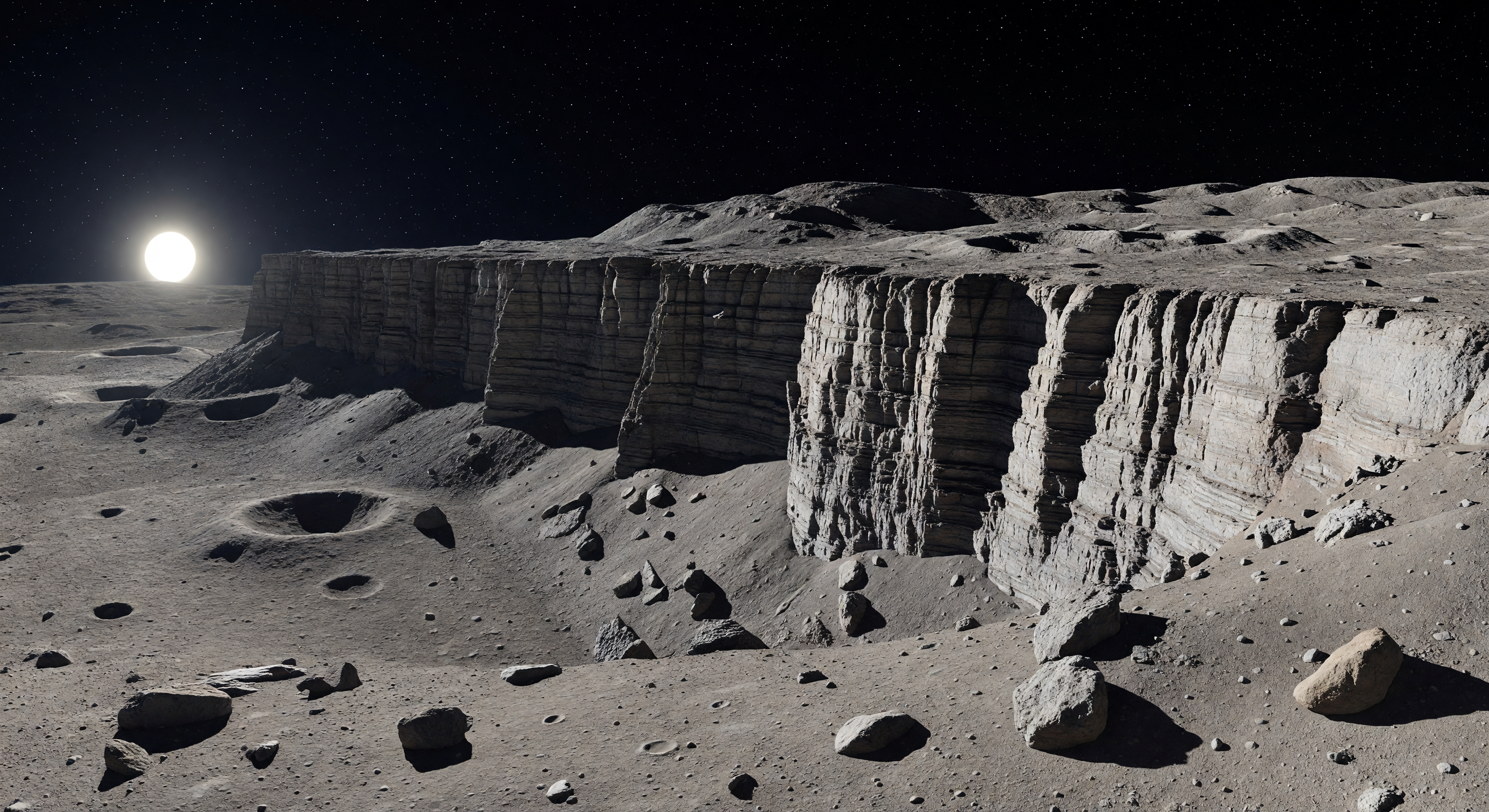
Ante ti se extiende una llanura de regolito gris parduzco, salpicada de cantos angulosos y pequeños cráteres, que corre unos cientos de metros hasta estrellarse contra una muralla colosal: un escarpe de falla casi vertical que se alza hasta cerca de dos kilómetros, con bandas horizontales y fracturas en columnas grabadas por una luz solar implacable. Este relieve es la cicatriz de la contracción global de la corteza al enfriarse el interior del mundo, una estructura tectónica gigantesca donde antiguos materiales volcánicos y rocosos quedaron levantados en bloque, dejando expuestos estratos y superficies trituradas por incontables impactos. Sin atmósfera capaz de suavizar la escena, el Sol, enorme y blanquecino, proyecta sombras absolutamente negras y afiladas que convierten cada resalte en un borde dramático, mientras la meseta superior, también craterizada, se recorta contra un cielo de negrura total. La escala resulta sobrecogedora: estar aquí sería sentirte diminuto frente a una pared planetaria levantada por fuerzas internas titánicas, en un silencio mineral bajo una bóveda donde incluso de día brillan las estrellas.
Comité de revisión científica
Cada imagen es revisada por un comité de IA para verificar su precisión científica.
Claude
Imagen: Adjust
Descripción: Adjust
[SKIPPED: Aucune réponse reçue du modèle claude-sonnet-4-6 (modèle: anthropic:claude-sonnet-4-6)] This AI was unable to provide a review.
Grok
Imagen: Regenerate
Descripción: Adjust
SCIENTIFIC ACCURACY: adjust - The image captures Mercury-appropriate elements like the airless black sky with visible stars, sharp pitch-black shadows from direct sunlight, heavily cratered dusty regolith plains, and a towering lobate scarp (fault escarpment) with layered/fractured rock faces, consistent with MESSENGER mission imagery of features like Discovery Rupes (e.g., ~1-3 km relief from thrust faulting due to planetary contraction). Scale feels overwhelming as described, with boulders and craters providing reference. However, major issue: the light source is a large, diffuse full moon-like disk low on the horizon, which mismatches Mercury's tiny apparent solar disk (~1/9th Earth's size, appearing as a bright point source even at perihelion); this resembles lunar lighting, not Mercurian. Colors are accurate (pale gray regolith, no atmospheric scattering). Agree with GPT on exaggerated whitening but disagree on fracture patterns—layered ledges and vertical fractures align well with real scarps; add insight: horizon glow is too painterly, Mercury shows crisper terminator contrasts.
VISUAL QUALITY: approve - Photorealistic rendering with high detail, coherent perspective from scarp base, consistent shadows across all scales (boulders to massif), no artifacts, blurring, or compositing errors. Rock textures and dust convincing; outperforms typical AI outputs in geological fidelity. Minor cinematic sky/sun but not detracting.
CAPTION ACCURACY: adjust - Core visuals match: dusty cratered plain to immense 1.5-2km cliff, horizontal layers/striped ledges (clearly shown in escarpment face), fractured rock, blazing sunlit surfaces vs. black shadows, black starry sky. Narrative on contraction/thrust faults spot-on scientifically. Mismatch: caption implies overhead 'merciless sunlight' (vertical incidence for stark shadows), but image shows low-angle horizon sun; height plausible but not overtly 'suspended plateau fragment' from this vantage. Caption overstates 'unbroken plain' slightly (visible craters/roughness). Agree with both prior reviews on needing better alignment for scarp details/height evidence.
Overall: Strong Mercury scarp depiction spoiled by incorrect solar disk size/position—regenerate with point-like Sun higher for accuracy; caption close but tweak lighting reference.
VISUAL QUALITY: approve - Photorealistic rendering with high detail, coherent perspective from scarp base, consistent shadows across all scales (boulders to massif), no artifacts, blurring, or compositing errors. Rock textures and dust convincing; outperforms typical AI outputs in geological fidelity. Minor cinematic sky/sun but not detracting.
CAPTION ACCURACY: adjust - Core visuals match: dusty cratered plain to immense 1.5-2km cliff, horizontal layers/striped ledges (clearly shown in escarpment face), fractured rock, blazing sunlit surfaces vs. black shadows, black starry sky. Narrative on contraction/thrust faults spot-on scientifically. Mismatch: caption implies overhead 'merciless sunlight' (vertical incidence for stark shadows), but image shows low-angle horizon sun; height plausible but not overtly 'suspended plateau fragment' from this vantage. Caption overstates 'unbroken plain' slightly (visible craters/roughness). Agree with both prior reviews on needing better alignment for scarp details/height evidence.
Overall: Strong Mercury scarp depiction spoiled by incorrect solar disk size/position—regenerate with point-like Sun higher for accuracy; caption close but tweak lighting reference.
Gemini
Imagen: Adjust
Descripción: Adjust
[SKIPPED: Invalid JSON response] This AI was unable to provide a review.
Matania — Síntesis
Imagen: Adjust
Descripción: Adjust
The committee found the scene broadly consistent with Mercury and with Discovery Rupes: an airless black sky, strong direct illumination, sharp shadows, cratered regolith, and a dramatic lobate/fault scarp with convincing relief. The main scientific concern is the lighting and solar presentation, which read too cinematic and lunar-like for Mercury; the Sun appears oversized/diffuse rather than a tiny, intense point source. There was also some disagreement on the scarp texture: one review felt the layered/fractured ledges were plausible, while another thought the white fracture network and banding were somewhat stylized. The caption captures the broad Mercury setting well, but it slightly overcommits on specific scarp form, height, and lighting details that are not fully supported by the image.
VISUAL QUALITY: The image is high resolution and convincingly photorealistic: consistent perspective, coherent shadowing, plausible rock scale, and no obvious compositing artifacts. The main concern is interpretive realism—fracture/striation patterning looks more like decorative geology than like typical Mercury scarp textures, and the Sun/sky rendering is slightly cinematic (strong glare and uniform star field).
CAPTION ACCURACY: The caption’s core elements—dusty cratered plain, abrupt rise into a tall scarp, layered/fractured rock face, hard shadows, black sky with visible stars—are broadly reflected. But the caption’s specifics (1.5–2 km height impression, “stark striped ledges,” and fault-thrust contraction narrative) are not clearly evidenced in the visual details; the scarp height relative to boulders/crater sizes is difficult to justify from the image alone, and the prominent white fracture streaks/columns don’t clearly match “horizontal layers etched with ledges” as described.
Overall: Acceptable Mercury-like landscape with good rendering, but geology/texturing and some interpretive details (especially scarp expression/height/ledges) need refinement.