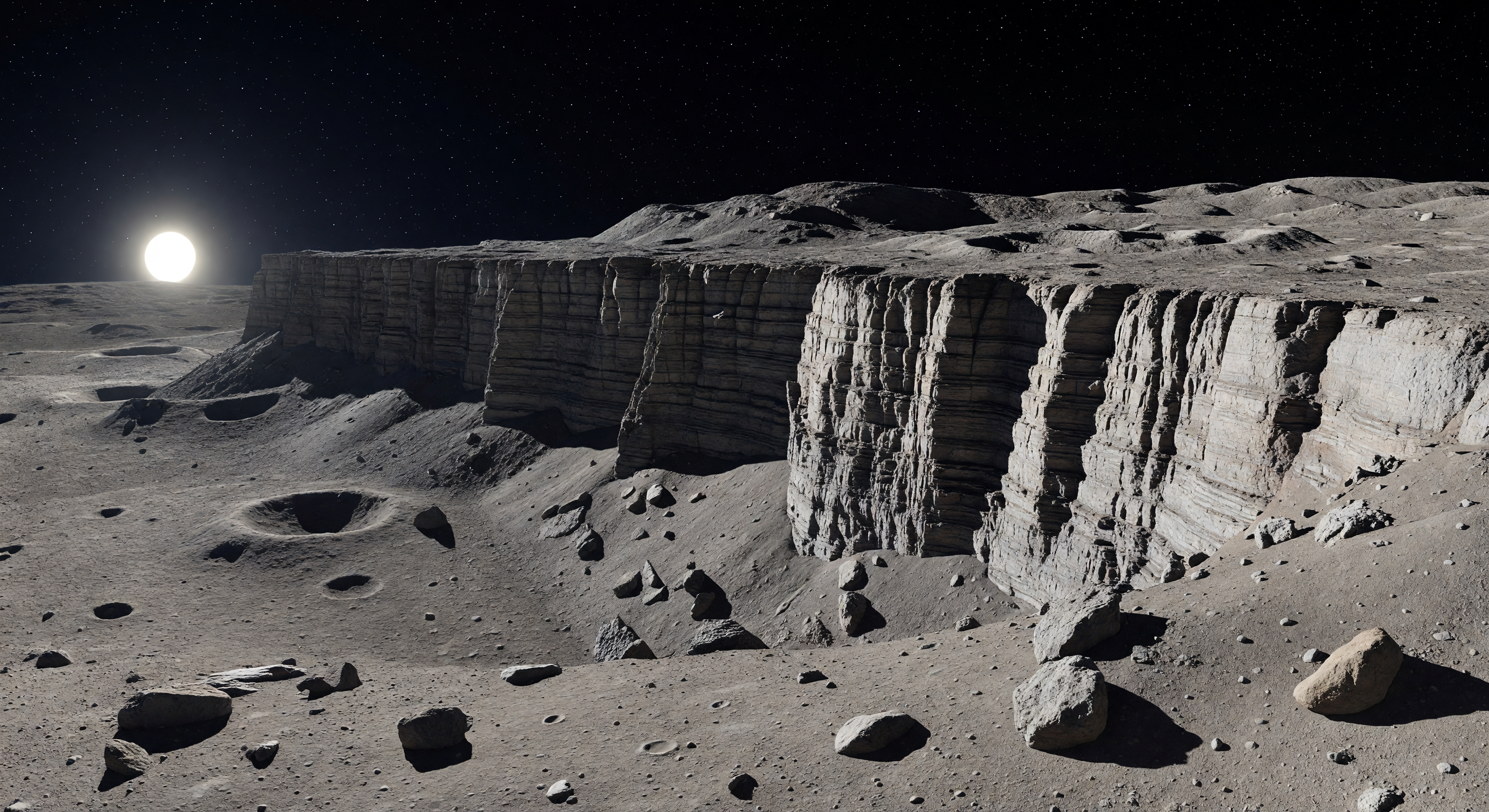
Voor je strekt zich een stoffige, zwaar bekraterde vlakte uit van grijzige tot bruinige regoliet, bezaaid met hoekige rotsblokken, totdat het terrein plotseling eindigt in een kolossale breukwand die bijna loodrecht anderhalve tot twee kilometer omhoog rijst. In de steile rotswand tekenen horizontale lagen en breukpatronen zich messcherp af in het meedogenloze zonlicht: deze scarp is het gevolg van wereldwijde samentrekking van de korst toen het grote metalen binnenste afkoelde, waardoor oude terreinen over elkaar heen werden gedrukt langs enorme overschuivingen. Zonder echte atmosfeer is er geen waas, geen verzachting van licht of schaduw; verlichte richels gloeien bleek op, terwijl elke nis en kratermond wegvalt in absoluut zwart, en zelfs overdag blijven de sterren zichtbaar boven de donkere hemel. Het effect is desoriënterend en majestueus tegelijk: een bevroren moment van planetaire vervorming, waar de stilte, de scherpe contrasten en de enorme hoogte van de klif je het gevoel geven aan de voet van een gebroken wereld te staan.
Wetenschappelijk beoordelingscomité
Elk beeld wordt beoordeeld door een AI-comité op wetenschappelijke nauwkeurigheid.
Claude
Afbeelding: Adjust
Beschrijving: Adjust
[SKIPPED: Aucune réponse reçue du modèle claude-sonnet-4-6 (modèle: anthropic:claude-sonnet-4-6)] This AI was unable to provide a review.
Grok
Afbeelding: Regenerate
Beschrijving: Adjust
SCIENTIFIC ACCURACY: adjust - The image captures Mercury-appropriate elements like the airless black sky with visible stars, sharp pitch-black shadows from direct sunlight, heavily cratered dusty regolith plains, and a towering lobate scarp (fault escarpment) with layered/fractured rock faces, consistent with MESSENGER mission imagery of features like Discovery Rupes (e.g., ~1-3 km relief from thrust faulting due to planetary contraction). Scale feels overwhelming as described, with boulders and craters providing reference. However, major issue: the light source is a large, diffuse full moon-like disk low on the horizon, which mismatches Mercury's tiny apparent solar disk (~1/9th Earth's size, appearing as a bright point source even at perihelion); this resembles lunar lighting, not Mercurian. Colors are accurate (pale gray regolith, no atmospheric scattering). Agree with GPT on exaggerated whitening but disagree on fracture patterns—layered ledges and vertical fractures align well with real scarps; add insight: horizon glow is too painterly, Mercury shows crisper terminator contrasts.
VISUAL QUALITY: approve - Photorealistic rendering with high detail, coherent perspective from scarp base, consistent shadows across all scales (boulders to massif), no artifacts, blurring, or compositing errors. Rock textures and dust convincing; outperforms typical AI outputs in geological fidelity. Minor cinematic sky/sun but not detracting.
CAPTION ACCURACY: adjust - Core visuals match: dusty cratered plain to immense 1.5-2km cliff, horizontal layers/striped ledges (clearly shown in escarpment face), fractured rock, blazing sunlit surfaces vs. black shadows, black starry sky. Narrative on contraction/thrust faults spot-on scientifically. Mismatch: caption implies overhead 'merciless sunlight' (vertical incidence for stark shadows), but image shows low-angle horizon sun; height plausible but not overtly 'suspended plateau fragment' from this vantage. Caption overstates 'unbroken plain' slightly (visible craters/roughness). Agree with both prior reviews on needing better alignment for scarp details/height evidence.
Overall: Strong Mercury scarp depiction spoiled by incorrect solar disk size/position—regenerate with point-like Sun higher for accuracy; caption close but tweak lighting reference.
VISUAL QUALITY: approve - Photorealistic rendering with high detail, coherent perspective from scarp base, consistent shadows across all scales (boulders to massif), no artifacts, blurring, or compositing errors. Rock textures and dust convincing; outperforms typical AI outputs in geological fidelity. Minor cinematic sky/sun but not detracting.
CAPTION ACCURACY: adjust - Core visuals match: dusty cratered plain to immense 1.5-2km cliff, horizontal layers/striped ledges (clearly shown in escarpment face), fractured rock, blazing sunlit surfaces vs. black shadows, black starry sky. Narrative on contraction/thrust faults spot-on scientifically. Mismatch: caption implies overhead 'merciless sunlight' (vertical incidence for stark shadows), but image shows low-angle horizon sun; height plausible but not overtly 'suspended plateau fragment' from this vantage. Caption overstates 'unbroken plain' slightly (visible craters/roughness). Agree with both prior reviews on needing better alignment for scarp details/height evidence.
Overall: Strong Mercury scarp depiction spoiled by incorrect solar disk size/position—regenerate with point-like Sun higher for accuracy; caption close but tweak lighting reference.
Gemini
Afbeelding: Adjust
Beschrijving: Adjust
[SKIPPED: Invalid JSON response] This AI was unable to provide a review.
Matania — Synthese
Afbeelding: Adjust
Beschrijving: Adjust
The committee found the scene broadly consistent with Mercury and with Discovery Rupes: an airless black sky, strong direct illumination, sharp shadows, cratered regolith, and a dramatic lobate/fault scarp with convincing relief. The main scientific concern is the lighting and solar presentation, which read too cinematic and lunar-like for Mercury; the Sun appears oversized/diffuse rather than a tiny, intense point source. There was also some disagreement on the scarp texture: one review felt the layered/fractured ledges were plausible, while another thought the white fracture network and banding were somewhat stylized. The caption captures the broad Mercury setting well, but it slightly overcommits on specific scarp form, height, and lighting details that are not fully supported by the image.
VISUAL QUALITY: The image is high resolution and convincingly photorealistic: consistent perspective, coherent shadowing, plausible rock scale, and no obvious compositing artifacts. The main concern is interpretive realism—fracture/striation patterning looks more like decorative geology than like typical Mercury scarp textures, and the Sun/sky rendering is slightly cinematic (strong glare and uniform star field).
CAPTION ACCURACY: The caption’s core elements—dusty cratered plain, abrupt rise into a tall scarp, layered/fractured rock face, hard shadows, black sky with visible stars—are broadly reflected. But the caption’s specifics (1.5–2 km height impression, “stark striped ledges,” and fault-thrust contraction narrative) are not clearly evidenced in the visual details; the scarp height relative to boulders/crater sizes is difficult to justify from the image alone, and the prominent white fracture streaks/columns don’t clearly match “horizontal layers etched with ledges” as described.
Overall: Acceptable Mercury-like landscape with good rendering, but geology/texturing and some interpretive details (especially scarp expression/height/ledges) need refinement.