Scientific confidence: High

You stand inside a vast band of youthful grooved terrain where parallel ridges and troughs of water ice, silver-white with faint blue highlights, march to the horizon in immense corrugations under a perfectly black sky. The ground is a jumble of angular ice blocks, granular frost, and scattered darker silicate-rich debris, while sharply cut fault scarps, icy steps, and crosscut fractures reveal a crust pulled apart by extensional tectonics and later altered by radiation and micrometeorite bombardment. In the weak sunlight, only a small hard disk at this distance, illuminated slopes blaze with cold reflections and every shadow falls razor-black, emphasizing the low gravity and the extraordinary crispness of the landforms. Above the horizon hangs Jupiter, huge and banded in beige, white, and rust, dwarfing the stark frozen landscape and making the silent scale of this tectonically resurfaced world feel almost overwhelming.
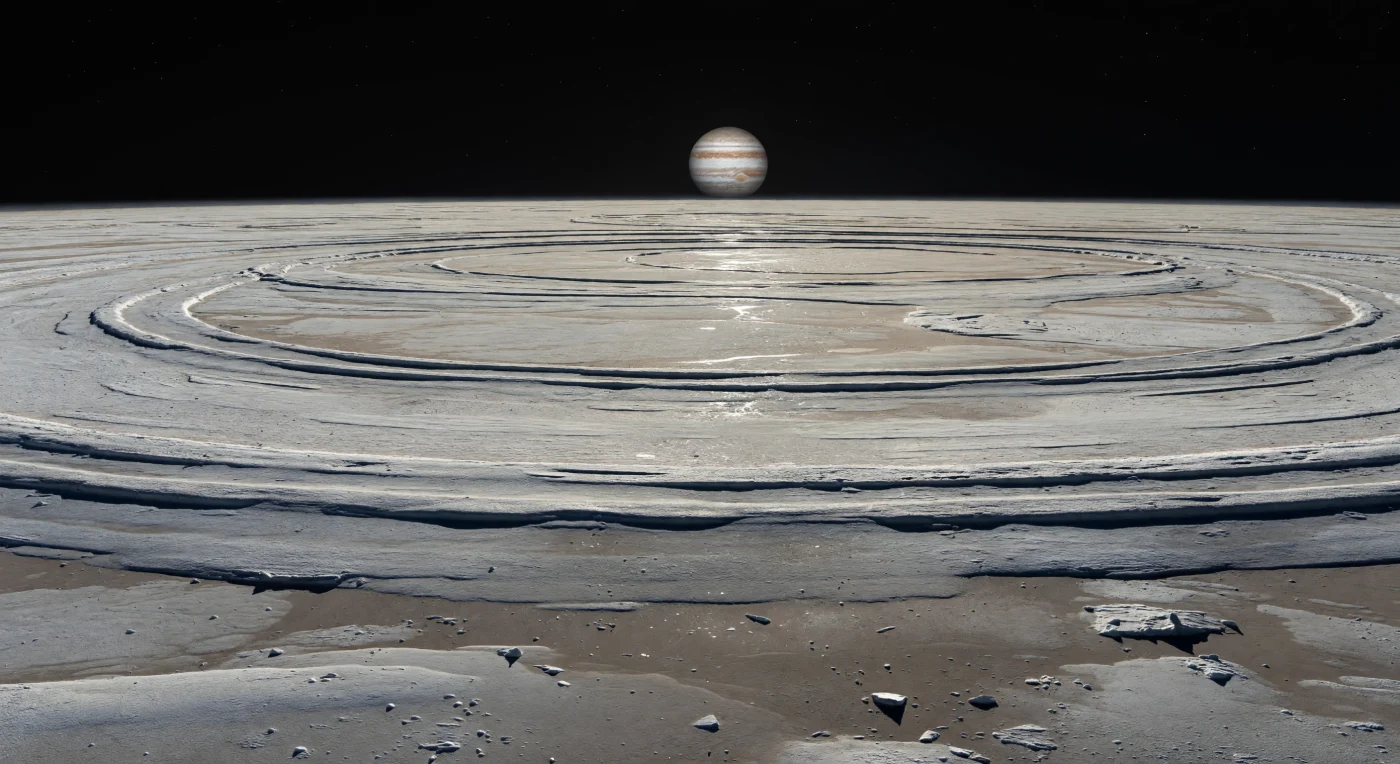
At sunrise, the plain resolves into an almost erased impact structure of astonishing scale: broad, low concentric swells, faint arcuate rings, and barely lifted circular scarps ripple outward across a frozen horizon, their subtle relief exposed by razor-long black shadows. Under the perfectly black, near-airless sky, the ground is a hard crust of water ice mixed with darker silicate-rich dust and space-weathered contaminants, colored in restrained grays and beige-browns, with fractured plates, angular ice-rock fragments, polygonal cracks, and small softened craters scattered across the foreground. These “ghost” basin rings are the worn remains of an ancient colossal impact, later muted by tectonic resurfacing and icy deformation, so that instead of dramatic walls they survive only as gentle arcs, hummocks, and occasional brighter grooved bands crossing the plain. In the cold, weak sunlight so far from the Sun, clean ice flashes briefly while dusty ice stays matte, and the immense banded disk hanging low above the horizon makes the landscape feel both silent and immeasurably vast.
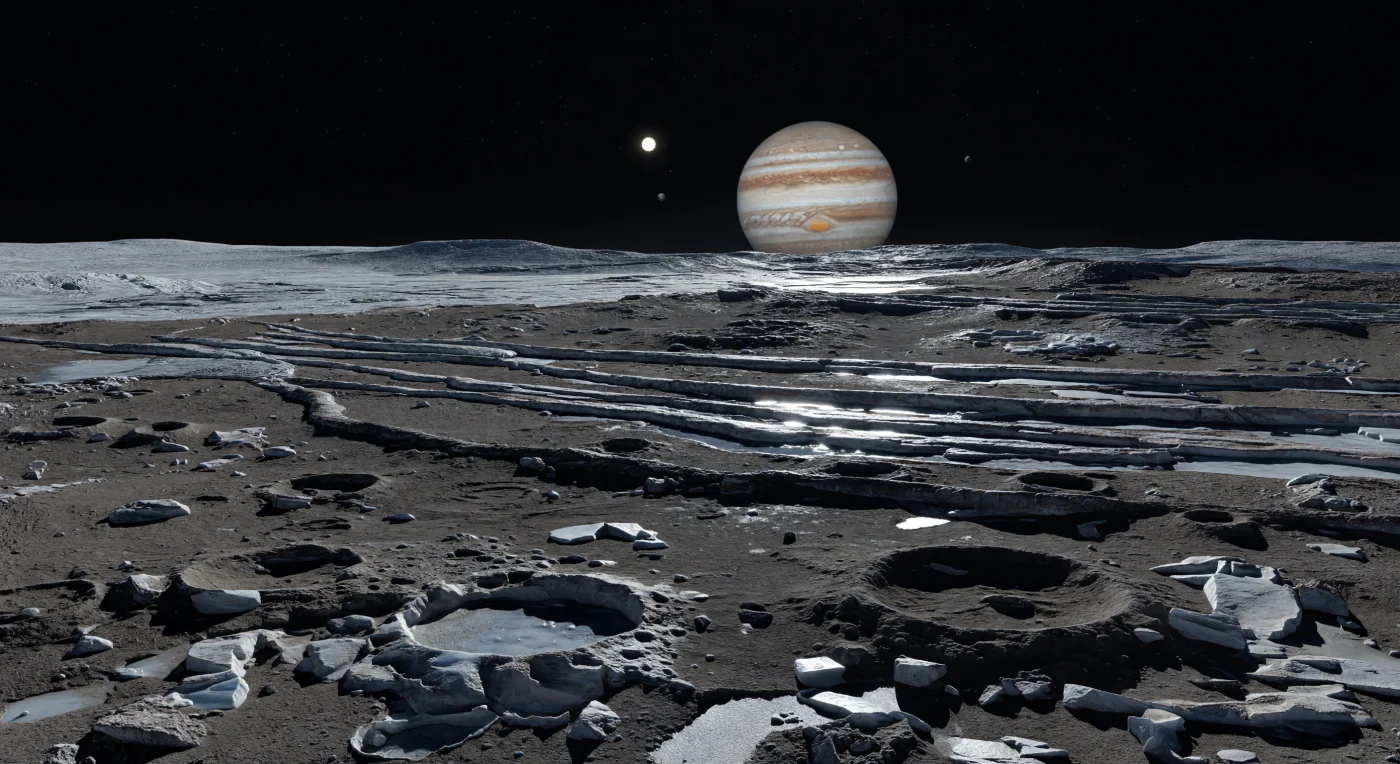
From ground level, the ancient highlands stretch away as a vast, battered plain of charcoal and brown-gray ice-rich regolith, its hummocky surface littered with shattered breccia, frost-edged blocks, and overlapping craters whose rims have been worn soft by eons of impact gardening and slow sublimation. Pale water-ice glints along fractures and in shaded crater walls, while beyond the darker plains the landscape breaks into brighter grooved bands—parallel ridges and troughs where tectonic disruption has exposed cleaner ice beneath the older, space-weathered surface. In the airless cold, the sunlight is weak compared with Earth’s yet brutally crisp, carving razor-black shadows across the low-gravity terrain and making every ridge, terrace, and boulder field seem unnaturally sharp. Above this frozen ruin hangs an immense, nearly motionless Jupiter low in the black sky, its banded disk looming over a horizon that feels both desolate and impossibly grand.
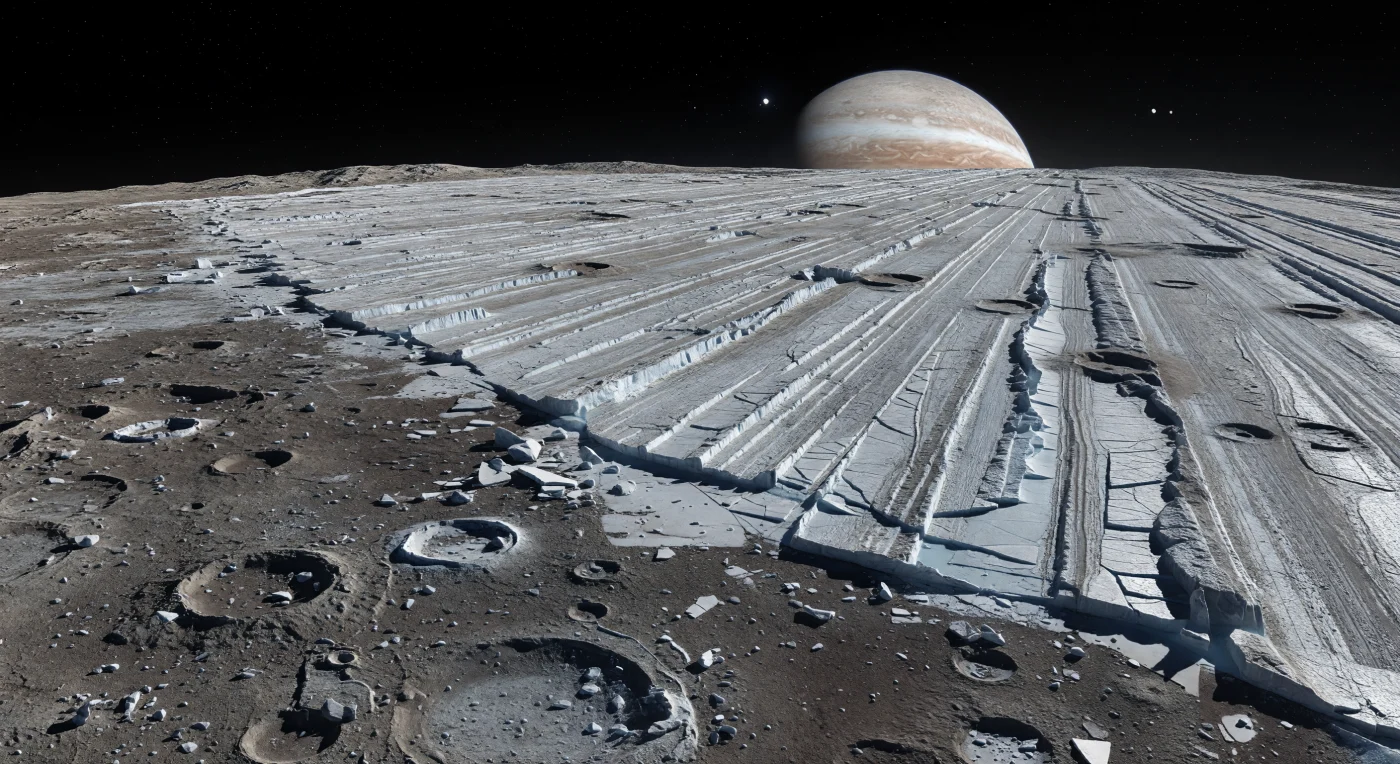
At your feet, the frontier between two ancient worlds is frozen in place: dark, heavily cratered crust of dirty ice and rock—brown-gray, charcoal, and faintly rust-stained—breaks abruptly against a luminous swath of younger grooved terrain, where parallel ridges, troughs, and fault scarps slice diagonally toward the horizon. Subdued crater rims and embayed crater remnants show where older impact scars were partly flooded and overprinted by tectonic resurfacing, while angular boulders of water ice mixed with darker silicate debris sit in crisp, elongated shadows cast by the small, distant Sun. This stark contrast records a long history of internal stretching and faulting in an icy lithosphere, with bright frostier ice exposed along scarps and lineations while the darker terrain preserves an older surface altered by impacts and radiation. Above the airless plain, the sky is pure black and unnervingly clear, stars glimmer in daylight, and a gigantic banded Jupiter looms over fault-bounded icy plains and distant crater walls, making the scale of this frozen tectonic boundary feel immense and profoundly alien.

From the sharp rim of this relatively young crater, a blanket of fresh water-ice ejecta blazes white with a faint cyan tint, draped over jagged shattered blocks, coarse frost, and patches of older brown-gray, silicate-rich icy ground exposed between the splashes of brighter debris. The crater’s steep walls and stepped slump terraces fall away into a vast interior swallowed partly by black shadow, their crisp edges preserved by low gravity, frigid temperatures, and an almost nonexistent atmosphere that leaves sunlight unsoftened and shadows razor sharp. Around the rim, scattered secondary pits, broken boulders, and subtle linear grooves in the surrounding plains hint at a crust shaped not only by impacts but also by ancient tectonic stretching in ice as hard as rock at these temperatures. Above it all, against a perfectly black sky, the Sun shines as a small hard disk while an immense banded giant looms over the horizon, making the frozen silence and monumental scale of the scene feel both starkly scientific and profoundly alien.

A long, ruler-straight rift cleaves the frozen crust, its parallel scarps rising in pale walls where fresh breaks expose brilliant water ice that flashes in the low Sun, while angular blocks and cryogenic rubble spill down onto a darker floor of dust-laden ice and regolith. In this airless cold, nothing softens the view: shadows fall as black blades, the horizon stays razor sharp, and every fracture, boulder, and frost-coated shard stands out under severe side-lighting. The trough is a tectonic wound in an ancient icy shell, where stretching and faulting have opened the surface and left bright clean ice beside older terrain darkened by silicate dust, irradiation, and slow space weathering. Beyond the chasm, subdued ridges, troughs, and softened impact scars spread for kilometers beneath a black sky, while the low gravity lends the shattered cliffs an uncanny height and crispness that make the landscape feel both monumental and eerily still.
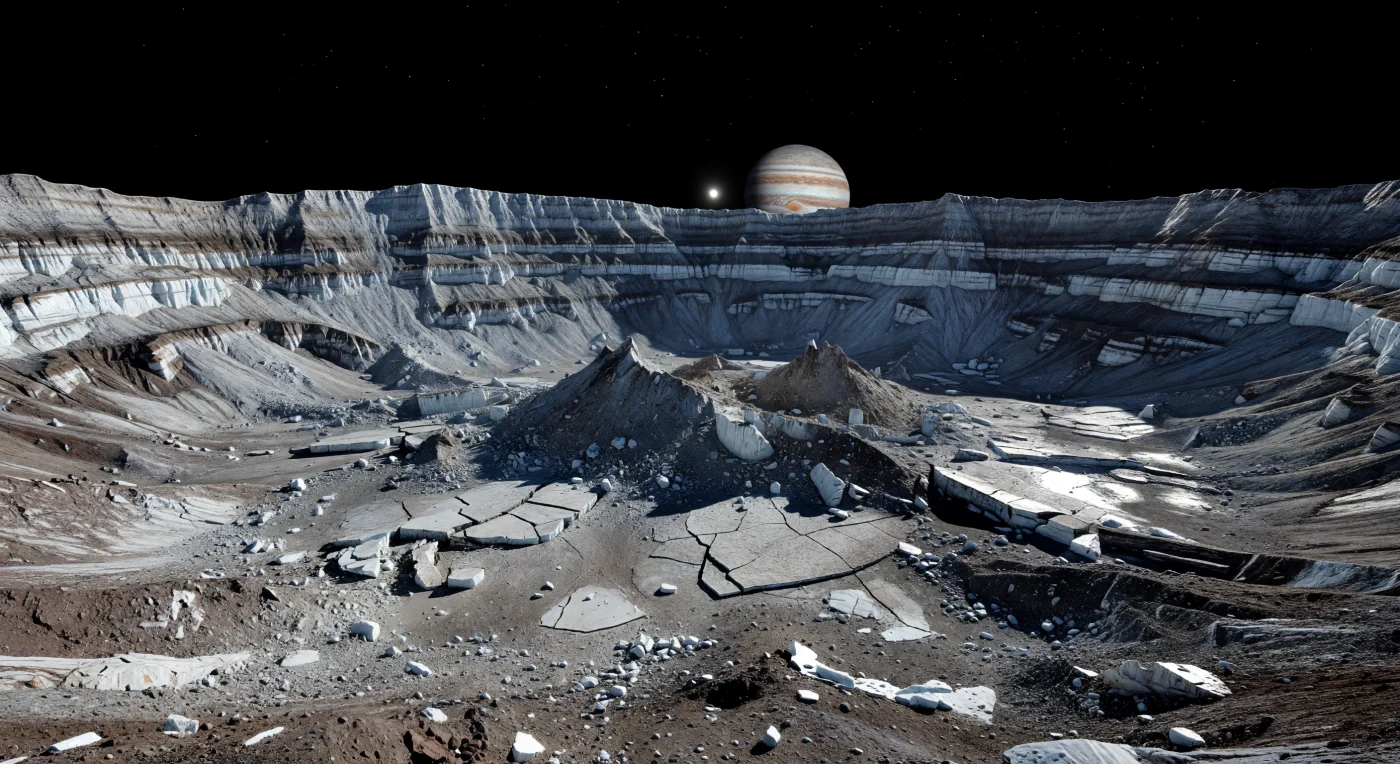
You stand within a vast shattered bowl where steep terraced walls rise in frozen concentric steps, their scarps exposing bright water ice, bluish frost, and darker bands of ancient silicate-rich crust that were excavated and uplifted by the impact that formed this complex crater. Across the broad floor, angular ice blocks, coarse breccia, scattered boulders, and polygonal plates are split by narrow black fissures, while a modest cluster of jagged central peaks marks the rebound of the crust in this low-gravity, ice-rock target. With essentially no atmosphere to soften the view, every distant rim segment remains unnervingly sharp beneath a perfectly black sky, where a smaller, hard white Sun throws long ink-dark shadows and makes clean ice faces flash with cold brilliance. Above the rim looms a huge banded Jupiter, turning the crater interior into a silent frozen amphitheater of hard vacuum, ancient impacts, and immense planetary scale.

At the foot of a colossal escarpment, fractured walls of water-ice bedrock tower overhead in pale gray and bluish-white layers, their ledges, vertical cracks, and frost-bright breaks dropping angular debris across a dark, rubble-strewn plain. The ground is a frozen mix of radiation-darkened regolith, coarse icy grains, and silicate-rich lag, interrupted by subtle tectonic grooves, softened old craters, and occasional brighter patches where fresher ice has been exposed. In the weak sunlight this far from the Sun, illumination is harsh and precise: a tiny brilliant solar disk hangs low above the horizon, carving knife-edged shadows that make the cliff seem even taller in the moon’s low gravity. Beneath a black vacuum sky, with only faint icy glints and the immense banded presence of Jupiter overhead, the landscape feels silent, airless, and immense—a tectonically broken shell of ice preserving the history of impacts, stress, and relentless space weathering.
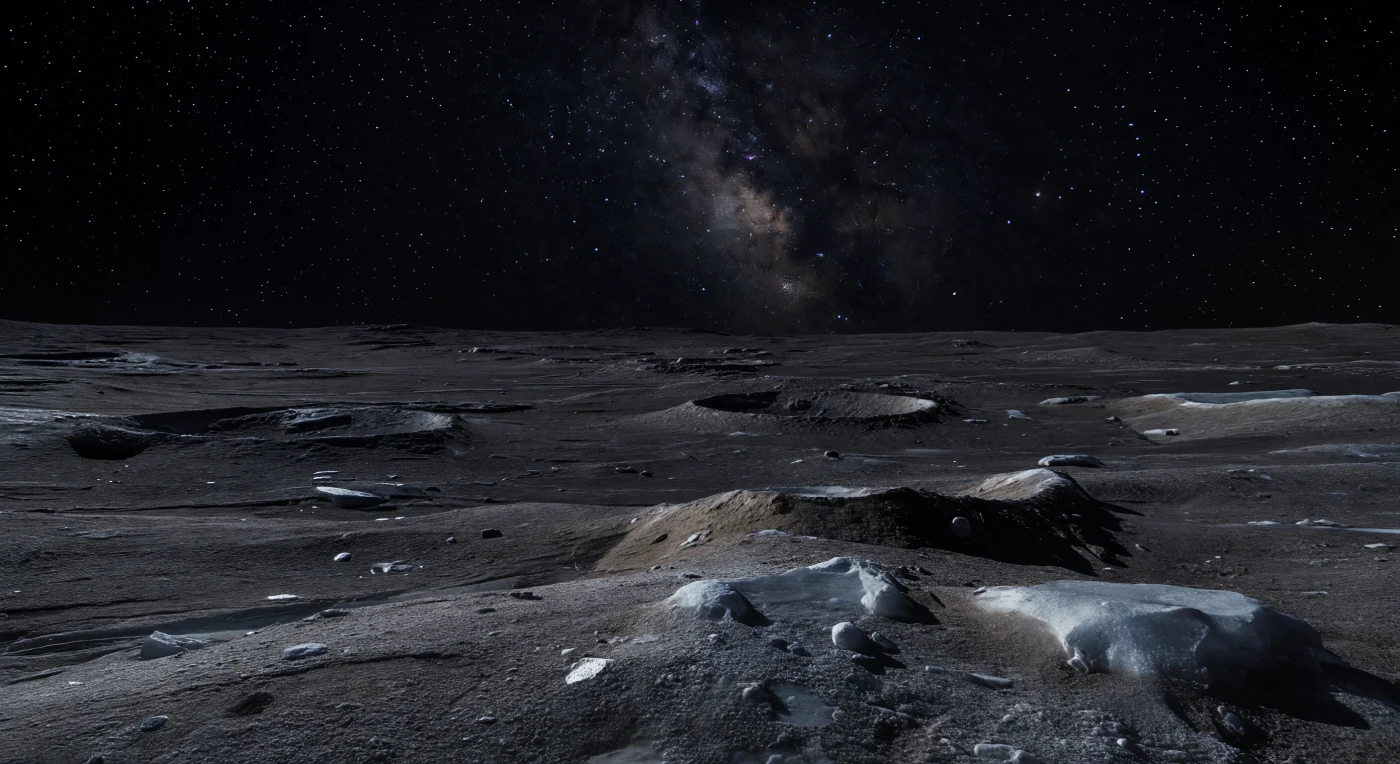
Here on the hemisphere where the giant primary never rises, the surface is almost swallowed by darkness: a close foreground of brittle, frost-dusted grains, angular ice-rock fragments, and shallow micro-craters lies in muted gray-brown tones, with only faint silvery-blue glints betraying the presence of water ice. Low hummocks and softened crater rims emerge only gradually from the blackness, their subdued shapes recording an ancient dark terrain built from heavily space-weathered icy crust, silicate-rich regolith, and countless impacts that have churned and buried the surface over billions of years in the absence of wind, weather, or liquid erosion. Under weak gravity, ejecta blocks and subtle fracture traces remain crisp yet worn, while the cratered plain seems to fade endlessly into shadow. Above it all, the vacuum sky is an abyss of razor-sharp stars and dense Milky Way dust lanes, so brilliant against the black that you feel suspended on a frozen, airless world at the edge of light itself.
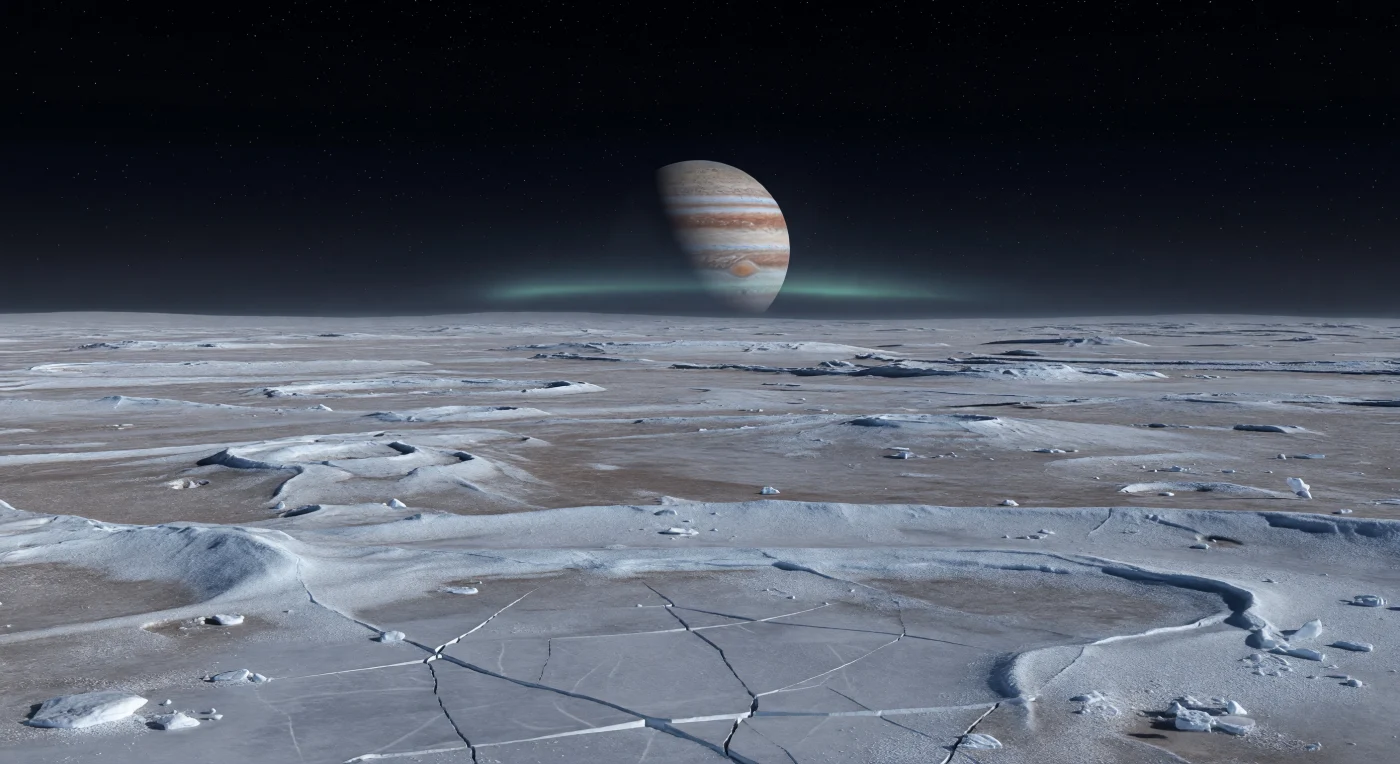
Under a black, star-crowded sky, a frozen plain stretches away in muted gray, blue-white, and brown-gray tones, its brittle polygonal cracks, low frost-softened ridges, scattered ice blocks, and shallow pitted hollows picked out by the faint glow of Jupitershine. The ground is a hard mixture of water ice and darker, silicate-rich, radiation-altered debris, dry and crystalline in the vacuum, with no air, no drifting snow, and no liquid—only an immense, silent crust shaped by impacts, tectonic grooving, and relentless space weathering. Farther out, subdued crater rims and long troughs fade into the darkness, their relief subtly sharpened by low gravity, while Jupiter hangs huge near the horizon, its banded disk casting a dim, cold light across the frost. Just above that horizon, a thin bluish-green arc of oxygen aurora glows faintly—an understated signal of charged particles interacting with this moon’s rarefied exosphere and intrinsic magnetic field, lending the scene an eerie, electrified stillness.

At the day-night boundary, the bright grooved plains rise and fall in long, parallel bands of frozen bedrock, each ridge blazing on its sunward face while its opposite slope vanishes into pitch-black shadow, turning the ground into a vast striped pattern that runs for kilometers to the horizon. Under a star-filled black sky, a tiny hard-white Sun skims low above the landscape, and the enormous banded disk of Jupiter looms overhead, dwarfing any familiar moon and emphasizing the scale of this airless, low-gravity world. Up close, the surface is a brittle mosaic of bluish-white water ice, dirty frost, dark silicate-rich dust trapped in troughs, angular shattered blocks, and small impact pits scattered across terrain that has been pulled, fractured, and resurfaced by ancient tectonic stresses. With no atmosphere to soften the light, every crest flashes coldly, every hollow drops into near-absolute darkness, and the repeating grooves feel both geologically precise and profoundly alien, like standing inside a frozen record of planetary forces.
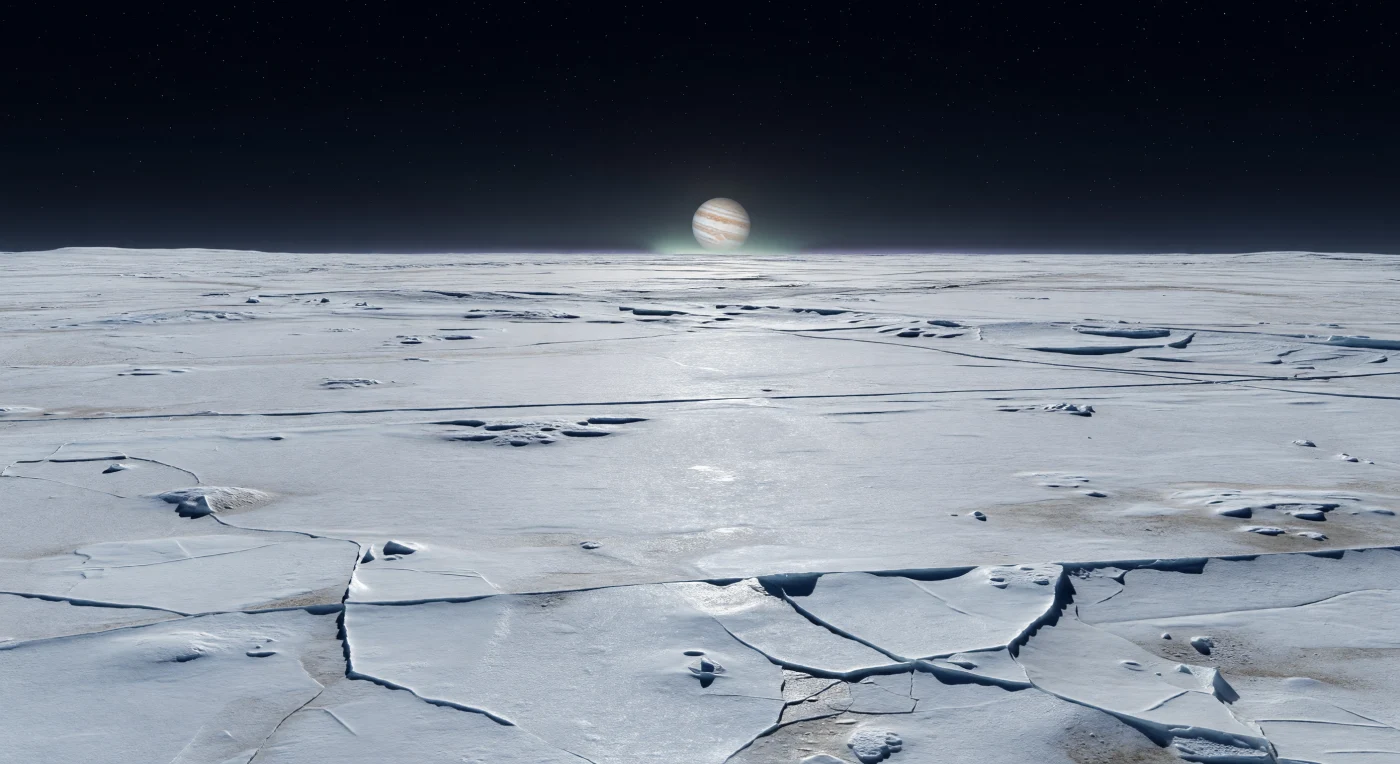
Under a Sun that hangs low as a hard, distant point, an immense polar plain of water-ice bedrock stretches away in white and pale blue-white veneers, its surface broken into brittle polygonal plates divided by narrow charcoal-gray fissures. Frost crystals flash against the shadows, while scattered icy hummocks, faint grooved bands, low ridges, shallow troughs, and softened crater rims reveal a crust shaped by tectonic disruption, impact gardening, and the slow redistribution of bright frost over older, darker silicate-rich contamination. In the airless cold, every edge remains unnervingly sharp and every shadow razor-long, with no haze, wind, or weather to soften the view—only a black sky, a few faint stars, and perhaps a whisper-thin green-violet auroral veil near the horizon. Low above that horizon, enormous and nearly motionless, Jupiter looms with muted cream and rust bands, making the frozen expanse feel at once desolate, crystalline, and vast beyond instinct.
