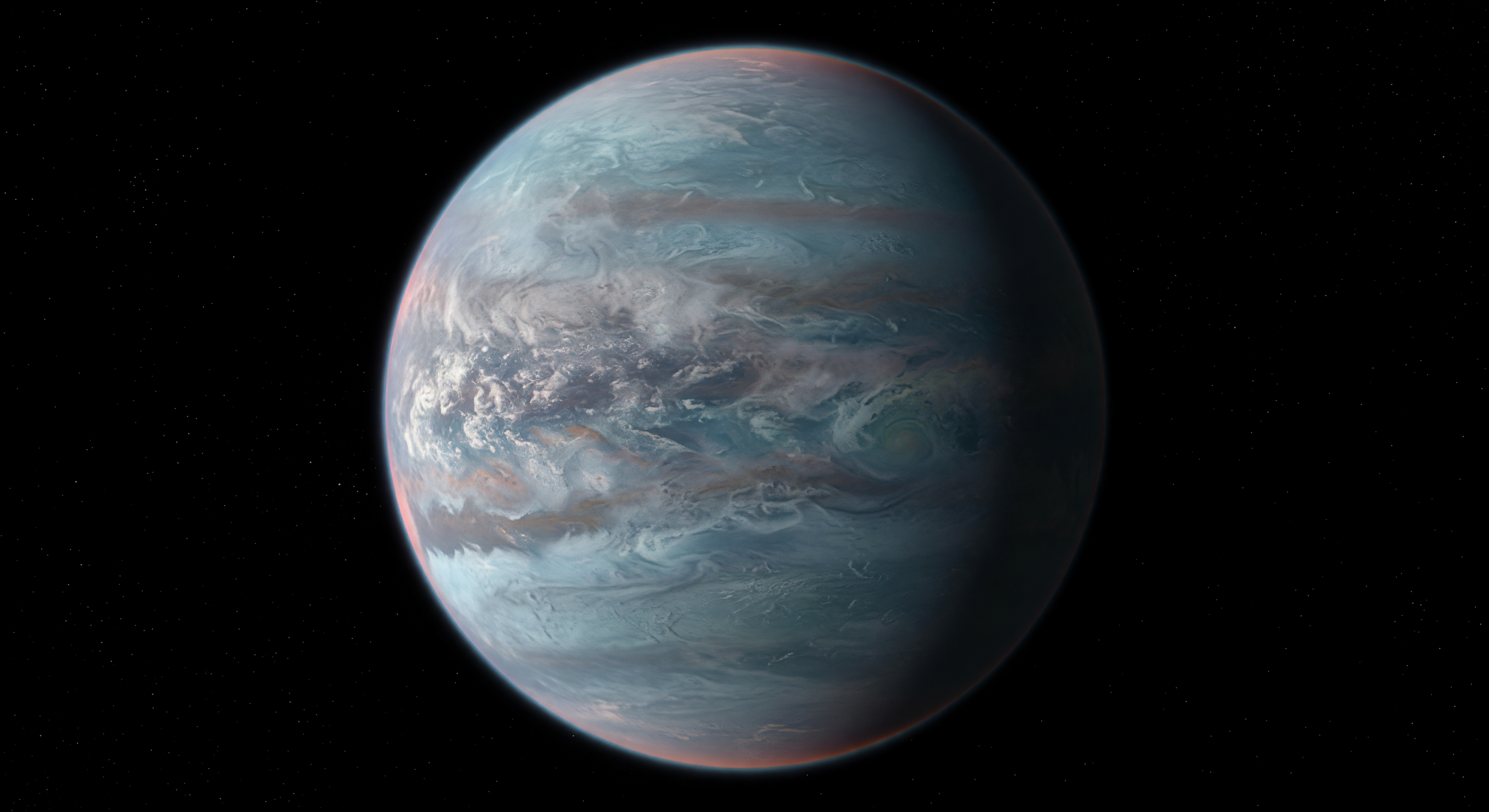
Scientific confidence: Speculative

Inside this planet’s mid-level cloud deck, the world closes in to a few kilometers of glowing amber-cinnamon haze, where immense ragged walls of vapor and shredded fog banks drift through a horizonless atmosphere. A bloated crimson disk of the nearby red dwarf hangs only as a blurred glow behind thick aerosols, its light scattered into soft salmon, rust, and smoky maroon gradients with no sharp shadows anywhere. The towering cloud columns and layered veils are not weather above a surface but the landscape itself—an immense envelope of high-metallicity gases, condensates, and photochemical hazes suspended over deeper, darker cloud abysses. With no rock, ocean, or ice in sight, the scene feels like floating inside a colossal, humid furnace of turbulence and condensation, where convection sculpts kilometer-high vapor architecture in a world likely hiding superheated, high-pressure water-rich layers far below.

An endless ocean of cloud stretches in every direction, its matte surface rippling in silver-gray, warm cream, and faint rose-beige swells that rise into kilometer-high convective domes before sinking into darker troughs of haze. Above this roof of condensates, the local red dwarf hangs as an enormous orange-red disk in a dense maroon sky, its light heavily filtered by metallic haze so that the entire scene glows with a muted, rust-colored softness and the horizon dissolves into reddish mist. This is not a landscape of rock or sea, but the visible top of a deep volatile envelope: thick, high-metallicity clouds and vapor layers likely shroud hotter, denser fluids below, perhaps grading downward into supercritical water under immense pressure. Standing here in imagination, you would feel suspended over a world with no true surface in sight—only atmospheric architecture on a planetary scale, vast, warm, and profoundly alien.

All around you, the world rises in towering walls of cloud: immense cauliflower-shaped storm bastions billowing up from a lower plain of smooth vapor, their glowing peach and copper flanks lit by the low, oversized disk of a reddish star while their interiors sink into plum-gray shadow and amber smog. There is no ground, no ocean, no horizon in any familiar sense—only layer upon layer of dense atmospheric structure, with dark chasms, rolling fog banks, and sheared bands of mineral-rich mist hinting at convective towers that may climb for tens to hundreds of kilometers. In this hot, high-pressure sub-Neptune atmosphere, the “landscape” is built from superheated steam, photochemical haze, and high-metallicity condensate clouds, likely suspended above a hidden envelope of supercritical water rather than any accessible solid surface. The result feels both majestic and oppressive: a realm where mountains are made of weather, valleys are pockets of shadowed vapor, and distant ranks of storm towers fade into a red-gold murk beneath the huge, dim ember of the host star.

Here, there is no ground at all—only a vast, nearly level deck of molten-copper fog stretching to the horizon, its softly rippled surface broken ahead into immense vapor escarpments that plunge without warning into blue-black cloud chasms on the nightward side. A bloated reddish star hangs fixed on the horizon, half-smothered by photochemical haze, and its low copper light slices sideways through layered mist to outline towering convective columns, anvil-shaped cloud tops, and drifting metallic veils tens of kilometers high. This is the exposed face of a tidally locked sub-Neptune with a high-metallicity, haze-choked atmosphere: a world where thick clouds and suspended droplets flatten the spectrum, no solid surface is visible, and deeper gaps may hint at a hot supercritical water envelope below. Standing in this permanent twilight belt would feel like hovering above the edge of an atmospheric ocean, where rust, ember-orange, smoky violet, and indigo fade within a few kilometers from glowing fog plains into planet-scale darkness.

Under a black vault crowded with sharp stars, an immense cloud plain stretches to the horizon, its surface a smooth sweep of steel-gray, charcoal, and violet-black swells with no land or ocean anywhere—only atmosphere shaped into dark, rolling topography. This world is thought to be a volatile-rich sub-Neptune with a dense, high-metallicity atmosphere, so the “ground” here is likely a lofty cloud deck of thick aerosols and condensates suspended above far deeper, hotter layers rather than any solid surface. A faint maroon thermal glow seeps along the lowest horizon where heat redistributed from the dayside outlines distant ridges of haze, while isolated violet-white flashes reveal storm cells buried within the clouds. The effect is vast and unsettling: a planetary weather system frozen into a dim, endless night, where even the quietest contours suggest crushing depth, heavy air, and a world built almost entirely of sky.

From this lofty perch within the upper atmosphere, the world below resolves into no solid ground at all, only immense parallel ribbons of cloud and haze streaming beyond the horizon, their cream, dusty teal-gray, mauve, rust, and charcoal layers combed into thousand-kilometer bands by violent superrotating equatorial winds. The thick, high-metallicity atmosphere is loaded with condensate hazes and photochemical aerosols, so the “landscape” becomes pure vapor topography: anvil-like cloud banks, scalloped wave fronts, braided shear zones, and feathered filaments peeling off into darker troughs that hint at a deeper, hotter envelope where water may exist not as ocean or ice, but as supercritical fluid under crushing pressure. Overhead, a huge reddish-orange stellar disk glows through bronze and salmon haze, its filtered light washing the ribbon fields in diffuse coppery illumination and soft shadows that emphasize the planet’s vast curvature. Standing here would feel like hovering above an endless storm-built continent made entirely of atmosphere—beautiful, immense, and profoundly unearthly.

You are suspended above an abyss with no floor, peering down between colossal storm columns that rise like canyon walls of dark smoke, their layered hazes stained charcoal, rust, and copper under a dim blood-orange glow filtering from a distant opening far overhead. Here the “landscape” is entirely atmospheric: towering escarpments of cloud, plunging curtains of vapor, and vast convective cells sculpted by violent circulation in a hot, high-metallicity, water-rich envelope where no solid surface is visible or likely accessible at all. Fine droplets and metallic haze thicken the air, muting the oversized red-orange disk of the host star while intermittent lightning inside the cloud walls briefly reveals bronze-gray folds and turbulent recesses kilometers deep before the chasm closes back into reddish-black murk. The result is a scene of crushing scale and pressure, an alien descent into a volatile world where weather itself becomes the terrain.

You appear to be suspended inside a global cloud ocean as a colossal, near-circular rupture opens overhead and downward at once, its rim blazing cream, copper, and rose where the swollen haze catches the red-weighted light of the enormous host star. Around it, continent-scale vapor walls, anvil-like shelves, and braided curtains of condensate curl inward, while the opening itself falls away through stacked decks of amber mist, bronze haze, and charcoal-brown cloud until all detail is swallowed by pressure-thickened murk. This is a world with no visible ground at all: observations indicate a deep, high-metallicity, water-rich atmosphere veiled by persistent clouds and hazes, likely descending into supercritical fluid layers rather than any accessible solid surface. Under the diffuse reddish-orange glow, with only soft shafts of light dissolving into the abyss, the scene feels less like weather over a planet than a fleeting wound in an atmosphere hundreds of kilometers deep.

You are suspended in a horizonless realm where atmosphere and ocean seem to lose their meaning, a bronze-black murk of compressed vapor and dense fluid merging seamlessly into one continuous medium. Around you, towering fog banks, descending curtains of condensate, and blurred convection cells drift through layers of charcoal, burnt umber, and iron-red haze, while dark reflective sheens and ghostly plumes hint at supercritical water under crushing pressure and intense heat. Far above, only a dim rust-red glow filters through the metallic smog, with the host star reduced to a swollen, blurred reddish disk whose weak light produces faint copper highlights but almost no shadows. This is the kind of environment scientists infer for a high-metallicity, cloud-shrouded sub-Neptune: not a world with a shoreline or solid ground, but an immense abyssal transition zone where fluid and atmosphere blend into a hot, opaque envelope of planetary scale.
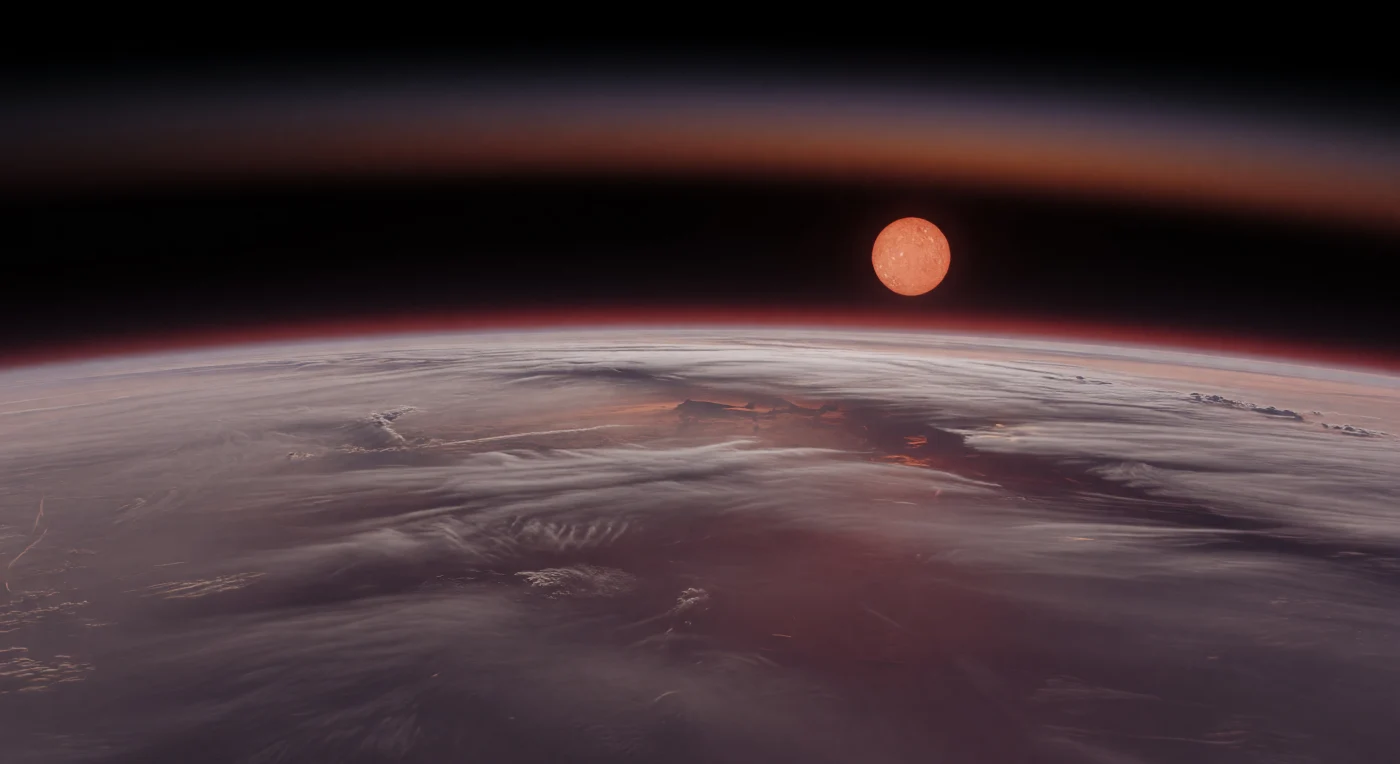
From this lofty perch near the top of the haze, you look out over a world with no shore, no summit, and no solid ground—only a vast, curved expanse of pale gray cloud tops fading into smoky violet and wine-dark depths. Layer upon layer of metallic hazes and volatile-rich aerosols forms smooth terraces, delicate bands, and feathery shear streaks that wrap around the horizon, where the atmosphere ignites into a crimson limb before vanishing into black space. Off to one side, the parent red dwarf hangs immense and dimly fierce, its orange-red disk several degrees wide, casting a coppery, low-contrast glow across the upper cloud deck and emphasizing the perpetual twilight feel of this tidally heated, high-metallicity mini-Neptune. The scene hints at enormous pressures and temperatures far below, where models suggest a deep supercritical water envelope may replace any true surface, making this atmospheric seascape less a sky above a planet than the outer skin of a hot, cloud-shrouded volatile world.