Scientific confidence: Speculative
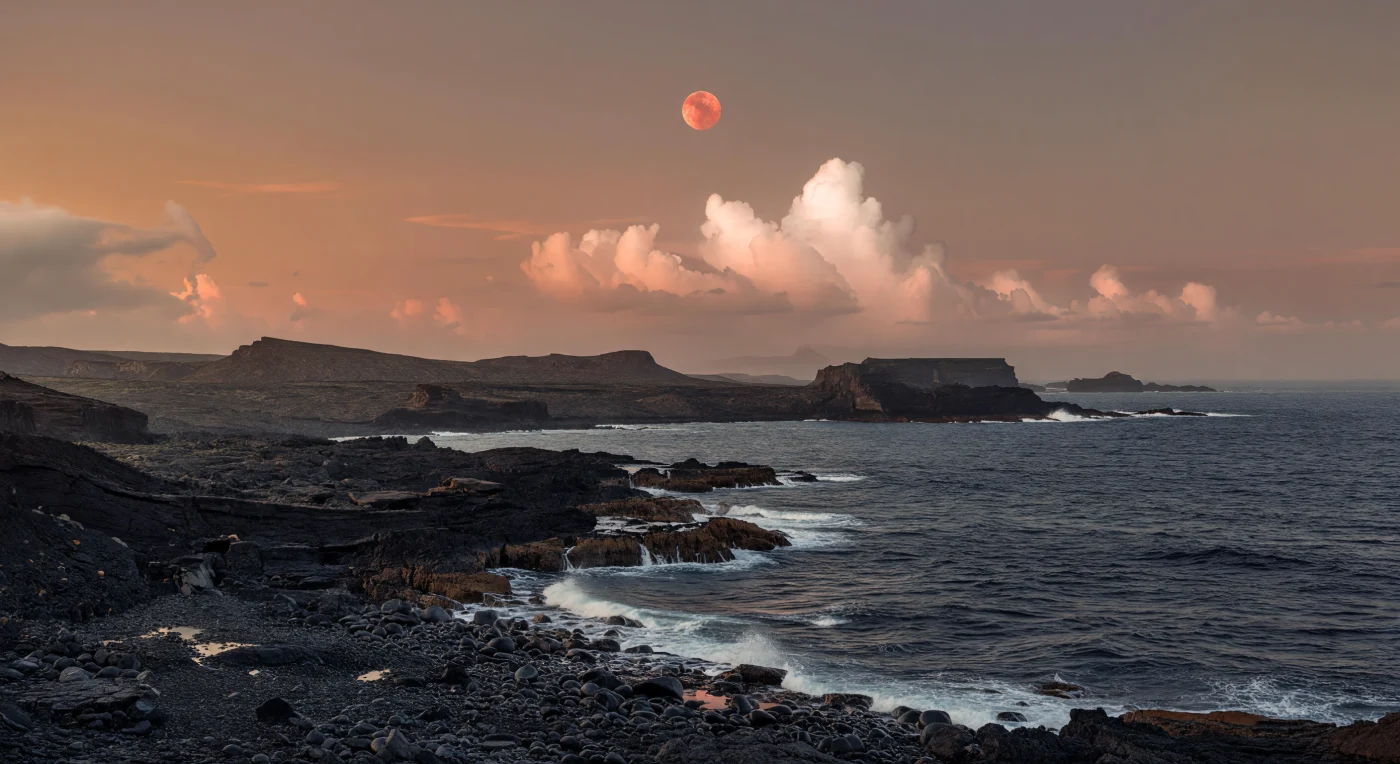
You stand on a shore of black basalt and glassy volcanic rock where dense, compact waves shove a dark steel-blue ocean into fractured lava shelves, leaving pale foam in tide pools and across spray-slick boulders. Overhead, a deep orange-red star hangs broader than the Sun appears from Earth, its dimmer, red-rich light filtered through a moist nitrogen-rich atmosphere into coppery haze and soft shadows that flatten the rugged coast into layers of charcoal headlands and low shield-like rises. Towering convective cloud banks billow above the warm sea, their bright white tops and pink-gray undersides hinting at vigorous evaporation and heat transport on the permanent day side of a likely tidally locked super-Earth. The scene feels immense and heavy: stronger gravity keeps the surf squat and forceful, the rocks massive and grounded, and every wet surface gleams with a subdued metallic glow under an alien sky.
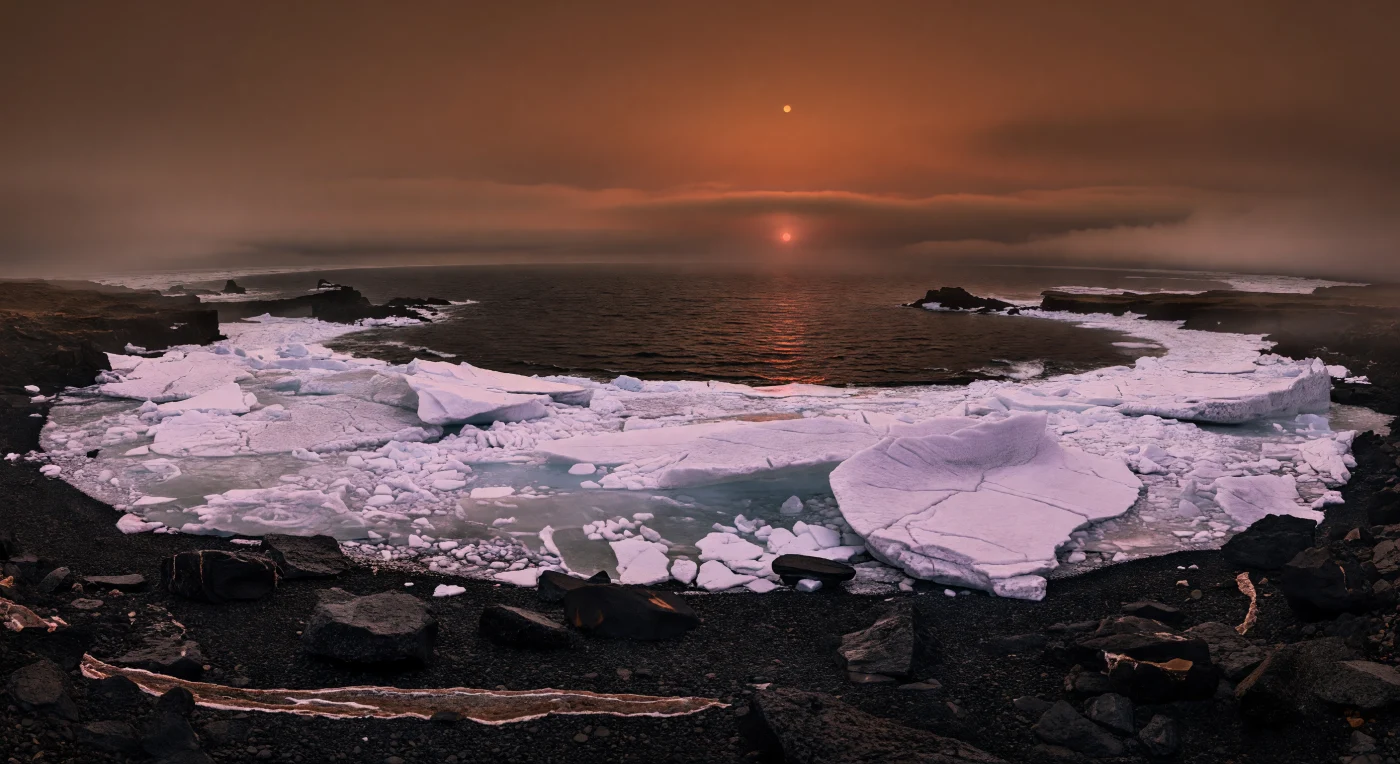
You stand on a tide line between climates: a wet, charcoal-black basalt shore littered with sharp volcanic blocks and mineral-dark gravel, where thin rusty bands of frost and salt trace the ground, and beyond it a chaos of lilac-white pack ice heaves in broken plates and pressure ridges against the coast. Just offshore, a strip of nearly black water remains open beneath the planet’s warmer hemisphere, its low waves catching bronze-red glints from a reddish star that hangs forever near the horizon, softened by a dense, nitrogen-rich atmosphere and drifting sea fog. This is the kind of boundary a tidally locked world may create, where perpetual low-angle light, strong thermal contrasts, and migrating ice concentrate water ice, basaltic dust, and frozen spray into a grinding terminator coast. The shoreline curves away into haze through headlands, frozen inlets, and distant cliffs, making the scene feel immense and austere, as if an entire world is balanced here between oceanic warmth and planetary ice.

A frozen basin of staggering scale spreads into the permanent dark, its gray-white ice plains broken by bluish crevasse bands, wind-sculpted sastrugi, and scattered basaltic boulders that look small only against glacier walls towering far beyond them. Along one horizon, a dim crimson glow marks the distant day-night boundary, the only hint of the red dwarf’s light filtering through a cold, substantial nitrogen-rich atmosphere, while thin ice fog clings to the surface and softens the shadows into bluish-black haze. Overhead, delicate red-violet auroral curtains ripple across a star-filled sky, their reflections trembling on polished ice and pressure-ridged snow. The scene suggests a super-Earth where persistent katabatic winds, deep cold, and immense ice loads have carved continent-scale escarpments, fractured basin floors, and black nunataks rising like islands from a frozen ocean of ice.
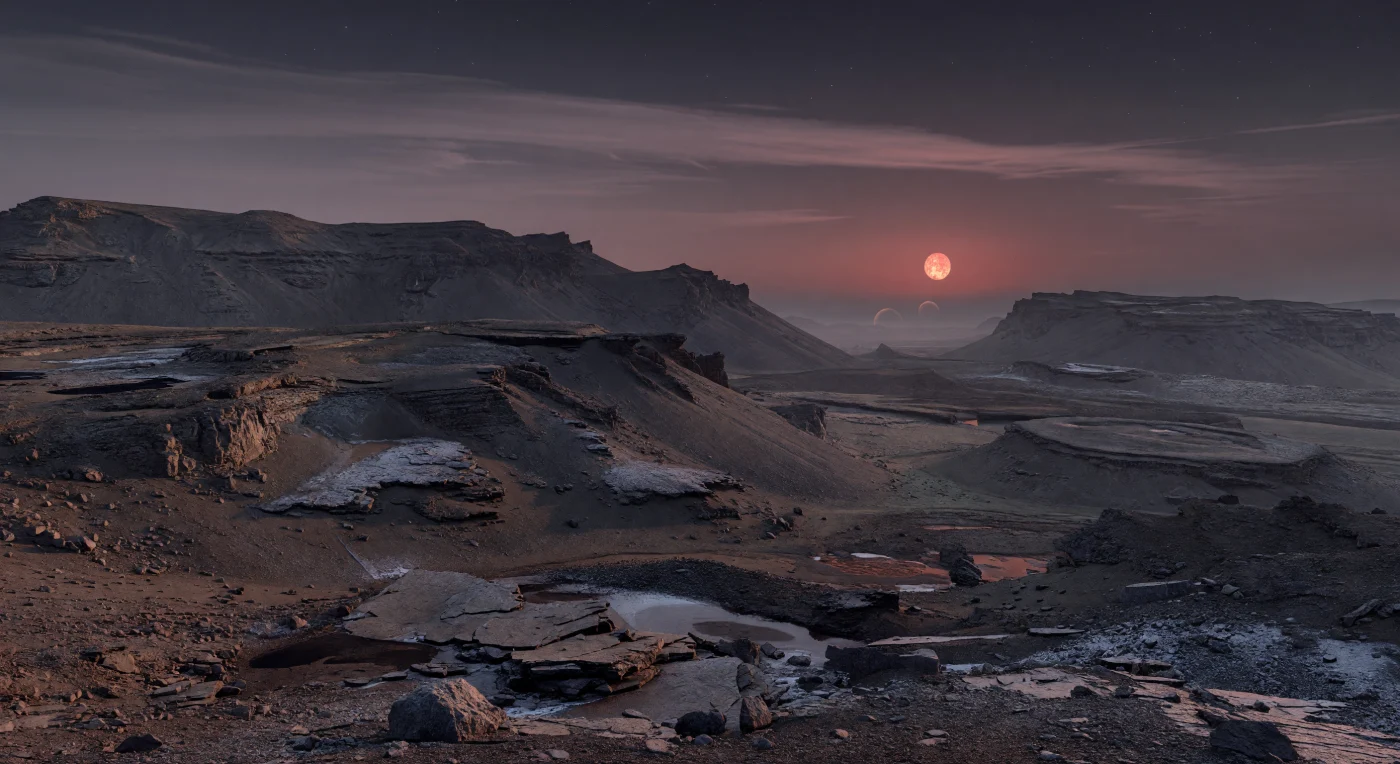
In the terminator highlands, immense dark-gray ridges of basaltic and ultramafic rock rise in overlapping walls, their compact lower slopes choked with rusty scree, shattered talus, and angular boulders dusted here and there with thin, dirty ice preserved in permanent shadow. Stepped escarpments, softened ancient crater rims, and long debris fans speak to a geologically old, heavy-gravity landscape shaped by impacts, frost, and persistent wind working across a nitrogen-rich atmosphere, while weak copper-red light catches only faintly on fractured slabs and sediment-filled hollows. Along one horizon, the oversized red dwarf hangs in eternal twilight behind a crimson-amber glow, casting extraordinarily long, muted shadows; in the opposite direction, the sky thins through mauve and violet haze into blue-black night where the first stars emerge. Standing here, the scale feels immense and austere: kilometer-high ridge walls fading into dusky haze, a world cold, dry, and alien, poised forever between day and darkness.

You stand on a storm-lashed shore of black basalt, where columnar lava, vesicular rock, and volcanic sand gleam under sheets of wind-driven spray, and tide pools hold trembling reflections of a dim reddish star filtered through rain. Beyond the beach, jagged islands and sea stacks of fresh volcanic stone rise from a nearly black ocean, their cliffs scarred by landslides, sea caves, and stacked lava terraces that hint at repeated eruptions and relentless wave attack under the stronger gravity of a super-Earth. Overhead, a dense nitrogen-rich atmosphere feeds a permanent substellar storm shield: immense white cloud towers and layered anvils boil upward into a copper-red sky, glowing red-gold at the edges where the cool red dwarf’s light penetrates, while curtains of rain and salt haze erase the farthest highlands. In this heavy air and crimson daylight, the whole archipelago feels immense, wet, and unquiet—a coastline shaped by volcanism, violent weather, and an ocean that never fully rests.

Fresh black lava plains stretch outward like a broken sea of stone, their ropy pahoehoe crusts and jagged ʻaʻā rubble split by branching fissures that reveal molten basalt glowing orange-red far below. In this high-gravity super-Earth setting, the dense basaltic flows would spread heavily across broad rift zones, building pressure ridges, collapsed lava tubes, spatter ramparts, and low volcanic cones beneath a substantial, likely nitrogen-rich atmosphere. Overhead, a dusty lavender-gray sky scatters the red dwarf’s dim, enlarged light into a muted crimson haze, while steam-laden plumes and ash columns boil upward from the cracks and flatten into layered veils aloft. The immense escarpments on the horizon and the heat shimmering at your feet make the landscape feel both oppressively close and staggeringly vast, as if the planet itself is still being pulled apart and remade in fire.

You stand at the lip of a colossal canyon labyrinth where dense super-Earth crust has fractured into steep, branching chasms, their dark basalt walls striped with oxidized rust and broken into massive jointed faces that plunge into fog-softened depths. In the shadowed ledges and colder recesses, thin frost and translucent ice cling to the rock, hinting that moisture here likely condenses and freezes out of a substantial nitrogen-rich atmosphere rather than flowing as open water, while the canyon floors lie coated in frozen regolith, dark dust, and smooth mineral crusts. The low, reddish dwarf star hangs near the horizon in a smoky copper-mauve sky, casting soft amber sidelight that stretches long muted shadows and ignites faint crimson glints across the ice. Under the heavier gravity implied by this world’s mass, the landscape feels starkly compressed yet immense—sheer cliffs, blocky talus, and serrated highlands rising beyond the maze with a silent scale that dwarfs any familiar desert on Earth.

From the surface of the terminator, you would stand amid an immense sea of black basaltic dunes and dark volcanic glass, their crescent ridges, rippled flanks, and steep slip faces carved by persistent winds in a cold, dense atmosphere. A broad copper-red star hangs forever near the horizon, casting soft but strongly directional light that paints ember tones across the brighter rim of the sky while smoky violet shadows stretch knife-like toward the planet’s night side, where the land fades into indigo-black gloom. Scattered basalt boulders, obsidian-like blocks, and fractured lava outcrops interrupt the sand, hinting at volcanic bedrock and ash-rich deposits that have been ground, sorted, and sintered into a dry, mineral-rich surface with no visible water. In the far distance, haze-veiled volcanic highlands rise faintly beyond dune chains that seem to run without end, giving the landscape a vast, austere grandeur unlike any desert on Earth.
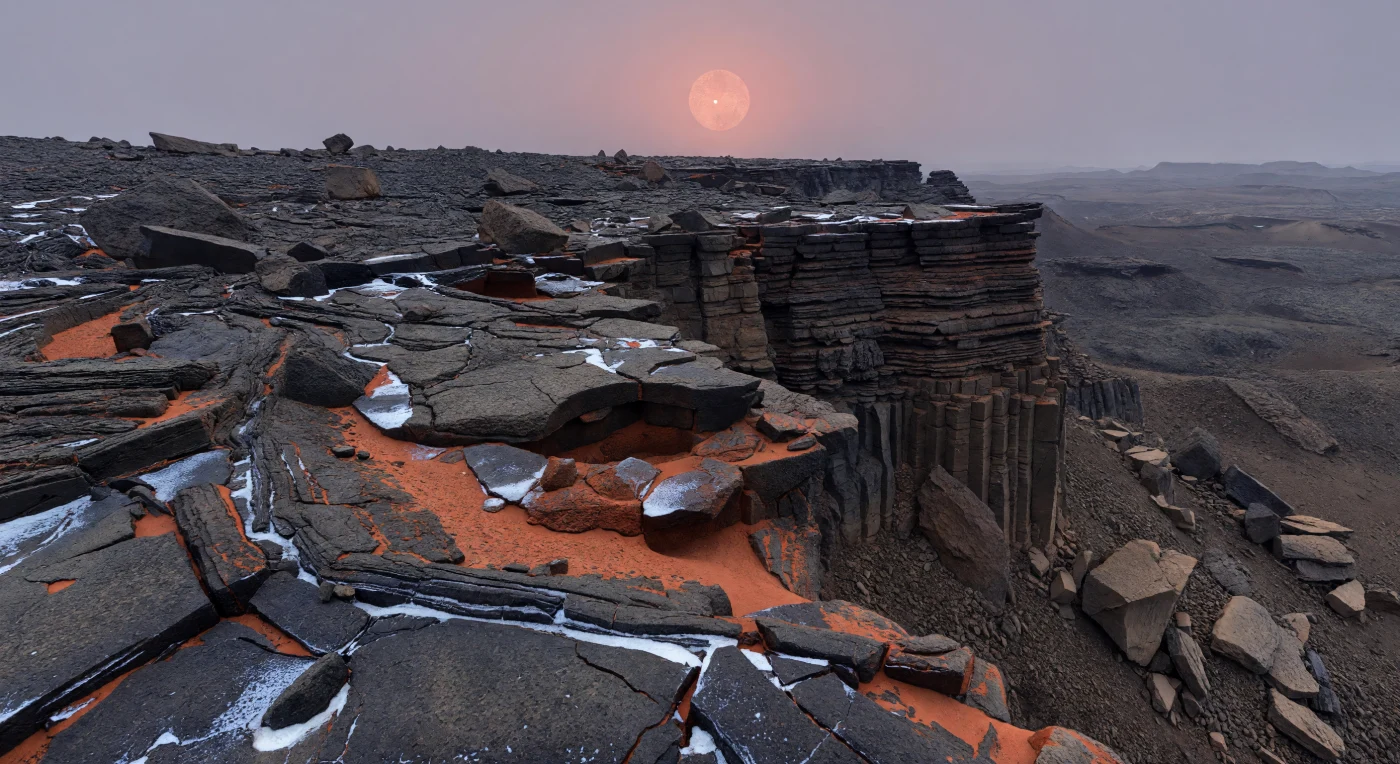
You stand on a dark volcanic tableland where charcoal-black basalt has cooled into fractured plates and pressure ridges, their rough vesicular surfaces dusted with reddish iron oxides and stitched by pale frost lodged in contraction cracks. Ahead, the plateau breaks abruptly into a scarp hundreds of meters high, revealing stacked flood-basalt layers, columnar joints, and boulder-strewn talus that descend toward immense cold plains marked by low shieldlike rises and distant cratered hollows. The subdued orange-red light of the nearby dwarf star, filtered through a substantial nitrogen-rich atmosphere, turns the sky a muted lavender gray and casts soft shadows that flatten nothing so much as emphasize the world’s immense, heavy stillness. In this thin haze and long-range clarity, every ledge and fallen block hints at a geologically powerful past of extensive volcanism, later fractured by cooling, uplift, and cold-trapping frost in sheltered stone.
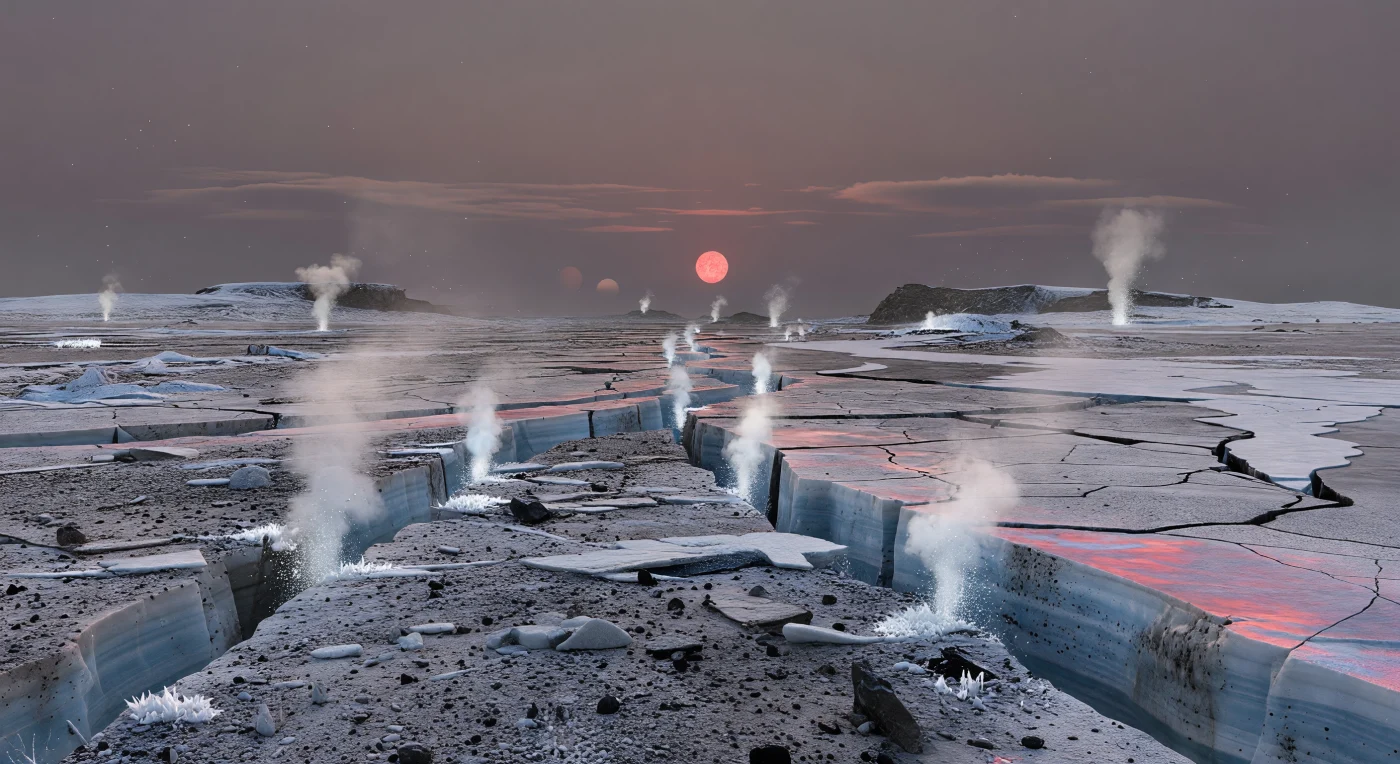
At ground level, the plain feels immense and heavy under higher gravity: a jumbled pavement of blue-white water ice and dark rocky cryoclastic debris is split by ruler-straight rifts, where collapsed slabs, pressure ridges, and low hummocks lead the eye toward distant ice-capped uplands. Along the fracture walls, layered translucent ice stained with silicate dust and black mineral grains glows rose and violet in the weak, low light, while active fissures release white vapor and glittering ice crystals that drift through a cold, dense, nitrogen-rich twilight atmosphere. The broad grabens, polygonal cracked plates, and frozen cryolava flows suggest a geologically young surface shaped by tectonic stress and cryovolcanism, as volatile-rich material from below repeatedly breaks through the crust and freezes in place. Over it all, the salmon-red dwarf star hangs permanently near the horizon in a mauve and smoky-rose haze, casting soft-edged crimson light across a world that feels both frozen and restless.

Across the frozen ocean plain, jagged pressure ridges of water ice rise in chaotic, overlapping walls and heavy hummocks, their dirty white frost and blue-gray glacial faces streaked with darker mineral dust and cryogenic sediment. In the low, permanent red light near the terminator, wind drives spindrift through narrow troughs between shattered crust plates, ice boulders, and sastrugi, while thinner edges of ice catch a faint internal glow beneath the scarlet illumination. These ridges likely form where a thick ice shell is compressed and buckled by stress in the frozen surface, with the world’s stronger gravity keeping the relief compact and massive rather than towering. Above it all, a nitrogen-rich atmosphere softens the scene into copper-red haze and mauve twilight, making the immense icefield feel both silent and crushingly vast, as if the horizon itself has been folded and heaved by a planet-sized winter.

At ground level, the basin spreads out as a maze of shallow braided streams and still, mirror-dark pools threading through black basaltic sediment, charcoal mud, and rusty mineral crusts, with rounded volcanic boulders and fractured bedrock shelves protruding from the wet flats. A dense nitrogen-rich atmosphere and persistent humidity would soften the view with silver fog, while the red-dwarf light above filters down as a muted peach-red glow, turning reflections in the water to copper, salmon, and smoky gray instead of Earthly blue. The dark plains and low cratered walls suggest a landscape built from volcanic rock, then reworked by flowing water, chemical precipitation, and repeated cracking from drying or freeze-thaw cycles in a temperate but uncertain climate. With the reddish star hanging low through haze and the far ridges dissolving into mist, the whole wetland feels immense, quiet, and profoundly alien—as if you are standing at the edge of a habitable world still half veiled from understanding.
