Scientific confidence: Low
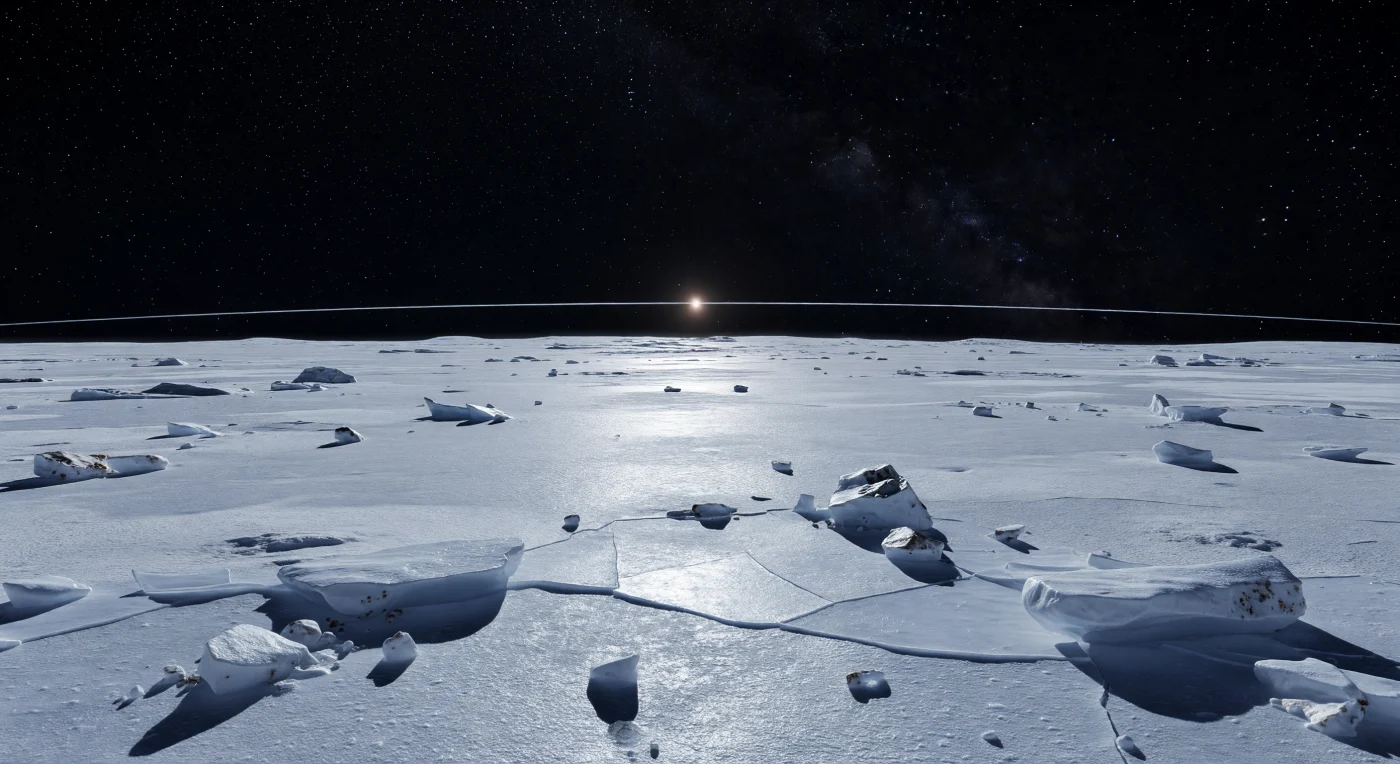
At equatorial noon, an immense plain of bluish-white crystalline water ice gleams like broken glass, its hard crust split into polygonal plates and scattered with angular blocks whose sharp edges have survived unchanged in the airless cold. The horizon curves away strikingly fast under a pitch-black sky, a reminder of the world’s small size and rapid rotation, while a tiny, dazzling Sun casts razor-edged blue-black shadows across frost veneers, shallow impact pits, and low ridges of uplifted ice. Here, at roughly 40 kelvin, there is no wind, no liquid, and no erosion—only ancient impact debris, slow regolith migration in weak gravity, and a surface dominated by highly reflective crystalline water ice with occasional darker rocky fragments from long-ago collisions. Overhead, stars and the Milky Way remain visible in full daylight, and a narrow ring slices across the sky as a perfectly thin luminous line, making the frozen landscape feel both pristine and profoundly alien.

From within this frozen scarp belt, the ground breaks away into arrow-straight troughs and staggered walls of dazzling water ice, their rubble-filled floors littered with angular blocks, granular frost, and faint streaks of darker organic dust caught in the cracks. These immense fractures likely record a crust stretched by intense rotational and tectonic stresses, where weak gravity allows unusually steep, sharp-edged cliffs to stand in brilliant layered ice, with occasional darker rocky fragments exposed among the reflective strata. Under temperatures near 40 K and a sky of pure vacuum, the tiny distant Sun casts only a cold, feeble light, yet every edge throws a razor-black shadow across the glassy surface and makes the pale blue-white ice glitter against the close-curving horizon. Above the black skyline, a single bright point—Hiʻiaka—hangs among dense stars, deepening the uncanny sense of standing on a small, fast-spinning world whose ancient crust has been split open on a colossal scale.

At the crater’s edge, the ground falls away into a startlingly fresh bowl gouged from dazzling crystalline water ice, its raised rim piled with fractured white and blue-gray blocks that gleam under a tiny, distant Sun. Steep interior walls descend in glassy, brittle terraces to a floor swallowed by absolute black shadow, while long rays of newly blasted ejecta streak across the plain as bright bands of frost, splintered ice, and glittering debris spread far by weak gravity. With no atmosphere to soften the light, every edge is razor-sharp: the nearby horizon curves unnervingly close, stars and the Milky Way burn in the black sky even in daylight, and a thin pale ring hangs overhead as a reminder of this small body’s unusual dynamics. The scene is both beautiful and violent, preserving in near-perfect clarity the aftermath of a recent impact on an ancient, airless surface where erosion is almost absent and clean water ice can remain exposed for immense spans of time.

Under a black sky where stars blaze even in daylight, the ground is a shattered pavement of intensely reflective crystalline water ice, broken into sharp white and blue-gray slabs split by ink-dark fractures and separated by hollows filled with muted maroon, rusty brown, and gray-red frost. This rough, patchy drape of darker material marks the inferred dark red spot: likely ice contaminated by complex irradiated organics and other impurities, pooled in low areas and partly infilling small crisp-rimmed craters across the brighter, cleaner substrate. In the weak gravity and brutal cold of roughly 40 K, every boulder, shard field, and hummock sits in perfect stillness beneath razor-edged shadows, while the close curved horizon hints at the body’s small size and rapid rotation. Overhead, a thin luminous ring cuts across the star-packed void and tiny moons glint like distant beacons, making the frozen landscape feel both exquisitely pristine and profoundly alien.

At this fractured, elongated end of the dwarf world, brilliant white-to-blue water-ice bedrock rises in jagged fins and knife-edged ridges, split by deep tension cracks and bordered by collapsed scarps, while perched boulders and loose talus cling to steep slopes as if gravity barely holds them in place. The close, strongly curved horizon makes the landscape feel small and oddly stretched, a visible consequence of the body’s rapid rotation and weak, uneven surface gravity, which help preserve sharp relief and precarious slope instability on this ancient, airless terrain. In the pure black sky, dense stars and the bright band of the Milky Way remain visible beside a tiny, fiercely bright Sun, whose hard white light glints off crystalline H2O ice and throws monolithic blocks and fracture walls into ink-black shadow; a thin icy arc of the ring and one or two distant moons hang silently above. At roughly 40 K, with no atmosphere to soften light or erode the surface, every frost-coated outcrop, impact pit, and glittering grain appears frozen in exquisite detail, untouched for billions of years.

At your feet, a maze of brilliant, broken water-ice blocks rises from hand-sized shards to towering megaboulders tens of meters across, their fractured faces flashing silvery light while powdery frost and sparkling ice grains linger in black, permanent shadows between them. The ground is a pristine mix of hard reflective H₂O ice bedrock, slabby ancient ejecta, and thin pale-gray icy regolith, with subdued impact scars and collapsed rubble ridges hinting at a surface shaped by old collisions, extreme cold, and billions of years in an airless vacuum. The horizon curves away surprisingly close, and the odd tilt of the slopes, along with a few delicately balanced blocks, reveals how weak gravity and rapid rotation can subtly reshape an icy world. Above this frozen wilderness, the sky is an absolute black crowded with stars, a bright sweep of the Milky Way, a hairline ring arc, and tiny distant moons, while the far Sun shines only as a fierce point casting long, razor-edged shadows across the silent boulder garden.

You stand on a broad plain of brilliant crystalline water ice, its hard sintered frost and shallow sublimation pits preserved perfectly in the windless vacuum, while scattered angular boulders rise as black silhouettes against a faint silver-blue glow. The surface is astonishingly reflective for such a distant world, and under the weak moonlight of Hiʻiaka and the subtle icy ringshine, even warped plates of fractured ice and low hummocks glint with cold, bluish highlights. Above the strongly curved horizon imposed by low gravity and small size, the ring cuts across the black sky as a razor-thin luminous thread, while countless stars and the Milky Way remain unnervingly sharp in the airless darkness. It is a landscape of frozen stillness: ancient impact scars softened by redistributed frost, darker rock-rich blocks embedded in near-pure water ice, and a silence so complete that the entire plain feels suspended outside time.
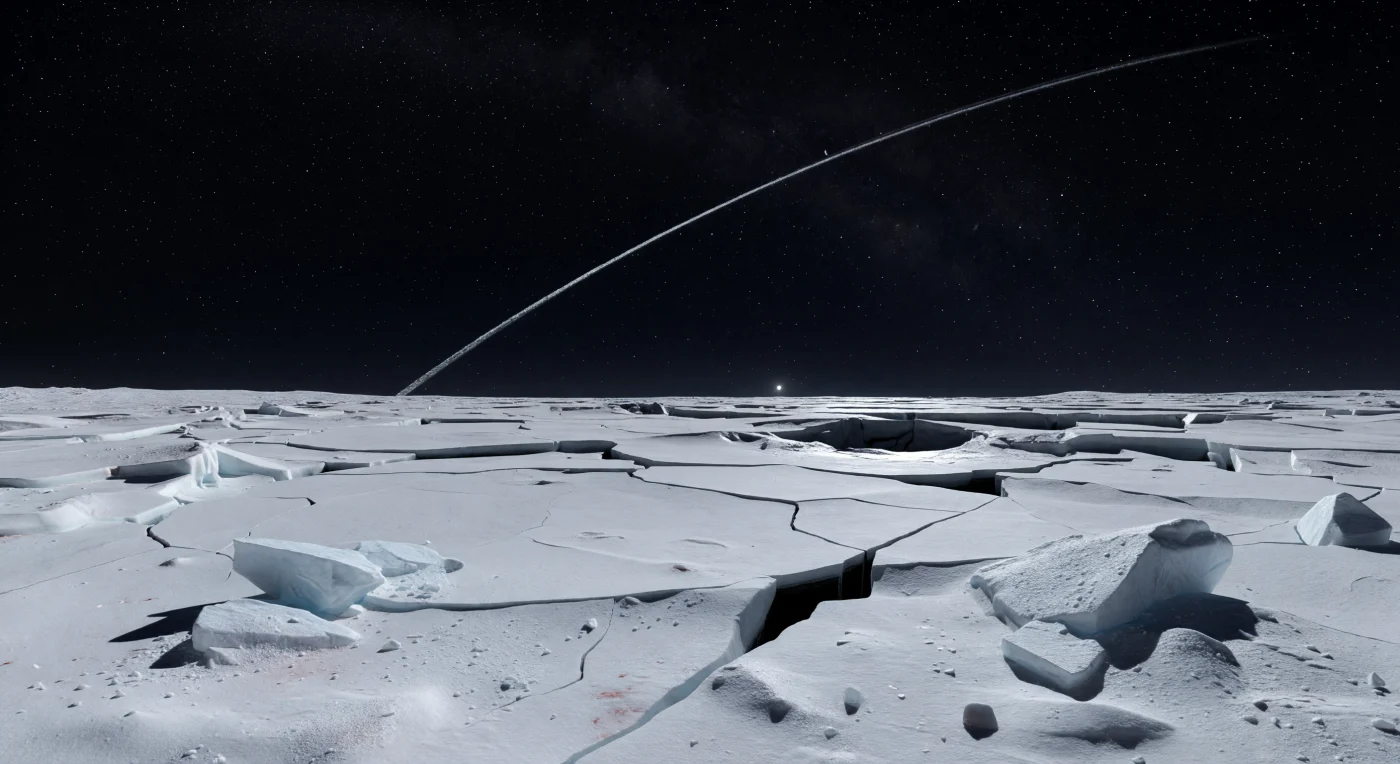
From this high, broken plateau, the ground is a blinding expanse of crystalline water ice split into broad polygonal plates, pressure ridges, and narrow crevasses so dark and sharp they look carved with a knife into the frozen crust. The tiny Sun hangs low like an intense star, and in the airless vacuum its faint light produces icy silver and pale cyan glints on boulders and frost-shattered slabs while every trough falls into absolute black shadow; the nearby, strongly curved horizon hints at the small, elongated world beneath your feet. Sweeping diagonally overhead, a slender dark ring hangs as a tilted arc against a star-packed sky and the Milky Way, its dusty, clumped structure faintly resolved above the stark white terrain. The scene is a study in extreme cold and low gravity: ancient, nearly pure water ice preserved in vacuum, with subtle gray impurities and occasional reddish tholin stains, all frozen into a silent landscape that feels both pristine and precariously fragile.

You are standing at the edge of a vast downslope apron of brilliant, chalk-white water frost and shattered crust, where polygonal plates have cracked loose and sagged into tilted rafts, pressure-ridged slabs, and lobate trains of angular ice blocks that spill away under weak gravity altered by the body's extreme 3.9-hour spin. Every surface is razor-sharp and pristine in the airless cold of about 40 K: no dust softens the scarps, no wind reshapes the debris, and no liquid has ever rounded these house-sized monoliths, so exposed crystalline faces flash like mirrors in the tiny Sun’s hard, silvery light. Farther downslope, the mass-wasting corridor steepens into overlapping flow fronts of coarse water-ice rubble, while the low, strongly curved horizon and distant hummocky icy ridges reveal the small, elongated world beneath your feet. Above, the sky is pure black, crowded with stars and the Milky Way, crossed by a thin pale ring, as the stark shadows and cold glints make the entire landscape feel both frozen in time and precariously in motion.

You stand in a broad, shallow depression so smooth it seems almost unreal: a luminous basin of fine-grained, sintered crystalline water ice, brilliant white with a faint bluish cast, its surface broken only by delicate ripple-like undulations, subtle polygonal seams, and a few half-buried angular blocks casting knife-edged shadows. This frost mantle is ancient and airless, formed and slowly reworked not by wind or flowing liquid but by eons of impact gardening, radiation, and thermal cycling at temperatures near 40 K, leaving the ice hard, brittle, and extraordinarily reflective under the distant Sun’s stark light. Beyond the near, tightly curved horizon, low icy scarps and gentle ridges rise from the basin edge, their shapes hinting at weak gravity and the body’s stretched form, while above them the sky remains a perfect black vacuum where stars and even the Milky Way shine in full daytime. In that stillness, every silver-blue glint from the frost feels amplified, as if the landscape has been frozen not just in ice, but in time for billions of years.
