Scientific confidence: Low

At your feet, sparkling methane frost breaks into fragile granular crusts, brittle polygonal plates, and tiny sublimation pits, its white-to-cream surface flashing with faint pink highlights where the distant Sun catches the crystals at a low angle. Farther out, the plain rises and falls in long frozen swells of methane mixed with grayer nitrogen and ethane ice, dotted with half-buried water-ice boulders, shallow impact pits, thin fracture seams, and subtle reddish-brown tholin stains left by radiation-driven chemistry over immense spans of time. In airless cold near 40 kelvin, nothing softens the view: shadows are dim but razor-sharp, the horizon curves surprisingly close on this small world, and every hummock and icy rim seems preserved almost unchanged for billions of years. Above it all, a pure black sky crowded with hard, steady stars and a brilliant star-like Sun makes the landscape feel both pristine and profoundly alien, as if you are standing on the frozen skin of the outer Solar System itself.

From the crater floor, you stand in a frozen amphitheater of staggering scale: a pale plain of methane and ethane frost, broken by angular ice-rock blocks and brittle ridges, rises toward immense terraced walls striped in bright volatile-ice layers and darker red-brown bands of radiation-processed organic material. In the weak but unforgiving sunlight of the outer Solar System, every ledge, talus fan, and impact-fractured gully appears etched with extraordinary sharpness, while absolute black shadows slice across the basin because no air softens the light. The smooth, reflective frost underfoot likely records the slow seasonal migration and redeposition of surface ices, while the exposed strata preserve a long history of impacts, irradiation, and chemical alteration at temperatures only a few tens of degrees above absolute zero. Overhead, the sky remains perfectly black and star-filled even in daytime, making the silent, airless basin feel less like a landscape on a world than a window into deep space itself.

A jagged wall of ancient water ice towers overhead like a frozen blade, its razor crests and fractured faces rising from a broken plain strewn with talus blocks as large as buildings. In the weak sunlight of the outer Solar System, exposed ice shines gray-white while patchy methane and ethane frosts cling to ledges and alcoves in cream, peach, and faint pink tones, contrasting with rusty tholin stains left by long radiation processing of surface organics. With no real atmosphere to soften the view, every edge is perfectly crisp and every shadow drops into blue-black darkness, while polygonal frost cracks, impact pits, and angular debris record eons of extreme cold, slow volatile transport, and relentless impact gardening. Beneath a black sky crowded with stars and the Milky Way, the immense scarp feels silent and almost timeless, a landscape suspended at about 40 kelvin where even sunlight seems too distant to disturb the stillness.

Across this ancient ejecta plain, towering angular blocks of water ice and ice-cemented rock lie scattered like the shattered remains of a primordial collision, their sharp edges and precarious balances preserved by weak gravity and the absence of air, wind, or flowing liquid. The ground between them is a granular carpet of dark maroon, rust, and reddish-brown tholin-rich regolith, subtly hummocky with old ridges and shallow hollows, while sunward faces of many boulders are dusted with pale methane and ethane frost that glints faintly in the distant sunlight. In the black vacuum overhead, stars and the Milky Way remain visible even by day, and the Sun itself is only a brilliant point, casting razor-thin shadows that deepen the stark contrast between white frost, fresh ice, and radiation-darkened surfaces. At roughly 40 kelvin, this landscape is a deep-frozen archive of impact debris and surface chemistry, a silent, otherworldly field that seems almost unchanged for billions of years.
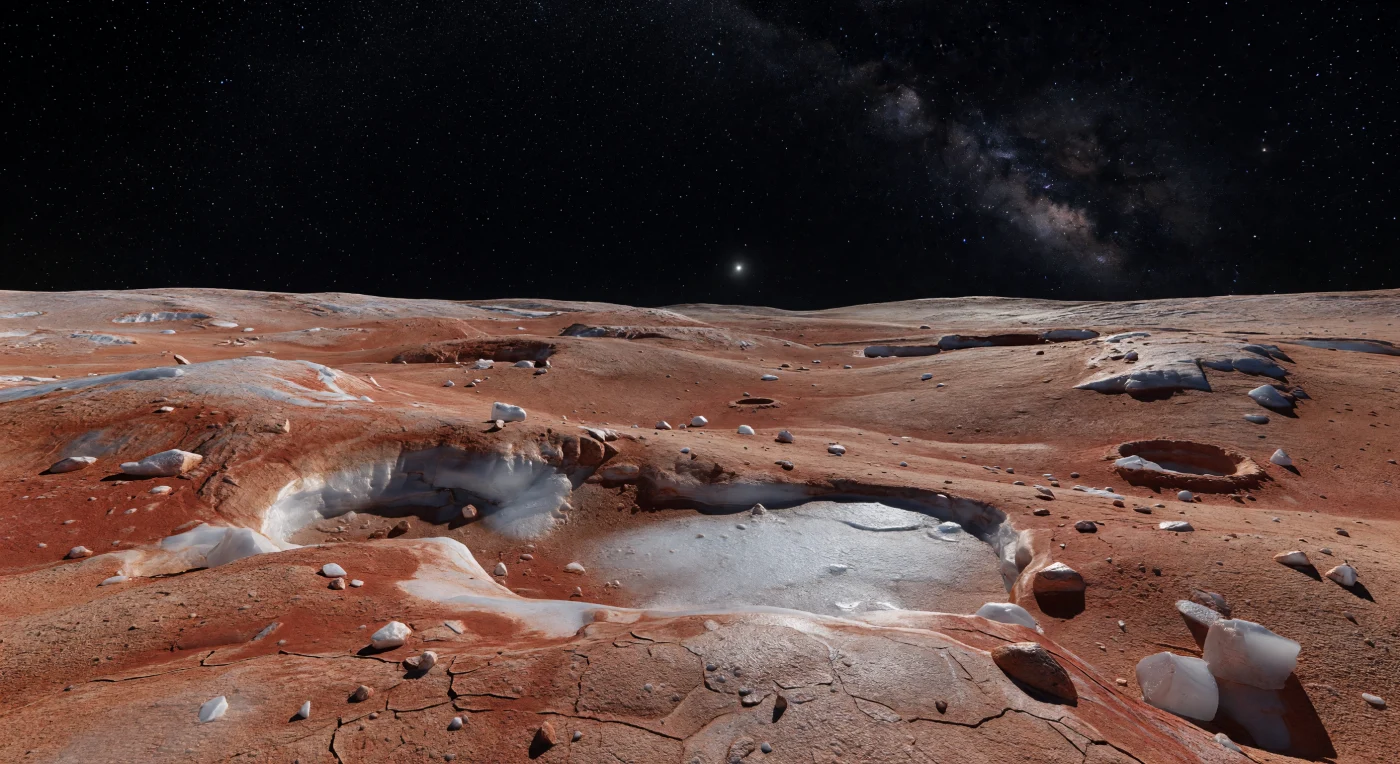
You stand on a vast, gently heaving upland of ice and organic residue, where salmon, tawny, rust-red, and orange-brown crust stretches to a low far horizon under a pure black sky crowded with hard, unmoving stars. The ground is brittle and granular, broken into polygonal plates, sharp frost-cemented pebbles, angular ice blocks, and meter-high scarps whose fractured faces reveal cleaner white-gray ice beneath a darker veneer stained by tholins—complex organic compounds forged as methane-rich surface ices are altered by relentless radiation over immense spans of time. In shallow hollows, fresh methane frost lies undisturbed in luminous patches, sparkling faintly in the weak, distant sunlight, while softened ancient craters and long subdued ridges speak of an airless world where there is no wind, no rain, and almost no erosion to erase the record of billions of years. Everything feels frozen beyond intuition: the sunlight is dim yet razor-sharp, the shadows are perfectly black, and the broad rolling terrain seems to fade not into haze, but straight into the vacuum of deep space.
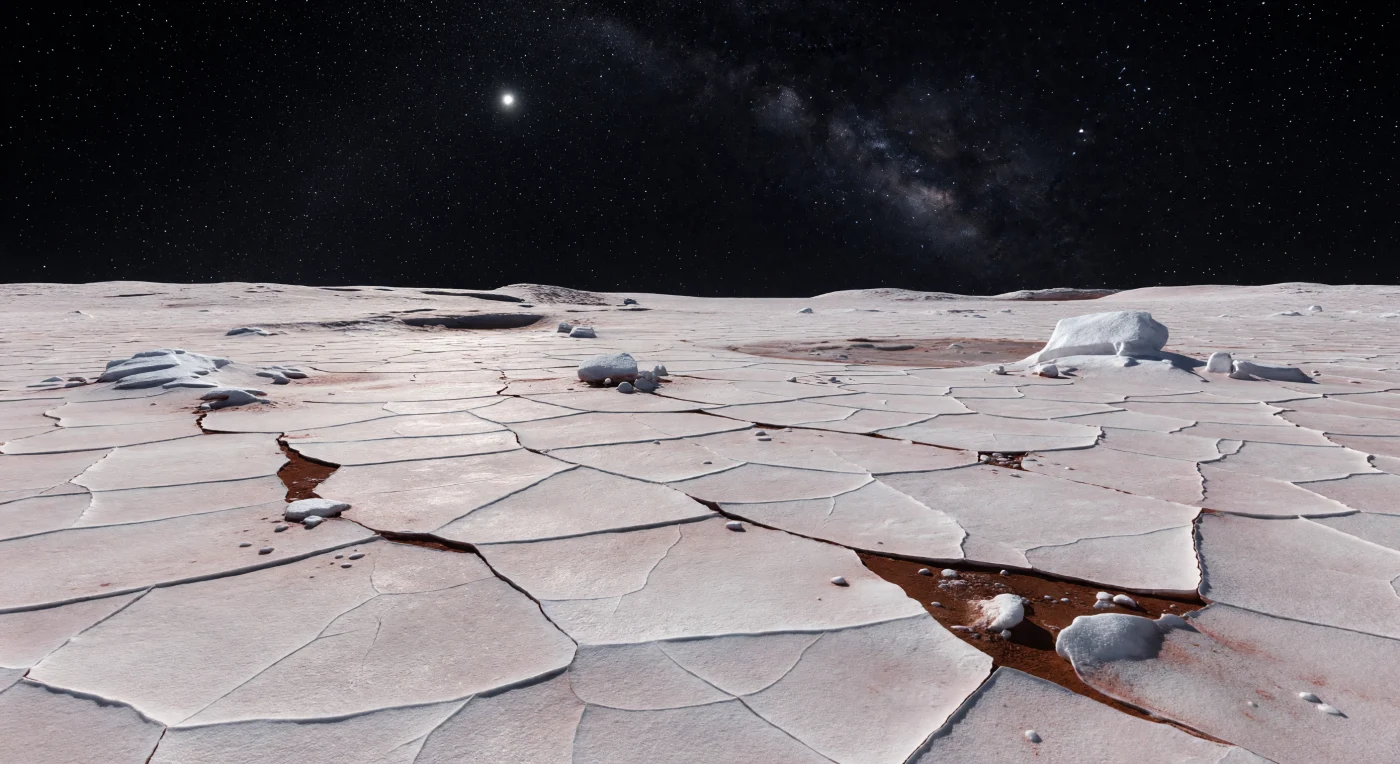
At your feet, a rigid frost pavement spreads across the plain in crisp, meter-wide polygons, their slightly raised plates tinted cream, cold white, and the faintest pink, while narrow troughs between them hold dark red-brown organic residues like seams in the ice. These patterns likely form as intensely cold methane-, ethane-, and nitrogen-rich frost sinters into a hard crust and contracts, opening cracks where radiation-processed tholins and dust accumulate over immense spans of time. In the weak light of a Sun reduced to a brilliant star, the bright surface gives off a subdued crystalline gleam, and every trough cuts a razor-sharp shadow into the frozen ground beneath a sky of pure black crowded with stars and the Milky Way. Low hummocks, scattered ice clasts, and distant subdued ridges emphasize the stillness of an ancient, airless world where nothing flows, nothing stirs, and the landscape has remained locked in cryogenic silence for eons.
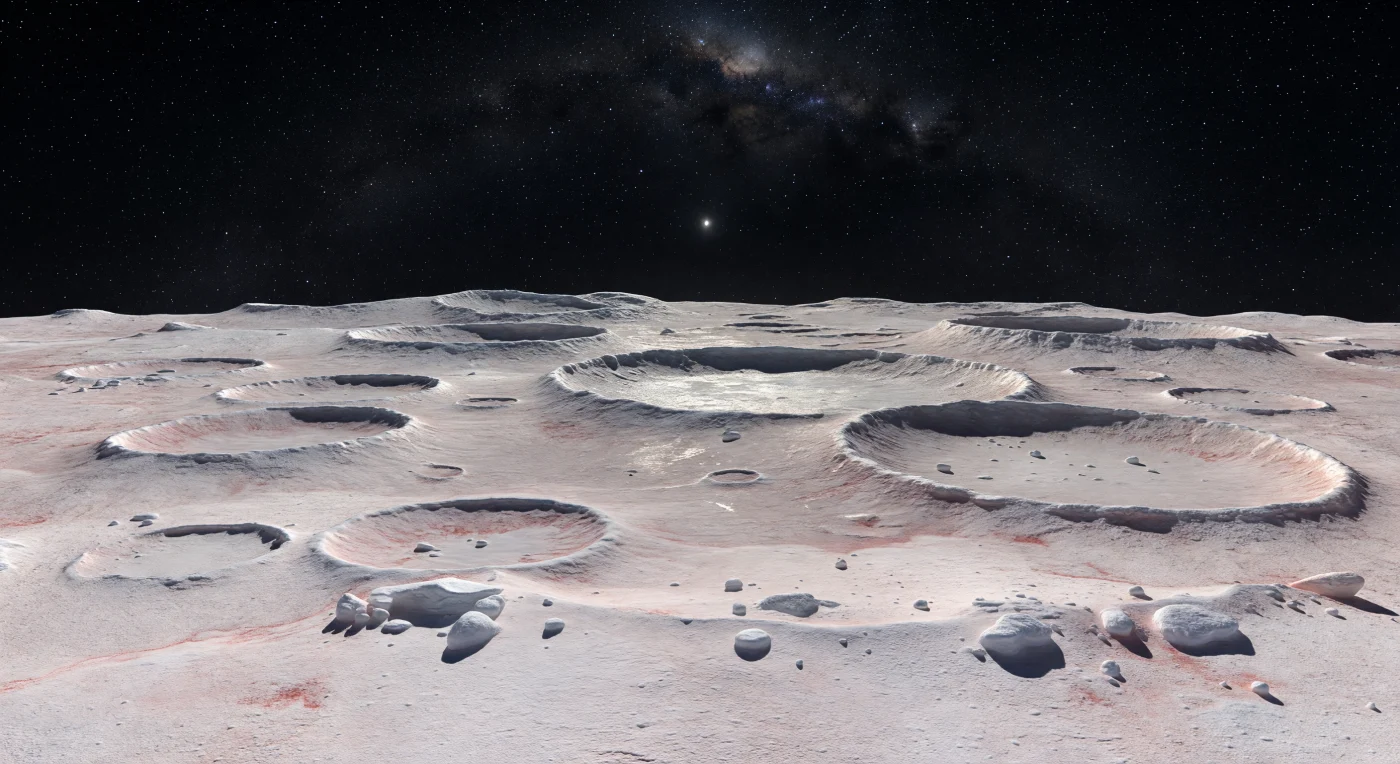
From this frozen ground-level view, the highlands unfold as a vast quilt of overlapping ancient craters, low ridges, and broad bowl-shaped depressions whose once-sharp rims have been muted by repeated coatings of methane and ethane frost. The surface glows in subdued cream, pale pink, and faded red tones, where bright volatile ices mingle with darker tholin-rich material produced by long exposure to radiation, while scattered rounded icy blocks sit half-buried in weakly cohesive frost-regolith under low gravity. In the dim sunlight—reduced here to the illumination of a brilliant distant star—silvery highlights gleam on frost-mantled basin floors and shadows fall razor-sharp into the shallow hollows, emphasizing a landscape that has remained rigidly frozen near 40 kelvin for billions of years. Above, with no atmosphere to soften the view, a pure black sky crowded with stars and crossed by the Milky Way makes the softened crater rims fading over the body’s gentle curvature feel both intimate underfoot and immense beyond sight.

At your feet, a rough dark island rises slightly above the surrounding bright ice plains, its surface armored in coarse, tholin-rich organic crust colored deep rust, maroon, and brown-black, with scattered angular fragments of water ice and hydrocarbon ice embedded like frozen debris. In the weak, airless sunlight, isolated flecks of methane frost linger in sheltered cracks, shallow hollows, and along boulder shadows, stark white against the darker, volatile-poor ground where sublimation has stripped away more reflective ices and left behind a concentrated organic lag. Sharp-rimmed impact pits, brittle polygonal fractures, low scarps, and frost-lined crevices remain exquisitely preserved in the extreme cold of roughly 40 kelvin, while beyond the patch the terrain opens into a pale pink-white plain of methane and ethane ice that rolls gently toward distant crater rims. Overhead, the sky is an absolute black vacuum crowded with hard, steady stars and a luminous sweep of the Milky Way, while the Sun shines only as a tiny brilliant point, casting razor-edged shadows across a landscape that feels silent, crystalline, and immeasurably remote.

From the floor of this vast hollow, the ground gleams like frozen metal: an intensely reflective plain of methane frost, likely enriched in places with nitrogen and touched by traces of ethane, spreads outward in silver-white sheets edged with a faint blush of pink where the volatile ice thins into darker terrain. Delicate polygonal contraction cracks, low frost hummocks, broken crust plates, and a few angular water-ice boulders dusted with hoarfrost interrupt the otherwise pristine surface, while steep enclosing slopes of red-brown, tholin-darkened icy regolith rise around the basin, their scarps, pits, and fractured ledges preserved in low gravity and airless stillness. Under a pure black sky crowded with hard stars and the bright band of the Milky Way, a tiny Sun casts weak but razor-sharp light, throwing long black shadows across the luminous floor and making the contrast between brilliant frost and maroon basin walls almost surreal. At temperatures near 40 K, this is a natural cold trap where volatile ices can persist for immense spans of time, an ancient landscape of radiation-processed organics and frozen gases that seems untouched for billions of years.
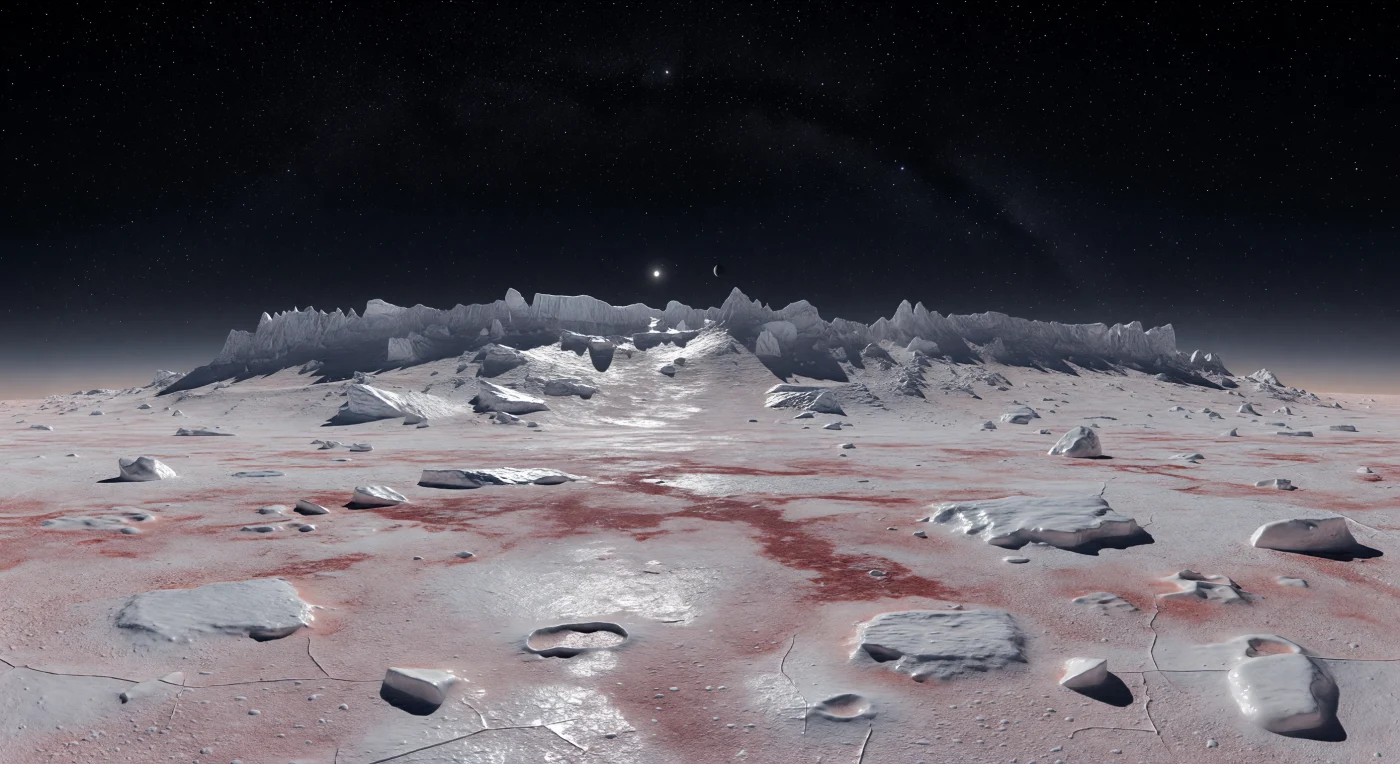
At the edge of night, a jagged ridge of ancient water-ice bedrock rises from a broad frozen plain, its knife-like crests glowing faintly above a red-white-grey mosaic of methane, ethane, and nitrogen frosts stained by darker tholin-rich organic material. The dwarf world’s curvature is visible along the horizon, emphasizing both its small planetary scale and the immense emptiness of this airless terrain, where sublimation pits, contraction polygons, and angular ice boulders have remained nearly undisturbed for billions of years in extreme cold and vacuum. In the black sky, crowded with stars and the Milky Way, the Sun appears only as a tiny, piercing point of white light, casting razor-sharp shadows across the frost, while far above the ridge MK 2 hangs as a faint dusky speck. Standing here, you would see a landscape of preserved volatile ices and radiation-darkened organics suspended in perpetual stillness, beautiful and severe under the weakest daylight in the Solar System.
