Scientific confidence: Speculative
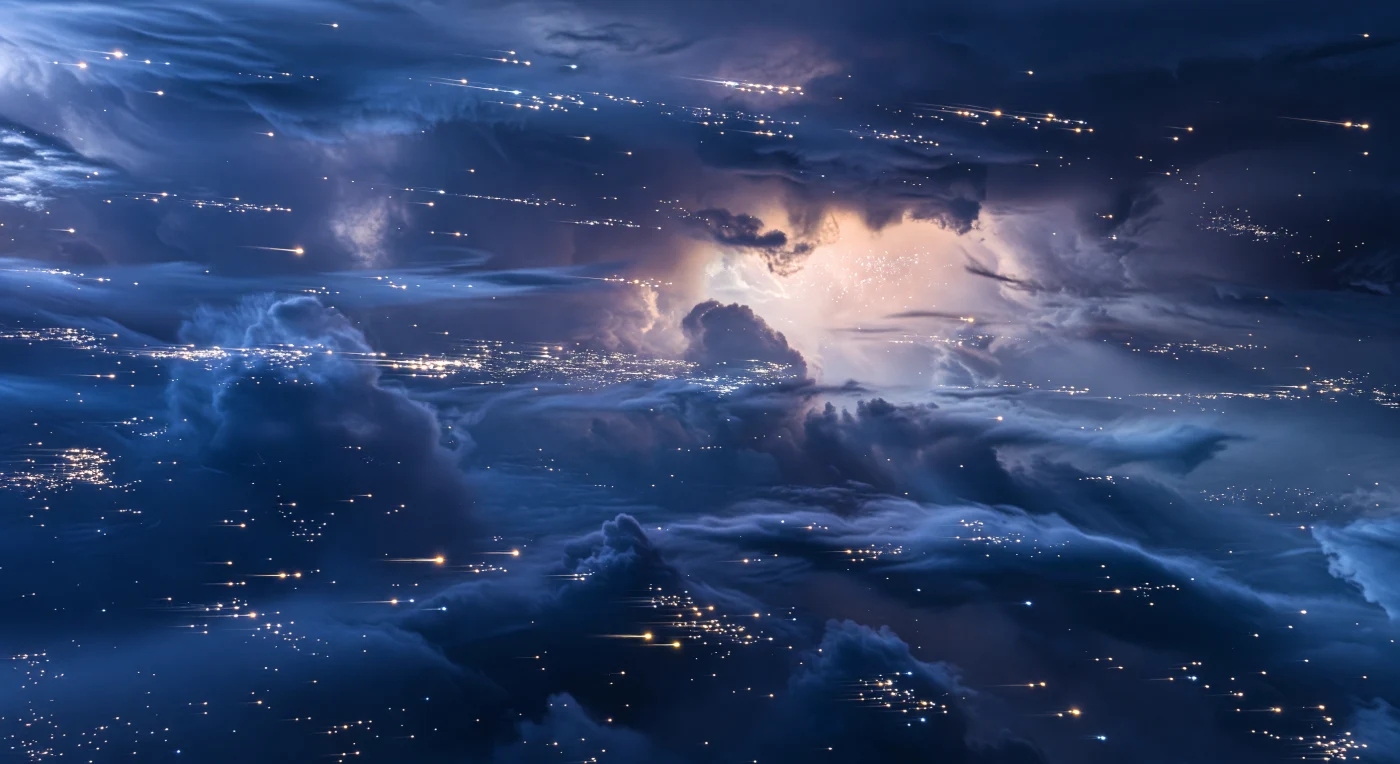
There is no ground here—only a vast, storm-torn atmosphere dropping away in stacked escarpments of cobalt, steel-blue, and bruised violet cloud, their layers twisted into shear bands, vortices, and plunging curtains by winds that can race at several kilometers per second. Through the dense mineral haze, incandescent silicate droplets and bright grit streak almost sideways in blazing sheets, a likely manifestation of hot silicate condensates forming and being hurled through the atmosphere like molten glass rain. The deep blue color is thought to arise not from water but from scattering by high-altitude haze and silicate particles, while the immense, close-orbiting star is reduced to a diffuse orange-white blaze smeared across the storm wall by the choking clouds. Suspended amid this horizonless turbulence, with no solid surface anywhere below, you would feel as if you were hovering inside a planetary-scale furnace made of wind, vapor, and shattered light.
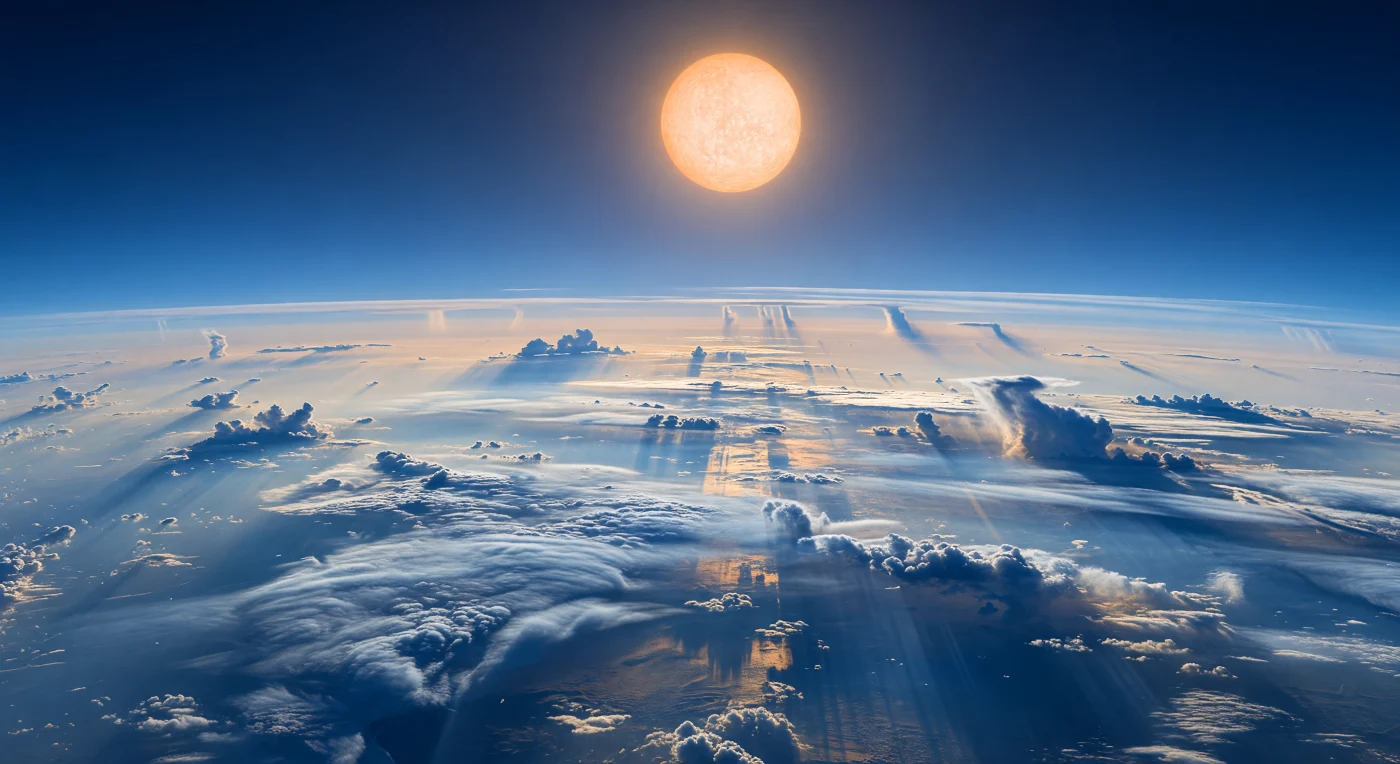
Beneath a blazing orange-white star swollen to many times the apparent width of the Sun, an immense silver-blue ocean of cloud tops arcs away with the planet’s curvature, its smooth haze deck broken by wind-combed streaks, anvil-shaped condensate banks, and distant convective towers rising like vapor mountains. The deep cobalt sky is colored not by water, but by high silicate haze and scattering in a superheated atmosphere, where the cool metallic blues conceal infernal conditions hot enough for rock-forming materials to exist as aerosols and condensates. Here there is no ground at all—only layered atmosphere descending into darker ultramarine depths, with occasional far-off sheets of glass-rich precipitation likely driven nearly sideways by supersonic winds. Standing in this view would feel like hovering above a luminous weather ocean on a giant world, suspended over endless cloud architecture shaped by heat, chemistry, and violence on a planetary scale.

Beneath an enormous orange-white stellar disk, the atmosphere opens into a boundless plain of pale cobalt, silver, and white-gold cloud tops, their smooth swells and stretched cellular bands revealing not land or sea, but dense silicate haze and condensate layers suspended in the deep atmosphere of a hot Jupiter. The light is fierce yet diffuse through the particle-rich air, so the cloud deck gleams with short, weak shadows while thin reflective streamers and flattened vapor veils are pulled relentlessly eastward by winds moving at several kilometers per second. Here and there, darker ultramarine breaks hint at hotter layers far below, and in the near haze a few tiny incandescent streaks of molten silicate rain cut almost sideways through the glare, a subtle sign of the planet’s extreme weather. Everything recedes into heat shimmer and atmospheric curvature, giving the uncanny impression of standing above an endless, oven-bright ocean made entirely of storm-driven cloud and glass-laden sky.

There is no ground beneath you here—only a colossal, curving wilderness of atmosphere, where endless ribbons of cobalt, azure, indigo, and silver-gray cloud stream eastward in tightly ordered bands above a superrotating jet. Warm amber light from the huge, low-hanging star grazes the cloud tops, catching the edges of shear billows and rolled walls of turbulence, while darker gaps open between the bands into deeper, denser layers that glow a muted blue through the haze. This blue color comes not from oceans but from silicate-rich aerosols and cloud particles suspended in the hot atmosphere, where winds likely race at several kilometers per second and sculpt the clouds into wave trains reminiscent of Kelvin-Helmholtz instabilities on a planetary scale. Now and then, molten silicate droplets—essentially glass rain—are swept nearly sideways through the jetstream, flashing as white-hot orange flecks and amber-blue spray in a sky that feels less like weather and more like an entire world made of wind.

You seem to be suspended above an endless atmosphere rather than a world, looking out across a curved expanse of navy and cobalt cloud tops shaped into braided bands, troughs, and giant vortices by ferocious circumpolar winds. Thin sheets of silicate haze drift through the foreground, while occasional breaks expose deeper layers glowing a dim red-orange from the planet’s internal heat, like embers buried beneath blue storm decks. High overhead, faint violet-green auroral curtains ripple through the black upper sky, tracing magnetic activity in a place where no ground exists and weather alone forms the landscape. The scene is vast and unsettlingly beautiful: a hot giant’s nightside atmosphere, colored by scattering through mineral-rich haze and animated by supersonic flow, molten-silicate condensates, and storm structures on a scale far beyond any sky seen from Earth.

Suspended above an endless abyss of atmosphere at the permanent boundary between day and night, you would see colossal blue-black storm towers rising hundreds of kilometers from a darker cloud deck below, their faces banded with silicate haze and shredded by fierce wind shear. On the dayward horizon, the swollen orange-white disk of the nearby K-type star hangs low through dense vapor, washing the cloud wall in amber light, while the opposite sky deepens from cobalt to indigo and near-black, with vast crepuscular shadows cast sideways across the haze. This is a hot Jupiter’s atmosphere, not a surface: the “terrain” is built from stratified cloud layers, aerosol mists, and convective plumes of superheated gas, where silicate particles can condense and molten glass may rain almost horizontally in supersonic winds. The metallic glint of suspended mineral droplets and the continent-sized architecture of the storms make the scene feel both beautiful and hostile, as if you were floating beside a living wall of weather on a scale far beyond any world with solid ground.

You seem to be hovering inside a vast basin made not of rock, but of atmosphere itself: stacked cobalt and indigo cloud plains sag into a darker hollow filled with dense violet silicate fog, while ragged vapor escarpments and towering haze columns fade into immense distance. Through breaks in the murk, deeper and much hotter layers glow with a subdued crimson incandescence, as if buried heat were shining upward from within the planet’s superheated envelope, and sheets of molten silicate condensate streak almost sideways under winds moving at kilometers per second. Along the horizon, only a thin amber rim marks the nearby star beyond the permanent day-night boundary, its weak grazing light catching mineral veils, ash-like particles, and violent shear channels carved through the clouds. There is no ground anywhere—only colossal, stratified weather in a crushing hydrogen-rich atmosphere where silicate haze, thermal gradients, and supersonic flow turn the sky into a dark, luminous ocean of storm.

Here on the permanent night side, there is no ground and no true horizon—only a vast abyss of cloud decks sinking into darkness, layered in maroon, violet-black, and cobalt where silicate hazes catch their own faint heat. Towering mineral storm columns and continent-scale anvil clouds are carved by supersonic winds into canyons, vortex walls, and shredded bands, while molten silicate condensates—effectively glass rain—slash sideways through the air as glowing needles. In the long intervals between flashes, the atmosphere glows dimly from its internal heat; then blue-white lightning erupts across hundreds of kilometers at once, exposing wet aerosol veils, turbulent eddies, and the immense vertical architecture of a hot giant’s atmosphere. The effect is both beautiful and violent: a roofless storm ocean of rock vapor and scorching condensates, suspended over bottomless blackness under a sky that never sees dawn.

Suspended high above a world with no ground, you look along an immense curved horizon of deep cobalt and sapphire atmosphere, where layered silicate hazes and cloud decks fade downward into dark blue depths streaked by turbulent bands, wind-shredded mineral veils, and faint luminous ribbons that may mark molten silicate precipitation driven sideways by supersonic winds. At the dawn edge, the atmosphere ends in a razor-thin electric-blue to ultraviolet-white glow: an irradiated exosphere and escaping upper haze peeled outward into space, its delicate filaments and plumes shaped by intense stellar heating. The host star, swollen to many times the apparent width of our Sun, grazes the limb as a warm orange-white disk, its light filtered through a translucent shell that casts amber halos and pearly cyan highlights across the haze. Everything here is atmosphere, motion, and light—an enormous hot-Jupiter skyscape where scattering by silicate particles paints the famous blue color and the planet’s scale is felt in the sweep of its curvature against the black of space.

Here, there is no ground—only a vast atmospheric chasm carved into the lower cloud decks, where towering walls of navy, indigo, and charcoal vapor rise like canyon cliffs and fade into pressure-thick darkness below. Weak blue-amber light from the swollen nearby star filters through torn upper haze, catching suspended silicate particles and streaks of nearly horizontal molten glass rain that flash like luminous filaments in the storm. These sculpted cloud escarpments, overhangs, and terraces are not rock but dense condensate layers and turbulent weather structures, shaped by supersonic winds racing through the atmosphere of a surface-less gas giant. Standing in this abyss of heat, haze, and violent motion, you would feel suspended inside a living canyon of storms, with mountain-scale cloud walls and a glowing ultramarine void descending endlessly beneath you.
