Scientific confidence: Speculative
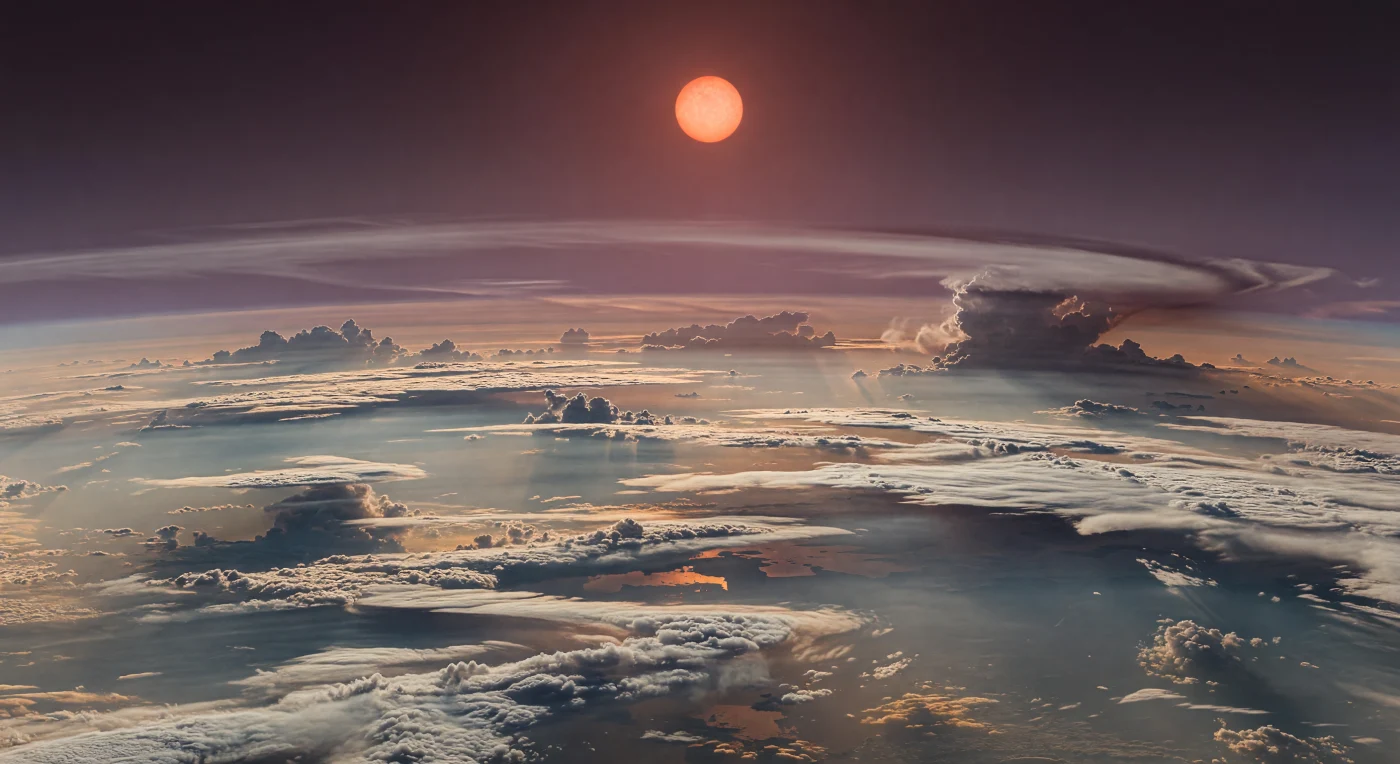
From this buoyant perch in the upper atmosphere, you look out over an endless cloud-ocean of cream, silver-gray, pale copper, and muted teal, its broad shelves, scalloped wave bands, and distant storm domes rolling away to a sharply curved horizon with no trace of land below. Overhead, a dark wine-violet sky is thick with hydrogen haze and methane-rich photochemical smog, which softens the light from the swollen orange-red disk of the parent star into a dim, coppery glow that paints the cloud tops with subdued highlights and gentle shadows. Occasional darker troughs open in the deck to reveal deeper amber-brown layers, hinting at a vast, dense atmosphere descending toward enormous pressures and, perhaps far below, a hidden global water-rich realm. The scene feels less like standing above weather and more like hovering over a living planetary ocean made entirely of gas, where every visible feature is shaped by convection, chemistry, and the immense scale of a volatile-rich sub-Neptune world.

Hovering above a radiant lower cloud deck, you would see a world made entirely of atmosphere: immense storm towers rise like fortress-citadels tens of kilometers into a thick hydrogen sky, their cauliflower flanks shaded in sepia and maroon while their upper anvils glow amber under the broad orange-red disk of the star. Curtains of virga and torn condensate streamers hang between them, tracing violent updrafts, wind shear, and gravity-wave ripples through methane- and hydrocarbon-laced haze that turns the air copper, salmon, and smoky rose instead of blue. The scene reflects a deep sub-Neptune atmosphere where methane, carbon dioxide, and photochemical hazes filter the light, and where any ocean or volatile layer lies far below these inaccessible cloud decks under crushing pressure. With no land or horizon to anchor the eye, only receding cloud banks and mountain-scale convection fading into reddish mist, the atmosphere feels boundless and cathedral-like—an alien sky-ocean lit by perpetual red dusk.
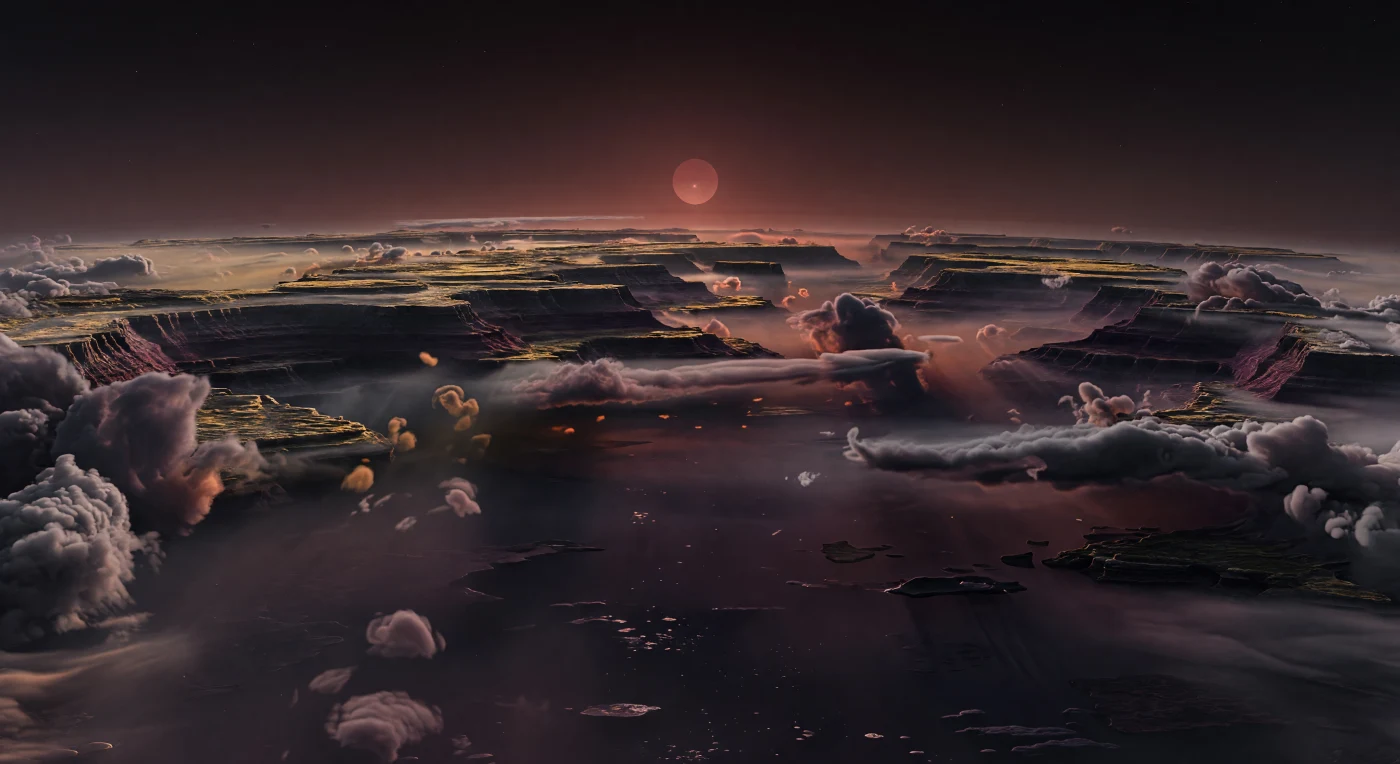
Here, at the planet’s permanent twilight boundary, the horizon is not land but a colossal escarpment of atmosphere—towering stratified cloud walls in charcoal, bronze, mauve, and plum, their scalloped faces and vapor terraces stretching for what feels like continents through the haze. A dim reddish-orange star hangs fixed near the horizon, its enlarged disk casting perpetual low-angle light that turns one face of the cloud cliffs to rust, ember, and dusky gold, while the far side dissolves into purple-black night. Suspended methane-rich haze, carbon dioxide-bearing air, and diffuse hydrogen mist soften every edge, revealing a world with no visible solid surface at all, only immense layered condensate decks above darker depths that may hide liquid or supercritical water far below. The result is an eerie, majestic meteorology of a Hycean-like sub-Neptune: a place where gravity, chemistry, and eternal tidal locking sculpt the sky itself into something that feels as vast and alien as an ocean turned upright.

You seem to be floating inside a colossal atmospheric canyon, where gray-beige and muted taupe cloud decks have been pulled into razor-straight ribbons, braided wave trains, and curling shear patterns by ferocious superrotating winds. Warm reddish-orange light from the nearby red dwarf filters through methane-rich smog and carbon-dioxide-laced haze, turning the brightest filament edges to burnished copper while darker amber gaps fall away into a pressure-thickened abyss with no solid surface in sight. This is the weather architecture of a hydrogen-helium sub-Neptune: immense condensate layers, photochemical hazes, and turbulent jetstream bands hundreds of kilometers long, shaped by extreme atmospheric shear rather than by mountains or oceans visible from above. With the star reduced to a smeared orange glare through the smoky apricot sky, the scene feels vast and unsettlingly alien, as if the entire world is made of wind, depth, and dim firelit cloud.
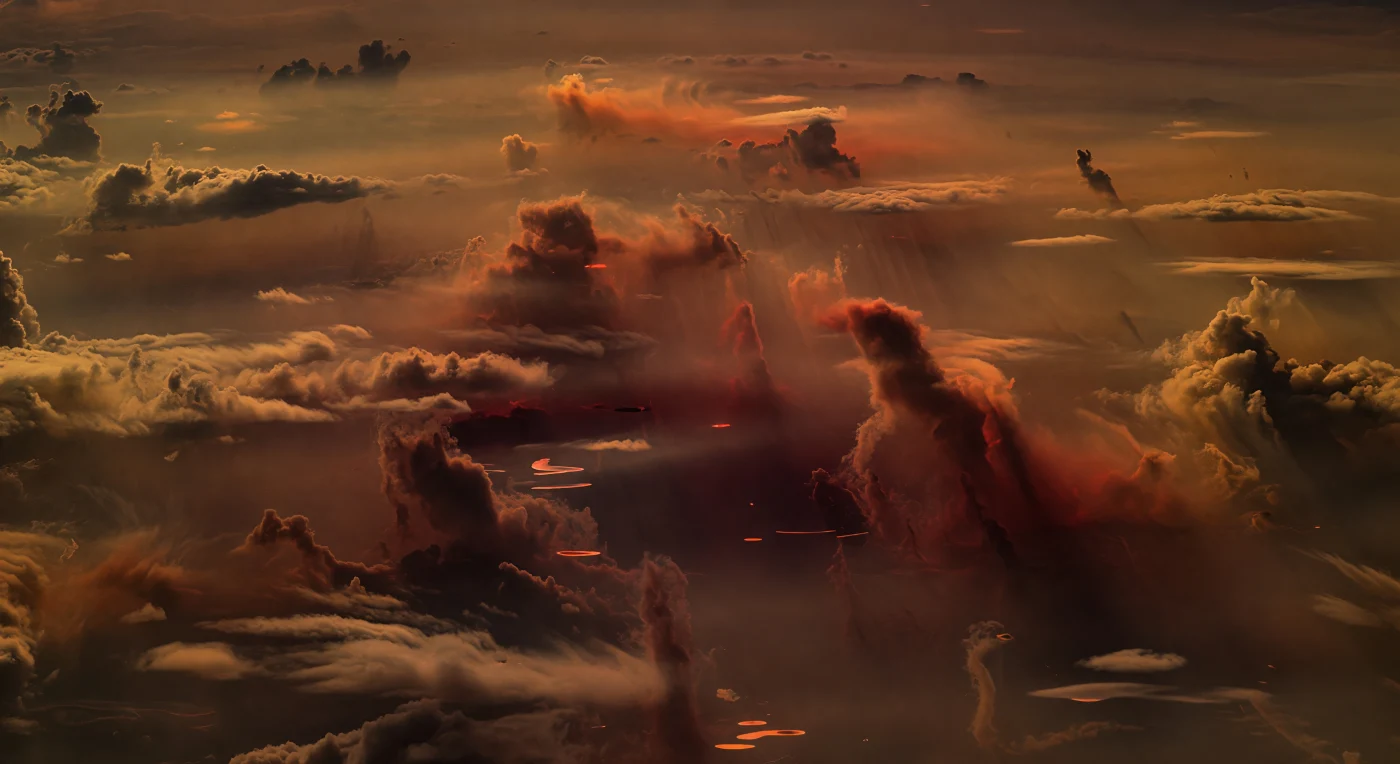
Suspended within a colossal mid-atmospheric abyss, you would see no horizon, no ground, and no open sky—only immense walls of sepia and bronze haze, layered like drifting continents of cloud, while dim reddish-orange beams seep down from brighter murk above into darker vapor chasms below. The air here would be thick with hydrogen, methane, carbon dioxide, and photochemical aerosols, scattering the red dwarf’s light into a muted amber glow and limiting visibility to only a few kilometers despite the vast scale of the surrounding cloud buttresses and fog terraces. Deeper down, the atmosphere fades into maroon-brown voids that hint at crushing pressures and warmer, denser layers far beneath, where any ocean or supercritical water realm—if present at all—remains completely hidden. It is a landscape made entirely of atmosphere: humid, pressurized, and strangely luminous, with every rust-colored plume and shadowed condensate veil reinforcing the sense of floating inside a world that has no familiar surface, only depth.
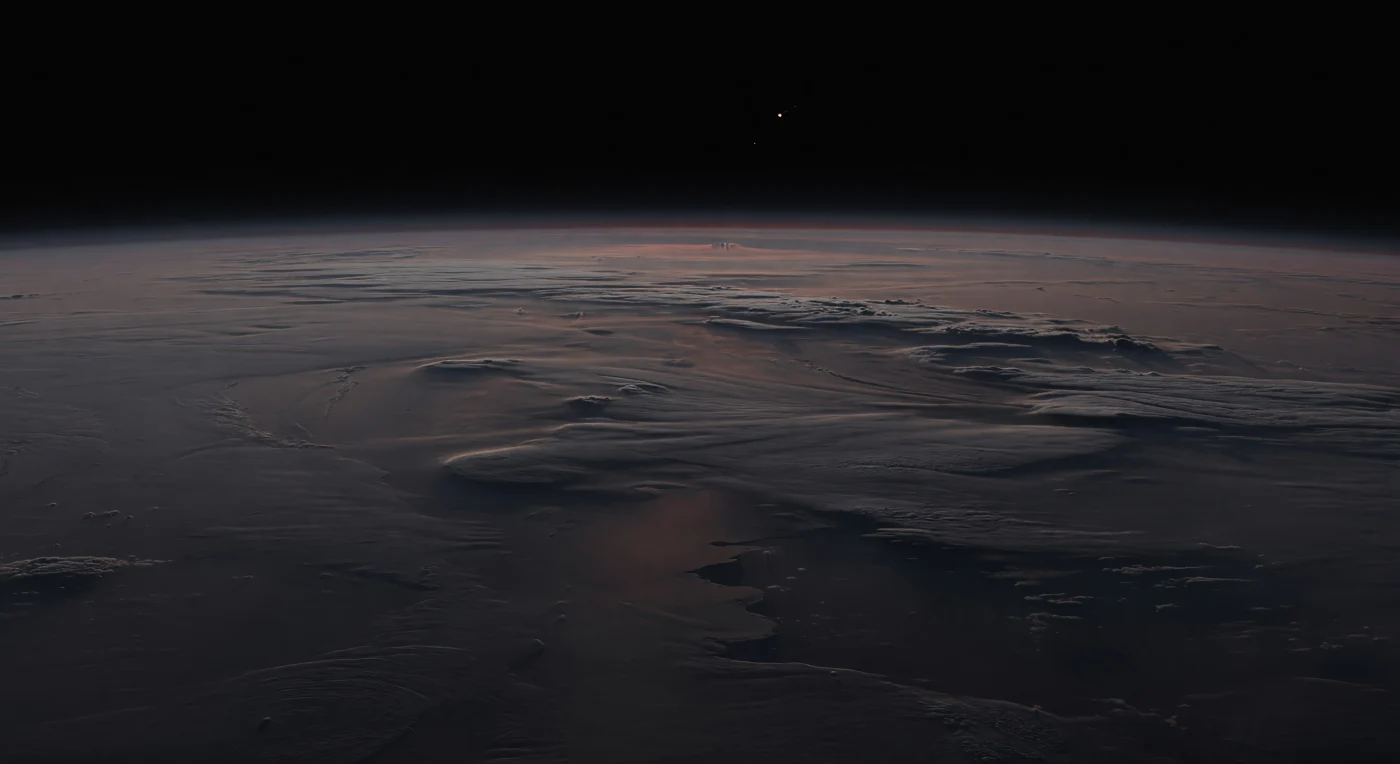
Beneath a clear, nearly space-black sky, an immense plain of cloud tops stretches to every horizon, smooth as a dark sea yet built from dense aerosols and condensate haze in a hydrogen-rich atmosphere rather than liquid water. The surface-like layer is shaded in graphite, charcoal, and muted violet-gray, its broad ripple bands, shallow troughs, and darker downwelling patches revealing slow atmospheric circulation shaped by high-altitude winds, methane-bearing haze, and carbon-dioxide-rich layering detected in this world’s envelope. Far off, a faint rusty glow from the permanent terminator traces the planet’s curvature and hints at staggering scale, while the unseen depths below vanish into pressure and darkness with no solid ground in sight. Overhead, only a single warm-white point drifts across the blackness—another planet in the system—making the silence of this cold, stable weather ocean feel even more profound.
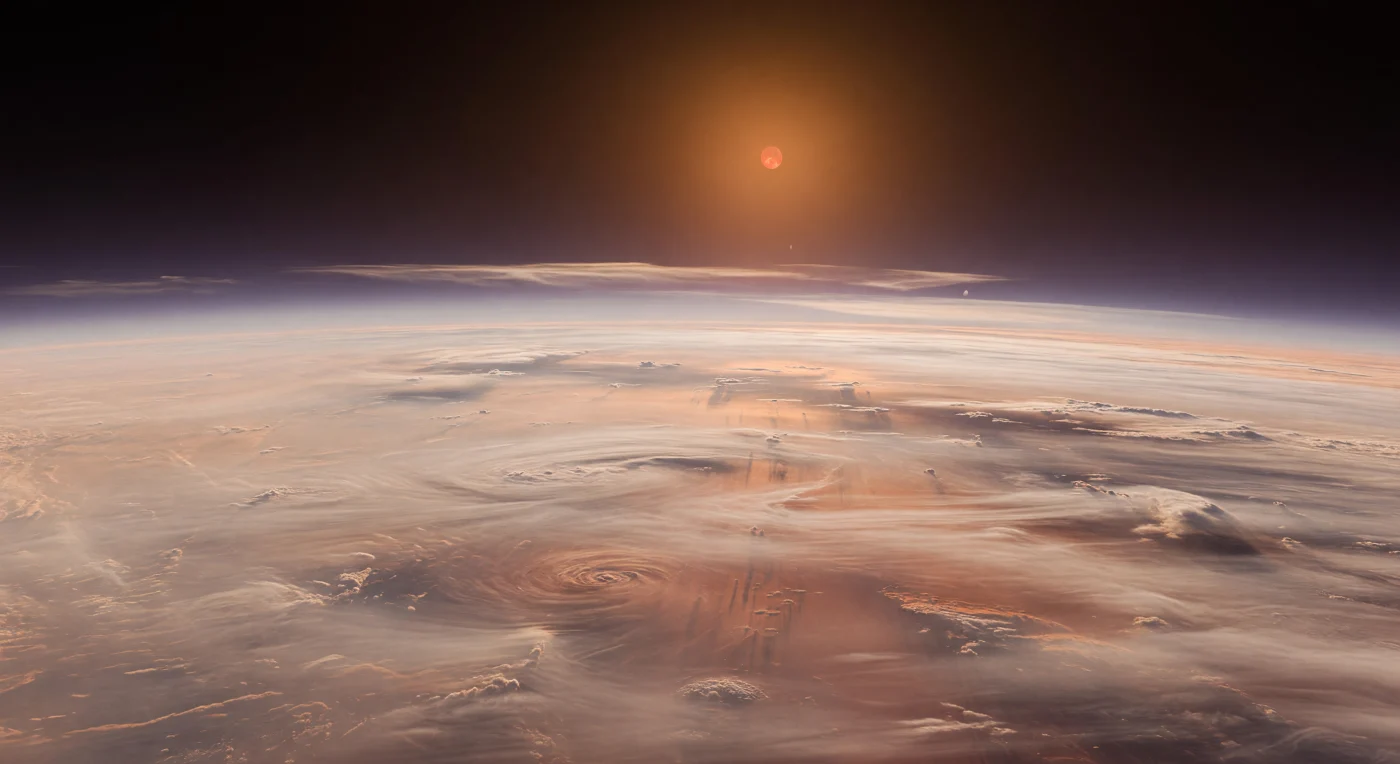
High in the still upper atmosphere, thin translucent veils of hydrogen haze drift across a sky that deepens from wine-dark violet to an amber glow around an oversized orange-red star, its light softened by methane-rich smog and fine aerosols. Far below, with no land or solid surface anywhere in sight, a vast pale cloud globe curves away beneath you—cream, apricot, and dusty rose layers streaked by rust-colored bands, giant spiral storms, and broad convective swells thousands of kilometers across. This is the view from a Hycean sub-Neptune’s upper haze deck, where a hydrogen-rich atmosphere laced with methane and carbon dioxide scatters the red dwarf’s dim, warm light into muted copper tones and feathery shadowed strata. The immense curvature, the depthless drop into darker pressure layers below, and the quiet suspension above a planet-wide ocean of cloud make the scene feel less like weather than standing at the edge of an entire living atmosphere.
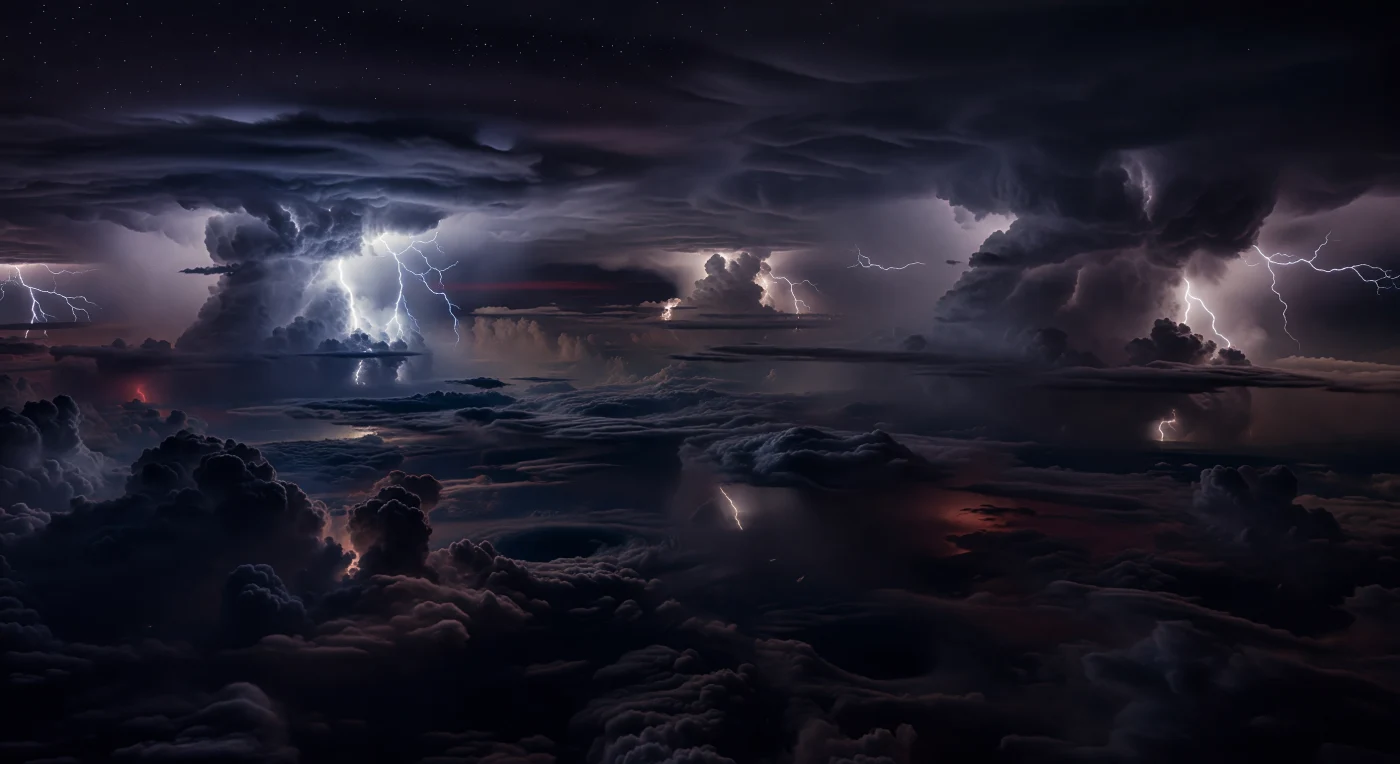
Here, there is no ground and no sea in sight—only a planet-wide wilderness of atmosphere, where black-violet cloud plains roll into colossal canyons, rising domes, and towering anvil-topped storm walls that loom like continents suspended in darkness. Deep within these methane- and water-bearing clouds, blue-white sheet lightning pulses through the hydrogen-rich air, briefly illuminating layered billows, rain veils, and braided storm bands before the scene falls back into near-total night under a star-speckled, lightless sky. The chemistry and pressure structure inferred for this kind of sub-Neptune atmosphere likely produce heavy hydrocarbon hazes and immense convective systems unlike anything on Earth, with no accessible solid surface at these altitudes and cloud towers that may span hundreds of kilometers. Hovering here would feel like drifting inside a world-sized thunderhead, where every flash reveals the staggering depth, motion, and alien weather of a vast permanent nightside.
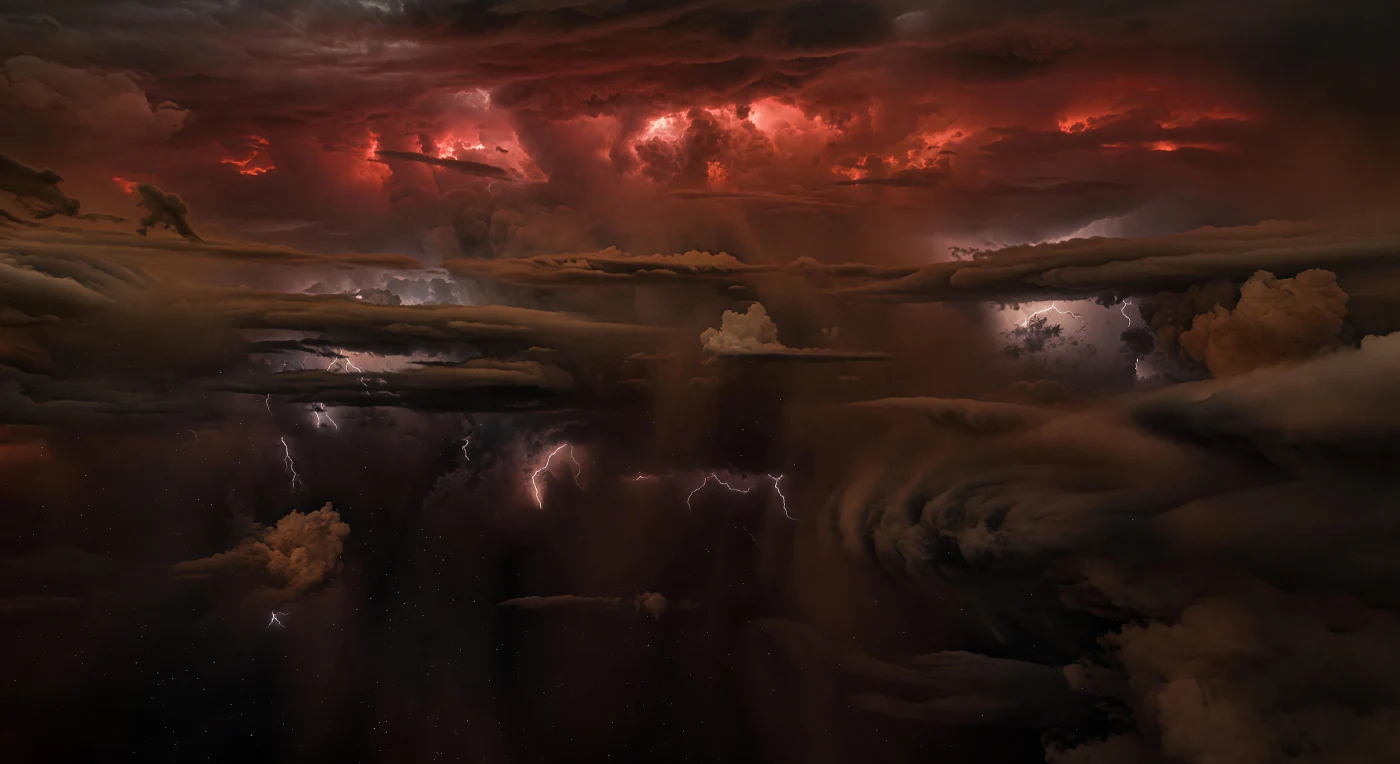
Far beneath the upper cloud decks, the atmosphere opens into a vast brown-black chamber with no ground or horizon, only depth upon depth of turbulent vapor fading into darkness below. A dim crimson-orange glow filters down from far overhead through kilometers of hydrogen-rich haze laced with methane, carbon dioxide, water vapor, and photochemical aerosols, tinting the storm layers in sepia, burnt umber, and muted maroon. Curtains of rain, stacked mist bands, and colossal convective cloud pillars roll through the gloom, their immense scale briefly exposed when sheet lightning and branching flashes illuminate cooler gray-violet interiors within the storm. The effect is both suffocating and majestic: a world of pure atmosphere, where weather towers for hundreds of kilometers beneath the reddish ceiling of a distant red-dwarf day.
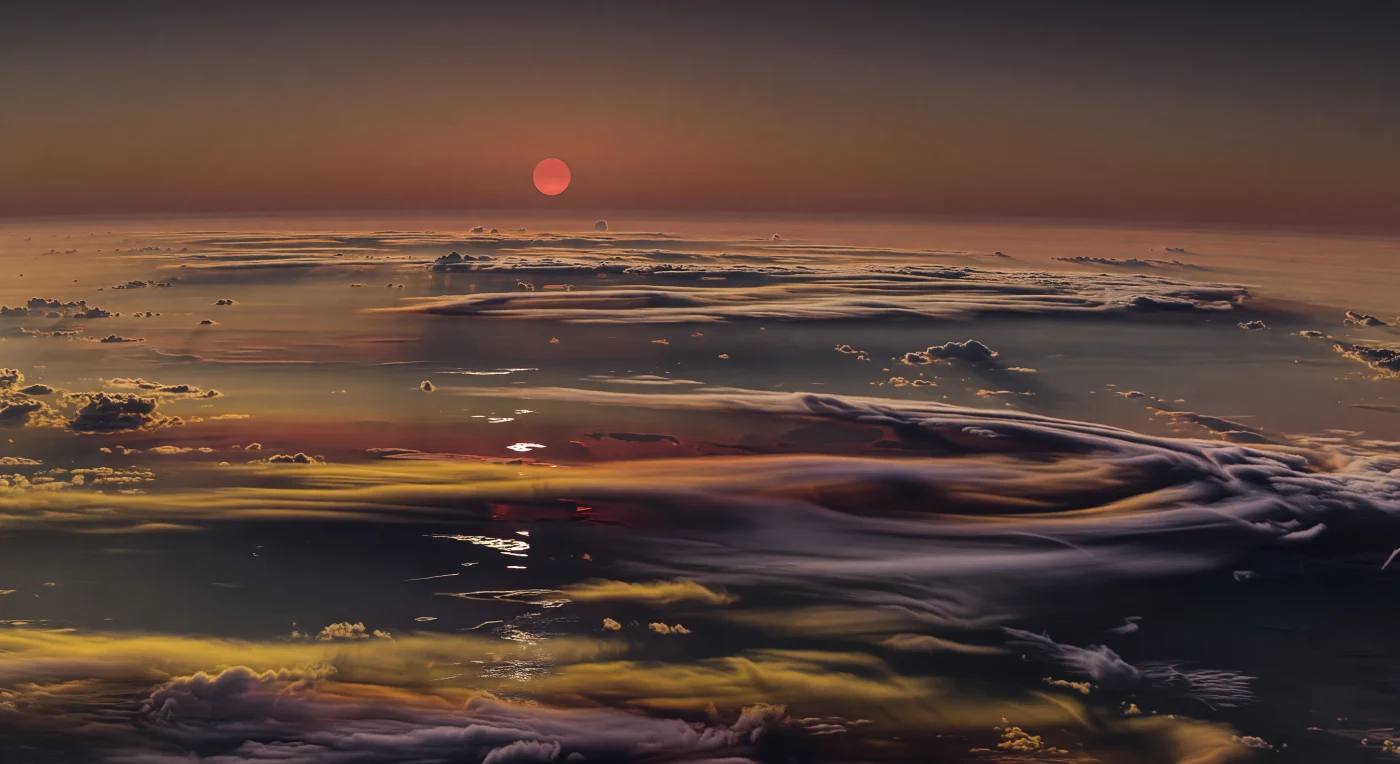
Here at the permanent boundary between day and night, the atmosphere arranges itself into colossal, wave-like shelves of cloud and haze—bands of golden amber, rust-red, purple-gray, and charcoal stretching for many kilometers like airborne dunes above an unseen abyss. The reddish-orange disk of the star hangs low on the horizon, its grazing light filtered through a thick hydrogen-rich sky laden with methane, carbon dioxide, aerosols, and condensates, so every crest glows softly while immense troughs fade into humid, pressure-dark depths where only faint silvery hints suggest liquid layers far below. These are not surface landforms at all but atmospheric gravity waves and stratified cloud decks, shaped by powerful shear between layers in a volatile-rich sub-Neptune envelope. In the dim twilight, with virga dissolving into haze and no solid ground anywhere in sight, the scale feels oceanic yet sky-bound—an alien weather world where the landscape is made entirely of atmosphere.
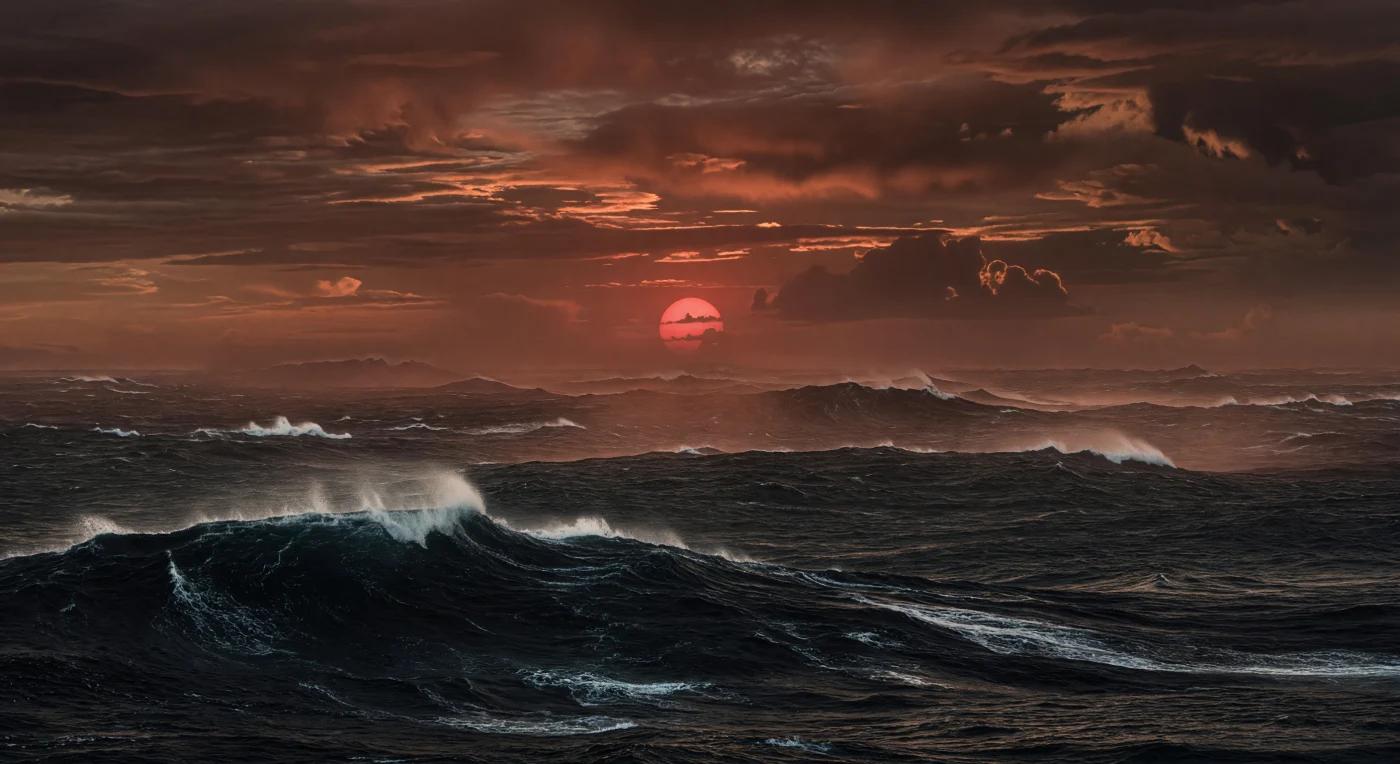
Beneath a massive hydrogen-rich sky, an unbroken ocean of black to graphite-blue water rises in long, towering swells, its wind-torn crests shredded into gray-white spray that vanishes into a reddish haze where no land, shore, or solid surface exists. Overhead, layered cloud decks and methane-rich murk filter the light of a swollen orange-red star into a dim rust-colored glow, casting soft reflections across glossy wave faces and leaving the horizon almost erased by mist, aerosols, and atmospheric depth. This is the kind of seascape expected on a volatile-rich sub-Neptune Hycean candidate: a world defined not by rock, but by immense pressure, a dense atmosphere rich in hydrogen with methane and carbon dioxide, and perhaps a global ocean hidden beneath perpetual storm and twilight. Standing here in imagination, you would feel dwarfed by wave walls tens of meters high and by the sheer planetary scale of liquid meeting sky, as if the boundary between ocean and atmosphere were the only landscape the world has ever known.

Above an endless, gently curved ocean of charcoal and blue-gray cloud tops, the polar night sky is filled with gigantic auroral curtains—crimson, magenta, and deep violet veils that descend in braided folds and trembling streamers across the entire dome of haze-darkened atmosphere. Their spectral glow washes the hydrogen-rich mists and methane-bearing condensate layers in soft red light, revealing banded turbulence, distant anvil-shaped storm towers, and faint virga sinking into the darkness below, all suspended in an atmosphere thousands of kilometers deep with no solid surface anywhere in sight. This is meteorology on sub-Neptune scale: a volatile world of thick hydrogen air, trace carbon dioxide and methane, and photochemical hazes, where charged particles from the nearby red dwarf drive immense polar auroras even while the star itself remains permanently below the horizon. Hovering here would feel like standing above a planet-sized sea of vapor beneath a silent, luminous crown, serene in motion yet overwhelming in scale.
