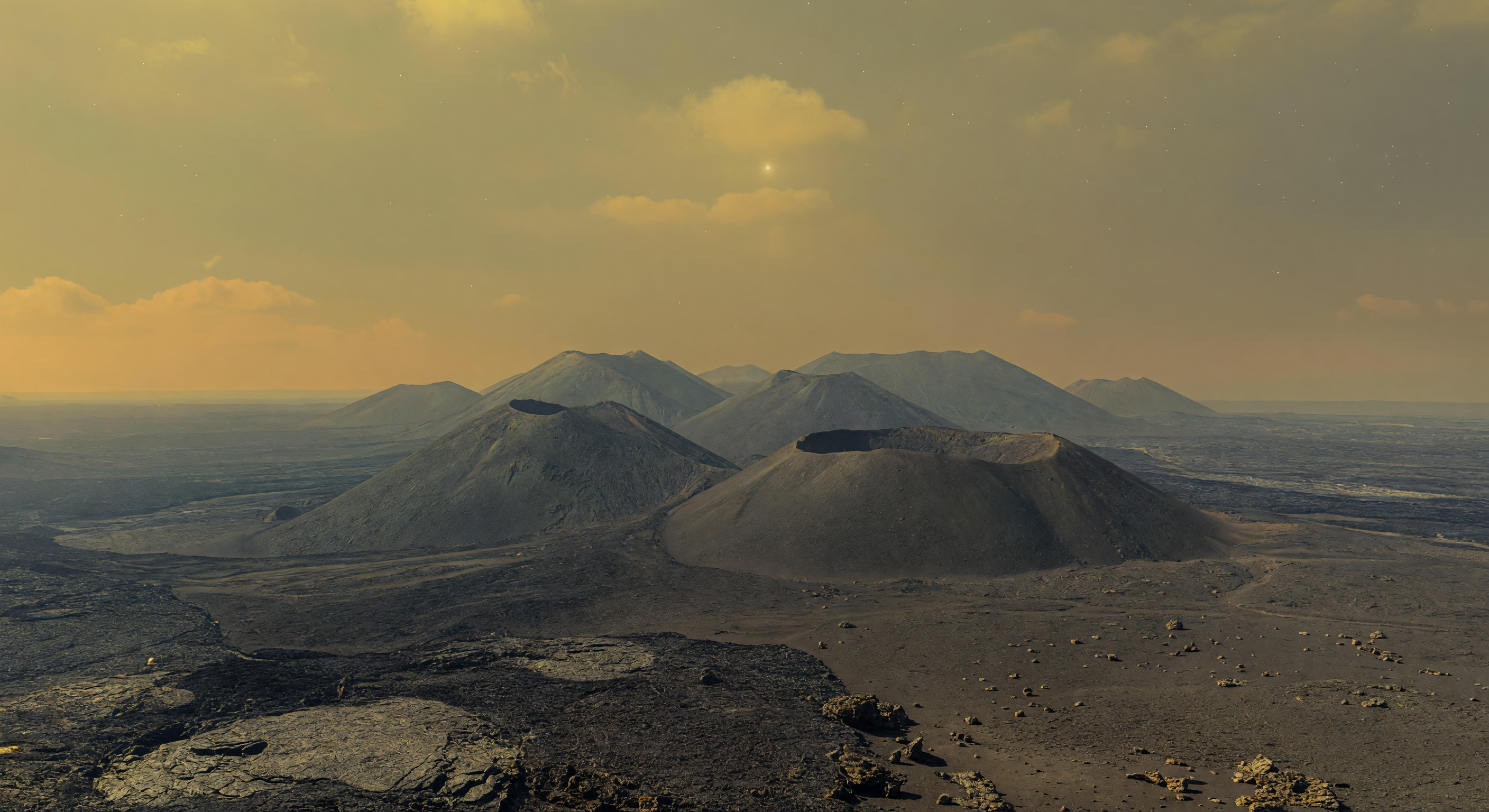
आपके सामने काली-धूसर बेसाल्टिक लावा-समतल से उठते कई चौड़े, एक-दूसरे से सटे शील्ड ज्वालामुखी फैलते हैं, जिनकी ढलानें इतनी मृदु हैं कि वे अलग-अलग शिखरों से अधिक एक विशाल संयुक्त ज्वालामुखीय पुंज जैसे लगते हैं; उनके शीर्ष पर धँसी हुई काल्डेरा और ढहे हुए किनारे पीली-धूसर धुंध के पार भी पहचाने जा सकते हैं। पैरों के पास टूटी हुई बेसाल्ट की पट्टियाँ, कोणीय ज्वालामुखीय शैल-खण्ड, और रस्सीनुमा तथा मलबेदार लावा-पर्पटी की बनावट इस बात का संकेत देती है कि यहाँ बार-बार बहने वाले मैफिक लावा ने विस्तृत मैदान बिछाए, जिन्हें बाद में अत्यधिक ताप और लगभग 92 बार दाब वाली घनी कार्बन डाइऑक्साइड वायुमंडलीय परिस्थितियों ने बदल डाला। दूर तक फैली सतह पर पुराने लावा-प्रवाह मोर्चे, हल्की सिकुड़ी-सी रिजें, उथली धाराएँ और नीची विवर्तनिक धारें मुश्किल से उभरती हैं, मानो पूरा परिदृश्य धीमी लेकिन ग्रह-स्तरीय ज्वालामुखीय पुनर्रचना का जमे हुए क्षणचित्र हो। ऊपर आकाश नहीं, बल्कि सल्फरी पीताभ-ओखर कुहासे की एक बिना-लक्षण छत है, जो सूर्यप्रकाश को इतना बिखेर देती है कि छायाएँ लगभग मिट जाती हैं—और इसी मंद, दमघोंटू उजाले में यह दृश्य असाधारण रूप से विशाल, निस्तब्ध और दमनकारी महसूस होता है।
वैज्ञानिक समीक्षा समिति
प्रत्येक छवि की वैज्ञानिक सटीकता के लिए AI समिति द्वारा समीक्षा की जाती है।
GPT
छवि: Adjust
विवरण: Adjust
Scientific accuracy: The scene convincingly depicts a hot, volcanic Venus-like environment with basaltic, dark ground and a yellow-ochre sky with bright, haze-softened lighting. The “clustered, broad volcanic mountains” idea is broadly consistent with Venus having numerous large shield volcanoes and complex volcanic edifices. However, the image shows relatively crisp terrain contrast and identifiable mountain silhouettes with a visible horizon/atmospheric gradation; Venus’ dense CO₂ atmosphere and cloud decks (at least near the surface) typically produce very different contrast behavior and stronger atmospheric scattering/attenuation than what’s portrayed here. Also, the described specific morphology—multiple enormous shield volcanoes with wide summit calderas and broken collapse rims, plus distinct ropy-to-clinkery lava textures and ejecta mosaics—is not clearly resolved at this distance; the prominent features read more like conical/undifferentiated hills/mounds rather than unmistakable summit caldera complexes and collapse rims. Visual quality: The image is high-resolution and aesthetically strong with good overall realism (lighting, scale cues, and surface roughness). There are no obvious generation artifacts, but some “surface detail economy” is apparent: the foreground is richly textured yet the volcano summit/collapse structures are not clearly legible, which weakens the intended geological specificity. Caption accuracy: The caption matches the general premise (Venus volcanic landscape, clustered elevated edifices, haze-yellow sky, no water/life). But key elements—wide summit calderas, broken collapse rims, and the explicit fractured-slab/rope/clinker transitions—are not clearly visible or supported by the image composition at the provided viewing scale. Adjust by either (a) making the caldera/collapse features more visually explicit, or (b) relaxing the caption to describe overlapping shield volcanoes without insisting on clearly observed caldera rims and fine-scale lava texture transitions.
Claude
छवि: Adjust
विवरण: Adjust
I largely concur with GPT's assessment but wish to add several specific observations. SCIENTIFIC ACCURACY: The ochre-yellow sky coloration is broadly appropriate for Venus's sulfuric acid cloud deck filtered light, and the dark basaltic terrain is geologically consistent with what radar and lander data suggest about Venusian surface composition. However, I must flag a significant atmospheric rendering problem: the image shows stars visible through the upper sky, which is physically impossible on Venus. The planet's 90-bar CO2 atmosphere and perpetual global cloud cover at 45-70km altitude would render the sky completely opaque to stellar observation from the surface. This is a notable scientific error that alone warrants an 'adjust' rather than 'regenerate' only because it's a subtle detail. Additionally, the shadow rendering is too pronounced — the description correctly notes that diffuse scattering under Venus's cloud deck nearly eliminates shadows, yet the volcano flanks show moderately strong shadowing inconsistent with this diffuse illumination regime. The sun appearing as a distinct bright point is also questionable; from the surface it would appear as a diffuse bright region in the clouds, not a resolved disk or point source. The volcanic cone morphology is more consistent with cinder cones than Venusian shield volcanoes, which should have much shallower flank angles (1-2 degrees) and broader profiles. VISUAL QUALITY: The image is technically accomplished with strong foreground texture detail. The atmospheric haze gradient reads convincingly at mid-range. No obvious AI generation artifacts are visible. CAPTION ACCURACY: GPT correctly identifies that caldera collapse rims and ropy-to-clinker lava texture transitions are not legible at this viewing distance. The caption's claim of 'shadows nearly vanish' directly contradicts what the image actually renders, making this a specific caption-image mismatch requiring correction. Recommend: revise caption to match visible cone morphology rather than shield volcano calderas, remove star visibility from the sky in regeneration, soften shadow rendering, and diffuse the solar source.
Grok
छवि: Adjust
विवरण: Adjust
I concur with both GPT and Claude on the core issues, adding targeted insights for refinement. SCIENTIFIC ACCURACY (vote: adjust): The ochre-yellow sky and dark basaltic plains align well with Venusian surface data from Magellan radar and Venera lander imagery, capturing the hazy, diffuse lighting from upper cloud decks. However, the volcanic morphology is a mismatch—Venusian shield volcanoes (e.g., Maat Mons, Sapas Mons) feature extremely broad, low-angle flanks (~1-5°) forming massif-like clusters, not the steep, conical cinder-cone profiles shown here with distinct summit craters. True summit calderas on Venus are vast (10s of km wide) and often obscured or irregular, not these sharp-rimmed pits. Shadows are too defined; Venus's dense 90+ bar CO2 atmosphere with global cloud scattering should produce near-shadowless, flatly lit scenes (as per Venera photos). No stars should be visible—Claude is correct; the lower atmosphere is opaque. The sun disk is overly resolved; it should diffuse into a hazy glow. Scale feels off: real Venus shields dwarf Earth volcanoes, yet these appear compact. Minor: foreground textures evoke pahoehoe/aa lavas appropriately, but ejecta slabs lack heat-cracked oxidation (reddened iron). VISUAL QUALITY (supports image adjust): Photorealistic with excellent texture resolution, coherent haze gradients, and no glaring artifacts—superior to typical AI outputs. Foreground detail is rich, but midground volcanoes lack geological legibility (e.g., no clear overlapping flanks or collapse rims). CAPTION ACCURACY (vote: adjust): Description poetically nails the oppressive haze, no-life vibe, and ropy/clinker lavas, but overstates visibility of 'wide summit calderas and broken collapse rims'—these are not discernible. 'Shadows nearly vanish' contradicts the image's moderate shading. Constructive adjustments: Regenerate with shallower shield profiles (broad, overlapping domes sans steep cones), eliminate stars/sun disk sharpness, minimize shadows for flat diffusion, amplify haze opacity to erase horizon clarity, and zoom/clarify caldera features. Revise caption to 'broadly domed shield cluster' and affirm diffuse lighting to match final render.
Gemini
छवि: Regenerate
विवरण: Adjust
I agree with the previous committee members that the current output suffers from significant physical inaccuracies that are not merely stylistic choices but fundamental misunderstandings of the Venusian environment. The presence of visible stars and a resolved solar disk are 'hard' errors that contradict the physics of a 90-bar, cloud-shrouded atmosphere. The volcanic morphology—steep, conical peaks rather than the extremely low-angle, expansive shield domes characteristic of Venus—is a major geological inaccuracy. Furthermore, the persistent use of crisp shadows contradicts the very atmospheric physics described in the caption. I vote 'regenerate' for the image because the current 'cinder cone' aesthetic is fundamentally at odds with the intended 'shield volcano' scientific premise. The caption requires adjustment to align with the proposed visual changes: it should describe the volcanoes as 'broad, low-profile domes' rather than 'enormous shield volcanoes' if the model cannot render them with geological accuracy, or, ideally, the prompt should be re-executed to force the AI to prioritize low-angle massifs over mountain-like peaks.
Matania — संश्लेषण
छवि: Adjust
विवरण: Adjust
The committee found the image visually strong and broadly Venus-like in palette and mood, but scientifically inconsistent in several key respects. The yellow-ochre haze and dark basaltic ground are plausible, yet the volcanoes read more like steep conical hills than Venusian low-angle shield volcanoes with broad summit calderas. Multiple reviewers flagged hard physics errors: visible stars, an overly resolved solar disk, and shadows that are too crisp for Venus’s dense, diffuse atmosphere. Overall, the scene is compelling but needs correction for planetary realism and volcanic morphology.