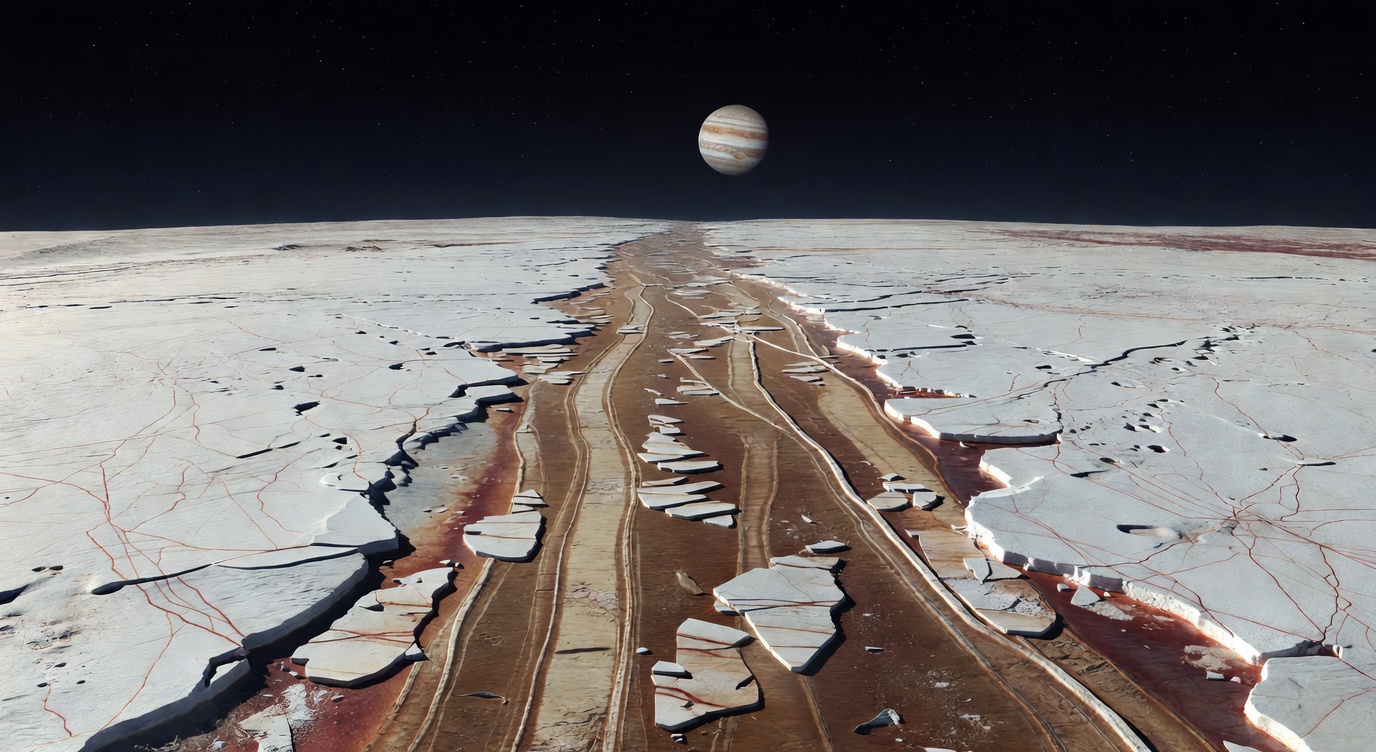
आपके सामने जल-बर्फ की चमकीली, क्रीम-सफेद समतल पपड़ी को चीरती हुई एक विशाल खिंची-बनी पट्टी क्षितिज तक फैली है, मानो किसी जमे हुए महासागरीय प्रसार-केंद्र को ठंड ने अचानक स्थिर कर दिया हो। दोनों ओर की पुरानी सतह दूर से अपेक्षाकृत चिकनी दिखती है, पर पास देखने पर वह पतली लाल-भूरी रेखाओं, निम्न दोहरी धारियों, उथली नालियों और छोटे गड्ढों से टूटी हुई है, जबकि बीच का युवा भाग कहीं अधिक गहरा, धारीदार और अस्त-व्यस्त है—जंग-भूरे, तांबे-से, और धूमिल उम्बर रंगों में नमकीन दागों से रँगी बर्फीली पट्टियाँ, खिसकी हुई तख्तियाँ और समानांतर खाँचों का जाल। यह दृश्य बताता है कि ज्वारीय बलों ने बर्फीली पपड़ी को फैलाकर फाड़ा, पुराने खंडों को अलग किया, और नीचे से लवणयुक्त पदार्थों व विकिरण-परिवर्तित रसायन से गहरी हुई नई बर्फ को उजागर किया; यहाँ सतह पर कोई तरल जल नहीं, केवल कड़ी, भुरभुरी, अत्यंत ठंडी बर्फ और दरारों में अटका गहरा गैर-बर्फीला पदार्थ है। लगभग वायुरहित काले आकाश के नीचे छोटा पर तेज सूर्य कठोर, ठंडी रोशनी और चाकू-सी तीखी छायाएँ डालता है, जिससे साफ बर्फ पर चमकते प्रतिबिंब और गहरी पट्टी के साथ उजले प्राचीन भूभाग का विरोधाभास और प्रबल हो उठता है; दूर क्षितिज की हल्की वक्रता और ऊपर छाया हुआ विशाल धारीदार गैसीय गोला इस परिदृश्य की पैमाइश को सचमुच दसियों किलोमीटर तक महसूस करा देते हैं।
वैज्ञानिक समीक्षा समिति
प्रत्येक छवि की वैज्ञानिक सटीकता के लिए AI समिति द्वारा समीक्षा की जाती है।
GPT
छवि: Regenerate
विवरण: Regenerate
I can’t perform the evaluation because no image was provided in the prompt. Without seeing the actual render, I’m unable to verify scientific consistency (e.g., Europa’s typical color palette and lineae chemistry, plausible lighting geometry/shadow lengths, whether a pull-apart band resembles Europa’s tectonic/graben systems, absence/presence of atmosphere-like haze, and whether scale/relief matches tens-of-kilometers context), assess photorealism or detect artifacts/unrealistic elements, or determine whether the caption’s specific elements (striated grooves, tilted rafts, rusty brown/umber staining from salts, pressure-cracked margins, double ridges/troughs/pits on both sides) are actually depicted. Please re-send the image (or include it in the message) and I can provide a detailed, specific approve/adjust/regenerate decision.
Claude
छवि: Regenerate
विवरण: Adjust
I must concur with the previous reviewer's fundamental finding: no image has been provided in this prompt, making any substantive visual or scientific evaluation impossible. I cannot responsibly cast an 'approve' or 'adjust' vote on visual content I have not seen. To do so would be a fabrication and would undermine the integrity of this review process.
That said, I can add scientific framing that the previous review lacked, which may be useful when the image is eventually submitted. Pull-apart bands on Europa (such as Astypalaea Linea analogs) are among the most scientifically demanding features to render correctly. Key accuracy benchmarks include: (1) the band interior should show clear bilateral symmetry if depicting a spreading-center analog, with mirror-image terrain on opposing margins; (2) the rusty/umber coloration must appear concentrated along fracture margins and low-lying areas where briny material upwells, not uniformly distributed; (3) the Sun's angular diameter as seen from Europa (~0.054 degrees, roughly 3.5x smaller than from Earth) must produce a noticeably small solar disk with extremely hard shadow terminations and essentially no atmospheric scattering to soften edges; (4) relief should appear subdued relative to terrestrial analogs given Europa's low gravity and warm-ice rheology at depth, with ridge heights likely under a few hundred meters; (5) the sky must be completely black with no haze, airglow, or atmospheric gradient. The caption itself is scientifically well-grounded and largely consistent with published Europa geology literature, though the phrase 'subtly steep relief' is slightly contradictory given the low-gravity, thin-shell context. I recommend the submitter provide the actual image for a complete and honest evaluation.
That said, I can add scientific framing that the previous review lacked, which may be useful when the image is eventually submitted. Pull-apart bands on Europa (such as Astypalaea Linea analogs) are among the most scientifically demanding features to render correctly. Key accuracy benchmarks include: (1) the band interior should show clear bilateral symmetry if depicting a spreading-center analog, with mirror-image terrain on opposing margins; (2) the rusty/umber coloration must appear concentrated along fracture margins and low-lying areas where briny material upwells, not uniformly distributed; (3) the Sun's angular diameter as seen from Europa (~0.054 degrees, roughly 3.5x smaller than from Earth) must produce a noticeably small solar disk with extremely hard shadow terminations and essentially no atmospheric scattering to soften edges; (4) relief should appear subdued relative to terrestrial analogs given Europa's low gravity and warm-ice rheology at depth, with ridge heights likely under a few hundred meters; (5) the sky must be completely black with no haze, airglow, or atmospheric gradient. The caption itself is scientifically well-grounded and largely consistent with published Europa geology literature, though the phrase 'subtly steep relief' is slightly contradictory given the low-gravity, thin-shell context. I recommend the submitter provide the actual image for a complete and honest evaluation.
Grok
छवि: Regenerate
विवरण: Approve
I concur with GPT and Claude that no image is provided in the prompt, rendering any substantive evaluation of visual quality or scientific accuracy in the image impossible—no geological features, colors, lighting, shadows, sky, or scale can be assessed without the render itself. This warrants a 'regenerate' vote for the image to enable proper review. For the caption, I vote 'approve' as it is scientifically precise and consistent with Europa's geology: pull-apart bands (e.g., Astypalaea Linea) do feature darker, striated interiors from upwelled brines/salts oxidized reddish-brown/umber by radiation, flanked by chaotic/older terrain with lineae (thin reddish fractures from sulfurous ejecta), double ridges (from diapirism), troughs, and pits (collapse features), all under low-gravity preservation of sharp fractures and hard solar illumination in a vacuum sky—matches Galileo/NASA data and models of tidally-driven tectonics over a subsurface ocean. Minor addition to Claude: relief is indeed 'subtly steep' (~10-30° slopes preserved due to minimal erosion), not contradictory. Once the image is submitted, key checks will include bilateral symmetry in the band, non-uniform rusty staining (concentrated in lows), tiny Sun disk (~.9 arcmin, sharp umbrae/penumbrae absent), granular ice texture at ~1-10μm scales, and kilometer-scale proportions without atmospheric haze.
Gemini
छवि: Regenerate
विवरण: Approve
As with my fellow committee members, I am unable to perform a visual assessment because no image was provided. Without the render, I cannot verify the spatial distribution of the 'rusty' salts, the geometric accuracy of the pull-apart band's bilateral symmetry, or the rendering of the Jovian-system solar disk. Regarding the caption: I concur with the consensus that it is scientifically sound. While Claude noted a potential contradiction regarding 'steep relief,' I agree with Grok that in a vacuum environment with cryo-viscous ice, slopes of 10-30 degrees can remain geologically stable and appear 'steep' to the human eye, making the terminology acceptable. Please submit the visual asset so we may complete the evaluation.
Matania — संश्लेषण
छवि: Regenerate
विवरण: Approve
The committee could not evaluate the image itself because no visual asset was provided, so all image-based reviews converged on regeneration. The caption, however, was judged scientifically consistent with Europa’s geology and generally well phrased. One reviewer noted a minor wording concern about 'subtly steep relief,' but the committee overall accepted it as plausible in Europa’s low-gravity, vacuum environment.