Scientific confidence: Medium

From this bright crater-rim crest, the ground looks like shattered chalk carved from porous water ice—pale, brittle, and pitted with tiny voids—before dropping away into a vast honeycomb of deep, overlapping cups whose smooth floors are stained dark reddish-brown by carbon-rich organic material. The stark contrast between bright icy walls and shadow-black hollows is a signature of this moon’s extraordinarily low density and high porosity: impacts here excavate crisp, steep rims and preserve sharp relief because gravity is feeble, there is no atmosphere, and almost nothing erodes the frozen surface. The horizon curves close and abruptly, emphasizing the tiny scale of the world, while angular blocks of ejecta seem barely anchored in place under the weak pull of gravity. Above the silent black sky, Saturn hangs immense, its thin rings flung wide in hard white sunlight that casts razor-edged shadows across the sponge-like terrain and makes the entire scene feel both delicate and profoundly alien.

From the floor of this steep impact bowl, you would stand on a strangely smooth pond of dark, matte lag deposits—cocoa, umber, and reddish-brown material likely enriched in complex organics and mixed with darker icy regolith—broken here and there by angular blocks of bright water ice fallen from the walls. Around you, the crater rises in sharp, cream-white slopes of porous ice, their pitted, scalloped, sponge-like texture revealing a crust so low in density and so rich in void space that impacts carve deep, crisp-walled cups instead of softer, slumped basins. In the airless stillness, the tiny distant Sun casts razor-edged shadows, making the sunlit rim glare almost white against a star-filled black sky while faint reflected light from the icy walls barely softens the darkness below. The scene feels both intimate and immense: an ancient impact hollow frozen in vacuum, where weak gravity, brittle ice, and dark settled residues create one of the Solar System’s most uncanny landscapes.

At your feet, the scarp looks less like solid ground than a torn wall of frozen sponge—pale water ice riddled with pits, knife-edged cavities, brittle ledges, and crumbly pockets of granular debris, each pore outlined by stark black shadow under the tiny, distant Sun. Dark reddish-brown to charcoal grains of irradiated organic-rich dust collect in the hollows and along fractured floors, a striking contrast that hints at how impacts have stirred and concentrated darker material within this moon’s extraordinarily porous, low-density crust. Beyond the foreground, the terrain rises into jumbled hummocks and sharp-rimmed, cup-shaped depressions whose delicate relief survives because gravity here is so weak that shattered ice is not easily compacted or erased. Above the airless black sky, Saturn looms immense and serene, its rings a thin luminous blade, making this fragile, honeycombed landscape feel both intimate in texture and vast in planetary scale.
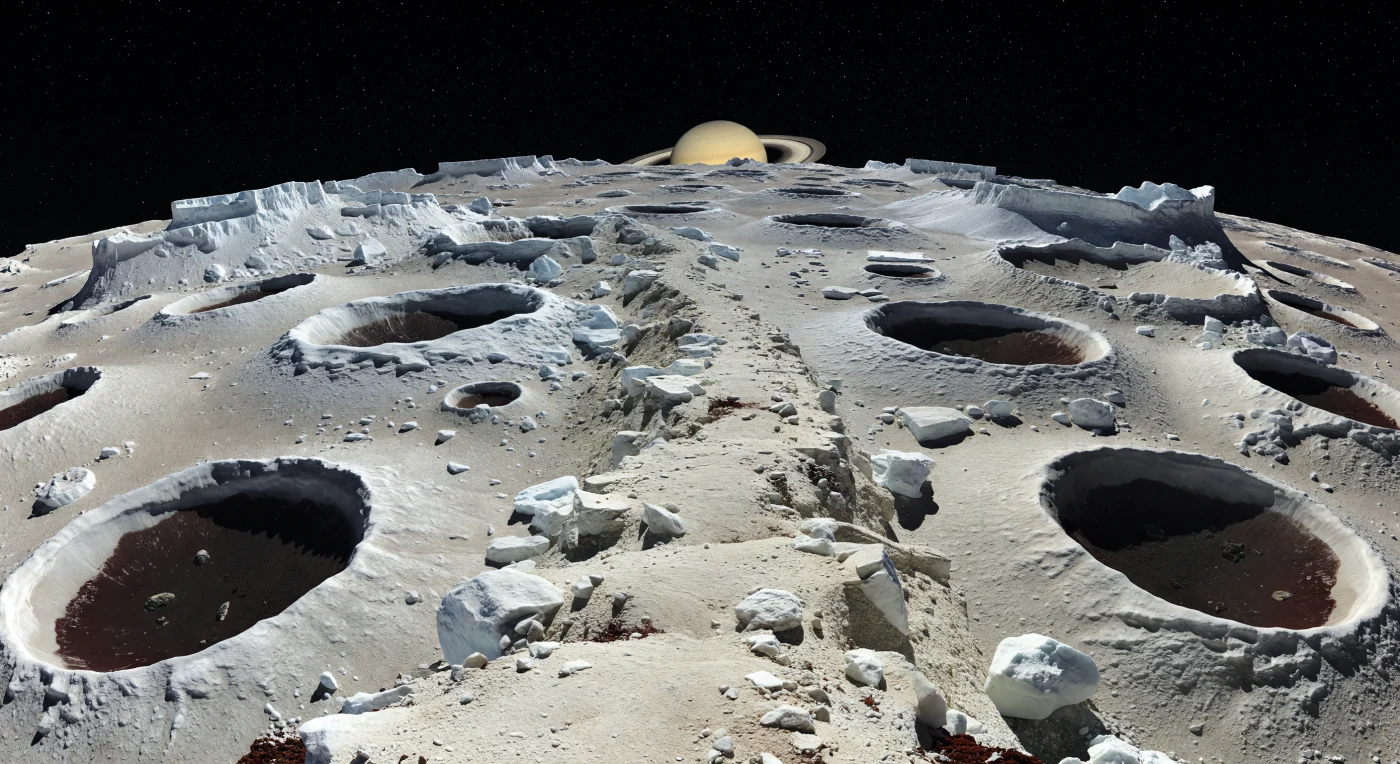
You appear to be standing on a knife-edge path only a few meters to tens of meters wide: a rounded spine of dirty-cream water-ice rubble and porous regolith winding between immense, steep-sided impact bowls whose bright rims and ink-dark floors plunge away on either side. The pale surface is littered with angular icy blocks, crumbly talus, and scattered reddish-brown organic-rich debris, while the surrounding terrain repeats the moon’s signature sponge-like geology—overlapping cup-shaped craters, broken rims, hummocky uplands, and blocky outcrops of weak, highly porous ice that can preserve startlingly sharp slopes in feeble gravity. Because there is no atmosphere, every distant ridge and crater chain remains perfectly crisp beneath a pure black sky, where stars shine even in daylight, the Sun glares as a small hard beacon, and Saturn hangs enormous with its tilted rings spread across the void. The near, subtly curved horizon and the abyssal depth of the neighboring craters make the landscape feel both miniature and vertiginous, as if a fragile frozen ruin had been carved from cream-colored ice and suspended over darkness.

You stand on a fragile, sponge-like plain of dusty beige-gray ice where a fresh impact has punched through the older, contaminant-darkened regolith and laid bare a startling patch of bluish-white water ice, its crisp rim and scattered blocks so sharp they seem newly shattered in the weak gravity. The surrounding landscape is a chaos of deep cup-shaped craters, jagged hummocks, and steep-walled pits, with pale icy high spots dropping into dark reddish-brown crater floors where carbon-rich material has collected over time, a pattern made possible by an interior so porous and low-density that impacts carve unusually steep, preserved forms instead of slumping away. Under the tiny hard Sun, every edge throws a razor-black shadow across the silent ground, and the clean ice catches a faint crystalline sparkle while the older surface stays matte and dusty. With no air to soften the view and only black vacuum above, the scene feels both miniature and immense: a shattered fragment of ice and organics, frozen in stark detail beneath the distant light of the outer Solar System.

At the edge of local day, the maze-like surface rises and falls in a bewildering field of overlapping bowl craters, where brilliant white and faintly tan ice rims catch the Sun like polished blades while the interiors plunge almost instantly into blackness. The ground underfoot looks fragile and skeletal—sharp fractured blocks, loose frost-coated regolith, crumbly ejecta, and jagged buttresses of water-ice bedrock—its sponge-like texture revealing a body so porous and weakly bound that impacts carved deep, crisp-walled pits instead of flattening into smoother plains. In the deepest hollows, dark reddish-brown to sooty deposits of carbon-rich material have collected like dust in wells, heightening the contrast between clean ice highlands and organic-stained crater floors. Above this near-airless world, a tiny hard Sun hovers low on the horizon, casting razor-edged shadows across a honeycomb landscape that stretches to the distance, while Saturn looms immense in a black star-speckled sky, making the scene feel at once frozen, silent, and impossibly vast.

At local noon, the landscape resolves into an immense honeycomb of tightly packed impact cups, where pale gray-white to faintly tan rims of porous water-ice bedrock link together in a cellular web around countless deep, dark brown crater centers. The weak overhead sunlight shortens the shadows just enough to expose the regional pattern in full: friable icy regolith, scattered angular ice blocks, and dusty, organic-rich lag trapped on ledges and crater floors, all preserved in an airless environment with no wind, clouds, or liquid erosion to soften the damage of eons of impacts. This sponge-like terrain reflects the body’s extraordinarily low density and high porosity—a rubble-rich mix dominated by water ice, with dark contaminants concentrated in the steep bowls—so the surface looks less like solid rock than a battered frozen foam extending unbroken to the horizon. Above it, the sky is a pure black vacuum, the Sun a small hard blaze, and off to one side Saturn hangs huge and ringed, making the scene feel both starkly scientific and almost impossibly unreal.

From the knife-edge rim of a giant impact pit, you look out across a bizarre sponge-like wilderness of pale water-ice bedrock, shattered angular blocks, and powdery regolith, where crater after crater overlaps in chaotic ranks and their steep walls plunge into unnaturally dark floors dusted with reddish, organic-rich debris. The muted light comes not from a bright sun overhead but from a rare eclipse: Saturn’s immense banded disk has nearly swallowed the tiny distant Sun, while its brilliant rings arc across the black sky and bathe the icy terrain in a faint, cold silvery glow. This landscape is shaped by extreme porosity and feeble gravity—an icy body so low in density and so loosely consolidated that impacts leave sharp-rimmed, cup-shaped hollows instead of broad collapsed basins, preserving a jagged relief out of all proportion to the moon’s small size. In the airless darkness, with stars still visible away from the eclipse and shadows inside the pits dropping to near-perfect black, the scene feels at once intimate and cosmic, as if you are standing on a fractured shard of ice suspended beneath a giant world.
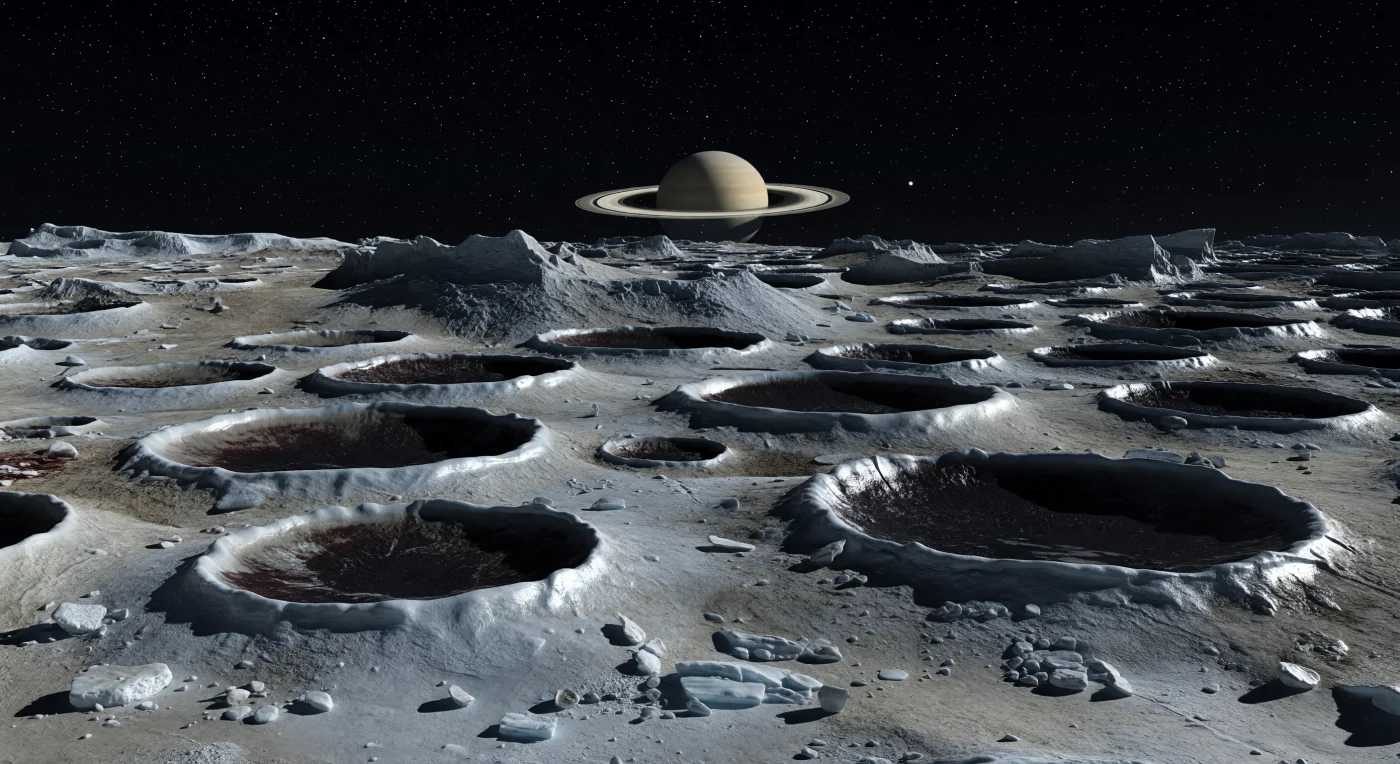
In the cold dark of local night, the ground appears like a shattered frozen sponge: pale, brittle water-ice regolith and fractured bedrock spill between steep, cup-shaped craters whose sharp silver-gray rims catch the faint reflected glow of the giant ringed world hanging overhead, while their floors sink into almost absolute blue-black darkness. This landscape owes its uncanny texture to an extraordinarily porous, low-density icy body, where weak gravity preserves crisp edges, overlapping impact scars, and scattered angular ice blocks, with some crater bottoms stained by mysterious reddish-brown to charcoal dark material mixed into the ice. Beyond the intimate foreground rubble, densely packed craters and hummocky ice highlands stretch to a broken horizon, emphasizing the small, irregular shape of the world beneath your feet. Above, in a sky made perfectly black by the total absence of atmosphere, clouds, or haze, a dense untwinkling starfield surrounds the softly banded disk and luminous rings whose feeble Saturnshine paints the entire scene in restrained tones of dirty white, gray, silver, and shadow.

From this gently rolling upland, the ground looks like a frozen sponge: pale, porous water-ice regolith is punched through with countless shallow, sharp-rimmed pits whose dark reddish-brown centers mark concentrations of radiation-processed organic material settled into impact floors. The horizon curves surprisingly close, a reminder that this tiny, low-density world has so little gravity that it never pulled itself into a sphere, leaving an irregular landscape of hummocks, broken crater rims, and brittle-looking crust preserved in pristine detail by the airless vacuum. Under a black sky, the distant Sun shines as a hard, pinpoint lamp, carving razor-edged shadows into every hollow while Saturn hangs low and immense, its bright rings tilted across space, with Titan nearby glowing as a muted orange disk against the darkness. Standing here would feel like standing on the surface of a shattered snowbank in deep space—silent, stark, and strangely delicate, on terrain made mostly of ice but shaped by impacts, extreme porosity, and the cold chemistry of the outer Solar System.
