Scientific confidence: High

Under the stark noon Sun, the equatorial plain stretches away in muted charcoal, brown-black, and faint reddish dust, a thin dark mantle draped over an ancient crust of water ice and broken by countless softened impact craters. Their shallow bowls, overlapping rims, and low hummocky ejecta linger with unusual clarity in the airless, low-gravity environment, while scattered angular ice boulders and bright patches on steep crater walls reveal the pale substrate beneath the dark lag deposits. Far on the horizon, a low but immense linear rise hints at the equatorial ridge province, its scale only gradually registering against the moon’s broad curvature and the immense stillness of the scene. Above it all hangs a pure black sky, where a small, fierce Sun casts razor-sharp shadows so black they seem cut into the ground, emphasizing the vacuum, the bitter cold, and the extraordinary contrast between soot-dark surface dust and rare glints of exposed ice.

Under a pure black, airless sky, an immense wilderness of brilliant white to pale gray ice stretches in every direction, its surface crowded with overlapping craters, jagged ejecta ridges, and shattered blocks of water-ice bedrock that glitter harshly in the Sun. The foreground is a tactile mix of powdery regolith, brittle slab-like ice, and hummocky debris aprons, while beyond it crater rims pile up to the horizon in stacked rings that reveal a surface battered for eons by impacts and preserved in deep freeze by the absence of air, liquid water, and active erosion. Because this terrain is dominated by highly reflective water ice, sunlight flashes off exposed faces with blinding intensity, yet the shadows fall razor-sharp and almost black, tinted faintly blue by stark contrast in the vacuum clarity. In the weak gravity, steep inner walls hold precarious talus-like rubble and isolated knobs that seem suspended in stillness, making the entire landscape feel silent, frozen, and impossibly ancient.
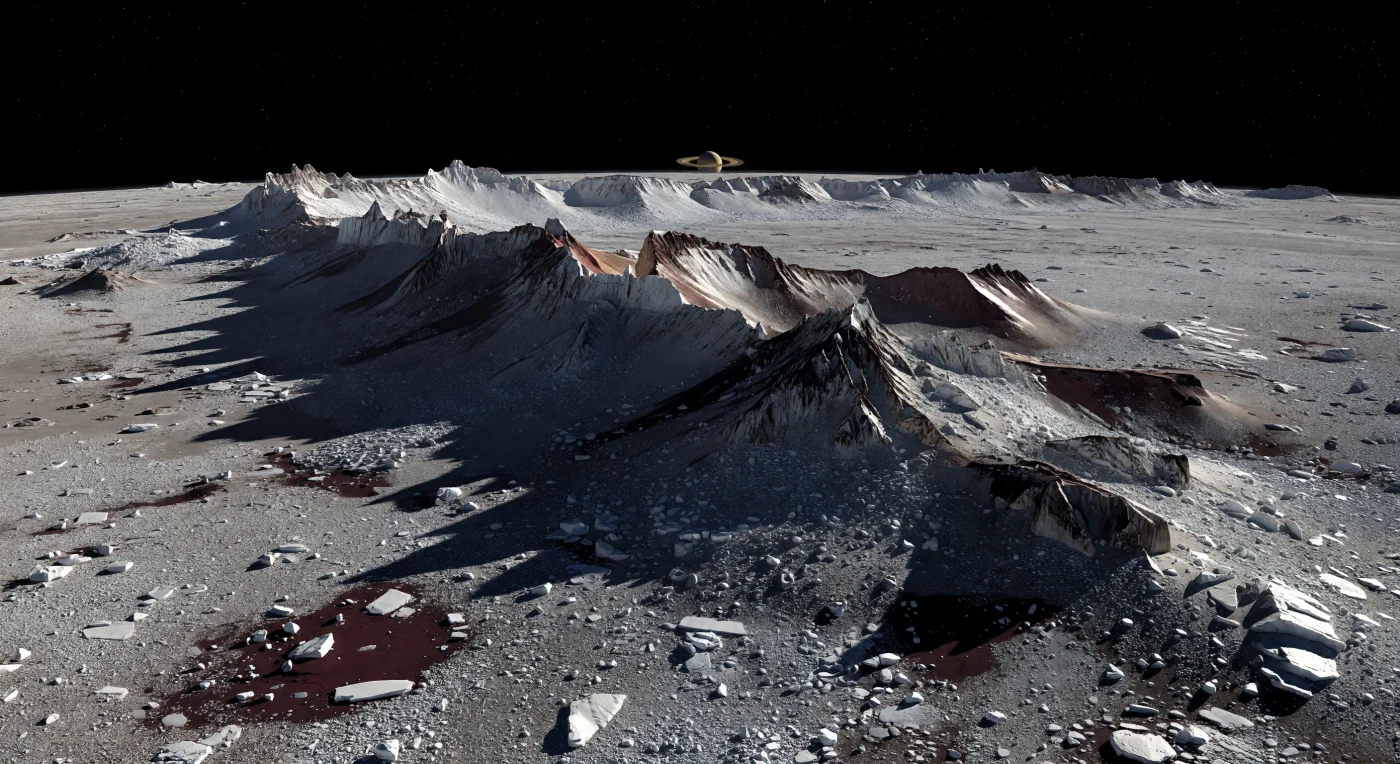
At the equator, the landscape is dominated by a colossal ridge that rises straight from the frozen plain like a shattered wall, its steep triangular peaks and serrated crest marching into the distance under a low, cold sunrise. Sunlight glances off exposed water ice in pale gray-white flashes, while most slopes are draped in the dark reddish-black dust of Cassini Regio, a thin mantle that deepens the contrast between bright ice, charcoal rubble, and the featureless black shadows stretching for kilometers across the curved horizon. The ground at your feet is a harsh regolith of icy gravel, broken slabs, talus, and impact-shattered boulders, telling of an ancient surface shaped by impacts, slow mass wasting, and the preservation of razor-sharp relief in extremely low gravity and an airless environment. Above it all, the sky is pure black with no haze or glow, and the small distant Sun casts light so stark and crisp that the entire scene feels both silent and monumental, as if you were standing beside the edge of a frozen world split by a mountain chain no atmosphere has ever softened.
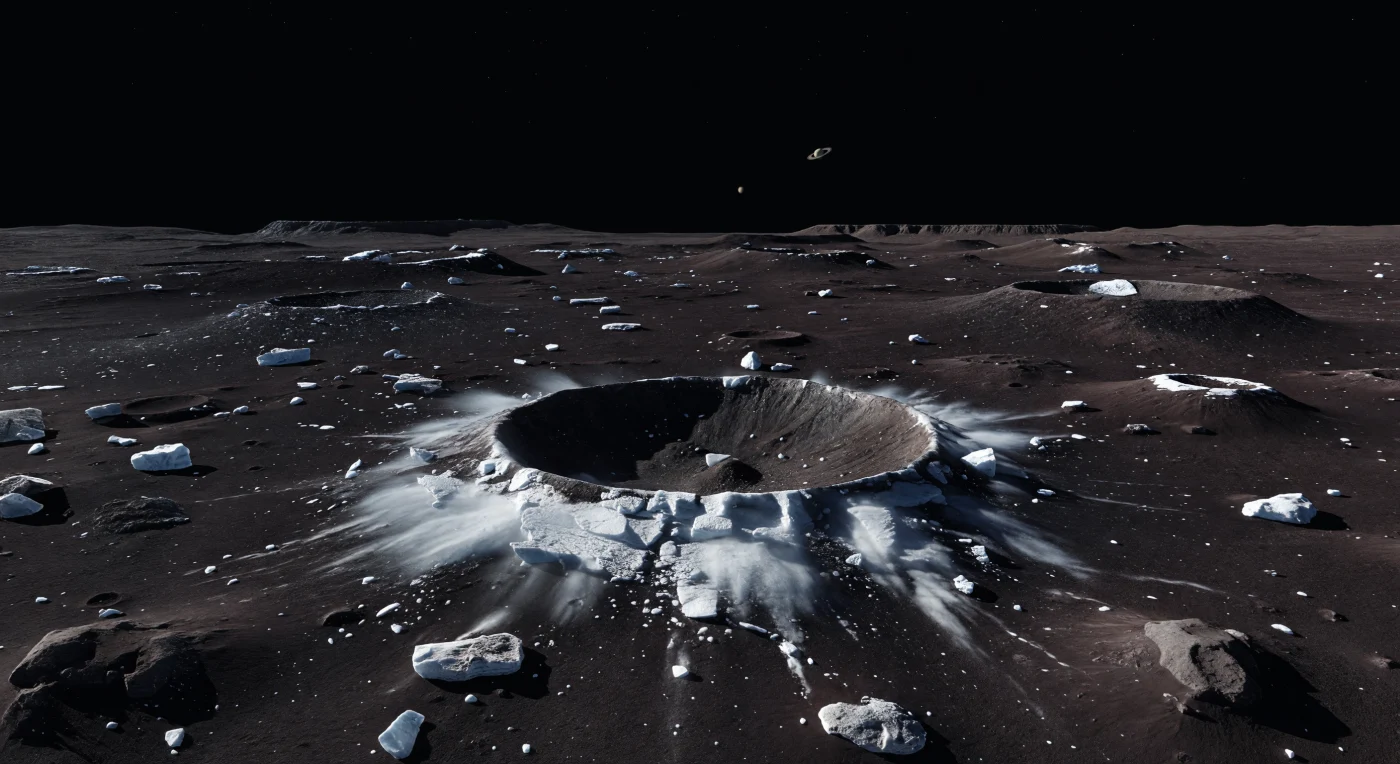
A young impact crater tears through the soot-dark mantle of the plain, its sharply cut rim and steep inner walls exposing brilliant water ice that bursts outward in white and faintly bluish ejecta rays across the cocoa-black ground. The dark surface here is a thin lag of carbon-rich dust draped over an ice-rich crust, so a fresh strike reveals the moon’s hidden brightness in angular blocks, shattered icy breccia, and gleaming rim fragments that throw stark contrast under the tiny, distant Sun. With no atmosphere to soften the light, every shadow is ink-black and razor-edged, the ancient surrounding terrain fading into subdued old craters, dusty hummocks, and far-off hints of steep mountains and a faint equatorial ridge. Standing here would feel like standing in a frozen stain suddenly split open—silent, airless, and immense, with a small ringed planet hanging low in a sky of absolute black.

At the foot of the equatorial ridge, immense talus fans spread outward in a frozen avalanche of angular debris—dirty-white water-ice boulders, reddish-black coated blocks, shattered slabs, and coarse regolith cascading from a towering wall of fractured bedrock that rises kilometers above the foreground. In the weak sunlight so far from the Sun, the airless surface is rendered with brutal clarity: clean ice flashes with cold brilliance, darker carbon-rich lag deposits absorb the light, and every crack, chip, and sublimation-softened facet throws a knife-edged shadow into the black sky. The ridge itself appears like a planetary spine, its jagged escarpments and exposed icy layers hinting at a still-debated origin shaped by ancient tectonics, collapse, or debris emplacement, while the mixed bright and dark materials record the moon’s famous contrast between cleaner ice and dust-darkened terrain. Standing here, among blocks as large as cars and gravel at your feet, the low gravity and absolute silence make the landscape feel both intimate and enormous—an avalanche slope frozen in time beneath one of the strangest mountain chains in the Solar System.

A stark transitional plain cuts across the landscape like a planetary tide line, where crater rims, hummocky ejecta, and shallow slopes are split into opposing halves of velvet-dark dust and dazzling water ice. The black-brown coating is a thin lag of carbon-rich material that warms in sunlight, driving nearby ice to sublimate and migrate into colder niches, where it recondenses as bright frost and icy streaks along shaded walls and pole-facing hollows. Under the tiny, fierce Sun, every ridge throws a razor-edged shadow, every ice block flashes with cold brilliance, and the moon’s weak gravity leaves boulders and crestlines perched with an improbable delicacy. Above the silent cratered plains and broken distant highlands, Saturn hangs almost motionless in a perfectly black sky, deepening the uncanny sense that you are standing on an ancient world divided between darkness and frost.

A pale silver-white plain of frost-rich regolith extends in every direction beneath a perfectly black sky, its horizon noticeably close and strongly curved by the moon’s small size. In the low, distant sunlight, clean water ice gleams with faint bluish highlights while razor-sharp shadows pool inside sparse, crisp-rimmed craters and beside scattered angular ice blocks half-buried in the surface. The ground is delicately textured with polygonal frost cracking, sublimation-scalloped ripples, and ancient micrometeoroid churning preserved in vacuum, untouched by wind, liquid, or weather of any kind. Standing here would feel like occupying a frozen, airless world of immense stillness, where bright polar ice records eons of impact and sublimation in hard-edged detail.

From the floor of this ancient crater, the pole-facing wall rises in a steep sweep of sooty brown and reddish-black debris, its fractured icy bedrock and angular boulders striped by thin, brilliant frost that clings to the coldest ledges, gullies, and talus aprons. The scene is a frozen record of thermal migration: water molecules liberated from warmer dark terrain in the vacuum have drifted and recondensed here as bright veneers and patchy streaks, while nearby sunlit slopes remain bare, darker, and faintly warm-toned under the tiny distant Sun. With no air to soften the light, every block throws a razor-edged shadow into black fissures, frost crystals flash with faint bluish sparkle, and the crater rim looms high above in immense, silent scale. Over the stark landscape, a black sky holds faint stars and a pale ringed giant hanging nearly motionless, deepening the sense of standing in a place that is both geologically active in slow motion and utterly still.

In the cold twilight of an airless world, multiple serrated crests of the equatorial ridge rise abruptly from the horizon like parallel blades, their knife-edged summits outlined by a thin, brilliant rim of sunlight as the Sun slips just behind them and the first stars emerge in the black sky. At your feet, a frozen plain of reddish-black, carbon-rich dust and lag deposits lies draped over water-ice bedrock, broken by angular icy boulders, shallow craterlets, and bright fracture lines where landslides and sublimation have stripped away the dark mantle. The alternating bands of muted dark coating and stark, dirty-white ice reveal the moon’s famous albedo contrast in miniature, while steep talus slopes, narrow saddles, and impact-scalloped notches show how this immense ridge has been modified by impacts, mass wasting, and the slow loss of exposed ice in vacuum. In the weak gravity, these mountain walls tower for kilometers with an unnaturally elongated, almost architectural scale, and without air to soften the light, every shadow falls razor-black and every icy scarp flashes with a hard, unearthly gleam.

You stand on the floor of an immense ancient impact basin carved into water-ice bedrock, where brilliant hummocky plains of frost-bright regolith and scattered angular ice blocks spread outward in pale whites, ivories, and faint tan tones under a hard, high Sun. The gently rolling basin floor is crossed by shallow troughs, softened craterlets, and old scars muted by eons of sublimation and ice redistribution, while a broad, subdued central rise swells almost imperceptibly from the plain. Far beyond the moon’s surprisingly short horizon, colossal terraced rim walls curve across the black, airless sky in broken steps of scarps, slumped icy debris, and crater-pocked highlands, their razor-edged shadows revealing both the low gravity and the enormous scale of the basin. With no atmosphere to soften the light, every glint from clean ice and every peppering of darker carbon-rich dust stands out starkly, making the whole scene feel like a frozen amphitheater suspended in silent space.

Across these bright highlands, the ground is a shattered skin of ancient water ice—powdery white regolith, granular frost, and sharp-edged blocks strewn over fractured bedrock and old crater ejecta, all preserved with remarkable crispness in the moon’s feeble gravity and airless vacuum. The sunlight is distant yet hard, making the pale terrain gleam in brilliant whites, creams, and faint tans while every pebble and crater rim throws an ink-black shadow with razor-sharp edges. Beyond the foreground rubble, rugged cratered uplands and subdued ridges stretch for kilometers, their relief barely softened over immense spans of time by only micrometeorite impacts and slow space weathering. Above the horizon, nearly motionless in the black sky, hangs a pale yellow-beige Saturn a few degrees wide, its thin bright rings cleanly resolved—an enormous, silent marker that fixes the scene in a world of deep cold, ancient surfaces, and astonishing scale.

Under a pure vacuum-black sky, a broad plain of bright water ice stretches away in silver-gray silence, its granular frost, scattered angular blocks, low hummocks, and shallow craterlets picked out by the dim reflected glow of Saturn and its rings hanging near the horizon. The light is weak but exquisitely crisp: in the absence of any atmosphere, even these faint shadows remain sharp-edged, while smoother patches of icy regolith catch a delicate ringlight sheen and distant ancient craters appear softened by eons of sublimation and slow ice migration. This terrain is geologically quiet and brutally cold, built mostly of clean water ice with only sparse dark meteoritic specks and fractured icy outcrops interrupting the pale surface. With the horizon held low by the moon’s small size, the plain feels both intimate in its tiny foreground fragments and immense in its far-off crater floors, as if you are standing in a frozen, airless desert lit only by a giant world’s ghostly shine.
