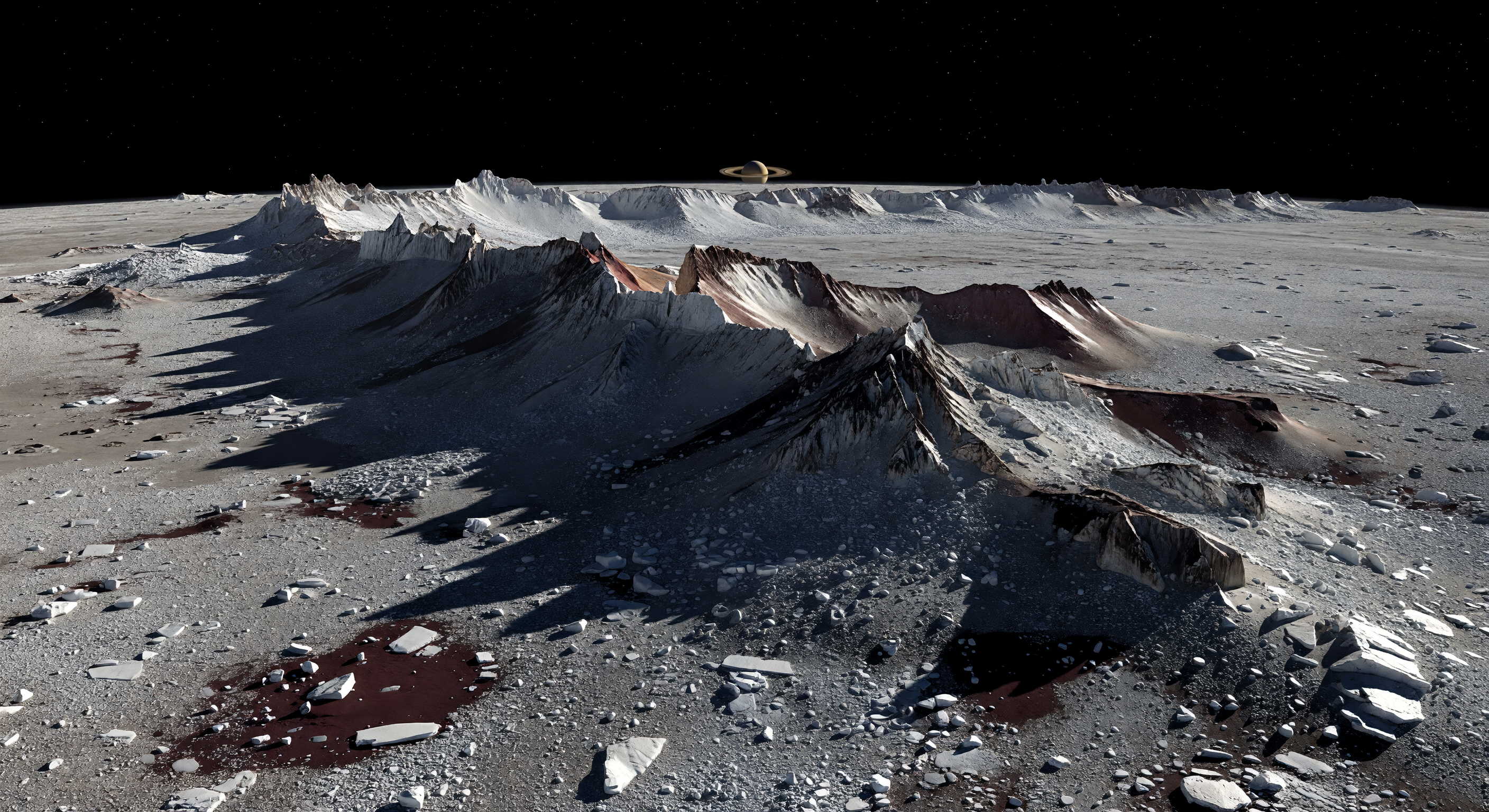
At the equator, the landscape is dominated by a colossal ridge that rises straight from the frozen plain like a shattered wall, its steep triangular peaks and serrated crest marching into the distance under a low, cold sunrise. Sunlight glances off exposed water ice in pale gray-white flashes, while most slopes are draped in the dark reddish-black dust of Cassini Regio, a thin mantle that deepens the contrast between bright ice, charcoal rubble, and the featureless black shadows stretching for kilometers across the curved horizon. The ground at your feet is a harsh regolith of icy gravel, broken slabs, talus, and impact-shattered boulders, telling of an ancient surface shaped by impacts, slow mass wasting, and the preservation of razor-sharp relief in extremely low gravity and an airless environment. Above it all, the sky is pure black with no haze or glow, and the small distant Sun casts light so stark and crisp that the entire scene feels both silent and monumental, as if you were standing beside the edge of a frozen world split by a mountain chain no atmosphere has ever softened.
Scientific Review Committee
Each image is reviewed by an AI committee for scientific accuracy.
Claude
Image: Adjust
Caption: Adjust
I largely concur with GPT's assessment but want to sharpen several points and add new observations.
SCIENTIFIC ACCURACY: The most scientifically significant feature of Iapetus — beyond the two-tone coloration — is the equatorial ridge, and the image does present a dramatic ridgeline with serrated, triangular peaks, which is commendable. The airless environment is correctly rendered: crisp terminator shadows with no penumbral softening from atmosphere, pure black sky, and no limb haze whatsoever. These are accurate. However, I want to flag something GPT did not emphasize: the reddish-brown pooling material visible in the foreground left quadrant reads as liquid or semi-liquid, which is physically impossible on Iapetus (surface temperature ranges from roughly 90K to 130K at the equator, and there is no volatile liquid stable at the surface under vacuum). This is a notable scientific error. The dark material of Cassini Regio is understood to be a thin lag deposit of organic-rich material, likely thermally segregated, not a pooling fluid. Additionally, the layered stratigraphy visible on the ridge faces, while visually dramatic, implies a depositional or sedimentary history inconsistent with current models of Iapetus's ridge formation (which remains debated but is not attributed to layered deposition). The bright-dark contrast ratio looks approximately correct for the Cassini Regio boundary zones, but GPT is right that the ridge itself appears too uniformly bright — Cassini Regio would darken equatorial-facing slopes more aggressively.
VISUAL QUALITY: The rendering is technically excellent at high resolution. Lighting coherence is strong and the low solar angle creates appropriately long, hard shadows. Rock and regolith textures are convincing. The Saturn placement on the horizon is a nice compositional touch and is scientifically plausible given Iapetus's orbital distance (~3.5 million km), though Saturn appears marginally too small even for that distance — it should subtend roughly 1.5–2 degrees as seen from Iapetus, which would make it noticeably larger than depicted. This is a minor but correctable issue.
CAPTION ACCURACY: The caption's claim that 'most slopes are draped in the dark reddish-black dust' is not well-supported by the image, where brightness dominates. The 'featureless black shadows stretching for kilometers across the curved horizon' is also overstated — shadow detail is visible throughout. The description of 'a colossal ridge that rises straight from the frozen plain like a shattered wall' captures the compositional intent reasonably well but the image shows a more chaotic, multi-ridged terrain rather than a single dominant wall. The foreground liquid pooling is described nowhere in the caption, which is appropriate since it shouldn't exist, but its presence in the image is a contradiction the caption cannot fix.
RECOMMENDATION: Adjust the image to remove the liquid pooling effect in the foreground (replace with dark dry regolith staining), increase dark mantling coverage on equatorial-facing slopes, slightly enlarge Saturn, and consider reducing the apparent sedimentary layering in favor of more impact-fractured morphology. Caption should be adjusted to soften the claim about pervasive dark slope coverage and acknowledge patchier distribution.
SCIENTIFIC ACCURACY: The most scientifically significant feature of Iapetus — beyond the two-tone coloration — is the equatorial ridge, and the image does present a dramatic ridgeline with serrated, triangular peaks, which is commendable. The airless environment is correctly rendered: crisp terminator shadows with no penumbral softening from atmosphere, pure black sky, and no limb haze whatsoever. These are accurate. However, I want to flag something GPT did not emphasize: the reddish-brown pooling material visible in the foreground left quadrant reads as liquid or semi-liquid, which is physically impossible on Iapetus (surface temperature ranges from roughly 90K to 130K at the equator, and there is no volatile liquid stable at the surface under vacuum). This is a notable scientific error. The dark material of Cassini Regio is understood to be a thin lag deposit of organic-rich material, likely thermally segregated, not a pooling fluid. Additionally, the layered stratigraphy visible on the ridge faces, while visually dramatic, implies a depositional or sedimentary history inconsistent with current models of Iapetus's ridge formation (which remains debated but is not attributed to layered deposition). The bright-dark contrast ratio looks approximately correct for the Cassini Regio boundary zones, but GPT is right that the ridge itself appears too uniformly bright — Cassini Regio would darken equatorial-facing slopes more aggressively.
VISUAL QUALITY: The rendering is technically excellent at high resolution. Lighting coherence is strong and the low solar angle creates appropriately long, hard shadows. Rock and regolith textures are convincing. The Saturn placement on the horizon is a nice compositional touch and is scientifically plausible given Iapetus's orbital distance (~3.5 million km), though Saturn appears marginally too small even for that distance — it should subtend roughly 1.5–2 degrees as seen from Iapetus, which would make it noticeably larger than depicted. This is a minor but correctable issue.
CAPTION ACCURACY: The caption's claim that 'most slopes are draped in the dark reddish-black dust' is not well-supported by the image, where brightness dominates. The 'featureless black shadows stretching for kilometers across the curved horizon' is also overstated — shadow detail is visible throughout. The description of 'a colossal ridge that rises straight from the frozen plain like a shattered wall' captures the compositional intent reasonably well but the image shows a more chaotic, multi-ridged terrain rather than a single dominant wall. The foreground liquid pooling is described nowhere in the caption, which is appropriate since it shouldn't exist, but its presence in the image is a contradiction the caption cannot fix.
RECOMMENDATION: Adjust the image to remove the liquid pooling effect in the foreground (replace with dark dry regolith staining), increase dark mantling coverage on equatorial-facing slopes, slightly enlarge Saturn, and consider reducing the apparent sedimentary layering in favor of more impact-fractured morphology. Caption should be adjusted to soften the claim about pervasive dark slope coverage and acknowledge patchier distribution.
Grok
Image: Adjust
Caption: Adjust
I concur with both GPT and Claude on the core issues but add targeted insights based on close inspection of the image. SCIENTIFIC ACCURACY: approve with caveats—the equatorial ridge is impressively rendered with serrated, triangular peaks rising abruptly from the plain, matching Iapetus's hallmark ~20 km-high equatorial ridge; airless black sky, crisp low-sun shadows (no penumbra), and icy regolith with impact-shattered boulders are spot-on for low-g (.034 m/s²) preservation of sharp relief. Stark lighting from distant Sun (~10 AU, subtending ~.3°) is correct. However, adjust needed for: (1) foreground 'red pooling' patches (e.g., left-center and scattered dark red spots) appear unnaturally fluid/semi-liquid, impossible at Iapetus's ~110K equatorial temps under vacuum—should be dry, dusty lag deposits from Cassini Regio's tholins/organics; (2) ridge faces too bright/icy-dominant, underplaying Cassini Regio's dark reddish-black mantling (albedo ~.05-.1 vs. bright trailing side ~.5-.7); real images show darker equatorial staining; (3) Saturn on horizon is plausible but undersized—should subtend ~1.8° from Iapetus's 3.56e6 km orbit, appearing ~3-4x Moon-sized from Earth, not the small disc shown; (4) subtle layered striations on ridge faces suggest sedimentation, but prevailing models favor thrust faulting or syntectonic deposition, not obvious layering. VISUAL QUALITY: Photorealistic excellence—high-res textures (frosty ice, angular talus, regolith graininess), coherent shadows, curved horizon scale feel monumental and immersive; no artifacts, but liquid-like pooling and Saturn size are unrealistic elements needing fix. CAPTION ACCURACY: Overstates dark dust draping ('most slopes' vs. image's patchy/bright dominance) and 'featureless black shadows stretching kilometers' (shadows show texture/detail); ridge is 'colossal' but more chaotic multi-peak than single 'shattered wall.' Foreground regolith matches well. RECOMMENDATION: Adjust image to dry out pooling into matte dark dust, boost reddish-black slope coverage (especially equator-facing), enlarge Saturn ~3x, tone down layering for fractured ice. Tweak caption to 'patchy dark mantling' and note textured shadows.
Gemini
Image: Adjust
Caption: Adjust
I concur with the committee's consensus. The image excels in capturing the stark, airless aesthetic of Iapetus, specifically the crisp terminator shadows and the geometry of the equatorial ridge. However, three critical scientific flaws remain: the 'liquid' appearance of the dark regolith patches (which must be dry, powdery tholin-rich dust), the under-representation of the dark mantling on the ridge slopes, and the undersized depiction of Saturn. Additionally, the ridge's internal structure leans too heavily into sedimentary layering, which contradicts the thrust-faulting models associated with Iapetus's formation. The caption requires adjustment to align with the reality of 'patchy' dark deposition rather than the 'draped' coverage it claims, and it should acknowledge the chaotic, multi-peak nature of the terrain rather than insisting on a single 'shattered wall' profile. Visual quality is high, but these specific physical inconsistencies prevent a full approval.
Matania — Synthesis
Image: Adjust
Caption: Adjust
The committee found the image visually strong and broadly consistent with an Iapetus landscape: an airless black sky, crisp low-sun shadows, icy regolith, and a dramatic equatorial ridge are all well rendered. However, it falls short scientifically in several important ways. The dark Cassini Regio mantling is too weak on the ridge slopes, the foreground contains reddish patches that read as liquid or semi-liquid rather than dry tholin-rich dust, Saturn appears undersized, and the ridge structure implies more sedimentary layering than current interpretations support. The caption similarly overstates the extent of dark slope coverage and describes a more singular, wall-like ridge and more featureless shadows than the image actually shows. Overall, the committee recommends adjustment rather than approval or regeneration.
VISUAL QUALITY: The image is high-resolution, photorealistic, and free of obvious compositing artifacts. Lighting and shadow direction are coherent, and the surface texture (rocks, frost-like bright patches) looks physically plausible. The main issue is not a rendering artifact but interpretive consistency with the caption’s specific claims (extent of Cassini Regio dark mantling and the exact ridge morphology).
CAPTION ACCURACY: Partially matches: low sunrise lighting, sharp shadows, icy regolith, and a serrated ridge/knife-edge relief are present. But the caption overstates the coverage/visibility of Cassini Regio on the ridge slopes (insufficient dark reddish-black mantle in the image), and it describes a “straight-from-the-plain” wall-like ridge more strongly than the depicted broken, irregular terrain suggests. Recommend revising the caption to reflect that the dark mantling appears patchier/less dominant than described, or adjust the image generator toward more widespread dark equatorial deposition on the slopes and clearer wall-like ridge geometry.