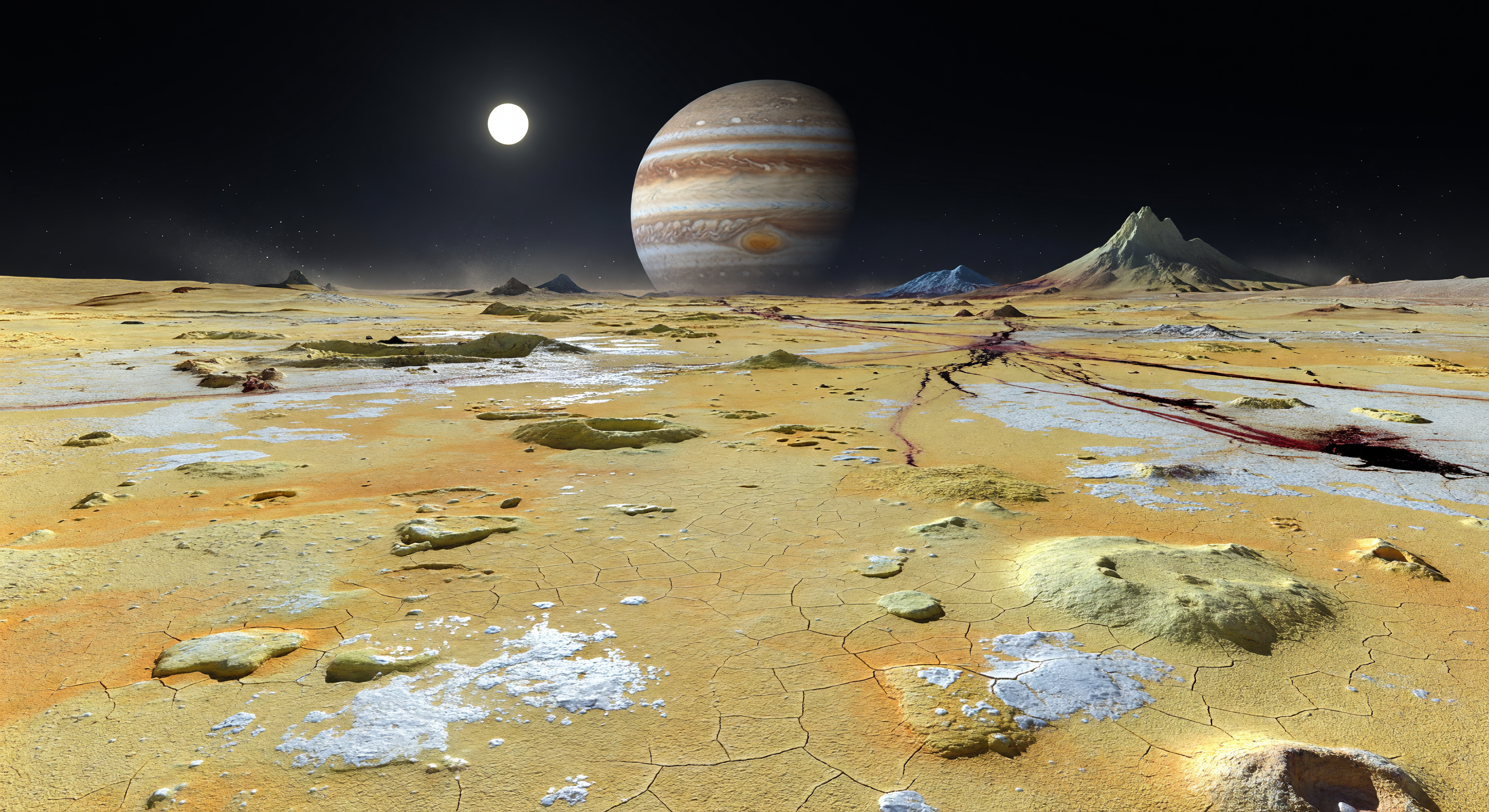
You stand on a young volcanic plain of brittle sulfur crust and ash-like dust, where mustard-yellow and ochre ground is broken by polygonal sublimation cracks, low hummocks, and dazzling white patches of sulfur dioxide frost pooled in colder hollows. Thin black and deep red fallout streaks hint at eruptions beyond the horizon, while a few shallow collapse pits and far-off steep silicate massifs reveal a crust continually resurfaced by relentless tidal heating rather than rivers, wind, or rain. Above this dry, airless-looking expanse, the sky is almost pure black under an atmosphere so tenuous that sunlight remains stark and unsmoothed, casting razor-edged shadows across every fracture and frost crust. Dominating everything is enormous banded Jupiter, fixed above the horizon like a suspended wall in the sky, making the immense sulfur plain feel at once frozen, volcanic, and profoundly alien.
Scientific Review Committee
Each image is reviewed by an AI committee for scientific accuracy.
Claude
Image: Adjust
Caption: Adjust
I largely concur with the GPT reviewer's assessment but want to add several specific observations and one notable disagreement.
SCIENTIFIC ACCURACY: The sulfur-dominated color palette (mustard yellow, ochre, pale greens) is genuinely well-chosen and consistent with Voyager and Galileo imagery of Io's surface. The polygonal cracking pattern is a reasonable artistic interpretation of thermal contraction or sublimation fracturing, though Io's actual surface textures tend toward smoother sulfur flows and calderas rather than desiccation-crack polygons—this is a minor geological inaccuracy. The white SO2 frost pooling in topographic lows is scientifically sound. The steep silicate massifs in the background are appropriate; Io does host mountains formed by compressional stress, not volcanism per se, and their snow-capped appearance here is misleading—those caps should read as SO2 frost, not silicate snow, but the distinction is visually ambiguous. The red streaks are plausible as pyroclastic fallout, though real Io fallout deposits tend to be annular and diffuse rather than linear. My key disagreement with the GPT reviewer concerns Jupiter's scale: Jupiter subtends roughly 19.5 degrees as seen from Io, making it genuinely enormous in the sky—the rendering here actually undersells this slightly rather than exaggerating it. The Sun at Io's distance (5.2 AU) should appear as a brilliant but noticeably reduced disk, roughly 1/27th the solid angle seen from Earth, yet the image renders it nearly as bright and large as seen from Earth's surface, which is a clear inaccuracy. The sky darkness is correct for Io's near-vacuum atmosphere (surface pressure ~0.3 nPa), but there is a subtle blue-gray horizon glow that is physically unjustified and should be eliminated entirely.
VISUAL QUALITY: The rendering is technically accomplished with good texture resolution and coherent directional lighting. However, the red streak feature reads as composited and too graphically vivid—real pyroclastic deposits on Io show more diffuse, muted coloration. The planet and sun compositing feels slightly disconnected from the surface lighting model; the surface shadows do not perfectly align with the implied solar direction when Jupiter's reflected light contribution is considered.
CAPTION ACCURACY: The description is evocative and scientifically informed but overclaims on a few points. 'Thin black fallout streaks' are not clearly visible—only the red streak is prominent. 'Shallow collapse pits' are not distinguishable from generic low-relief depressions in this rendering. The 'almost pure black' sky claim is contradicted by visible horizon glow. The phrase 'fixed above the horizon like a suspended wall' captures Jupiter's apparent angular size well conceptually. Overall the caption is aspirationally accurate but describes a more scientifically precise image than was actually rendered.
SCIENTIFIC ACCURACY: The sulfur-dominated color palette (mustard yellow, ochre, pale greens) is genuinely well-chosen and consistent with Voyager and Galileo imagery of Io's surface. The polygonal cracking pattern is a reasonable artistic interpretation of thermal contraction or sublimation fracturing, though Io's actual surface textures tend toward smoother sulfur flows and calderas rather than desiccation-crack polygons—this is a minor geological inaccuracy. The white SO2 frost pooling in topographic lows is scientifically sound. The steep silicate massifs in the background are appropriate; Io does host mountains formed by compressional stress, not volcanism per se, and their snow-capped appearance here is misleading—those caps should read as SO2 frost, not silicate snow, but the distinction is visually ambiguous. The red streaks are plausible as pyroclastic fallout, though real Io fallout deposits tend to be annular and diffuse rather than linear. My key disagreement with the GPT reviewer concerns Jupiter's scale: Jupiter subtends roughly 19.5 degrees as seen from Io, making it genuinely enormous in the sky—the rendering here actually undersells this slightly rather than exaggerating it. The Sun at Io's distance (5.2 AU) should appear as a brilliant but noticeably reduced disk, roughly 1/27th the solid angle seen from Earth, yet the image renders it nearly as bright and large as seen from Earth's surface, which is a clear inaccuracy. The sky darkness is correct for Io's near-vacuum atmosphere (surface pressure ~0.3 nPa), but there is a subtle blue-gray horizon glow that is physically unjustified and should be eliminated entirely.
VISUAL QUALITY: The rendering is technically accomplished with good texture resolution and coherent directional lighting. However, the red streak feature reads as composited and too graphically vivid—real pyroclastic deposits on Io show more diffuse, muted coloration. The planet and sun compositing feels slightly disconnected from the surface lighting model; the surface shadows do not perfectly align with the implied solar direction when Jupiter's reflected light contribution is considered.
CAPTION ACCURACY: The description is evocative and scientifically informed but overclaims on a few points. 'Thin black fallout streaks' are not clearly visible—only the red streak is prominent. 'Shallow collapse pits' are not distinguishable from generic low-relief depressions in this rendering. The 'almost pure black' sky claim is contradicted by visible horizon glow. The phrase 'fixed above the horizon like a suspended wall' captures Jupiter's apparent angular size well conceptually. Overall the caption is aspirationally accurate but describes a more scientifically precise image than was actually rendered.
Grok
Image: Adjust
Caption: Adjust
I concur with both GPT and Claude on the overall 'adjust' ratings, as the image captures a compelling Io-inspired vista but falls short of full scientific and photorealistic fidelity. SCIENTIFIC ACCURACY (adjust): Strong alignment with Io's sulfurous yellow/ochre plains, SO2 frost (white patches in lows), polygonal cracks (plausible for sublimation/thermal stress per Galileo data), red/black streaks (consistent with plume fallout like Ra Patera deposits), and silicate massifs (e.g., ~10-15km peaks from compression). Jupiter's banded disk dominating the horizon aptly conveys its ~19.5° angular diameter, fixed tidally. However, key issues persist: (a) prominent full moon (likely Europa) is too crisp/large without atmospheric extinction—Io's satellites appear as faint points except during rare occultations; (b) Sun rendered unrealistically large/bright (should be ~.11° disk, ~1/200 Earth brightness at 5.2 AU, not a glaring orb); (c) subtle horizon haze/glow unjustified in Io's ~10^-12 bar SO2 exosphere—no scattering expected; (d) shadows razor-sharp (correct for vacuum) but surface lighting doesn't fully account for Jupiter's albedo contribution (~10-20% illumination). These are minor-to-moderate deviations from Voyager/Galileo/Juno imagery. VISUAL QUALITY (adjust): Photorealistic textures excel—brittle crust, frost pooling, dust streaks feel tangible with coherent perspective (foreground cracks to distant peaks). No major artifacts, but compositing flaws evident: sky elements (Jupiter, Sun, moon) slightly haloed/disconnected from surface; red streaks overly vivid/saturated vs. diffuse real deposits; color grading stylized (boosted yellows/greens). CAPTION ACCURACY (adjust): Excellently matches core visuals (sulfur expanse, cracks, frost hollows, red streaks, massifs, black sky, giant Jupiter). Discrepancies: 'thin black fallout streaks' vague/minor amid reds (not prominent); 'shallow collapse pits' indistinguishable from hummocks/depressions; sky not 'almost pure black' due to glow/moon/sun; no mention of extra moon, which alters 'profoundly alien' isolation. Constructive: Regenerate with dimmed/tiny Sun, fainter moon (or remove), pure black sky, subtler reds/glows for approval—image is 80% there scientifically/visually.
Gemini
Image: Adjust
Caption: Adjust
I concur with the committee's consensus that the image is a high-quality, evocative representation that requires technical refinement to meet rigorous scientific standards. The core issue remains the 'compositing' effect: the sky elements (Sun, Jupiter, and the extraneous moon noted by Grok) lack a unified lighting model with the surface. Specifically, the Sun is rendered as a standard Earth-like star, failing to reflect the diminished angular size and intensity at 5.2 AU. The 'horizon glow' is a significant scientific error for an airless body like Io, which should exhibit a stark, hard transition between the ground and the black of space. While the sulfur-rich color palette and polygonal terrain are excellent, the pyroclastic deposits (red streaks) need to be rendered with less saturation and more diffuse, 'dust-like' textures to match real-world observations from Galileo and Juno. The caption is well-written but describes features—specifically the 'collapse pits' and 'thin black streaks'—that remain ambiguous or absent in the current rendering. To move to 'approve', the next iteration must remove the horizon haze, correct the solar disk size, and ensure the red fallout patterns appear as surface-level deposits rather than painted-on textures.
Matania — Synthesis
Image: Adjust
Caption: Adjust
The committee found the scene broadly Io-plausible and visually strong, with convincing sulfurous yellows, polygonal cracking, white SO2-frost-like deposits, rugged massifs, and a dramatic sense of scale beneath Jupiter. However, it falls short of full scientific fidelity due to compositing and illumination issues: the Sun is too Earth-like in size/brightness, the sky shows an unjustified horizon glow for Io’s near-vacuum environment, and the visible moon/sky elements feel slightly disconnected from the surface lighting model. The red fallout streaks are plausible in concept but read as overly saturated and painterly rather than diffuse plume deposits. The caption captures the main scene well, but it overstates or ambiguously describes a few features not clearly visible, especially the thin black streaks and collapse pits, and it also implies a darker, cleaner sky than the image actually shows.
Other languages
- Français: Étendue sulfure sous-jovienne
- Español: Extensión de azufre subjoviana
- Português: Extensão sulfúrea subjoviana
- Deutsch: Subjovische Schwefelweite
- العربية: مدى الكبريت دون المشتري
- हिन्दी: उप-जोवियन गंधक विस्तार
- 日本語: 準木星の硫黄原
- 한국어: 목성 아래 황 평원
- Italiano: Distesa sulfurea subjoviana
- Nederlands: Subjoviaanse zwavelvlakte
2) VISUAL QUALITY (adjust): The image is high-resolution and strongly rendered with convincing terrain texture and legible crack polygons. Lighting is dramatic and consistent with a single direction, and the scale composition (foreground cracks → distant features → giant planet) is coherent. That said, the rendering is not clearly photorealistic: colors look heavily stylized/saturated, the red streak/fallout looks painted rather than physically blended into ejecta, and the planet/sun combination in the sky appears composited for effect.
3) CAPTION ACCURACY (adjust): The caption matches several visible motifs (brittle yellow/ochre plain, polygonal cracking, white bright deposits in low areas, distant rugged massifs, no rivers/wind/rain). But the description includes details that are not unambiguously supported by the image: “thin black and deep red fallout streaks hint at eruptions beyond the horizon” is only partially supported (the red feature is prominent, but “thin black” fallout is not clearly shown), and “few shallow collapse pits” are not distinctly identifiable at this resolution/contrast. Also, “almost pure black” sky is slightly contradicted by the visible sky glow near the horizon.
Overall: The image is broadly Io-plausible and visually compelling, but sky/lighting compositing and some geological/eruption specifics are too stylized or not clearly evidenced—so minor correction/regeneration with closer physical fidelity is recommended rather than full approval.