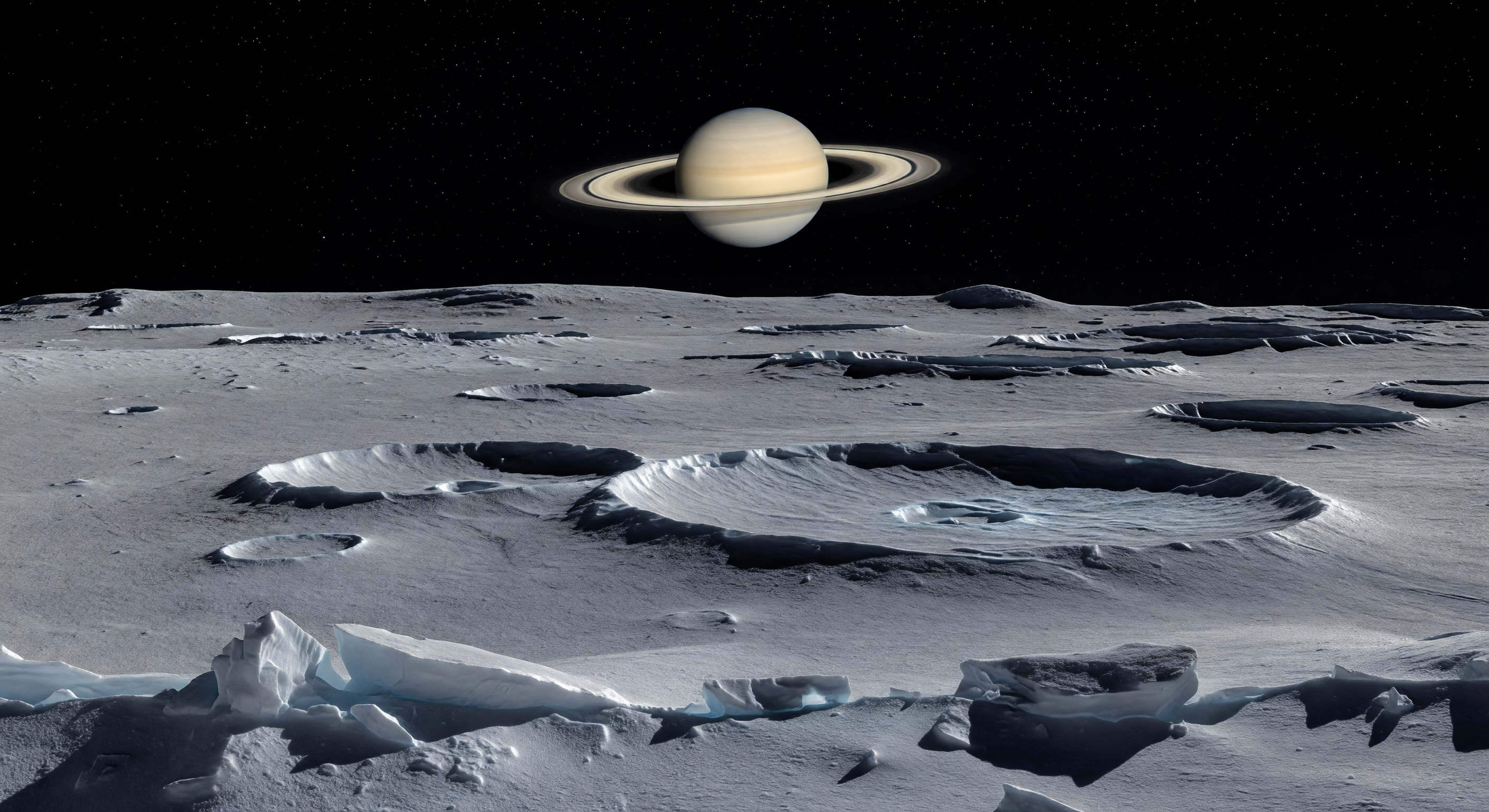
Sulla pianura notturna, il suolo di ghiaccio d’acqua si stende fino a un orizzonte vicino e lievemente curvo, coperto da polvere gelata compatta, blocchi angolosi spezzati dal freddo e basse gobbe di ejecta che brillano appena di riflessi blu-biancastri. La debole luce di Saturno e dei suoi anelli, fissi nel cielo per la rotazione sincrona del satellite, trasforma questo paesaggio ad altissima albedo in una distesa argentea e silenziosa, dove crateri sovrapposti dai bordi insolitamente netti incidono una crosta rigida quasi interamente composta di acqua ghiacciata, con affioramenti di ghiaccio pulito, chiazze più scure di contaminanti e sottili lineazioni tettoniche. In assenza totale di atmosfera non c’è foschia né diffusione della luce: il cielo resta nero assoluto, fitto di stelle, mentre le ombre sono taglienti e nere come inchiostro e ogni cresta illuminata sembra scolpita nel vetro. Sopra tutto domina l’enorme disco fasciato del pianeta con l’arco luminoso degli anelli, così vasto da dare alla scena una grandiosità irreale, come se ci si trovasse su un deserto di gelo antico sospeso nel vuoto.
Comitato di revisione scientifica
Ogni immagine viene esaminata da un comitato di IA per la precisione scientifica.
Claude
Immagine: Adjust
Descrizione: Adjust
I largely concur with GPT's assessment but want to add more specific observations and a few points of disagreement.
SCIENTIFIC ACCURACY: The surface composition (silver-gray water-ice regolith, angular frost-shattered blocks) is well-rendered and consistent with Cassini/Voyager data on Tethys. The airless vacuum conditions are correctly depicted: ink-black shadows with no atmospheric scattering, stars visible, no limb haze. However, the most significant scientific issue is the illumination contradiction. Tethys' geometric albedo is approximately 1.229 — one of the highest in the solar system — so even under Saturnshine it would appear bright, but the foreground lighting here reads as near-full sunlit intensity rather than the diffuse, bluish-silvery reflected light that Saturnshine and ringlight would produce. At Saturn's distance (~9.5 AU), solar illumination is ~1% of Earth's; Saturnshine on Tethys' nightside would be far more subdued and directionally soft, not the high-contrast raking illumination shown. Saturn's angular diameter as seen from Tethys averages roughly 5.6°, so the planet's depicted size is plausible, though it reads slightly large. The ring system's tilt and visual detail appear reasonable. One underappreciated issue not raised by GPT: the horizon curvature is insufficient. Tethys has a mean radius of only ~531 km, which would produce a dramatically tight, visibly curved horizon much closer than depicted — the landscape currently feels more Moon-scaled (~1737 km radius) than Tethys-scaled.
VISUAL QUALITY: Photorealism of surface textures is strong. The crater morphology is broadly consistent with icy-body impacts — shallow, flat-floored, with visible central terracing — though the crater rims appear slightly too sharp and dramatic for Tethys' old, heavily relaxed terrain (viscous relaxation in ice shells softens crater topography over geological time). The white ice exposures in the foreground are visually striking but may overstate the brightness contrast; they resemble fresh-fracture ice correctly, but their theatrical sharpness edges toward artistic license. No obvious rendering artifacts detected.
CAPTION ACCURACY: The description references 'faint tectonic lineations' and 'darker contaminant-rich patches' that are genuinely not identifiable in the image — this is a meaningful discrepancy. The caption's 'nightside' framing is the core mismatch: the image reads as a low-sun dayside or terminator scene, not a nightside dominated by Saturnshine. I would recommend either regenerating with a true Saturnshine-illuminated scene (dimmer, softer, cooler-toned light with Saturn as the clear dominant light source casting faint ring-shadow banding on the surface) or adjusting the caption to describe a terminator/low-sun scene. The description's poetic quality is high and scientifically informed in its language, but it currently describes a scene the image does not fully deliver. Verdict: adjust both — the image needs corrected illumination intensity/quality and tighter horizon curvature; the caption needs to either match the actual illumination shown or be paired with a regenerated image.
SCIENTIFIC ACCURACY: The surface composition (silver-gray water-ice regolith, angular frost-shattered blocks) is well-rendered and consistent with Cassini/Voyager data on Tethys. The airless vacuum conditions are correctly depicted: ink-black shadows with no atmospheric scattering, stars visible, no limb haze. However, the most significant scientific issue is the illumination contradiction. Tethys' geometric albedo is approximately 1.229 — one of the highest in the solar system — so even under Saturnshine it would appear bright, but the foreground lighting here reads as near-full sunlit intensity rather than the diffuse, bluish-silvery reflected light that Saturnshine and ringlight would produce. At Saturn's distance (~9.5 AU), solar illumination is ~1% of Earth's; Saturnshine on Tethys' nightside would be far more subdued and directionally soft, not the high-contrast raking illumination shown. Saturn's angular diameter as seen from Tethys averages roughly 5.6°, so the planet's depicted size is plausible, though it reads slightly large. The ring system's tilt and visual detail appear reasonable. One underappreciated issue not raised by GPT: the horizon curvature is insufficient. Tethys has a mean radius of only ~531 km, which would produce a dramatically tight, visibly curved horizon much closer than depicted — the landscape currently feels more Moon-scaled (~1737 km radius) than Tethys-scaled.
VISUAL QUALITY: Photorealism of surface textures is strong. The crater morphology is broadly consistent with icy-body impacts — shallow, flat-floored, with visible central terracing — though the crater rims appear slightly too sharp and dramatic for Tethys' old, heavily relaxed terrain (viscous relaxation in ice shells softens crater topography over geological time). The white ice exposures in the foreground are visually striking but may overstate the brightness contrast; they resemble fresh-fracture ice correctly, but their theatrical sharpness edges toward artistic license. No obvious rendering artifacts detected.
CAPTION ACCURACY: The description references 'faint tectonic lineations' and 'darker contaminant-rich patches' that are genuinely not identifiable in the image — this is a meaningful discrepancy. The caption's 'nightside' framing is the core mismatch: the image reads as a low-sun dayside or terminator scene, not a nightside dominated by Saturnshine. I would recommend either regenerating with a true Saturnshine-illuminated scene (dimmer, softer, cooler-toned light with Saturn as the clear dominant light source casting faint ring-shadow banding on the surface) or adjusting the caption to describe a terminator/low-sun scene. The description's poetic quality is high and scientifically informed in its language, but it currently describes a scene the image does not fully deliver. Verdict: adjust both — the image needs corrected illumination intensity/quality and tighter horizon curvature; the caption needs to either match the actual illumination shown or be paired with a regenerated image.
Grok
Immagine: Adjust
Descrizione: Adjust
I concur with both GPT and Claude on the core issues of illumination mismatch and caption discrepancies, with additional insights on scale and details. SCIENTIFIC ACCURACY (adjust): Surface features (silver-gray icy regolith, angular blocks, overlapping shallow craters with dark interiors) align well with Tethys' Cassini-observed geology, including Ithaca Chasma-like scarps and contaminant-darkened patches faintly visible in midground craters. Airless environment is spot-on: crisp edges, black shadows, starfield, no scattering. Saturn's size (~5-6° angular diameter from Tethys) and ring prominence are plausible, but primary flaw is lighting—foreground ice is too brightly lit with high-contrast raking shadows resembling low-Sun dayside/terminator (solar flux at 9.5 AU is ~.01x Earth's), not dim, diffuse Saturnshine/ringlight expected on nightside (albedo-driven reflected light would be ~10-100x fainter, cooler-toned blue-gray). Horizon curvature remains insufficient for Tethys' 531 km radius (should close in at ~2-3 km viewer distance, versus Moon-like expanse here). No ring shadows or phase-dependent Saturn shading visible. VISUAL QUALITY (adjust): Excellent photorealism in ice textures, crater terracing, and regolith graininess; no artifacts. However, stylized drama in rim sharpness (Tethys craters relax via ice viscosity) and composited Saturn feel slightly artificial; scale feels lunar, not microgravity Tethys. CAPTION ACCURACY (adjust): Matches ice plain, craters, blocks, Saturn/rings, and vacuum crispness, but 'nightside' and 'cold glow of Saturn/ringlight' contradict bright foreground; 'faint tectonic lineations' and 'darker contaminant-rich patches' are subtle at best, not prominent. Poetic tone is scientifically evocative but needs illumination tweak (e.g., 'terminator plain under Saturnshine'). Recommendation: Adjust image for dimmer Saturn-dominant lighting, tighter horizon, softer crater edges; align caption accordingly—or regenerate for true nightside fidelity.
Gemini
Immagine: Regenerate
Descrizione: Adjust
I concur with the previous committee members regarding the illumination paradox and the scale error. The most critical failure is the 'nightside' lighting: the image presents high-contrast, directional light that implies a nearby star, whereas nightside Tethys should be illuminated by the complex, diffuse, and significantly dimmer glow of Saturn and the rings. The current 'hero shot' of Saturn creates a lighting environment that is physically inconsistent with the moon's position in shadow. Furthermore, the horizon curvature is a significant oversight for a moon with a radius of only 531 km; the current composition suggests a much larger body. The crater morphologies, while aesthetically pleasing, lack the viscous relaxation characteristic of Tethys' ancient, warm-ice history. I recommend a regeneration that dramatically lowers the ambient light levels, shifts the color palette to the cool blues/grays of reflected ringlight, increases the horizon curvature to reflect the small scale of the moon, and softens the crater rims to account for geological age. The caption should be adjusted to accurately reflect the specific lighting conditions achieved in a revised render.
Matania — Sintesi
Immagine: Adjust
Descrizione: Adjust
The committee found the image scientifically promising but not fully consistent with the intended Tethys 'Saturnshine Night Plain' setting. The icy regolith, angular frost-shattered blocks, impact craters, and airless black-shadowed environment are broadly plausible for Tethys, and the overall photorealism is strong. However, the scene is lit too brightly and too directionally to read as a true nightside Saturnshine view; it resembles a low-sun terminator or dayside scene instead. Several reviewers also noted that the horizon curvature is too shallow for Tethys' small radius, making the landscape feel Moon-scaled rather than Tethys-scaled. The caption likewise overreaches relative to the image, since the referenced faint tectonic lineations and darker contaminant-rich patches are not clearly visible, and the 'nightside' framing conflicts with the apparent illumination.
Visual quality: The image is high resolution and convincingly photorealistic in terms of surface detail (ice blocks, crater rims, shadow softness). There are no obvious rendering artifacts, but the horizon curvature and the scale relationship between the camera ground distance and crater sizes are a bit stylized; additionally, Saturn’s presence and ring appearance look like a composited “hero shot” rather than physically constrained illumination.
Caption accuracy: Partially matches—there are an ice-rich plain, impact craters, and sharp-edged frost/ice features. But the caption’s emphasis on a cold, near-lightless “nightside” with Saturn/ring light as the dominant illumination is not strongly reflected; the foreground appears too bright for a true nightside. Also, referenced elements (darker contaminant patches and faint tectonic lineations) are not clearly identifiable. Recommend adjusting the description to better match the actual illumination (more “low-Sun/bright ice plain under Saturnshine” rather than fully nightside), or regenerating with dimmer, Saturn-ring-dominated lighting and more subtle tectonic/contaminant signatures.